
Accueil / Information / Aller plus loin... / Aériens / Environnement intérieur / Les acariens

Les acariens

dimanche 8 juillet 2012, par Allerdata, Dr Alain Thillay


Les acariens sont des arthropodes. Le schéma ci-dessous donne un aperçu de la phylogénèse des acariens, ainsi que de l’extrême diversité de leur écologie :

La pathologie due aux acariens n’est pas limitée aux réactions allergiques respiratoires :

Elle affecte aussi de nombreux animaux de compagnie et d’élevage (mammifères, oiseaux). Qui, à leur tour, peuvent entraîner une allergie chez l’homme .

Les acariens phytophages et les acariens prédateurs utilisés contre ces derniers sont également la cause d’allergies respiratoires professionnelles .

D’innombrables études ont été menées pour comprendre l’épidémiologie, la pathogénie ou la nature des allergènes des acariens. Elles se sont concentrées sur un nombre relativement restreint d’espèces, au premier rang desquelles Dermatophagoides farinae, Dermatophagoides pteronyssinus et Blomia tropicalis.

Ces acariens dits « domestiques » sont une cause majeure d’allergie respiratoire persistante. Leurs caractéristiques allergologiques sont détaillées ci-après, en même temps que celles d’autres espèces d’acariens retrouvés dans les habitations ou dans des environnements favorables à leur croissance (acariens dits de stockage).

Des réactivités croisées ont été décrites entre acariens et d’autres invertébrés, posant la question d’une association pertinente ou non sur le plan clinique : se reporter aux thèmes crustacés, mollusques marins, escargots et blattes.

Les allergènes des acariens

On ne connaît pas moins de 100 allergènes différents ayant pour origine les acariens . Ce grand nombre s’explique par :

  • la fréquence de l’allergie aux acariens et le caractère mondial de celle-ci
  • la variété des espèces d’acariens
  • la richesse en molécules IgE-réactives différentes révélées avec les acariens quand on les étudie avec des méthodes séparatives, comme les immuno-empreintes.

La plupart des allergènes d’acariens ont reçu une dénomination officielle (IUIS).


Le tableau suivant donne un résumé des allergènes (et/ou protéines IgE-réactives) caractérisés à ce jour :

L’usage est resté de parler de « groupes », chaque groupe correspondant, en fait, à des allergènes de même fonction biochimique. Quand cette fonction n’est pas encore connue, on classera dans un même groupe des molécules suffisamment homologues les unes des autres (ex. groupe 5).

Contrairement à d’autres produits allergisants, par exemple les poissons, les acariens n’ont pas un allergène vraiment dominant : la majeure partie de l’IgE-réactivité est répartie entre 4-5 groupes au moins.

La relevance clinique n’a pas été contrôlée pour chacun des allergènes des acariens, notamment par des tests de provocation nasale et/ou bronchique. Parmi les allergènes d’acariens, beaucoup sont plutôt des « molécules IgE-réactives ».

Les propriétés des différents groupes

  • Groupe 1  : les allergènes du groupe 1 sont des cystéine protéases, c’est-à-dire des enzymes capables de scinder d’autres protéines. Ce sont les premiers allergènes d’acariens à avoir été caractérisés : Der p 1 en 1980 et Der f 1 en 1982 . Der p 1 et Der f 1 ont une homologie de séquence de 85%. Si l’homologie est forte entre Der p 1, Der f 1 et Eur m 1 (Euroglyphus), elle tombe à moins de 35% entre ces allergènes et Blo t 1 (Blomia), et plus encore en surface des protéines , de sorte que Blo t 1 ne croise pas avec le groupe 1 des acariens Pyroglyphides.

La masse moléculaire de Der p 1 est de 25 kDa

A noter l’absence de groupe 1 (pour le moment) dans les acariens « de stockage » type Lepidoglyphus.

Les allergènes du groupe 1 sont principalement dans les feces des acariens . Ils représentent une part significative de la réactivité dans un extrait d’acarien Dermatophagoides, même si, malgré une tendance à la standardisation des extraits, des concentrations assez différentes sont relevées d’un fournisseur à un autre.

Le groupe 1 des acariens appartient aux cystéine protéases C1. Ces enzymes sont dites aussi « papaïne-like ». On ne s’étonnera pas de trouver des homologues dans la papaye (papaïne), dans l’ananas (ananaïne, broméline), dans le soja (Gly m Bd30K), etc.. Si des réactions croisées avec ces cystéines protéases végétales ont lieu , elles sont très marginales. Il faut dire que les pourcentages d’identité entre ces protéines ne sont pas favorables à une réactivité croisée.

L’impact de Der p 1 sur l’immunité ne se limite pas à une IgE réactivité. Sa fonction protéase le rend capable de capable de modifier la perméabilité de la barrière bronchique épithéliale. Il est également susceptible d’induire la libération de médiateurs pro-inflammatoires et la production de récepteurs de chimiokines. Der p 1 joue aussi un rôle direct sur les mastocytes, les éosinophiles, les cellules musculaires lisses bronchiques .

Les allergènes du groupe 1 comportent tous un site de N-glycolysation au niveau des résidus 53-55, ce qui explique la présence d’hydrates de carbone dans l’extrait naturel purifié. En outre, en conditions physiologiques, l’existence d’une structure non glycolysée sous forme d’un dimère de 40 kDa a été mis en évidence .

  • Groupe 2  : ces protéines font partie d’une grande famille possédant un domaine dit « ML domain lipid binding ». Elles ont une cavité apte à transporter un stéroïde, par exemple. On les trouve dans les feces, mais moins électivement que pour le groupe 1. Elles seraient secrétées par les acariens mâles et semblent particulièrement résistantes à la chaleur.

Les allergènes du groupe 2 ont quelque homologie avec MD2, une molécule du complexe Toll TLR-4. A ce titre, elles pourraient jouer un rôle immuno-modulateur.

L’homologie est faible entre Der p 2 / f 2 et Blo t 2 (Blomia) ou les allergènes d’acariens « de stockage » comme Gly d 2 (Glycyphagus), Lep d 2 (Lepidoglyphus), Tyr p 2 (Tyrophagus). Chez ces derniers, faute de groupe 1, le groupe 2 tient une place importante.

Les allergènes du groupe 2 ont une masse moléculaire de 14 à 18 kDa.

Les allergènes du groupe 2 se distinguent par la présence de lignages différents selon les régions du monde, ainsi que par des isoformes qui ne suivent pas la taxonomie.

  • Groupe 3  : ce sont des sérine protéases comme pour les groupes 6 et 9. Mais le groupe 3 (trypsine-like) a moins de 40% d’identité avec le groupe 6 (chymotrypsine-like) ou avec le groupe 9 (collagénase-like). Peu d’homologie également avec la trypsine bovine (env. 40% d’identité).

Ces allergènes sont trouvés dans les feces. Ils présentent un très grand polymorphisme. Leur allergénicité serait importante pour certains auteurs, mais leur fragilité dans les extraits tend à expliquer la faible IgE-réactivité constatée pour ces allergènes.

Le poids moléculaire des allergènes du groupe 3 est de 30 kDa.

Les allergènes du groupe 3 sont capables de cliver le complément avec pour conséquence la production des anaphylatoxines C3a et C5a .

  • Groupe 4  : ce sont des alpha amylases. Elles présentent une meilleure homologie entre Der p 4 / f 4 et Blo t 4 (env. 65% d’identité) qu’il n’est vu pour d’autres groupes.

Der p 4 a un poids moléculaire de 15 kDa.

  • Groupe 5  : bien que d’origine digestive ces allergènes ne sont pas que dans les feces. Leur fonction biochimique est inconnue pour le moment. Ils comprennent des isoformes très dissemblables (env 35% d’identité) et ne croisant pas entre elles.

Blo t 5 est l’allergène le plus important de Blomia tropicalis. Il ne croise pas avec Der p 5 / f 5. L’identité de séquence de Blo t 5 est de 43% avec Der p 5, de 40% avec Der p 21 alors que ce dernier n’a qu’une identité de séquence de 30% avec Der p 5.

Der p 5 a une masse moléculaire de 15 kDa.

  • Groupe 6 : ils ne croisent pas avec le groupe 3 (il existe une faible identité de séquence entre les deux groupes) et leur part dans l’IgE-réactivité globale semble très faible.

Der p 6 et Der f 6 ont un poids moléculaire de 25 kDa.

  • Groupe 7  : ces allergènes n’ont pas de fonction biochimique caractérisée pour le moment. Ils sont fragiles et se retrouvent sous formes de fragments très divers dans les extraits. De la sorte, l’évaluation exacte de leur allergénicité est difficile. Certains auteurs pensant qu’elle pourrait être aussi importante que celle du groupe 1.

Les allergènes du groupe 7 ont un poids moléculaire de 22 kDa.

  • Groupe 8  : ce sont des glutathion S-transférases (GST). Ces enzymes sont ubiquitaires au sein du monde vivant. Les GST ne sont pas dans les feces et leur IgE-réactivité est très mineure.

Les acariens possèdent des GST de classe µ, laquelle a moins de 30% d’identité avec les GST des plantes ou des insectes . Une réactivité croisée des GST d’acariens avec celle d’autres GST est donc peu probable. Une étude a cependant noté une inhibition de Der p 8 par la blatte américaine chez 2 patients/6 .

Der p 8 est un polypeptide d’un poids moléculaire de 27 kDa.

  • Groupe 9 : ce sont des sérine protéases à activité collagénase. Une homologie avec des sérine protéases de crustacés a été avancée mais calculée que sur une courte séquence N-terminale. Comme Der p 3, Der p 9 est susceptible d’induire la libération de GM-CSF et d’éotaxine en activant le récepteur PAR-2 des cellules épithéliales et de cliver les jonctions serrées ce qui entraîne une augmentation de la perméabilité de l’épithélium bronchique .

Der p 9 a un poids moléculaire de 28 kDa.

  • Groupe 10  : les tropomyosines des acariens sont suspectées de générer des réactions croisées avec celles d’autres arthropodes comme les crustacés ou les blattes. La pertinence clinique de ces RC est abordée ailleurs (Crustacés, Blattes, Mollusques et escargots).

Les Helminthes sont également à l’origine d’une IgE-réactivité vis-à-vis des tropomyosines et peuvent perturber l’interprétation des résultats pour les acariens. Une réactivation d’allergie à l’Anisakis chez un patient au cours de l’immunothérapie pour les acariens a même été rapportée .

En Europe, la prévalence de positivité pour le groupe 10 est plus faible que dans des régions d’endémie parasitaire.

Le poids moléculaire de Der p 10 est de 36 kDa.

  • Groupe 11  : ces protéines de forte masse (env. 100 kDa) sont des paramyosines. Comme les tropomyosines elles sont d’origine musculaire. Leur instabilité génère des formes dégradées, de sorte qu’il est difficile d’estimer l’importance clinique de ces allergènes.

On trouve des paramyosines dans certains parasites (Anisakis, Taenia, Schistosoma). Les pourcentages d’identité étant faibles (souvent 30-35% d’identité), les réactions croisées des paramyosines d’acariens avec celles de ces parasites semblent peu probables.

Les protéines du groupe 11 ont un poids moléculaire élevé de 92-94 kDa.

  • Groupe 12 : ce sont des protéines capables de se lier à la chitine. Les allergènes du groupe 12 de L. destructor et B. tropicalis ont une forte identié de séquence de 93%.

Ce groupe, à la fonction inconnue, n’a pas été décrit pour les acariens Pyroglyphides. Par contre, ils ont été retrouvé chez les acariens de stockage et Blomia tropicalis

Blo t 12 a un poids moléculaire de 14 kDa pour une séquence de 124 acides aminés.

  • Groupe 13  : ces protéines peuvent transporter des molécules lipophiles comme les acides gras. Bien qu’en concentration notable, leur IgE-réactivité semble très limitée.

Le recombinant rBlo t 13 a un poids moléculaire de 14,8 kDa.

  • Groupe 14  : ces protéines appartiennent à un ensemble dénommé « large LTP » qui contient notamment des vitellogénines de crustacés et des apolipophorines d’insectes. Elles sont habituellement désignées comme des apolipophorines. Ce sont des molécules de forte masse, plus ou moins hydrosolubles et mal représentées dans les extraits. Instables, elles génèrent des fragments (ex. M177 qui a 177 kDa). Mais ceux-ci conservent une IgE-réactivité notable.
    Une certaine confusion entoure les dénominations du groupe 14 : « Mag-3 » est un recombinant issu de D. farinae qui a servi (comme « Mag-1 ») à générer des anticorps utilisés pour repérer des allergènes homologues dans d’autres acariens.

Beaucoup d’auteurs considèrent le groupe 14 comme important cliniquement.

  • Groupe 15  : ces chitinases de fort poids moléculaire (env. 100 kDa) se distinguent par leur allergénicité de premier ordre chez le chien et le chat mais apparemment pas chez l’homme. Présentes dans l’appareil digestif des acariens, elles ne sont pas en quantités notables dans les feces. Ces protéines sont fortement O-glycosylées.

Les chitinases sont connues comme étant le support des réactions alimentaires dans le syndrome « latex- fruits exotiques ». Cependant les protéines du groupe 15 des acariens sont des molécules très différentes des chitinases végétales. Pas de réaction croisée décrite à ce jour entre la banane et un acarien !

  • Groupe 16  : ces gelsolines ont une IgE-réactivité faible
  • Groupe 17  : ce sont des protéines possédant un site dit « EF-hand » capable de lier le calcium (comme les parvalbumines). IgE-réactivité faible.
  • Groupe 18  : comme les chitinases du groupe 15, on ne les retrouve pas dans les feces. Ces chitinases sont particulières car leur domaine C-terminal, qui devrait porter l’activité enzymatique, est tronqué. Le groupe 18 ne croise pas avec le groupe 15 et a une IgE-réactivité faible.

Ces chitinases jouent un rôle dans l’inflammation et le remodelage tissulaire des mammifères.

Der f 18 a un poids moléculaire de 60 kDa.

  • Groupe 19 : on ne connaît que Blo t 19. Et encore : cet allergène adoubé par l’IUIS n’a pas été publié. Il aurait une vague homologie avec un « antimicrobial factor » d’Ascaris.

Cet allergène de B. tropicalis a une masse moléculaire de 7 kDa.

  • Groupe 20  : ce sont des arginine kinases. Ces enzymes suivent de près les tropomyosines : on les retrouve également chez les crustacés et les insectes. Elles semblent avoir une IgE-réactivité très limitée, notamment par leur faible concentration.

Les protéines du groupe 20 ont un poids moléculaire de 40 kDa.

  • Groupe 21  : on ne connaît pas la fonction biochimique de ces protéines si ce n’est qu’elles ont une petite homologie avec celles du groupe 5 (mais ne croisent pas avec elles). Elles ont une origine intestinale et semblent bien résister à la chaleur.
  • Groupe 22  : on ne connaît pour l’instant que Der f 22. Cet allergène est d’origine intestinale, a 35% d’identité avec Der f 2 et a été trouvé IgE-réactif chez 50% des patients.
  • Allergènes non encore rangés dans un groupe :
    • Les alpha tubulines  : ce sont des protéines ubiquitaires trouvées dans le cytosquelette des cellules. Celle de Lepidoglyphus a été montrée IgE-réactive chez 12% de patients suédois, et celle de Tyroglyphus chez 29% de coréens
    • Les thaumatine-like  : ces protéines sont connues comme allergènes dans les pollens de Cupressacées et dans certains fruits (pomme, cerise, kiwi). Des résultats préliminaires semblent montrer la possibilité d’une réactivité croisée entre acariens et végétaux par le truchement de ces thaumatine-like : l’acarien Glycyphagus domesticus possède une thaumatine-like qui présente 62% d’identité avec Mal d 2, la thaumatine-like de la pomme. Or, si l’on mesure la fréquence de positivité pour la thaumatine-like de Glycyphagus, on trouve 12% chez des sujets allergiques aux acariens (Singapour), mais pas moins de 78% chez des polliniques (Italie) ! A moins d’une interférence par des CCD, on pourrait donc se trouver en présence d’une réactivité croisée végétal/animal.
    • les heat shock proteins (HSP) sont des protéines ubiquitaires : les moisissures et la noisette, par exemple, ont des allergènes de ce type. La réactivité croisée avec les HSP d’acariens mériterait d’être étudiée

Malgré le nombre élevé des allergènes (ou molécules IgE-réactives) déjà caractérisés chez les acariens, certains travaux semblent montrer que ce nombre est encore très en dessous de la réalité.

Ainsi, l’équipe de F.T. Chew, à Singapour, a notablement agrandie la panoplie des allergènes (ex. dans le cas de Blomia tropicalis) ou des protéines se présentant comme de sérieux candidats à l’IgE-réactivité.

  • Ces auteurs ont décrit plus de 20 allergènes potentiels, jusque-là ignorés, dans Tyrophagus , dans Aleuroglyphus et dans Suidasia .
  • C’est ainsi que des familles d’allergènes décrites chez les végétaux, les moisissures, les mammifères pourraient trouver des membres parmi les acariens : des profilines, des cyclophilines, des thioredoxines, etc..
  • En produisant des recombinants pour certaines de ces protéines, Chew a pu montrer leur IgE-réactivité. Il a notamment caractérisé 2 homologues d’allergènes d’œuf de poule : une ovalbumine dans Tyrophagus, Suidasia et D. farinae ; et un ovomucoïde dans Blomia. Ces protéines sont mêmes assez fréquemment positives (in vitro) chez des patients allergiques aux acariens (Singapour) .
    • Est-ce que les ovalbumine et/ou ovomucoïde d’œuf de poule croisent avec ces homologues d’acariens ? Cela ne semble pas avoir été étudié jusqu’alors. La question est d’intérêt quand on sait que la positivité pour l’œuf à 6 mois/1 an est un assez bon facteur prédictif pour une allergie respiratoire à 4-7 ans.

Activité biochimique et allergénicité

Parallèlement à leur IgE-réactivité, les extraits d’acariens semblent posséder des propriétés biochimiques favorisant leur allergénicité.

Il s’agit avant tout de l’activité protéasique des allergènes du groupe 1 (Der p 1, Der f 1) qui a été étudiée et, à un moindre degré, celle des sérine protéases (groupes 3 et 9 ). Il faut remarquer que d’autres protéines dans les extraits (allergènes non identifiés, etc…) pourraient contribuer aussi bien à cet effet adjuvant (et à sa compensation) et donc que ces travaux ne sont pas le reflet fidèle du contact réel avec les poussières d’acariens.

Globalement, l’activité protéasique serait pro-inflammatoire et favoriserait les passages trans-épithéliaux des allergènes :

  • modification des molécules CD40, CD25, CD23 , DC-SIGN , PAR2
  • attaque des surfactants A et D et des inhibiteurs de protéases
  • effet direct sur les cellules épithéliales et leurs jonctions
  • stimulation de la réponse des cellules dendritiques

Malgré tous ces résultats in vitro ou chez l’animal , des questions restent en suspends : ces expériences sont-elles réalistes (concentrations d’allergènes utilisées) ? Les conditions expérimentales sont-elles transposables à l’homme ? Certains experts sont sceptiques . D’autant que chez le chat et le chien les allergènes dominants (groupe15) n’ont pas d’activité protéasique.

Acariens : polyréactivité / monoréactivité

Réagit-on aux acariens de Métropole quand on arrive d’Outre-Mer ? Et inversement. Est-il important de tester les 2 Dermatophagoides ? L’environnement professionnel est-il à prendre en compte en cas d’allergie due à des acariens domestiques ?

Les réponses à ces questions sont tributaires de plusieurs paramètres intriqués et néanmoins indépendants les uns des autres :


L’homologie entre allergènes d’acariens différents :

Les divergences entre protéines s’élèvent avec l’éloignement taxonomique des espèces (cf. le schéma taxonomique).

En termes de possibilités de réactivité croisée, plus l’identité entre 2 protéines est proche de 100% et plus on a des chances de rencontrer des réactions croisées entre ces protéines.


Le tableau suivant donne une idée des divergences entre allergènes d’acariens :

Par rapport à D. Farinae Blomia tropicalis Lepidoglyphus destructor Tyrophagus putrescenciae
D. Pteronyssinus Groupe 1 82 % d’identité 34 %
Groupe 2 88 % 39 % 36 % 27 %
Groupe 3 81 % 48 %
Groupe 4 90 % 68 %
Groupe 5 42 % 30 %
Groupe 6 75 % 58 %
Groupe 7 86 % 29 %
Groupe 9 72 % 56 %
Groupe 10 98 % 94 % 94 % 94 %
Groupe 11 89 % 78 %
D Farinae Groupe 13 80 % 79 % 57 %

On voit que des réactions croisées sont en théorie possibles entre allergènes du groupe 10 (tropomyosines) et peut-être au sein du groupe 13 (FABP) ; et aussi, bien sûr entre allergènes d’espèces proches comme D. farinae et D. pteronyssinus.

Mais ceci est malgré tout une simplification de la réalité.

De nombreux allergènes d’acariens se présentent sous plusieurs isoformes :

  • par exemple, Der p 1 n’a pas une séquence unique d’acides aminés mais plusieurs variantes très proches les unes des autres (23 exactement, de Der p 1.0101 à Der p 1.0123).
  • Ces isoformes sont même parfois en « désordre » par rapport à l’arbre taxonomique : par exemple Gly d 2 a une isoforme plus proche de Tyr p 2 que de Lep d 2 .

Enfin, on peut trouver aussi des paralogues, c’est-à-dire des allergènes similaires mais ayant dérivé beaucoup plus tôt au cours de l’évolution de sorte que leurs pourcentages d’identité sont très faibles, de l’ordre de 30-40% :

  • c’est le cas pour des allergènes du groupe 5 comme Der p 5 et Blo t 5 ou Sui m 5 .
  • Ces allergènes paralogues ne croisent pas entre eux.

L’ensemble de ces nuances constitue un éventail très large avec des proximités et des éloignements à la fois entre espèces et au sein des différents groupes d’allergènes.

Le résultat visible, à savoir la positivité des tests et les manifestations cliniques, sera la somme de toutes ces nuances. Il existe non pas une allergie aux acariens mais des allergies aux acariens.

L’environnement du patient, actuel mais aussi passé en cas de changement de lieu de vie, est un facteur majeur à prendre en considération pour comprendre une réactivité à plusieurs acariens.


L’écologie des acariens

Certains acariens ont été décrits principalement (ou uniquement) dans des régions à climat tropical ou sub-tropical :

  • les Blomia : Canaries, Caraïbes, Amérique du Sud, Asie du Sud-Est, Taïwan
  • les Suidasia : Malaisie, Singapour
  • Dermatophagoides siboney : Cuba, Porto-Rico

On a retrouvé des acariens Dermatophagoides dans toutes les régions du monde. D. farinae et D. pteronyssinus sont généralement présents simultanément. Parfois D. farinae est majoritaire (ex. en Grande Bretagne, Australie, Nouvelle-Zélande, Corée, Thaïlande), parfois minoritaire (ex. Colombie, Cuba).

La répartition d’une même espèce d’acarien peut varier dans un même pays d’une région à une autre, en rapport avec l’humidité ambiante .

Les acariens domestiques se distinguent le plus souvent des acariens trouvés dans les lieux de stockage ou les bâtiments agricoles. Cependant, la frontière n’est pas absolue et Tyrophagus, par exemple, est un acarien domestique en Corée (cf. Acariens domestiques ou de stockage ?).

Le classique travail de M. Van Hage montre bien l’importance du répertoire local des acariens sur la réactivité observée :

  • ces auteurs ont comparé des patients Suédois exposés à Lepidoglyphus avec des patients Brésiliens exposés à Blomia tropicalis :
    • In vitro, les patients étaient positifs pour les 2 acariens.
    • Mais si Lepidoglyphus parvenait à inhiber le RAST Blomia chez les sujets Suédois, cette même réaction croisée n’était pas obtenue avec le sérum des patients Brésiliens.
    • C’était même l’inverse : Blomia inhibait Lepidoglyphus avec le sérum des brésiliens et pas avec le sérum des suédois !
    • Clairement, cela montrait que les IgE des suédois étaient beaucoup plus affines pour les épitopes de l’acarien local (Lepidoglyphus) que d’un acarien non présent dans l’environnement (Blomia). Et vice versa.

Des résultats similaires ont été montrés pour D. farinae et Blomia entre Singapour et la Thaïlande .

On voit qu’une positivité à plus d’un acarien peut recouvrir une véritable sensibilisation à un acarien et une réactivité croisée pour un autre, celle-ci pouvant être sans relevance clinique si la réactivité croisée est de faible affinité.

Les réactivités croisées entre allergènes d’acariens

Les limites de réactivité croisée sont assez parallèles aux pourcentages d’identité des allergènes deux à deux.

Ceci étant, ce sont surtout les modifications d’acides aminés situés en surface externe des allergènes qui vont limiter les possibilités de réactivité croisée .

Les allergènes les plus homologues entre les acariens peuvent constituer l’explication d’une réactivité croisée minimale, observée même si les acariens ne sont pas dans l’environnement du patient. On pense, bien sûr, avant tout aux tropomyosines  ; mais les paramyosines (groupe 11) et les FABP (groupe 13) sont des candidats aussi.

D’autres groupes d’allergènes sont peu propices à des réactions croisées, du moins entre les genres principaux que sont Blomia et Dermatophagoides. C’est le cas des groupes1, 2 et 5.

Mais si, de fait, Tyr p 2 (Tyrophagus, acarien de stockage) ne croise pas avec Der p 2, il croise très bien avec Lep d 2 et Gly d 2 qui lui sont plus proches taxonomiquement.

Globalement, on pourrait résumer ainsi :

  • Les Dermatophagoides (farinae, pteronyssinus, et aussi siboney aux Caraïbes) croisent très aisément entre eux.
    • Quelques cas de mono-réactivité à D. farinae sans réactivité à D. pteronyssinus (ou l’inverse) ont bien été décrits : ils restent très rares et soulignent, une fois encore, la possible variété des réponses immunologiques des patients face à un même allergène.
      Une étude menée sur un collectif de 1500 patients français a montré seulement 16 cas de CAP positifs pour D. farinae ayant un résultat <0,35 kU/l pour D. pteronyssinus (et uniquement 2 résultats D. farinae positifs avec D. pteronyssinus <0,10 kU/l) (Laurence Guilloux, Biomnis, in press).
  • Blomia tropicalis croise mal avec les Dermatophagoides.
    • Une double positivité pour Blomia et Dermatophagoides dans un environnement favorable à Blomia représente donc a priori une double sensibilisation : d’une part le sujet s’est sensibilisé à Blomia et, d’autre part, il s’est indépendamment sensibilisé à Dermatophagoides. Cela peut être important sur le plan de l’immunothérapie.
    • On a parfois trouvé des résultats positifs pour des tests in vitro Blomia dans des pays au climat incompatible avec Blomia tropicalis  : cela semble du à la présence d’un autre Blomia, Blomia tjibodas, qui se satisfait de conditions climatiques plus froides .
  • Euroglyphus maynei est considéré comme un acarien domestique, cohabitant avec les Dermatophagoides.
    • En général Euroglyphus est inhibé par D. farinae ou D. pteronyssinus, mais l’inverse est plus rare.
    • Euroglyphus aurait quelques épitopes qui lui seraient propres. Mais la part prise par Euroglyphus sur le plan clinique reste floue.
  • Dans certaines conditions d’exposition, Lepidoglyphus peut constituer l’acarien majeur pour les patients.
    • Il a alors été obtenu des inhibitions partielles de Dermatophagoides par Lepidoglyphus, mais au prix de doses élevées de Lepidoglyphus (parfois 10000 fois plus que la dose homologue) .
    • Lepidoglyphus forme avec Tyrophagus et Glycyphagus un groupe volontiers cross-réactif.
    • Acarus siro est souvent à part, croisant de manière inconstante avec les 3 précédents.
    • Il en est de même pour Chortoglyphus. Tous ces acariens sont dits « de stockage ».
    • La positivité pour un acarien de stockage chez un sujet non exposé professionnellement pose la question d’une réactivité croisée ou d’une réelle sensibilisation.
      Les réactivités croisées entre acariens pourraient être résumées dans le schéma ci-dessous établi à partir du cumul de 24 études différentes, sachant que les disparités d’exposition sont bien sûr gommées (climat, pays, etc..).

Les chiffres représentent le nombre d’études où une réaction croisée a été observée (au moins chez la moitié des patients) sur le nombre total d’études. Par exemple, 5 fois /9 un Dermatophagoides inhibait Lepidoglyphus, alors que l’inhibition inverse n’était relevée qu’une fois/11.
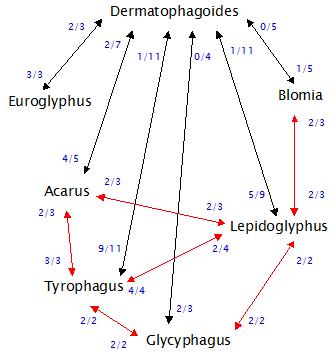
On remarquera que la réactivité croisée est en règle générale en faveur des acariens Dermatophagoides ; et que les RC entre acariens « de stockage » sont plus équilibrées.

La primauté des Dermatophagoides peut trouver plusieurs explications :

  • il est rare que ces acariens n’accompagnent pas une exposition à un autre acarien. Par exemple, dans une étude menée à Huelva (Espagne) si des Glycyphagus étaient présents dans 54% des domiciles testés, on trouvait D. pteronyssinus dans 95% des domiciles
  • par ailleurs, l’allergénicité des Dermatophagoides pourrait être dominante : dans la même étude, sur les 26 patients avec CAP positif pour Glycyphagus, seuls 3 avaient un CAP D. pteronyssinus nettement plus faible que celui pour Glycyphagus

Ceci étant, la réactivité croisée entre ces 2 acariens était quasi-absente et l’on peut dans le cas d’espèce pencher pour une double sensibilisation Glycyphagus + Dermatophagoides plutôt qu’une simple positivité pour Glycyphagus générée par des IgE anti-Dermatophagoides .

Acariens domestiques ou de stockage ?

Il est classique de distinguer les acariens de poussière de maison (« house dust mites ») des acariens que l’on rencontre volontiers dans des lieux à usage professionnel : comme ces lieux servent souvent de lieux d’entreposage, on a dénommé ces acariens « de stockage » (« storage mites »).

Cependant la distinction ne doit pas être considérée comme absolue et, dans des conditions favorables, tout acarien « de stockage » pourrait devenir un acarien de maison = un acarien domestique . C’est le cas pour Tyrophagus , pour Chortoglyphus , pour Glycyphagus , etc …

Les lieux favorisant le développement de ces acariens sont les silos, les stocks d’aliments pour bétail, les meuneries, voire les boulangeries ou les animaleries . Les fermiers sont exposés notamment là où le travail auprès des animaux s’effectue pendant une longue période hivernale en milieu clos (Scandinavie, Islande, montagne).

On considère comme acariens de stockage les Lepidoglyphus, Tyrophagus, Acarus, Glycyphagus, Aleuroglyphus et Chortoglyphus. Souvent c’est Lepidoglyphus qui domine .

L’exposition aux acariens de stockage n’est pas exclusive d’une exposition aux Dermatophagoides (ou Blomia). Dans leur grande majorité, les patients positifs pour un acarien de stockage sont positifs aussi pour un acarien domestique .

Blomia tjibodas a été décrit dans des fermes en Allemagne et pourrait positiver des tests pour Blomia tropicalis.

Une double positivité, au moins in vitro, pour un acarien domestique et un acarien de stockage sera donc fréquente. Comment interpréter cette double positivité ?

  • chez un patient professionnellement exposé, une double sensibilisation est probable, par exemple Dermatophagoides + Lepidoglyphus. Des réactivités croisées de Lepidoglyphus peuvent positiver d’autres acariens de stockage dont la présence dans l’environnement du patient n’est pas établie (ex. Glycyphagus et Tyrophagus).
  • chez un patient a priori non exposé à des acariens de stockage, tel un habitant des villes, le bilan sera moins clair.
    • On pensera d’abord à une positivité pour les acariens de stockage induite par l’acarien domestique. De fait, l’observation des réactions croisées montre que, dans ces conditions, Dermatophagoides inhibe aisément l’acarien de stockage mais que la réciproque n’a pas lieu : l’acarien sensibilisant est celui qui domine la réaction croisée, donc Dermatophagoides .
    • Le répertoire des IgE du patient a alors plus d’affinité pour Dermatophagoides que pour l’acarien de stockage. S’il faut traiter, c’est sur la sensibilisation vis à vis de Dermatophagoides qu’il faut jouer.
  • Ceci étant, l’absence totale d’acariens de stockage en milieu urbain est difficile à prouver (Ebner dans ).
  • Et les matelas des maisons en Islande ont beau être dépourvus d’acariens, 9% des Islandais ont été trouvés positifs en RAST pour D. pteronyssinus dans l’étude ECHRS . Dans ce cas, il a été formulé une hypothèse selon laquelle les patients se seraient sensibilisés au cours de leur jeunesse lors de camps à la ferme.
  • Cela montre en tous cas qu’il est important de revenir sur les conditions d’exposition prévalant dans le passé du patient.

Enfin, une positivité in vitro pour un acarien inattendu pourrait provenir d’une réactivité croisée glucidique (cf. Acariens et CCD).

  • Il est probable que cette éventualité est marginale, bien que pouvant expliquer en partie les fortes prévalences de RAST positifs pour des acariens de stockage relevées en population urbaine .

Acariens et « allergènes cachés »

Les acariens peuvent aussi provoquer des allergies alimentaires : c’est le « pancake syndrome » .

Des acariens s’étant multipliés dans/sur un aliment peuvent provoquer une réaction allergique (parfois sévère) à l’ingestion de ces aliments, même après cuisson, chez des patients ayant une allergie respiratoire aux acariens. De nombreux cas ont été publiés .

Dans la série d’observations de Sanchez-Borges 24 des 30 patients étaient des adultes .

On sait que les allergènes du groupe 2, notamment, sont thermostables . Et des TC positifs ont été trouvés avec des farines contaminées préalablement chauffées 1 heure à 100°C .

Dermatophagoides farinae porte un nom montrant bien que cet acarien ne se plait pas que dans les literies. La plupart des cas de « pancake syndrome » étaient dus à des farines contaminées par des acariens, mais il a aussi été rapporté des cas de contamination par des débris de blattes ou par des moisissures .

D’autres acariens peuvent aboutir aux mêmes réactions alimentaires : Tyrophagus, Suidasia, Aleuroglyphus, Blomia freemani, D. pteronyssinus, Thyreophagus ...

En dehors de la farine de blé (pancakes, gâteaux, aliments panés, pizzas, etc) on a noté des contaminations dans la farine de maïs (pollenta), avec diverses graines, des fruits secs, des poissons séchés, voire du thé .

Une étude au Japon a montré que 5,5% des échantillons de farine recueillie dans des cuisines familiales étaient contaminées par des D. farinae . Cela ne se produisait pas si la farine était gardée au réfrigérateur plutôt que dans un placard. Et dans un travail mené au Venezuela, 37% des farines testées étaient contaminées .

Le diagnostic repose sur un test cutané positif avec l’aliment incriminé et négatifs avec le même aliment non contaminé.

A noter qu’une anaphylaxie alimentaire induite par l’effort a été décrite avec une farine contaminée (par Suidasia) .

Et la fréquence très élevée d’une intolérance aux AINS relevée dans 2 larges séries de patients peut justifier la recherche de facteurs adjuvants.

Diagnostic d’une sensibilisation aux acariens

Tests basés sur des extraits

A priori, les acariens ne posent pas de difficultés diagnostiques majeures. En effet, certains allergènes représentent une part notable de l’IgE-réactivité et les extraits sont plus ou moins standardisés sur ces allergènes.

Par exemple, Hales donne une part de 50% pour les groupes 1+2 dans l’IgE-réactivité totale, et 10% pour chacun des groupes 4, 5 et 7.

Pourtant la multiplicité des sortes d’allergènes, le fait que certains se retrouvent dans les fèces (groupes 1 et 3 par exemple) ou au contraire dans le corps de l’animal (tropomyosines, paramyosines, par exemple), le manque d’hydrosolubilité (ex. apolipophorines) et la fragilité de certains allergènes dans un milieu contenant de nombreuses protéases font que les extraits peuvent différer sensiblement les uns des autres suivant les techniques de culture, récolte et extraction des fabricants d’extraits . Ainsi, le groupe 7 serait sous-représenté dans les extraits .

On a relevé des écarts entre les contenus en Der p1 pouvant aller d’un facteur 1 à 6 entre 9 extraits commerciaux, et même de 1 à 20 pour Der p 2 .

A cela s’ajoutent des variations issues de différences entre les acariens cultivés et ceux avec lesquels le patient est en contact.

  • On a pu montrer, par exemple, la présence de lignées génétiques différentes de sorte que les Der f 2 d’acariens européens étaient différents des Der f 2 d’Asie , ou que l’isoforme Der p 2.0101 était absente des acariens recueillis à Bangkok .

On peut donc craindre des différences entre les concentrations (et la répartition) des allergènes effectivement inhalés par les patients et des allergènes présents dans les extraits pour le diagnostic .

Globalement, il est cependant admis que les extraits sont acceptables pour être utilisés en immunothérapie pour autant que le patient soit réactif à des allergènes du groupe 1 et/ou du groupe 2 .

Cela pose donc la question de pouvoir affiner le diagnostic à l’aide d’allergènes purifiés ou recombinants.

Ceci est abordé ci-après. Au préalable, il convient de noter :

  • la piètre corrélation entre un résultat quantitatif (kU/l) pour un CAP acarien et l’expression clinique : on voit, par exemple, qu’une probabilité de 35% pour des sifflements chez un enfant correspond aussi bien à 3 kU/l qu’à 100 kU/l
  • l’effet d’entraînement sur les kU/l pour D. pteronyssinus par l’élévation globale des IgE totales en cas d’eczéma atopique : le rapport moyen acarien/IgE totales est à peu près le même chez un asthmatique et chez un sujet porteur d’eczéma atopique
  • le peu de travaux jusqu’à présent pour valider les tests d’activation des basophiles s’agissant des acariens

Tests utilisant les ressources de l’allergologie moléculaire

Peut-on remplacer les extraits par des allergènes recombinants ? La réponse n’est pas simple.


1 – Comment choisir les allergènes les plus pertinents ?

1A- sur la base d’une forte prévalence de positivité

De multiples études ont donné des taux de positivité pour tel allergène ou groupe d’allergènes. Il s’agissait, le plus souvent, d’études d’IgE-réactivité in vitro. Le tableau ci-dessous donne une idée de ces prévalences à partir d’une cinquantaine de travaux :

Ordres de grandeur des positivités in vitro (NB : les différences régionales peuvent être à l’origine de taux très variables ; les chiffres entre parenthèses signifient un nombre très restreint de travaux)

GroupeDermatophagoidesBlomia
1 60-100 % 60-80
2 60-95 40-60
3 20 et >> 50
4 25-75 10 et >>
5 30-60 50-80
6 40-50 10-20
7 20-50
8 10-50
9 30 et >> (25)
10 10-80 (30)
11 50-70 (10-50)
12 (20-50)
13 (10-50)
14 (40-70)
15 (70)
16 (30-40)
17 (35)
18 (60)
19 (10-20)
20 (10-30)
21 (25) (90)
22 (50)

On peut constater que, contrairement à d’autres sources d’allergènes, la réactivité se répartit sur de nombreux allergènes pour les acariens, sans prédominance évidente pour une catégorie précise.

Les allergènes des groupes 1 et 2 sont souvent présentés comme les plus pertinents :

  • dans une étude européenne multicentrique, une positivité pour Der p 1 et/ou Der p 2 était trouvée chez plus de 97% des patients
  • de même, chez des patients dont la réactivité était maximale pour les groupes 4 ou 5 ou 7, il était malgré tout observé une positivité pour un allergène du groupe 1 et/ou du groupe 2

Mais des différences régionales existent, tant en Europe que d’un continent à un autre :

  • les patients mono-réactifs à Der p 1 ou à Der p 2 sont beaucoup moins fréquents en France (18%) qu’en Italie, Suède ou Autriche
  • la positivité pour les groupes 1 et 2 était respectivement de 85-100% et 63-96% dans cette étude européenne, mais de 76% et 74% en Australie et de 64% et 69% en Colombie , par exemple
  • des différences encore plus grandes étaient vues pour certains autres groupes d’allergènes : par exemple 74% de positivité en Australie contre 28-45% dans l’étude européenne

1B – sur la base du niveau de l’IgE-réactivité

Les prévalences de positivité ne sont pas parallèles aux niveaux d’IgE-réactivité de chacun des allergènes, comme le montre le graphique ci-dessous

Aussi, serait-il préférable de choisir comme pertinents les allergènes qui représentent la plus grande part de l’IgE-réactivité globale.

En dehors de l’étude de Hales schématisée ci-dessus, peu de travaux ont cherché à comparer les positivités et l’IgE-réactivité de façon quantitative pour la plupart des allergènes d’une même espèce d’acariens.

L’équipe de Chew a présenté des résultats pour D. farinae et Blomia tropicalis en étudiant une cohorte de patients Singapouriens (n=181) . Pour ces auteurs, il faut ajouter le groupe 13 au rang des allergènes les plus importants. Le tableau ci-dessous montre la part relative d’IgE-réactivité des 10 premiers allergènes parmi les 30 étudiés par Chew.


Part relative de l’IgE-réactivité de divers allergènes, rapportée à celle de l’allergène le plus IgE-réactif. Valeurs trouvées à l’aide de recombinants (Singapour)

D. farinae Blomia tropicalis
Groupe

d’allergènes
IgE-réactivité

relative
Groupe

d’allergènes
IgE-réactivité

relative
1 1 5 1
2 0,58 13 0,85
5 0,45 1 0,51
4 0,20 3 0,39
13 0,19 12 0,25
14 0,18 14 0,25
3 0,18 2 0,19
7 0,10 11 0,12
Etc … Etc …

2 – Vers un choix restreint d’allergènes ?

Plusieurs travaux ont cherché à savoir si l’association de 2 ou 3 allergènes avait une sensibilité diagnostique proche de 100% :

  • en associant rDer p 1, rDer f 1 et rDer p 2, une sensibilité diagnostique de 94,8% a été obtenue chez des sujets Brésiliens, et même de 98,3% en y ajoutant 2 autres tests rBlo t 5 et rDer p 5
  • l’association des groupes 1 et 2 de D. pteronyssinus et D. farinae détectait 82% des patients au Japon et 89% en Espagne . Le déficit par rapport à 100% n’était pas du au groupe 7 car tous les patients positifs pour Der p 7 l’étaient aussi pour le groupe 1 ou le 2
  • la même observation était présente dans la cohorte étudiée par Hales en Australie
  • la sensibilité diagnostique dépassait 97% avec groupe 1 et/ou 2 dans l’étude de Weghofer
  • elle était de 93% en Colombie avec Der p 1 + Der p 2 + Der p 10 (tropomyosine)
  • et en tests cutanés une association de Der p 1, f1 , p 2 et p 5 montrait une sensibilité de 76%

Quelles sont les suggestions des auteurs ? :

  • Arruda opte pour Der p 1 + p 2 + p 5 <biblio9291
  • Thomas penche pour 1 + 2 + 4 + 5 + 7, et n’élimine pas les groupes 11, 14 ou 15 éventuellement
  • Weghofer estime que les groupes 1 et 2 suffisent, même si l’ajout des groupes 5 et 7 serait intéressant
  • enfin, il ne semble pas pertinent d’adjoindre une tropomyosine car la réactivité à cette famille d’allergènes est plutôt le résultat d’une sensibilisation tierce (ex. crustacés, helminthes)

Ces associations d’allergènes donnent des sensibilités diagnostiques très élevées. Il convient de remarquer cependant que ces taux sont artificiels : ils résultent de l’addition des positivités séparées de chacun des allergènes. Si les allergènes étaient mélangés dans le même test on obtiendrait une sensibilité moindre par simple effacement des combinaisons statistiques.

Pour le moment, la société Phadia ne propose pas encore de tests in vitro avec des recombinants d’acariens. Des tests sont disponibles avec la technique DPC-Siemens pour les allergènes naturels Der p 1 et Der p 2 de D. pteronyssinus.

Peut-on se satisfaire de l’IgE-réactivité aux groupes 1 et 2 des allergènes d’acariens ? :

  • en histamino-libération, Der p 1 ne représente qu’une part réduite de l’activité suscitée par un extrait de D. pteronyssinus
  • un extrait déplété en Der p 1 conserve quand même 70% de son activité
  • Der p 1+Der p 2, ou Der f 1+Der f 2, ne représentent que 80 voire 60% de l’IgE-réactivité d’un extrait
  • en challenge bronchique Der p 1 et Der p 2 donnent des réponses retardées plus faibles qu’un extrait de D. pteronyssinus
  • et les recombinants montrent parfois une IgE-réactivité inférieure à celle de leurs homologues naturels : moins 50% pour rDer p 1 ou rDer f 1, moins 30% pour rDer p 2 et moins 20% pour rDer f 2 . Ces déficits de réactivité se retrouvaient en histamine release.

Le choix entre allergène naturel et allergène recombinant se pose donc.

Un même allergène naturel est souvent un mélange d’isoformes et de variants, voire de paralogues ayant de grandes différences entre eux. Par exemple, Blo t 5 avec lequel il a été relevé des rBlo t 5 négatifs alors que les mêmes sujets avaient un nBlo t 5 positif .

Les recombinants sont-ils finalement trop sélectifs dans le cas des acariens ?

Améliorer les mesures in vitro ?

Il est classique d’observer des différences entre le résultat quantitatif (en kU/l) pour un extrait, disons du produit X, et la somme des résultats obtenus avec un panel d’allergènes naturels ou recombinants de ce même produit X. Par exemple, la somme des réactivités pour 9 recombinants de D. pteronyssinus varie de 50 à 300 KU/l pour une même réponse à 100 kU/l avec le CAP D. pteronyssinus global .

Ceci est-il du à un manque de standardisation des tests in vitro ? On sait qu’il n’y a pas interchangeabilité entre les unités des tests d’IgE « spécifiques », les kU/l, et celles pour les IgE totales, les UI/ml. Seules ces dernières sont adossées à un standard international OMS : une UI/ml équivaut à 2,4 ng/ml d’IgE.

Pour pallier cette difficulté, il a été proposé d’utiliser un mode de calibration des tests d’IgE « spécifiques » qui soit, lui aussi, adossé à l’étalon OMS. Un anticorps chimérique a été synthétisé à cet effet par recombinaison génétique à partir :

  • de la partie Fc d’une IgE humaine
  • de la partie Fab d’un anticorps monoclonal murin anti-Der p 2

Selon les promoteurs de cette technique , l’anticorps chimérique étant aisément quantifiable en UI/ml d’IgE totales (il possède une partie identique aux IgE humaines) peut servir pour calibrer un test in vitro, tel un CAP, et donc permettre de rendre des résultats d’IgE spécifiques pour des patients en UI/ml également.

Les résultats étant dorénavant standardisés en UI/ml, on pourrait espérer retrouver une meilleure adéquation entre un test global (ex. D pteronyssinus) et la somme des valeurs obtenues avec les allergènes du même produit.

Mais c’est oublier des fondamentaux ! :

  • un anticorps monoclonal n’est pas représentatif de la diversité des épitopes reconnus par les patients, même sur un allergène unique, et a fortiori si l’anticorps est d’origine non humaine (ici souris)
  • une calibration avec un « étalon » anti-Der p 2 aurait peut-être une utilité pour tester la réactivité de patients vis-à-vis de Der p 2 … mais pas pour Der p 1, etc, etc… Il faudrait créer autant d’étalons qu’il y a d’allergènes différents !!
  • et quand ce principe est proposé pour s’appliquer non plus à des molécules définies, comme Der p 2, mais à un extrait comme D. pteronyssinus, on peut considérer que la tentative est vouée à l’échec !!

Quelques travaux ont été publiés s’appuyant sur ce type d’étalonnage. Il va de soi que les conclusions qui en sont tirées sont sujettes à caution , quand elles ne sont pas contraires à la science .

Acariens et CCD

(voir aussi : Les CCD)

On estime à 20-30% la proportion des sujets polliniques porteurs d’IgE contre des glyco-épitopes. Les patients allergiques aux acariens (et non polliniques) ont rarement un CAP broméline positif . On pourrait donc penser que les tests in vitro pour les acariens ne sont pas influencés par les CCD.

Divers résultats tendent à modérer cette conclusion :

  • chez des sujets vus pour suspicion d’allergie respiratoire (n=4535) la prévalence de CAP positifs pour D. pteronyssinus passe de 3% en cas de CAP broméline négatif à 30% en cas de CAP broméline positif
  • le periodate tend à diminuer l’IgE-réactivité d’un extrait de D. farinae ou de Lepidoglyphus
  • chez un sujet avec des IgE anti-CCD, la broméline inhibe en partie le CAP D. pteronyssinus
  • une partie de l’IgE-réactivité vis à vis de D. pteronyssinus ou D. farinae peut être capturée par la broméline et/ou la peroxydase de raifort (HRP) .
  • dans leur série de patients allergiques aux hyménoptères (n=259), Kochuyt et coll. relevaient 17% de CAP acariens positifs parmi les sujets CCD positifs, contre 4% parmi ceux qui étaient CCD négatifs .

Existe-t-il des allergènes glycosylés pour expliquer cette glyco-réactivité des acariens ?

De fait, certains allergènes sont glycosylés (mais il faut rappeler que d’autres glycoprotéines que des allergènes dans l’extrait peuvent être reconnues par les IgE)  :

  • le groupe 1 : Der p 1, Der f 1, etc.. mais pas Blo t 1
  • le groupe 4
  • le groupe 7 , sauf Lep d 7
  • le groupe 11
  • le groupe 15
  • Der f 18

Ces glycoprotéines d’acariens pourraient générer des IgE reconnaissant des épitopes glucidiques. Mais ces épitopes glucidiques d’acariens peuvent-ils croiser avec ceux des plantes ou des venins d’hyménoptères ?

  • Pour cela il faudrait que des motifs glucidiques communs existent, comme un xylose ou un fucose-1,3. On connaît très mal les chaînes glucidiques des protéines d’acariens. Altmann estime que les acariens n’ont pas de chaînes avec un fucose-1,3.
  • Les cellules dendritiques reconnaissant Der p 1 par le biais de « récepteurs à mannose » , on peut supposer la présence de galactose et de béta-NAG sur Der p 1 . Mais des résultats contradictoires ont été obtenus avec les lectines .
  • Par ailleurs, un rDer f 1 muté au niveau du site de glycosylation conserve une IgE-réactivité équivalente à celle de l’allergène naturel nDer f 1 .

Au total, si l’IgE-réactivité glucidique des acariens est encore assez mal connue, les tests in vitro pour les acariens semblent peu ou pas du tout influencés par la présence d’IgE anti-CCD. Dans la grande majorité des cas, les tests in vitro suivent bien les résultats des tests cutanés et sont concordants avec la clinique.

[1] - Dougall A, Holt DC, Fischer K, Currie BJ, Kemp DJ, Walton SF. Identification and characterization of Sarcoptes scabei and Dermatophagoides pteronyssinus glutathione S-transferases: implication as a potential major allergen in crusted scabies. Am J Trop Med Hyg 2005;73:977-984
The astigmatid mite Sarcoptes scabiei is the causative agent of scabies, a highly infectious parasitic disease of the skin. Although the mite causes marked hypersensitivity reactions, particularly in crusted (severe) scabies, little is known about the specific scabies mite molecules involved in such immunologic responses. We have identified six genes encoding scabies mite homologues of mu and delta-like glutathione S-transferases (GSTs) as well as novel house dust mite GSTs. A mu class S. scabiei GST was subcloned into a prokaryotic expression system. The purified recombinant protein rSsGST01 reacted strongly with IgE and IgG4 in sera from crusted scabies patients. This response was not observed with control antigens or with ordinary scabies and uninfested patient sera. In addition, the specific IgE response to rSsGST01 did not correlate with the total IgE level of the patient. These results suggest that GST may play a role in the pathophysiology associated with crusted scabies.
[2] - Kleine-Tebbe J, Heinatz A, Gräser I, Dautel H, Nordskov Hansen G, Kespohl S, et al. Bites of the European pigeon tick (Argas reflexus): Risk of IgE-mediated sensitizations and anaphylactic reactions. J Allergy Clin Immunol 2006;117:190-195
BACKGROUND: Local and systemic reactions can occur after bites of Argas reflexus (Argas), a soft tick parasitizing pigeons . OBJECTIVE: Risk assessment of IgE-mediated sensitizations and systemic reactions after Argas bites . METHODS: Case histories, skin prick tests (SPTs) with a whole-body extract of Argas containing major allergen Arg r 1, and common inhalants and specific IgE measurements were obtained from 148 subjects who had had Argas bites and 20 volunteers as a control group . RESULTS: Systemic reactions (urticaria, angioedema, dyspnea, cardiovascular dysregulation, unconsciousness) were reported in 12 of 148 (8%); 146 of 148 (99%) had local reactions. Atopy was found in 37 of 146 (25%) with local reactions and 3 of 12 (25%) with systemic reactions. SPT to Argas was positive in 24 of 148 (16%) with a high proportion of atopics 10 of 24 (42%); specific IgE to Argas was detectable in 12 of 135 (8% of 148) with moderate concordance to systemic reactions. No positive SPT or specific IgE results to Argas were obtained in the control group. Immunoblotting of 23 sera revealed an IgE-binding protein in 19 of 23 sera (82%) at 22 kd, indicating a major allergen of Argas . CONCLUSION: Severe anaphylactic reactions were infrequently (approximately 8%) found after bites of the soft tick Argas reflexus. Atopy is a risk factor for skin sensitizations to Argas, but not for systemic reactions after bites by Argas. Using a whole-body extract of Argas, diagnosis through SPT and specific IgE is hampered by false-negative and irrelevant positive results, particularly in atopy.
[3] - Valls A, Pineda F, Belver M, Caballero T, Lopez Serrano M. Anaphylactic shocks caused by ticks (Rhipicephalus sp). EAACI 25th Congress, Vienna, 10-14 June, 2006, Poster n°393
Background Ticks frequently cause human disease by transmitting infectious agents (protozoa, rickettsia, bacteria, and viruses). Toxic local reactions are common, but systemic IgE-mediated reactions after tick bites are very few reported. The allergy to Argas reflexus , Ixodes ricinus , Ixodes holocyclus and Ixodes pacificus is well documented. There is one case of allergy to Rhipicephalus sp. in the literature, and we report another case of anaphylaxis due to Rhipicephalus sanguineous. Materials and Methods A farmer was evaluated for a history of recurrent severe reactions associated with tick bites. He was bitten by an insect while he was working with his goats, after that he started sweating, sickness, chest tightness, dyspnoea and loss of conscience. Specific IgE against tick extract was measured by an enzyme allergosorbent test (EAST) Separated protein bands were electrophoretically transferred to polyvinylene difluoride (PVDF) membranes. The binding of IgE antibody to allergens was analyzed by Western blot using serum from the allergic patient Results Skin prick test did not indicate any sensitisation to common inhalants, foods, Anisakis simplex, latex, Amoxiciline, insects and Shacaromyces except to Lepidoglyphus destructor. Total IgE levels were 716 kU/L (CAP System Ig E FEIA) and specific IgE to Lepidoglyphus Destructor and Rhiphicephalus sp was <0,35 kU/L and 3.4 kU/L respectively. Immunoblotting revealed IgE binding proteins of 15, 28 and 70 kDa, Conclusions We presented a case of a farmer, who suffered an anaphylactic shock in relation to a bite of a tick (Rhipicephalus.). Cross-reactivity among hard ticks allergens are suggested previously. Acero et al. comparing the molecular masses of I. Holocyclus, I. Pacificus and Rhipicephalus sp. obtained some common allergenic proteins with molecular masses 51, 38, 35 and 28 kDa. Allergen of 107 kDa is the most prominent allergen in I. Pacificus, and it appears to be unique to this tick. We obtained an allergenic protein with molecular mass of 28 kDa that are common with other types of ticks. We also obtained two different proteins of 15 and 70 kDa that have never been characterized before. The protein of 28 kDa could explain the possibility of cross-reactivity with others types of tick.
[4] - Hilger C, Bessot JC, Hutt N, Grigioni F, de Blay F, Pauli G, et al. IgE-mediated anaphylaxis caused by bites of the pigeon tick Argas reflexus: Cloning and expression of the major allergen Arg r 1. J Allergy Clin Immunol 2005;115:617-622
BACKGROUND: Anaphylactic reactions caused by bites of the European pigeon tick Argas reflexus are repeatedly reported. This soft-backed tick is a parasite of wild pigeons colonizing urban buildings and houses. Occasionally the ticks can bite human beings, inducing anaphylactic reactions in sensitized patients . OBJECTIVE: Our aim was to characterize the major allergen implicated in a series of anaphylactic reactions caused by Argas bites and to produce the allergen as recombinant protein for diagnostic purposes . METHODS: Protein extracts were prepared from whole A reflexus bodies, and IgE immunoblots were performed with sera from 13 patients who had an anaphylactic reaction with pigeon tick bites. A cDNA expression library was constructed from whole ticks and screened with a polyclonal rabbit antiserum raised against the major allergen . RESULTS: The cDNA coding for the dominant allergen Arg r 1 could be isolated. It encodes a protein belonging to the lipocalin family. Allergenicity of the recombinant Arg r 1 was confirmed by immunoblot, ELISA, and intradermal skin tests . CONCLUSION: The dominant allergen of A reflexus has been isolated and the corresponding cDNA cloned. The recombinant protein, a lipocalin, was expressed in Escherichia coli and was shown to be immunoreactive in vitro and in vivo. Recombinant Arg r 1 was used as a diagnostic tool in a series of anaphylactic reactions caused by pigeon tick bites.
[5] - Hilger C, Paesen G, Pauli G, Hentges F. Arg r 1, the major allergen of the pigeon tick, is a histamine binding lipocalin. Allergy 2007;62(suppl. 83):96
Background: Arg r 1 is the major allergen of the European pigeon tick, Argas reflexus. This soft-backed tick is a parasite of wild pigeons and may bite occasionally human beings, inducing anaphylactic reactions in sensitzed patients. Arg r 1 shows about 30% identity to some tick salivary gland lipocalins binding histamine and/or serotonin. We intended to investigate the ligand binding properties of Arg r 1. Methods: Recombinant Arg r 1 (rArg r 1) was expressed in E. coli. Native Arg r 1 was purified from whole tick extract by ion exchange chromatography. Circular dichroism spectroscopy was used to compare the three-dimensional structures of native and recombinant molecules. Radioligand binding and competitive binding assays as well as smooth muscle bioassays were performed with the recombinant molecule. Results: rArg r 1 binds histamine with high affinity and specificity with a Kd of 7.7 ± 4.7 nM. Competition experiments show that synthetic H1 and H2 receptor antagonists do not compete at all, nor do epinephrine and norepinephrine. To deplace 50% of the histamine, 339 times more serotonin is needed. These results were confirmed in a biological assay by measuring the muscle contraction in isolated guinea pig ileum. Arg r 1 very efficiently inhibited histamine-induced contraction of guinea pig ileum. Circular dichroism spectra show highly identical curves in the 200 to 240 nm range for both native and recombinant Arg r 1. Addition of histamine induced a conformational change of the three-dimensional structure of Arg r 1. Conclusion: Arg r 1, the major allergen of Argas reflexus(pigeon tick), has marked histamine binding properties. In this respect it is similar to other histamine and serotonin binding proteins found so far in salivary glands of ticks.
[6] - Colloff MJ, Merrett TG, Merrett J, McSharry C, Boyd G. Feather mites are potentially an important source of allergens for pigeon and budgerigar keepers. Clin Exp Allergy 1997;27:60-67
BACKGROUND: Previous studies on allergy to feathers have not addressed whether organisms living on feathers (mites, lice, moulds) are a source of allergens. OBJECTIVE: To investigate whether feather mites produced allergens of clinical relevance to bird keepers. METHODS: We examined serum IgE responses of 96 pigeon breeders to an extract of feather mites from pigeons (predominantly Diplaegidia columbae), using Western blotting, specific IgE assay using AlaSTAT EIA and RAST inhibition. RESULTS: Feather mites are a major source of soluble proteins derived from feathers, accounting for up to 10% of the total weight of the feather. Forty-three sera had a negative score (0) for anti-feather mite IgE, 27 were weakly positive (1-2) and 26 had strongly positive scores (3-4). Fewer pigeon breeders with scores > or = 3 were asymptomatic than those with negative scores (12 versus 40%), more had late onset symptoms (with or without early onset symptoms: 77% versus 44%) and had IgE antibody against house dust mite (89% versus 23%). Western blotting of eight sera against the extract of Diplaegidia columbae revealed 20 IgE-binding components ranging from 22 to 200 kDa. A high diversity of components was recognized by each serum: arithmetic mean 7 (range 2-14). RAST inhibition indicated feather mites had species-specific epitopes as well as ones that cross-reacted with Dermatophagoides pteronyssinus. CONCLUSION: Strongly-positive AlaSTAT scores to pigeon feather mite were associated with allergic symptoms of late onset in pigeon breeders. We conclude that feather mites are a major source of clinically-relevant allergens for pigeon breeders.
[7] - Drouet M, Bonneau JC, Nicolie B, Le Sellin J. Les allergènes respiratoires des horticulteurs et pépiniéristes. Rev Fr Allergol Immunol Clin 2005;45:406-410
Les horticulteurs et pépiniéristes côtoient de multiples substances tant dans le domaine végétal que dans le domaine chimique et toutes ces substances sont potentiellement allergéniques. Le contact peut entraîner des manifestations allergiques cutanées et la voie inhalée des symptômes respiratoires. Les végétaux sont probablement plus impliqués dans les allergies de contact alors que les produits chimiques induisent sans doute les deux types de symptômes. Ces données de la littérature méritent toutefois peut-être quelques réserves du fait du manque de standardisation des tests diagnostiques. Ne seront évoqués que les symptômes respiratoires.
[8] - Kronqvist M, Johansson E, Kolmodin-Hedman B, Oman H, Svartengren M, van Hage-Hamsten M. IgE-sensitization to predatory mites and respiratory symptoms in Swedish greenhouse workers. Allergy 2005;60:521-526
Background: Predatory mites are used as biological pesticides worldwide for control of spider mites and other pests in greenhouses. The aim of this study was to evaluate the impact of occupational exposure to Phytoseiulus persimilis and Hypoaspis miles on IgE sensitization among a large group of Swedish greenhouse workers and to examine the relationship between exposure and allergic asthma and rhinoconjunctivitis. Methods: A total of 96 greenhouse workers from the southern part of Sweden, who were using the predatory mites for control of pests, were investigated with a M. Kronqvist1, E. Johansson1, B. Kolmodin-Hedman2, H. man3, M. Svartengren2, M. van Hage- Hamsten1 1Department of Medicine, Clinical Immunology and Allergy Unit; 2Department of Public Health Sciences, Division of Occupational Medicine, Karolinska Institutet, Stockholm;
[9] - Kim YK, Kim YY. Spider-mite allergy and asthma in fruit growers. Curr Opin Allergy Clin Immunol 2002;2:103-107
Asthma and allergic diseases caused by domestic mites such as house dust mites and storage mites are major health problems worldwide. In contrast to domestic mites, spider mites are outdoor phytophagous mites causing significant damage to fruit leaves throughout the world. After several case reports of spider mite-induced asthma and allergy, cross-sectional surveys have demonstrated that spider mites are important allergens in the development of asthma and rhinitis in fruit farmers. Interestingly, epidemiological surveys have also demonstrated that spider mites are common sensitizing allergens that are related to the prevalence of asthma and rhinitis, even in the non-farming population exposed to spider mites. Protein analysis has demonstrated that crude extracts derived from spider mites contain several major allergens, and that N-terminal amino acid sequencing of the major allergens is not homologous with any previously characterized domestic mite allergens, suggesting that major allergens derived from spider mites are unique in terms of cross-reactivity to domestic mites. Taken together, these findings suggest that spider mites are important allergens in the development of asthma among the exposed non-farming population as well as among fruit farmers themselves, and that allergens derived from spider mites may be novel allergens.
[10] - de Jong NW, Groenewoud GCM, van Ree R, van Leeuwen A, Vermeulen AM, van Toorenenbergen AW, et al. Immunoblot and radioallergosorbent test inhibition studies of allergenic cross-reactivity of the predatory mite Amblyseius cucumeris with the house dust mite Dermatophagoides pteronyssinus. Ann Allergy Asthma Immunol 2004;93:281-287
BACKGROUND: In 1999, an extensive study among bell pepper growers showed that a predatory mite, Amblyseius cucumeris, is a potentially relevant source of occupational allergens because 23% of the population had positive skin prick test reactions . OBJECTIVE: To investigate whether cross-reactivity between A. cucumeris and Dermatophagoides pteronyssinus is responsible for the cosensitization to both mite species found in 58.7% of A. cucumeris-sensitized greenhouse workers . METHODS: Fifteen serum samples from greenhouse workers with work-related inhalant allergy and a positive radioallergosorbent test (RAST) reaction to A. cucumeris or D. pteronyssinus were selected for immunoblot analysis using extracts of both mites. A subselection (n = 5) was used for RAST and immunoblot inhibition to investigate potential cross-reactivity . RESULTS: On immunoblot, 2 distinct patterns were observed: one pattern showed common protein bands in A. cucumeris and D. pteronyssinus blots suggestive of cross-reactivity between A. cucumeris and D. pteronyssinus and the other pattern showed no shared protein bands. Dermatophagoides pteronyssinus RAST inhibition with A. cucumeris extract was low in 4 serum samples (<25% inhibition) and nearly absent in 1 serum sample; A. cucumeris RAST inhibition with D. pteronyssinus extract was high in 1 serum sample (75% inhibition), low in 2 serum samples (35% and <15% inhibition), and absent in 2 serum samples. These results were confirmed by immunoblot inhibition experiments . CONCLUSIONS: Amblyseius cucumeris, a new occupational allergen, has species-specific antigens and common antigens that are cross-reactive with the house dust mite D. pteronyssinus.
[11] - Thomas WR, Heinrich TK, Smith WA, Hales BJ. Pyroglyphid house dust mite allergens. Protein Pept Lett 2007;14:943-953
Mites of the family Pyroglyphidae are the most important source of house dust mite allergens. A small number of allergens, namely those of groups 1, 2, 4, 5 and 7 constitute the known major and mid-potency specificities, with possible important contributions of the groups 11, 14 and 15 requiring further definition. Most of the allergens can be identified by sequence homologies and the structures of the major allergens have been solved. There are however challenges in determining the nature of the group 5 and 7 allergens and in obtaining detailed structures of the significant allergens to be used for genetic engineering.
[13] - Chua KY, Cheong N, Kuo IC, Lee BW, Yi FC, Huang CH, Liew LN. The Blomia tropicalis Allergens. Protein Pept Lett 2007;14:325-333
Blomia tropicalis allergens are the most important mite allergens in tropical regions. Most of them only have 30-40% sequence identity with their Dermatophagoides counterparts and they share low IgE cross reactivity and exhibit different immunobiology. Unlike the pyroglyphid counterparts, Blo t 5 is the major allergen whereas Blo t 1 only has modest allergenicity.
[14] - Thomas WR, Heinrich TK, Smith WA, Hales BJ. Pyroglyphid house dust mite allergens. Protein Pept Lett 2007;14:943-953
Mites of the family Pyroglyphidae are the most important source of house dust mite allergens. A small number of allergens, namely those of groups 1, 2, 4, 5 and 7 constitute the known major and mid-potency specificities, with possible important contributions of the groups 11, 14 and 15 requiring further definition. Most of the allergens can be identified by sequence homologies and the structures of the major allergens have been solved. There are however challenges in determining the nature of the group 5 and 7 allergens and in obtaining detailed structures of the significant allergens to be used for genetic engineering.
[16] - Kawamoto S, Aki T, Yamashita M, Tategaki A, Fujimura T, Tsuboi S, et al. Toward elucidating the full spectrum of mite allergens. J Biosci Bioeng 2002;94:285-298
Our research has focused on the molecular design of immunotherapeutic vaccines and the advancement of mite-allergy diagnosis. Here, we describe the research history of the major group 1 and group 2 allergens, immunoelectrophoretic analyses covering the complete spectrum of mite allergens, our results on allergens with distinctive characteristics (a conjunctival congestion-eliciting antigen [LM2], an immunotherapeutic antigen [HM2] with high efficacy and without definite adverse reactions, and a potent T-cell stimulatory antigen [HM1] with secretion of IFN-gamma), the full spectrum and immunochemical properties of the major and other important mite allergens (including our newly described allergens: a pan-allergen [tropomyosin, group 10], a potent T-cell stimulatory allergen [M-177, apolipophorin, group 14] and its peptide fragments Mag1 and Mag3, a moderate IgE-binding allergen [gelsolin/villin, group 16], an EF-hand Ca(2+)-binding allergen [group 17], and a less IgE-binding allergen [heat shock protein 70]), and prospects for the development of immunotherapeutic and diagnostic agents.
[17] - Thomas WR, Smith WA, Hales BJ, Mills KL, O'Brien RM. Characterization and Immunobiology of House Dust Mite Allergens. Int Arch Allergy Immunol 2002;129:1-18
The examination of house dust mite extracts has indicated that over 30 different proteins can induce IgE antibody in patients allergic to the house dust mite. There are however dominant specificities especially the group 1 and 2 allergens which can account for much of the allergenicity of extracts. Of the 19 denominated allergens, the major IgE binding has been reported for the group 1, 2, 3, 9, 11, 14 and 15 allergens. The high-molecular-weight group 11, 14 and 15 allergens have only recently been described and although high IgE binding has been anticipated from immunoblotting, there is a need for considerable corroboration. Similarly, the study of the group 3 and 9 serine protease allergens has been incomplete. The group 4, 5, 7 and 8 allergens have shown intermediate IgE binding and the group 10 tropomyosins are of interest because of their potential cross-reactivity with allergen from disparate species. Although the progress with the production of recombinant group 1 allergens has been recent, many of the allergens can be produced as high IgE-binding polypeptides. The tertiary structure of the group 2 allergens has been determined from recombinant proteins and they are an excellent model for the investigation of modified allergens. An unexpected property of the group 1, 2 and 3 allergens has been the high degree of polymorphism found by cDNA analysis. It has however been possible to identify sequences to represent the variation in the natural allergens. The group 7 and 14 allergens show secondary modifications which vary in different extracts creating batch variation. While some estimate of the importance of allergens can be obtained from IgE binding, few analyses of T-cell responses have been made and these regulate both the development of, and the protection from sensitization.
[19] - Chua KY, Cheong N, Kuo IC, Lee BW, Yi FC, Huang CH, Liew LN. The Blomia tropicalis Allergens. Protein Pept Lett 2007;14:325-333
Blomia tropicalis allergens are the most important mite allergens in tropical regions. Most of them only have 30-40% sequence identity with their Dermatophagoides counterparts and they share low IgE cross reactivity and exhibit different immunobiology. Unlike the pyroglyphid counterparts, Blo t 5 is the major allergen whereas Blo t 1 only has modest allergenicity.
[20] - Bessot JC, Pauli G. Mite allergens: an overview. Eur Ann Allergy Clin Immunol 2011;43:141-156
Mite allergens from the Pyroglyphidae family are the most frequent and potent sources of perennial asthma and rhinitis. Since 1988 molecular knowledge has considerably increased and structures and functions have been determined for most of them. Of the 22 denominated allergens, Der p 1 and Der p 2 are major allergens recognized by more than 80% of lgE from Dpt allergic patients in Europe. Der p 4, Der p 5 and Der p 7 appeared to be intermediate allergens. The binding of IgE to groups 3, 6, 8, 9, 10 and 20 is constantly low. Most of the allergens can be identified by amino-acid sequences and the tertiary structure of the major allergens has been solved. Most Dpt mite allergens are proteolytic enzymes: Der p 1 for instance is a cysteine protease. Der p 2 has structural homology with MD-2, a co-receptor of the Toll-like receptor (TLR4) whose ligand is LPS. Knowledge of the mite allergens structure has allowed a better interpretation of cross reactions between allergens from the same family or from more distant families. From a practical point of view molecular epidemiology has allowed a better choice of allergen molecules useful for diagnosis. Finally, new concepts of immunotherapy based on genetically engineered hypoallergenic variants of major allergens, used alone or in combination, can be considered.
[21] - Taketomi EA, Silva DA, Sopelete MC, Gervasio AM, Alves R, Sung SJ. Differential IgE reactivity to Der p 1 and Der p 2 allergens of Dermatophagoides pteronyssinus in mite-sensitized patients. J Investig Allergol Clin Immunol 2006;16:104-109
Several studies have shown that the presence of IgE antibodies to house dust mites (HDM), particularly Dermatophagoides pteronyssinus (Dpt), is an important risk factor for asthma. Allergen immunotherapy is indicated for patients with IgE antibodies to clinically relevant allergens. The aims of this study were to analyze the levels of specific serum IgE to Der p 1 and Der p 2 allergens in mite-sensitized atopic patients and to compare them with both in vivo (skin prick test) and in vitro (IgE-ELISA) sensitizations to Dpt crude extract. Forty-seven atopic patients with allergic rhinitis with or without intermittent or persistent mild asthma and positive skin prick test (SPT) to Dpt total extract were studied. Thirty age-matched healthy subjects with negative SPT to HDM were included as controls. Levels of total IgE and Dpt-, Der p 1- and Der p 2-specific IgE were measured by ELISAs in SPT-positive atopic patients and SPT-negative control subjects. Among 47 symptomatic atopic patients, 27 (57.4%) were double positive IgE to Der p 1 and Der p 2 allergens, 3 (6.4%) were single positive IgE to Der p 1, 4 (8.5%) were single positive IgE to Der p 2, and 13 (27.6%) were double negative IgE to both allergens. There was a significant correlation between Der p 1- and Der p 2-specific IgE levels, but not between Der p 1- or Der p 2-IgE levels and SPT results. The double negative IgE patients had the smallest skin test reactions although they showed high mean levels of total serum IgE. Therefore, the knowledge of specific IgE levels to Der p 1 and Der p 2 major allergens might support physicians for indication or follow-up in mite-sensitized patients under allergen-specific immunotherapy. These approaches might be important for obtaining improved safety and efficacy of the current clinical practice of allergen immunotherapy.
[22] - Sauer J, Thorsted PB, Mutenda K, Ipsen H, Lund K. Identification of nDer p 3 as the Serine Protease Activity Associated With Purified nDer p 1 From House Dust Mite Extract. J Allergy Clin Immunol 2005;115(2 suppl.):S89
RATIONALE: Several papers have reported a proteolytic activity susceptible to inhibition with SBTI (a serine protease inhibitor) in purified preparations of the cysteine protease nDer p 1 from Dermatophagoides pteronyssinus nDer p 1 has even been proposed to exhibit a mixed cysteine-serine proteinase activity (Hewitt et al., Clin Exp Allergy, 1997, 27:201-207) METHODS: nDer p 1* was purified to apparent homogeneity from extracts of Dermatophagoides pteronyssinus house dust mites by a combination HIC, AIX and gel filtration (fraction 1) The purified nDer p 1* preparation was separated by Soybean Trypsin Inhibitor (SBTI) affinity chromatography into two fractions; bound serine protease and unbound nDer p 1, respectively Proteolytic activities in the three samples were assessed and proteins present were identified by MS RESULTS: Proteolytic assays, MS-peptide mapping and MS-peptide sequencing unambiguously identified the serine protease activity in our nDer p 1* preparation as originating from trace amounts of nDer p 3. Furthermore, in resemblance with natural Der p 1 the cysteine protease activity of recombinant Der p 1 was not inhibited by SBTI, whereas the cysteine protease inhibitor E64 blocked the activity CONCLUSIONS: We have demonstrated that nDer p 1 possesses only cysteine protease activity and that the observed closely associated serine protease activity originates from trace amounts of contaminating nDer p 3 with a very high proteolytic activity
[23] - Sehgal N, Ainsworth S, Dafforn T, Custovic A, Woodcock A. Protease Activity of Der p 1: Cysteine, Serine or Both? AAAAI 60th Annual Meeting, San Francisco, 19-23 March 2004, Poster n°1244
Rationale Shared sequence homology with the enzyme papain has identified the major house dust mite allergen, Der p 1, as a cysteine protease. Immunoaffinity-chromatography purified Der p 1, however, has both cysteine and serine activity. The serine activity is considered a contaminant and removed; yet its identity has not been elucidated. We have evaluated the protease activity (PA) of immunopurified Der p 1 and assessed its purity. Method s : PA of Der p 1 was calculated by measuring the rate of hydrolysis of N-benzoyl-Phe-Val-Arg-p-nitroanilide. Purity was assessed by SDS-PAGE, Western blot analysis, N-terminal amino-acid sequencing, mass spectrometry and 2D gel electrophoresis. Result s : PA of Der p 1 was inhibited by both E64 (21.4%) and APMSF (84.13%), specific cysteine and serine protease inhibitors. SDS-PAGE and silver stain analysis demonstrated a single band and the protein was recognised by the monoclonal antibodies 4C1, 5H8 and 10B9 on Western blot. Its N-terminal matched the published primary sequence: TNACSINGNA. MALDI-TOF mass spectrometry of both tryptic peptides and 2D gel electrophoresis separated material, resulted in 8 matched sequences with Der p 1, encompassing 49% overall sequence coverage. No other protein sequences could be detected. Conclusions : Immunopurified Der p 1 has both cysteine and serine protease activity. A contaminating source to account for the serine activity, however, is not evident. This would suggest that Der p 1 may represent a novel protease with a mixed mechanistic class of action.
[25] - Piboonpocanun S, Malainual N, Jirapongsananuruk O, Vichyanond P, Thomas WR. Genetic polymorphisms of major house dust mite allergens. Clin Exp Allergy 2006;36:510-516
BACKGROUND: Polymorphic sequence substitutions in the major mite allergens can markedly affect immunoglobulin E binding and T cell responses, but there are few studies on environmental isolates from Dermatophagoides pteronyssinus and none for D. farinae . OBJECTIVE: To determine the sequence variation of the group 1 and 2 allergens from environmental D. pteronyssinus and D. farinae . METHODS: RNA from each species was isolated from homes in Bangkok and the sequence of Der p 1, Der p 2, Der f 1, and Der f 2 determined from cDNA produced by high fidelity polymerase chain reactions . RESULTS: The enlarged data set revealed preferred amino acid substitutions in residues 19, 81, and 215 of Der p 1 as well as sporadic changes. Der p 2 showed frequent variations with clusters of amino acid substitutions, but the canonical Der p 2.0101 was not found in any of 17 sequences. Der f 2 showed variants with clusters of substitutions similar to Der p 2 but in different amino acid positions and without any structural concordance. Der f 1 in contrast to the other allergens had few amino acid sequence substitutions . CONCLUSIONS: The sequence information on variants provides data important for the optimal design of allergen formulations and useful for the genetic engineering and structure-function analyses of the major allergens.
[26] - Cain G, Elderfield AJ, Green R, Smillie FI, Chapman MD, Custovic A, et al. The effect of dry heat on mite, cat, and dog allergens. Allergy 1998;53:1213-1215
BACKGROUND: Various techniques have been tried in an attempt to reduce allergen levels in homes. This study investigated the effect of dry heat on mite, cat, and dog allergens. METHODS: Samples (50 mg) of Dermatophagoides pteronyssinus and D. farinae cultures, and of house dust rich in the major cat and dog allergens Fel d 1 and Can f 1 were heated for 5, 10, 15, 30, and 60 min at 60 degrees, 80 degrees, 100 degrees, 120 degrees, and 140 degrees C. Control samples remained at room temperature. Extracts were assayed with the appropriate two-site mono- or mono/polyclonal sandwich ELISA. RESULTS: For Der p 1, the breakdown was proportional to temperature and heating time; after 30 min at 120 degrees C, allergen levels were reduced to < 1% of control. Der p 2 was more heat stable, requiring 140 degrees C for 30-60 min to achieve > 99% reduction. D. farinae groups 1 and 2 allergens showed results similar to those obtained with D. pteronyssinus. In contrast, Can f 1 and Fel d 1 were considerably more thermostable, with 50% and 70%, respectively, of allergen remaining after 60 min at 140 degrees C. CONCLUSIONS: The effect of dry heat on allergens increased with increasing time and temperature, cat and dog allergens demonstrating greater heat resistance than mite allergens. Dry heating methods may represent an alternative technique for removal of mite allergens; however, the greater stability of Fel d 1 and Can f 1 suggests that this procedure may not be appropriate for pet allergens
[27] - Chruszcz M, Chapman MD, Vailes LD, Stura EA, Saint-Remy JM, Minor W et al. Crystal Structures of Mite Allergens Der f 1 and Der p 1 Reveal Differences in Surface-Exposed Residues that May Influence Antibody Binding. J Mol Biol 2009;386:520-530
The group 1 mite allergens Der f 1 and Der p 1 are potent allergens excreted by Dermatophagoides farinae and Dermatophagoides pteronyssinus, respectively. The human immunoglobulin E antibody responses to the group 1 allergens show more cross-reactivity than the murine immunoglobulin G antibody responses, which are largely species specific. Here, we report the crystal structure of the mature form of Der f 1, which was isolated from its natural source, and a new high-resolution structure of mature recombinant Der p 1. Unlike Der p 1, Der f 1 is monomeric both in the crystalline state and in solution. Moreover, no metal binding is observed in the structure of Der f 1 despite the fact that all amino acids involved in Ca(2+) binding in Der p 1 are completely conserved in Der f 1. Although Der p 1 and Der f 1 share an extensive sequence identity, comparison of the crystal structures of both allergens revealed structural features that could explain the differences in murine IgG and human IgE antibody responses to these allergens. There are structural differences between Der f 1 and Der p 1 that are unevenly distributed on the allergens' surfaces. This uneven spatial arrangement of conserved versus altered residues could explain both the specificity and cross-reactivity of antibodies against Der f 1 and Der p 1.
[28] - Bessot JC, Pauli G. Mite allergens: an overview. Eur Ann Allergy Clin Immunol 2011;43:141-156
Mite allergens from the Pyroglyphidae family are the most frequent and potent sources of perennial asthma and rhinitis. Since 1988 molecular knowledge has considerably increased and structures and functions have been determined for most of them. Of the 22 denominated allergens, Der p 1 and Der p 2 are major allergens recognized by more than 80% of lgE from Dpt allergic patients in Europe. Der p 4, Der p 5 and Der p 7 appeared to be intermediate allergens. The binding of IgE to groups 3, 6, 8, 9, 10 and 20 is constantly low. Most of the allergens can be identified by amino-acid sequences and the tertiary structure of the major allergens has been solved. Most Dpt mite allergens are proteolytic enzymes: Der p 1 for instance is a cysteine protease. Der p 2 has structural homology with MD-2, a co-receptor of the Toll-like receptor (TLR4) whose ligand is LPS. Knowledge of the mite allergens structure has allowed a better interpretation of cross reactions between allergens from the same family or from more distant families. From a practical point of view molecular epidemiology has allowed a better choice of allergen molecules useful for diagnosis. Finally, new concepts of immunotherapy based on genetically engineered hypoallergenic variants of major allergens, used alone or in combination, can be considered.
[31] - Meno KH, Kastrup JS, Kuo I, Gajhede M, Cheong N, Spangfort MD et al. Crystal Structure of the Group 1 Allergen From the Dust Mite Blomia tropicalis - A Structural Explanation For the Low IgE Cross-Reactivity With Der p 1. J Allergy Clin Immunol 2009;123:S228
RATIONALE: The Blomia tropicalis (Blo t) mite species is an important source of allergens associated with rhinitis and asthma in the (sub)tropics, where Blo t 1 has been shown to be a major allergen. Group 1 mite allergens are cysteine proteases containing a pro-peptide and a mature region. The published structure of Der p 1 (or closely related Der f 1) does not serve as a good structural model for Blo t 1 as they share only 33% sequence identity. Furthermore, there is only very low IgE cross-reactivity between these allergens. METHODS: proBlo t 1 was expressed recombinantly in yeast and crystallized. X-ray diffraction data were collected at Max-Lab and ESRF to a max resolution of 2.1 A° . RESULTS: The proBlo t 1 structure was solved using a combination of molecular replacement and heavy atom phasing. The overall fold is similar to that of Der p 1 and the catalytic triad is conserved suggesting that this allergen has cysteine protease activity. There is however prominent differences in surface loop structures. Only two of the three disulfide bridges found in Der p 1 are conserved in Blo t 1, which furthermore has a unique free cysteine of unknown function. CONCLUSIONS: Like Der p 1, the mature region of Blo t 1 forms a globular protein with two interacting domains that delimit the active site cleft. Low sequence identity between Blo t 1 and Der p 1 combined with differences in structures of surface-exposed loops can explain the low IgE crossreactivity between these two allergens.
[32] - Tovey ER, Chapman MD, Platts-Mills TA. Mite faeces are a major source of house dust allergens. Nature 1981;289:592-593
The association between house dust allergy and asthma has long been recognized, and it has been demonstrated that a major allergen in house dust is related to the presence of mites of the genus Dermatophagoides. Using extracts of mite culture for skin testing, as many as 10% of the population and up to 90% of allergic asthmatics give positive immediate reactions. Although mites may occasionally become airborne during bed- making, it has also been demonstrated that they 'secrete or excrete' some allergen. Recently, we have shown that up to three-quarters of the serum IgE antibodies to mites are directed against a major allergen- antigen P1 (molecular weight 24,000). Using a radioimmunoassay it is possible to measure the concentration of this glycoprotein in both dust samples and mite cultures. These measurements, which are reported here, show that more than 95% of the allergen accumulating in mite cultures is associated with faecal particles
[33] - Thompson SJ, Carswell F. The major allergen of the house dust mite, Dermatophagoides pteronyssinus, is synthesized and secreted into its alimentary canal. Int Arch Allergy Appl Immunol 1988;85:312-315
The natural production of Der pl, the major faecal allergen from the house dust mite (Dermatophagoides pteronyssinus), was investigated. Mite cultures grown on radiolabelled substrate were examined at intervals over a period of 21 days and incorporation of radiolabel into the mite proteins measured over the time course. Mite proteins were extracted, purified by chromatofocussing and characterized by immunodiffusion, SDS-PAGE, electroblotting and autoradiography. The faecal allergen, Der pl, did not incorporate a significant level of label until the 14th day (p less than 0.05). The results suggest that Der pl is a protein synthesized and excreted by the house dust mite
[35] - Merima B, Radauer C, Ebner C, Allwardth D, Thomas WR, Mari A, et al. IgE Cross-reactivity between the Cysteine Proteases Der p 1 and Act c 1, the Major Allergens from House Dust Mites and Kiwifruit. AAAAI 62nd Annual Meeting, Miami, 3-7 March 2006, Poster n°194
RATIONALE: The cysteine proteases Act c 1 and Der p 1 are welldescribed major allergens in mites and kiwifruit, respectively. However, there are no data about IgE cross-reactivity between these allergens that are taxonomically not related but belong to the same protein family METHODS: Crystal structures and sequences of Der p 1 and Act c 1 were used to locate identical residues on the molecules' surfaces. Characterization of IgE binding and inhibition experiments were performed using Act c 1 and Der p 1. Sera of 16 patients were selected who had allergy to kiwifruit and/or sensitization to mites RESULTS: Sequence of Der p 1 and Act c 1 showed 30.6% identity and 41.8% similarity. Structural analysis of exterior amino acid side chains showed 18.7% identity and 29.1% similarity. The highest structural similarity was found within and in the vicinity of the active site of the two molecules. All sera tested contained IgE reactive to Der p 1 and 10 sera to Act c 1. The overall range of inhibitory capacity of Act c 1 upon IgE binding to Der p 1 was 20% to 61%. Der p 1 inhibited IgE binding to Act c 1 from 25% to 92% CONCLUSIONS: Here we demonstrate that homologous cysteine proteases of diverse sources share common IgE epitopes despite espite low sequence and structural similarity This work was supported by the Austrian Science Fund grant SFBF01802 Funding: Austrian Science Fund SFB-F01802.
[36] - Bessot JC, Pauli G. Mite allergens: an overview. Eur Ann Allergy Clin Immunol 2011;43:141-156
Mite allergens from the Pyroglyphidae family are the most frequent and potent sources of perennial asthma and rhinitis. Since 1988 molecular knowledge has considerably increased and structures and functions have been determined for most of them. Of the 22 denominated allergens, Der p 1 and Der p 2 are major allergens recognized by more than 80% of lgE from Dpt allergic patients in Europe. Der p 4, Der p 5 and Der p 7 appeared to be intermediate allergens. The binding of IgE to groups 3, 6, 8, 9, 10 and 20 is constantly low. Most of the allergens can be identified by amino-acid sequences and the tertiary structure of the major allergens has been solved. Most Dpt mite allergens are proteolytic enzymes: Der p 1 for instance is a cysteine protease. Der p 2 has structural homology with MD-2, a co-receptor of the Toll-like receptor (TLR4) whose ligand is LPS. Knowledge of the mite allergens structure has allowed a better interpretation of cross reactions between allergens from the same family or from more distant families. From a practical point of view molecular epidemiology has allowed a better choice of allergen molecules useful for diagnosis. Finally, new concepts of immunotherapy based on genetically engineered hypoallergenic variants of major allergens, used alone or in combination, can be considered.
[37] - Bessot JC, Pauli G. Mite allergens: an overview. Eur Ann Allergy Clin Immunol 2011;43:141-156
Mite allergens from the Pyroglyphidae family are the most frequent and potent sources of perennial asthma and rhinitis. Since 1988 molecular knowledge has considerably increased and structures and functions have been determined for most of them. Of the 22 denominated allergens, Der p 1 and Der p 2 are major allergens recognized by more than 80% of lgE from Dpt allergic patients in Europe. Der p 4, Der p 5 and Der p 7 appeared to be intermediate allergens. The binding of IgE to groups 3, 6, 8, 9, 10 and 20 is constantly low. Most of the allergens can be identified by amino-acid sequences and the tertiary structure of the major allergens has been solved. Most Dpt mite allergens are proteolytic enzymes: Der p 1 for instance is a cysteine protease. Der p 2 has structural homology with MD-2, a co-receptor of the Toll-like receptor (TLR4) whose ligand is LPS. Knowledge of the mite allergens structure has allowed a better interpretation of cross reactions between allergens from the same family or from more distant families. From a practical point of view molecular epidemiology has allowed a better choice of allergen molecules useful for diagnosis. Finally, new concepts of immunotherapy based on genetically engineered hypoallergenic variants of major allergens, used alone or in combination, can be considered.
[38] - Keber MM, Gradisar H, Jerala R. MD-2 and Der p 2 - a tale of two cousins or distant relatives ? J Endotoxin Res 2005;11:186-192
MD-2, an LPS-binding protein is essential for the recognition of LPS by TLR4. MD-2 belongs to the ML superfamily of lipid-binding proteins. The tertiary structure of mite allergen protein Der p 2 was identified as having the protein fold most compatible with the sequence of MD-2. Comparison of MD-2 and Der p 2 reveals that they have many common biochemical characteristics: they are both rich in beta-structure and they are both very stable proteins as they both unfold only above 90 degrees C. In Der p 2, six cysteine residues form three disulfide bridges. We determined one free cysteine residue per recombinant biologically active MD-2 molecule, supporting similar disulfide topology with three disulfides bridges as in Der p 2. MD-2 binds LPS with high affinity; however, only weak binding of LPS was detected with Der p 2. Comparison of electrostatic potentials of the structural model of MD-2 and Der p 2 indicates a region of high positive potential on MD-2 and its absence in Der p 2, which may be the reason for its weak binding of LPS. We suggest that Der p 2 and its homologues probably do not have a role in response to Gram-negative bacteria in insects and that MD-2 family members with their specific role in innate immunity probably evolved from an ML ancestor only in higher vertebrates.
[39] - Takai T, Takaoka M, Yasueda H, Ogawa H. Dilution Method to Refold Bacterially Expressed Recombinant Der f 2 and Der p 2 to Exhibit the Secondary Structure and Histamine-Releasing Activity of Natural Allergens. Int Arch Allergy Immunol 2005;137:1-8
BACKGROUND: Structurally refolded recombinant forms of major house dust mite group 2 allergens, Der f 2 and Der p 2, expressed in Escherichia coli, were prepared by solubilizing the insoluble products with urea and subsequently dialyzing against buffer. In this study, we determined conditions for refolding the urea-denatured recombinant Der f 2 and Der p 2 by one-step dilution as an alternative to dialysis, which requires several steps of handling and much time and cost . METHODS: The insoluble bacterial product containing recombinant Der f 2 was solubilized with a buffer containing 8 M urea, and the solution was diluted to various urea concentrations. The refolding efficiency in each dilution was estimated from the height of the peak corresponding to the folded recombinant Der f 2 and that containing the aggregated form on anion exchange chromatography. The structure and allergenicity of the purified recombinant Der f 2 and Der p 2 refolded using the dilution method were analyzed based on circular dichroism and a basophil histamine-releasing assay, respectively . RESULTS: Although the refolding efficiency decreased as the urea concentration in the dilution increased, experimental conditions whereby the protein and urea concentrations in the dilution were less than 0.5 mg/ml and 0.8 M, respectively, achieved maximum refolding efficiency. The recombinant allergens prepared by the dilution method exhibited the secondary structure and histamine-releasing activity of natural allergens purified from mite culture . CONCLUSIONS: The dilution method established in this study is more convenient in terms of handling, time, and cost than the dialysis method and will be useful for large-scale production and for the preparation of numbers of mutants to analyze IgE epitopes.
[40] - Gattuso JR, Hales BJ, Thomas WR, Bi XZ, Chew FT, Tovey ER. Localization of Recently Discovered Allergens in Dermatophagoides pteronyssinus. J Allergy Clin Immunol 2005;115(2 suppl.):S91
RATIONALE: The location of Der p1 in faecal pellets and the digestive system of house dust mites elucidates the mechanism by which people become exposed to the allergens. The purpose of this study was to investigate the localization of the recently discovered allergens Der p 3, 5, 8, 10, 14 and 20 in Dermatophagoides pteronyssinus METHODS: Monoclonal antibodies raised against Der p 2 (14kDa), 3 (25kDa serine protease) and 14 (177 kDa Lipid-transport/storage-molecule) and polyclonal antibodies raised against Der p 5 (17 kDa), 8 (25 kDa), 10 (33 kDa tropomysin homology) and 20 were used to immunostain parrafin embedded sections of D. pteronyssinus. For each antibody, an alkaline phosphatase conjugated anti-mouse antibody was used with NBT/BCIP as the substrate. Negative controls included serum raised against unrelated antigens RESULTS: Anti-Der p 2 appeared to stain the hind-gut, anti-Der p 3 stained faecal particles and salivary glands, anti-Der p 5 stained the oesophageus and gut, anti-Der p 8 stained the brain, anti-Der p 10 stained sub-cutaneus muscular structures, anti-Der p 14 showed widespread staining in the exoskeleton and anti-Der p 20 stained the gut CONCLUSIONS: This study reaffirmed the location of Der p 2 as being in the hindgut. Der p 3 is also associated with the mite‚s digestive system and like Der p 1 and 2 is likely to be excreted. In contrast, many other allergens are not associated with the digestive system or faecal particles and sensitisation to these allergens may occur via different mechanisms
[41] - Reginald K, Wenk mR, Chew FT. The Major Mite Allergen From Dermatophagoides pteronyssinus, Der p 2, Is a Sterol Binding Protein. J Allergy Clin Immunol 2005;115(2 suppl.):S88
RATIONALE: Crystal structure of Der p 2, a major allergen from Dermatophagoides pteronyssinus, has previously been reported to have an unidentified hydrophobic ligand. Another molecule, NPC2 (Niemann- Pick disease type C2 protein), which is structurally similar to Der p 2, has been shown to bind cholesterols. Due to their high structural similarities, we hypothesize that Der p 2 may be a lipid binding molecule METHODS: To evaluate this, we performed pull down assays by incubating recombinant Der p 2 with liposomes prepared from total lipid bovine brain extracts with and without increasing concentrations of cholesterol In a separate experiment, we attempted to narrow down the identity of the ligand by delipidating Der p 2 and separating the lipid fraction on thin layer chromatography together with several standards from different classes of lipids RESULTS: Der p 2 bound to liposomes with cholesterol, in a dose dependent fashion. Nevertheless, Der p 2 was found to bind the liposomes alone at lower levels, suggesting that some components of the liposome were able to interact with Der p 2. The GST-fusion tag, acting as a non-specific control, did not bind to liposomes with or without cholesterol. The results suggest that cholesterol may be a possible binding partner of Der p 2. Separation on thin layer chromatography showed that Der p 2 had a bound ligand that migrated at the same rate as cholesterol CONCLUSIONS: Der p 2 is able to bind sterol molecules, in particular cholesterol, and may function as a lipid binding protein
[43] - Mueller GA, Benjamin DC, Rule GS. Tertiary structure of the major house dust mite allergen Der p 2: sequential and structural homologies. Biochemistry 1998;37:12707-12714
Sensitization to indoor allergens, especially those of the house dust mite, is strongly correlated with the development of asthma. We report the tertiary structure of the major house dust mite allergen, Der p 2, determined by NMR methods. The structure of Der p 2 is a beta-barrel and is composed of two three-stranded antiparallel beta-pleated sheets. This arrangement of beta-strands is similar to the immunoglobulin fold with respect to the orientation of the two sheets and the interactions of the strands. However, the three-dimensional structure of Der p 2 aligns equivalently with a number of proteins from different families within the immunoglobulin superfamily. The structural homology with the highest significance score from analysis by DALI is to Der f 2. Although Der p 2 and Der f 2 are 87% identical in amino acid sequence, they align in three dimensions rather poorly (4.85 A RMSD; Z-score, 8.58). This unexpected finding is likely due to the different solution conditions used during structure determination by NMR for both proteins. While the structural comparisons did not elucidate a clear homologue for the function of Der p 2 in mites, we report that Der p 2 is sequentially homologous to esr16. This is a protein from moths that is expressed coincident with molting. Thus, this homology has important ramifications for the study of mite allergy. The structure of Der p 2 provides a useful tool in the design of recombinant immunotherapeutics for the group 2 allergens.
[44] - Derewenda U, Li J, Derewenda Z, Dauter Z, Mueller GA, Rule GS, et al. The Crystal Structure of a Major Dust Mite Allergen Der p 2, and its Biological Implications. J Mol Biol 2002;318:189-197
The crystal structure of the common house mite (Dermatophagoides sp.) Der p 2 allergen was solved at 2.15 A resolution using the MAD phasing technique, and refined to an R-factor of 0.209. The refined atomic model, which reveals an immunoglobulin-like tertiary fold, differs in important ways from the previously described NMR structure, because the two beta-sheets are significantly further apart and create an internal cavity, which is occupied by a hydrophobic ligand. This interaction is structurally reminiscent of the binding of a prenyl group by a regulatory protein, the Rho guanine nucleotide exchange inhibitor. The crystal structure suggests that binding of non-polar molecules may be essential to the physiological function of the Der p 2 protein.
[45] - Piboonpocanun S, Malainual N, Jirapongsananuruk O, Vichyanond P, Thomas WR. Genetic polymorphisms of major house dust mite allergens. Clin Exp Allergy 2006;36:510-516
BACKGROUND: Polymorphic sequence substitutions in the major mite allergens can markedly affect immunoglobulin E binding and T cell responses, but there are few studies on environmental isolates from Dermatophagoides pteronyssinus and none for D. farinae . OBJECTIVE: To determine the sequence variation of the group 1 and 2 allergens from environmental D. pteronyssinus and D. farinae . METHODS: RNA from each species was isolated from homes in Bangkok and the sequence of Der p 1, Der p 2, Der f 1, and Der f 2 determined from cDNA produced by high fidelity polymerase chain reactions . RESULTS: The enlarged data set revealed preferred amino acid substitutions in residues 19, 81, and 215 of Der p 1 as well as sporadic changes. Der p 2 showed frequent variations with clusters of amino acid substitutions, but the canonical Der p 2.0101 was not found in any of 17 sequences. Der f 2 showed variants with clusters of substitutions similar to Der p 2 but in different amino acid positions and without any structural concordance. Der f 1 in contrast to the other allergens had few amino acid sequence substitutions . CONCLUSIONS: The sequence information on variants provides data important for the optimal design of allergen formulations and useful for the genetic engineering and structure-function analyses of the major allergens.
[46] - Park GM, Lee SM, Lee IY, Ree HI, Kim KS, Hong CS, et al. Localization of a major allergen, Der p 2, in the gut and faecal pellets of Dermatophagoides pteronyssinus. Clin Exp Allergy 2000;30:1293-1297
BACKGROUND: The house dust mite Dermatophagoides ptronyssinus is one of the most significant indoor sensitizing agents of allergy. Allergen localization may indicate the importance of secreted materials, faeces, and nonexcreted mite body components as allergen sources. OBJECTIVE: This study attempted to localize the sites and concentrations of Der p 2 in the cryostat sections of D. pteronyssinus using antirecombinant Der p 2 monoclonal antibody. METHODS: Male and female mites and mite faeces collected separately from both sexes were used. Live mites were embedded and serial cryostat sections for light microscopy were performed. Anti-recombinant Der p 2 monoclonal antibody previously produced by the authors was used. For immunoprobing, mite cryostat sections were incubated in the following antibody-containing solutions: monoclonal antibody against Der p 2 was initially applied to the sections and fluorescent isothiocyanate conjugated antimouse immunoglobulin G was reacted as the secondary antibody. The faecal pellets were treated the same as described above. RESULTS: Immunofluorescent probing of cryostat sections with the monoclonal antibody showed labelling of the gut lining, gut contents and defecated faecal pellets. No other internal organs were identified as positively labelled. CONCLUSION: This study suggested that a major allergen, Der p 2, found in the house dust mite D. pteronyssinus is derived from the digestive tract and concentrated in the faeces
[47] - Jeong KY, Lee IY, Ree HI, Hong CS, Yong TS. Localization of Der f 2 in the gut and fecal pellets of Dermatophagoides farinae. Allergy 2002;57:729-731
Background: House dust mite derived materials are known to be the most potent agent inducing allergic diseases. Localization of Der f 2 was attempted to specify the sites and concentrations of Der f 2 within the mite, which may indicate the importance of secreted materials and nonexcreted body components as allergen sources. Methods: Serial cryostat sections of embedded live mites and the fecal pellets, collected by brush, were immunoprobed using monoclonal antibody (mAb) 2F38 raised against recombinant (r) Der f 2. Results: Highest concentrations were found in the anterior midgut, implying that this is the site of Der f 2 synthesis and secretion. Digestive material and defecated fecal pellets were also labeled with mAb. Conclusions: Our results show that the major allergen, Der f 2, found in the house dust mite D. farinae is derived from the digestive tract, and is concentrated in the feces
[48] - Cain G, Elderfield AJ, Green R, Smillie FI, Chapman MD, Custovic A, et al. The effect of dry heat on mite, cat, and dog allergens. Allergy 1998;53:1213-1215
BACKGROUND: Various techniques have been tried in an attempt to reduce allergen levels in homes. This study investigated the effect of dry heat on mite, cat, and dog allergens. METHODS: Samples (50 mg) of Dermatophagoides pteronyssinus and D. farinae cultures, and of house dust rich in the major cat and dog allergens Fel d 1 and Can f 1 were heated for 5, 10, 15, 30, and 60 min at 60 degrees, 80 degrees, 100 degrees, 120 degrees, and 140 degrees C. Control samples remained at room temperature. Extracts were assayed with the appropriate two-site mono- or mono/polyclonal sandwich ELISA. RESULTS: For Der p 1, the breakdown was proportional to temperature and heating time; after 30 min at 120 degrees C, allergen levels were reduced to < 1% of control. Der p 2 was more heat stable, requiring 140 degrees C for 30-60 min to achieve > 99% reduction. D. farinae groups 1 and 2 allergens showed results similar to those obtained with D. pteronyssinus. In contrast, Can f 1 and Fel d 1 were considerably more thermostable, with 50% and 70%, respectively, of allergen remaining after 60 min at 140 degrees C. CONCLUSIONS: The effect of dry heat on allergens increased with increasing time and temperature, cat and dog allergens demonstrating greater heat resistance than mite allergens. Dry heating methods may represent an alternative technique for removal of mite allergens; however, the greater stability of Fel d 1 and Can f 1 suggests that this procedure may not be appropriate for pet allergens
[49] - Ford SA, Tovey ER, Baldo BA. The spectrum of low molecular weight house dust mite (Dermatophagoides pteronyssinus) allergens with emphasis on Der p II. Clin Exp Allergy 1990;20:27-31
Analysis by protein blotting of sera from 96 different house dust mite- allergic subjects revealed previously unrecognized complexity of low molecular weight (MW) (less than 20 kD) IgE-binding proteins in extracts of whole bodies of Dermatophagoides pteronyssinus. Of 11 different IgE-binding components of MW less than 20 kD identified, two (MW approximately 16 kD and approximately 15 kD), showed both a high frequency (88% and 49% respectively) and a high intensity of IgE- binding. The approximately 16 kD component, identified as allergen Der p II, showed the highest frequency of IgE antibody reactivity of any of the major D. pteronyssinus allergens including Der p I and Der p III
[50] - Yuuki T, Okumura Y, Ando T, Yamakawa H, Suko M, Haida M, et al. Cloning and expression of cDNA coding for the major house dust mite allergen Der f II in Escherichia coli. Agric Biol Chem 1991;55:1233-1238
A cDNA library corresponding to mite protein was screened using anti- Der f II, a major allergen from the house dust mite Dermatophagoides farinae, antibody. Three possible clones were obtained that contained cDNA fragments coding for Der f II, and the nucleotide sequences of the fragments were determined. There were minor differences observed affecting the deduced amino acid sequence among the three cDNA fragments. The amino acid sequence of the purified native Der f II protein could be analyzed to 45 residues from the N-terminus. As a result of comparison, all the three cDNA fragments code for a mature protein with a derived molecular weight of about 14,000. The amino acid sequence was not homologous to any known protein sequences and it contained six cysteine residues and no N-glycosylation sites
[51] - Loo AHB, Tan SPL, Angus AC, Kuay KT, Reginald K, Gao YF, et al. Genetic Relationship Between Allergy-Causing Dust Mites: Phylogenetic Inference From Random Amplified Polymorphic DNA (RAPD) Markers, Housekeeping Gene (18S rDNA), and Group 2 Allergens. AAAAI 59th Annual Meeting, Denver, 7-12 March, 2003, Poster n°373
RATIONALE: House dust mites are represented by species that come from diverse lineages in the Class Arachnida. Despite much work done on dust mites, there has been no extensive assessment of their genetic relationships. METHODS: Genetic relationships were assessed using Random Amplified Polymorphic DNA markers, 18S rDNA genes and Group 2 allergen cDNAs of 8 dust mite species. RESULTS: Based on 1584 RAPD haplotypes, genetic similarities among species ranged from 53.1-87.2%. Parsimony analysis of 18S gene gave the groupings (Dermatophagoides pteronyssinus, D. farinae, Glycyphagus destructor); (Lepidoglyphus domesticus, Blomia tropicalis); (Suidasia medanensis, Tyrophagus putrescentiae, Acarus siro). In the Group 2 allergen tree, Lep d, Gly d, Blo t, Tyr p, Sui m and Aca s formed a monophyletic group sister to the pyroglyphid mites Der p and Der f. Newly acquired Group 2 sequences (including polymorphic isoforms) of Tyr p, Aca s and Sui m formed a well-supported monophyletic clade but a previously published Tyr p 2 sequence was in a sister clade (with Blo t 2). The Gly d 2 isoforms fell into separate branches, one in a clade shared with Lep d 2 and another sister to the rest of the non-pyroglyphid mites. CONCLUSIONS: The Group 2 allergen cladogram indicates the presence of paralog genes that confound phylogenetic inference, suggesting gene duplication of Group 2 allergens within the mite genomes. Understanding such relationships will give us an overview of how allergen orthologues or paralogues evolved, which in turn may provide us with important information in designing allergen-based immunotherapies.
[52] - Gattuso JR, Hales BJ, Thomas WR, Bi XZ, Chew FT, Tovey ER. Localization of Recently Discovered Allergens in Dermatophagoides pteronyssinus. J Allergy Clin Immunol 2005;115(2 suppl.):S91
RATIONALE: The location of Der p1 in faecal pellets and the digestive system of house dust mites elucidates the mechanism by which people become exposed to the allergens. The purpose of this study was to investigate the localization of the recently discovered allergens Der p 3, 5, 8, 10, 14 and 20 in Dermatophagoides pteronyssinus METHODS: Monoclonal antibodies raised against Der p 2 (14kDa), 3 (25kDa serine protease) and 14 (177 kDa Lipid-transport/storage-molecule) and polyclonal antibodies raised against Der p 5 (17 kDa), 8 (25 kDa), 10 (33 kDa tropomysin homology) and 20 were used to immunostain parrafin embedded sections of D. pteronyssinus. For each antibody, an alkaline phosphatase conjugated anti-mouse antibody was used with NBT/BCIP as the substrate. Negative controls included serum raised against unrelated antigens RESULTS: Anti-Der p 2 appeared to stain the hind-gut, anti-Der p 3 stained faecal particles and salivary glands, anti-Der p 5 stained the oesophageus and gut, anti-Der p 8 stained the brain, anti-Der p 10 stained sub-cutaneus muscular structures, anti-Der p 14 showed widespread staining in the exoskeleton and anti-Der p 20 stained the gut CONCLUSIONS: This study reaffirmed the location of Der p 2 as being in the hindgut. Der p 3 is also associated with the mite‚s digestive system and like Der p 1 and 2 is likely to be excreted. In contrast, many other allergens are not associated with the digestive system or faecal particles and sensitisation to these allergens may occur via different mechanisms
[53] - Weghofer M, Thomas WR, Pittner G, Vrtala S, Valenta R. The profile of Dermatophagoides pteronyssinus allergens analyzed by two-dimensional immunoblots and IgE inhibition experiments with recombinant allergens. EAACI 22th Congress, Paris, 7-11 June, 2003, Poster n°284
Background: Allergens from the house dust mite Dermatophagoides pteronyssinus (Der p) are a major cause of respiratory allergic disorders (e.g., rhinitis, asthma). Method: Mite allergic patients were characterized for their IgE reactivity profiles with a panel of recombinant and natural Der p allergens (nDer p 1, rDer p 2, nDer p 4, rDer p 5, rDer p 7, rDer p 8, rDer p 10, rDer p 14 (1-260)). Sera with different IgE reactivity profiles were then used to analyze the patterns of natural Der p allergens by two- dimensional (2-D) immunoblotting and 2-D immunoblot inhibition experiments with recombinant and natural Der p allergens (rDer p 2, nDer p 4, rDer p 5, rDer p 7, rDer p 8, rDer p 10). Results: Two-D immunoblotting and inhibition experiments indicated the presence of not yet described Der p allergens in the 15 kDa molecular weight range and identified several IgE reactive isoforms of the mite allergens Der p 2, 5, 7 and 8. Preincubation of sera from mite allergic patients with single recombinant Der p allergens inhibited IgE reactivity to the naturally occurring isoforms. Conclusion:This result suggests that recombinant Der p 2, 5, 7 and 8 contain the relevant IgE epitopes of their natural isovariants and hence may be used for the production of vaccines for the treatment of house dust mite allergy.
[54] - Cheong N, Yang L, Lee BW, Chua KY. Cloning of a group 3 allergen from Blomia tropicalis mites. Allergy 2003;58:352-356
BACKGROUND: Blomia tropicalis is an important mite species in the tropics and subtropical regions of the world. It is well established that the allergen from this species of mite is one of the triggering factors for allergic asthma. The isolation and characterization of allergens in this mite species is desired to provide sensitive and specific reagents for diagnostic as well as therapeutic purposes . METHODS: The SMART (Clontech Laboratories, Palo Alto, CA, USA) rapid amplification of complementary DNA ends (RACE cDNA amplification) method was used to isolate the putative Blo t 3 gene. Polymerase chain reactions (PCR) were performed in the presence of specific gene primers to obtain the full-length gene, and were confirmed by DNA sequencing. The putative gene was cloned into E. coli expression vector GST-4T-1 and expressed as a fusion protein with glutathione-S-transferase (GST). The allergenicity of the GST-Blo t 3 recombinant protein was evaluated by human IgE enzyme-linked immunoassay (ELISA) and skin pricks tests . RESULTS: The full length Blo t 3 gene had 1138 base pairs, including a 105-bp long 5' nontranslated region, an ATG start codon at positions 106-108, and a stop codon TAA at positions 904-906, with an open reading frame coding for a polypeptide of 266 amino acids. Protein analysis revealed that it was a serine protease that had a prepro-mature structure that shared high sequence homology with group 3 dust mite allergens. The predicted molecular weight of the matured protein was approximately 23.8 kD with a theoretical pI of 8.87. The frequency of IgE reactivity of the recombinant protein showed up to 50% of IgE reactivity with mite allergic subjects but IgE titer was generally low . CONCLUSION: We had isolated and fully characterized the cDNA encoding an important B. tropicalis allergen that was highly homologous to Group 3 dust mite allergens and we proposed that it should be designated as Blo t 3. Its clinical importance was implicated by the high frequency of IgE reactivity with allergic sera.
[55] - Flores I, Mora C, Rivera E, Donnelly R, Montealegre F. Cloning and Molecular Characterization of a cDNA from Blomia tropicalis Homologous to Dust Mite Group 3 Allergens (Trypsin-Like Proteases). Int Arch Allergy Immunol 2003;130:12-16
Background: Exposure to the house dust mite Blomia tropicalis is increasingly being implicated as a major risk factor for asthma exacerbations in sensitized individuals. The objective of this study is to clone and characterize B. tropicalis allergens in order to better define their role in allergic asthma. Methods: A gt22A cDNA library was constructed from B. tropicalis mRNA and screened using specific DNA probes. A full-length cDNA (Bt2-3) was isolated, subcloned, and sequenced. Results: Sequence analysis showed that clone Bt2-3 encodes the full-length serine protease preproenzyme from B. tropicalis. The predicted Bt2-3 protein consists of a 15-amino-acid signal peptide, a 20-amino-acid propeptide and a mature protein of 231 amino residues. BLAST analysis of the deduced amino acid sequence showed high homology (48-54%) between clone Bt2-3 and serine proteases (group 3 allergens) from domestic dust mites. Both the serine active site (DACQGDSGGPVA; amino acids 214-225) and the histidine active site (LTAAHC; amino acids 71-76) of serine proteases were highly conserved. The estimated molecular weight of the preproenzyme is 27.5 kD and its theoretical pI is 8.7. The mature protein contains a putative tyrosine kinase phosphorylation site (amino acids 24-31) and several N-myristoylation sites. Sequence alignment shows that the serine protease active sites are highly conserved among the clinically important mite species, including B. tropicalis. Conclusion: We report the cloning and molecular characterization of a B. tropicalis cDNA clone encoding a trypsin-like protease, with a possible major role as an allergen. Expression and further characterization of the recombinant product will help determine the role of proteolytic enzymes in the pathophysiology of allergic asthma.
[56] - Ando T, Homma R, Ino Y, Ito G, Miyahara A, Yanagihara T, et al. Trypsin-like protease of mites: purification and characterization of trypsin-like protease from mite faecal extract Dermatophagoides farinae. Relationship between trypsin-like protease and Der f III. Clin Exp Allergy 1993;23:777-784
A serine protease from mite faecal extract, Dermatophagoides farinae, was purified using DEAE-Sephacel anion exchange chromatography and Superdex 75 pg gel chromatography. The molecular weight of this protease was 34 kD on SDS-PAGE under reducing conditions. The optimal pH and temperature of the protease were 8.0 and 47 degrees C, respectively. In addition, this protease cleaved arginyl or lysyl residue containing substrates selectively and was only inhibited by aprotinin, FUT-175, and soy bean trypsin inhibitor and not by chymostatin, E-64 and iodoacetic acid. These results show that our purified serine protease belongs to the trypsin-type. Purified trypsin-like protease was shown to be allergenic by enzyme-linked immunosorbent assay. Antigenicity of trypsin-like protease was completely different from those of Der f I and Der f II. Both, 20 N-terminal amino acid sequence and amino acid compositions of the purified protease were very similar to those of Der f III. Good similarities were found between trypsin-like protease and Der f III concerning physicochemical properties such as molecular weight on SDS-PAGE and ammonium sulphate solubility. Summarizing the above data, it can be concluded that a trypsin-like protease from mite faecal extract is actually the Der f III allergen and that it may be involved in the digestive process of the mite as it was found not in mite body but in mite faeces.
[57] - Kawamoto S, Aki T, Yamashita M, Tategaki A, Fujimura T, Tsuboi S, et al. Toward elucidating the full spectrum of mite allergens. J Biosci Bioeng 2002;94:285-298
Our research has focused on the molecular design of immunotherapeutic vaccines and the advancement of mite-allergy diagnosis. Here, we describe the research history of the major group 1 and group 2 allergens, immunoelectrophoretic analyses covering the complete spectrum of mite allergens, our results on allergens with distinctive characteristics (a conjunctival congestion-eliciting antigen [LM2], an immunotherapeutic antigen [HM2] with high efficacy and without definite adverse reactions, and a potent T-cell stimulatory antigen [HM1] with secretion of IFN-gamma), the full spectrum and immunochemical properties of the major and other important mite allergens (including our newly described allergens: a pan-allergen [tropomyosin, group 10], a potent T-cell stimulatory allergen [M-177, apolipophorin, group 14] and its peptide fragments Mag1 and Mag3, a moderate IgE-binding allergen [gelsolin/villin, group 16], an EF-hand Ca(2+)-binding allergen [group 17], and a less IgE-binding allergen [heat shock protein 70]), and prospects for the development of immunotherapeutic and diagnostic agents.
[58] - Smith WA, Thomas WR. Comparative analysis of the genes encoding group 3 allergens from Dermatophagoides pteronyssinus and Dermatophagoides farinae. Int Arch Allergy Immunol 1996;109:133-140
Group 3 allergens of the genus Dermatophagoides represent one of the major groups of house dust mite allergens. The cDNA sequence data for Der p 3, in combination with both N-terminal amino acid sequences and substrate affinity data, have confirmed that the group 3 allergens are trypsin-like proteases. Using the information from the Der p 3 P3WS1 cDNA clone, genes encoding both Der f3 and Der p 3 have now been amplified by the polymerase chain reaction and analysed. Two Der f3 clones and three Der p 3 genomic clones were sequenced. Each of the clones contained a single small intron and encoded a mature protein of 233 amino acids. The nucleotide sequence was identical for both Der f3 clones. There was 81% identity between the Der f3 sequence and the original Der p 3 P3WS1 clone. The calculated molecular weight of Der f3 was 25.27 kDa compared to 24.98 kDa for Der p 3. All the amino acid residues required for the catalytic activity and the substrate specificity were conserved between the two homologues. The cod ing sequences of two of the three Der p 3 genomic clones were identical to the original Der p 3 P3WS1 clone with the third having nucleotide changes resulting in four non-conservative amino acid substitutions in the mature protein. These substitutions resulted in a molecule with a slightly larger molecular weight and a more acidic pI value than the original Der p 3 clone. This third Der p 3 genomic clone is, therefore, an isoform of the Der p 3 P3WS1 clone and is classified as an isovariant of the allergen. The nucleotide sequence data presented are the first reported for Der f 3. The Der f 3 gene, like the Der p 3 gene, encoded a trypsin-like protease, but with a slightly larger molecular weight
[59] - Bessot JC, Pauli G. Mite allergens: an overview. Eur Ann Allergy Clin Immunol 2011;43:141-156
Mite allergens from the Pyroglyphidae family are the most frequent and potent sources of perennial asthma and rhinitis. Since 1988 molecular knowledge has considerably increased and structures and functions have been determined for most of them. Of the 22 denominated allergens, Der p 1 and Der p 2 are major allergens recognized by more than 80% of lgE from Dpt allergic patients in Europe. Der p 4, Der p 5 and Der p 7 appeared to be intermediate allergens. The binding of IgE to groups 3, 6, 8, 9, 10 and 20 is constantly low. Most of the allergens can be identified by amino-acid sequences and the tertiary structure of the major allergens has been solved. Most Dpt mite allergens are proteolytic enzymes: Der p 1 for instance is a cysteine protease. Der p 2 has structural homology with MD-2, a co-receptor of the Toll-like receptor (TLR4) whose ligand is LPS. Knowledge of the mite allergens structure has allowed a better interpretation of cross reactions between allergens from the same family or from more distant families. From a practical point of view molecular epidemiology has allowed a better choice of allergen molecules useful for diagnosis. Finally, new concepts of immunotherapy based on genetically engineered hypoallergenic variants of major allergens, used alone or in combination, can be considered.
[60] - Kuay KT, Wang WL, Shang HS, Lim SH, Chew FT. Molecular Cloning and Characterization of a Group 4 alpha-Amylase Blomia tropicalis Allergen. AAAAI 59th Annual Meeting, Denver, 7-12 March, 2003, Poster n°545
RATIONALE: In the tropical regions, the dust mite Blomia tropicalis is known to be an important source of indoor allergens. Here, we report the identification and characterization of an allergen from this dust mite showing homology to Group 4 -amylase allergens of mites. METHODS: We previously identified a 5´ truncated EST homologous to -amylase. We then designed RACE primers to obtain the full-length sequence of this transcript. Direct sequencing of the RACE product showed that it shared sequence similarity to Der p 4 and Eur m 4. Gene-specific primers were then generated to amplify the full-length sequence, designated Blo t 4, from the Blo t cDNA library. The coding regions of Blo t 4 was cloned into a pET32a expression vector and recombinant histidine-tagged proteins expressed in Escherichia coli were obtained RESULTS: The Blo t 4 complete cDNA sequence is 1708 bp long encoding an open reading frame of 1518 bases (506 amino acid residues with a calculated molecular mass of approximately 57kDa and pI of 6.44). No signal peptide or apparent N-glycosylation site (N-X-S/T) was observed. Translated protein sequence of Blo t 4 shared 69% identity to Der p 4 and 66% to Eur m 4, with residues important for the function of -amylase highly conserved. Recombinant Blo t 4 was found to bind specific IgE in 39 of the 99 Blomia tropicalis allergic patients' sera tested. CONCLUSIONS: We have thus identified the primary structure of an allergen from Blomia tropicalis, Blo t 4, which showed homology to -amylases.
[61] - Lake FR, Ward LD, Simpson RJ, Thompson PJ, Stewart GA. House dust mite-derived amylase: allergenicity and physicochemical characterization. J Allergy Clin Immunol 1991;87:1035-1042
Amylase activity was found in extracts of both Dermatophagoides pteronyssinus whole mite (0.16 U/mg) and spent growth medium (0.01 U/mg) but not in unused growth medium. It was also detected in all extracts of house dust obtained from mattresses (n = 20; geometric mean, 1.95 U/gm) and in 18 extracts of dust obtained from lounge room carpets (n = 20; geometric mean, 0.54 U/gm). Although the origins of amylase in dust are unclear, enzyme activity correlated with mite counts (n = 40; r = 0.35; p less than 0.05) and Der p I concentrations (r = 0.41; p less than 0.01). Mite amylase was purified from spent growth medium by affinity chromatography, gel filtration, and chromatofocusing. It was physicochemically similar to mammalian amylase with regard to molecular weight (60,000), charge heterogeneity (isoelectric point, 5 to 7) and the capacity to bind to an organomercurial affinity matrix. The optimum pH for enzymatic activity was revealed to be 6.4. IgE immunoblot studies demonstrated that the enzyme was allergeni c and that its expression was dependent on the integrity of intrachain disulfide bonds. Sera from 25% of mite-allergic children and 46% of mite-allergic adults contained specific IgE to mite amylase. IgE to amylase was associated (p less than 0.01) with increased concentrations of total mite-specific IgE determined with a direct RAST assay
[62] - Gao Y, Wang DY, Chew FT. Co-sensitization Not Due to Cross-reactivity Between Paralogs of Group 5 Allergens from Blomia tropicalis and Dermatophagoides Farinae. AAAAI 62nd Annual Meeting, Miami, 3-7 March 2006, Poster n°466
RATIONALE: Group 5 allergens from dust mite Blomia tropicalis and Dermatophagoides spp. are recognized as major allergens. We recently identified the presence of paralogous forms of these allergens possibly due to gene duplication events in multiple species of dust mites. We aim to evaluate if co-sensitization to these paralog allergens in the same individuals were due to independent sensitization or cross reactivity METHODS: Several cDNAs of group 5 allergens, including two paralogs each from B. tropicalis and D. farinae, were cloned and expressed in Escherichia coli. The allergenicity of these paralogs was evaluated via skin prick testing and immunoblotting. IgE inhibition assays were performed using competitive ELISA RESULTS: Among 97 dust mite sensitized Singapore atopic individuals, 55% (54/97) responded to Blo t 5, while 34% (33/97) respond to its paralog; 16% to Der f 5 and 15% to its paralog. Individuals with high IgE binding to the paralogs were observed to respond to Blo t 5 strongly as well, with only two Blo t 5 paralog responders reacting weakly to Blo t 5 ELISA inhibition study however showed very low cross-reactivity between Blo t 5 and its paralog; and little cross-reactivity between Der f 5 and its paralog as well CONCLUSIONS: Group 5 allergens from both B. tropicalis and D farinae are distinct and have relatively low cross-reactivity with their respective paralog forms. There is nevertheless a tendency to be co-sensitized simultaneously to the group 5 allergens and their respective paralogs, suggesting a host factor influencing sensitization to this group of allergens Funding: Biomedical Research Council (BMRC) Singapore
[63] - Gattuso JR, Hales BJ, Thomas WR, Bi XZ, Chew FT, Tovey ER. Localization of Recently Discovered Allergens in Dermatophagoides pteronyssinus. J Allergy Clin Immunol 2005;115(2 suppl.):S91
RATIONALE: The location of Der p1 in faecal pellets and the digestive system of house dust mites elucidates the mechanism by which people become exposed to the allergens. The purpose of this study was to investigate the localization of the recently discovered allergens Der p 3, 5, 8, 10, 14 and 20 in Dermatophagoides pteronyssinus METHODS: Monoclonal antibodies raised against Der p 2 (14kDa), 3 (25kDa serine protease) and 14 (177 kDa Lipid-transport/storage-molecule) and polyclonal antibodies raised against Der p 5 (17 kDa), 8 (25 kDa), 10 (33 kDa tropomysin homology) and 20 were used to immunostain parrafin embedded sections of D. pteronyssinus. For each antibody, an alkaline phosphatase conjugated anti-mouse antibody was used with NBT/BCIP as the substrate. Negative controls included serum raised against unrelated antigens RESULTS: Anti-Der p 2 appeared to stain the hind-gut, anti-Der p 3 stained faecal particles and salivary glands, anti-Der p 5 stained the oesophageus and gut, anti-Der p 8 stained the brain, anti-Der p 10 stained sub-cutaneus muscular structures, anti-Der p 14 showed widespread staining in the exoskeleton and anti-Der p 20 stained the gut CONCLUSIONS: This study reaffirmed the location of Der p 2 as being in the hindgut. Der p 3 is also associated with the mite‚s digestive system and like Der p 1 and 2 is likely to be excreted. In contrast, many other allergens are not associated with the digestive system or faecal particles and sensitisation to these allergens may occur via different mechanisms
[64] - Bi XZ, Gao YF, Chew FT. Blo t 5, the Major Allergen From Dust Mite Blomia tropicalis, Is Secreted From the Mite Stomach and Gut Epithelial and Is Associated With Gut and Fecal Contents. J Allergy Clin Immunol 2005;115(2 suppl.):S91
RATIONALE: Blo t 5 is a functionally unknown major allergen produced by dust mite Blomia tropicalis. Blo t 5 has been shown to form fiber-like aggregation in acidic conditions and is predicted to have a signal peptide suggesting that it is a secreted protein. Localization of this allergen in the mite body or materials may indicate the importance and distribution of this protein and may even provide clues to its biological function. This may also be important in our understanding of where and how this allergen is distributed METHODS: Using a differential light microscope, thin paraffin-embedded sections of Blomia tropicalis were immunochemically probed with a mouse monoclonal antibody against Blo t 5. Several hundred sections of mites at different stages of development and views were evaluated RESULTS: The antibody against Blo t 5 bound strongly to the mid-gut contents and fecal pellet, fairly strongly to the epithelial lining of the hindgut, marginally appearing as clusters in cell-like structures in the middle layers of the mid-gut wall, but continuous in the epithelial layer around the hindgut lumen. The antibody bound to dispersed mid-gut contents but slowly forming semi-circular fecal pellet structures which are strongly bound by the Blo t 5-specific antibodies CONCLUSIONS: Blo t 5 is secreted protein from the stomach walls and epithelium of the gut, and is strongly associated with the gut content, digestive materials and fecal pellet. It is not a structural protein of the mite body, but might be associated with the formation and stability of the mite fecal pellet
[65] - Gao XF, Bi XZ, Shang HS, Wang DY, Chew FT. Molecular Cloning and Characterization of a Group 5 Paralogue From Blomia tropicalis. J Allergy Clin Immunol 2005;115(2 suppl.):S90
RATIONALE: In the tropics, the dust mite Blomia tropicalis is an important source of indoor allergens and Blo t 5 is the major allergen. Here, we report a new group 5 paralogue from this dust mite and cross compared the two paralogues METHODS: Our in-house Blomia tropicalis ESTs database showed the presence of two clusters of cDNA sharing some sequence identity to Blo t 5 (U59102). The coding regions of these antigens were cloned and expressed in Escherichia coli. Allergenicity of these paralogues was evaluated via immunoblotting RESULTS: The Blo t 5 paralogue cDNA is 609bp, containing an open reading frame of 390bp encoding 129 amino acid residues. The two paralogues share only 55% identity at the nucleic acid level and 36% identity and 46% similarity at the protein level. Genomic studies revealed that the genes encoding these products have a small intron at the 5‚ terminal region, with an intron size of 55 and 54 nt, respectively The studies suggested that these group 5 paralogues are translated from different genes, which possibly originated from the same evolutionary ancestor. Recombinant Blo t 5 was found to bind specific IgE in 70 of the 133 Singapore atopic sera tested, while its paralogue only reacts to 50 individuals in the same sera set with lower intensity. Crossreaction studies showed that these two paralogues could only partially inhibit each other CONCLUSIONS: We have identified a new Blo t 5 paralogue, which has lower IgE binding capacity but share partial cross reactivity only
[66] - Yi FC, Chua KY, Cheong N, Shek LP, Lee BW. Immunoglobulin E reactivity of native Blo t 5, a major allergen of Blomia tropicalis. Clin Exp Allergy 2004;34:1762-1767
BACKGROUND: Blo t 5 is a major allergen of Blomia tropicalis and its complementary DNA (cDNA) has been expressed in both prokaryotic and eukaryotic expression systems. Although the recombinant Blo t 5 has been well characterized, relatively less is known about its native counterparts and the allergenicity comparison of the native and recombinant Blo t 5 allergens has not been reported . OBJECTIVE: The aims of this study are to characterize the native counterpart of Blo t 5, and compare the allergenicity of native and recombinant Blo t 5 by in vivo and in vitro assays . METHODS: Native Blo t 5 were purified by immuno-affinity chromatography and characterized by proteomic means. The allergenicity of the allergen was evaluated by skin prick tests, human IgE ELISA, ELISA inhibition and histamine release assays . RESULTS: Native Blo t 5 consists of at least five distinct isoforms, ranging from pI 3 to 5.5. Allergenicity assessment of recombinant and native Blo t 5 based on skin reaction, IgE-binding capacity and histamine release in allergic individuals indicated that there was a good correlation between both forms of Blo t 5 in general. However, data from IgE ELISA inhibition assay revealed the presence of additional unique IgE epitopes in native Blo t 5 . CONCLUSIONS: At least five distinct isoforms of Blo t 5 have been identified. Comparative assessment of native and recombinant Blo t 5 revealed that the allergenicity of these two forms was similar but not completely identical suggesting that the various isoforms of native Blo t 5 may exhibit additional unique IgE epitopes.
[67] - Gao YF, Tan XJ, Ong ST, Bi XZ, Shang HS, Wang DY, et al. Characterization of two paralogous genes showing identities to Group 5 allergens in house dust mite Dermatophagoides farinae. EAACI 23th Congress, Amsterdam, 12-16 June, 2004, Poster n°610
Background: Group 5 house dust mite allergens are clinically important because more than half of mite-sensitized individuals react strongly to them. Method: Our in-house Dermatophagoides farinae expressed sequence tag database showed the presence of two clusters of cDNA sequences sharing some degree of sequence identity to Group 5 allergens. PCR based methods were used to isolate the full length cDNAs encoding for these antigens and their genomic components. To evaluate the IgE binding patterns, open reading frames of the cDNAs were sub-cloned into pET-32a expression vectors. The purified recombinant proteins were evaluated in IgE immuno-blotting studies using 53 sera of allergic individuals and non-specific high total IgE controls. Results: Sequence alignment showed that the full length sequences of the two clusters shared 75% and 33% amino acid identity to Der p 5 respectively, and 54% identity at the nucleic acid level and 36% identity at the amino acid level between the two clusters. Genomic studies revealed that the genes encoding these products have a small intron near the 5' terminal region, with an intron size of 66 and 57 nt, respectively. These studies suggest that the two genes possibly originated from the same evolutionary ancestor. Immuno-blotting studies showed that IgE binding frequencies to both recombinants were similar with approximately 54% of sera tested responding strongly to them. A comparison of the IgE binding strength and frequencies of these two allergens showed that they were correlated (spearman rank correlation coefficient = 0.69). Nevertheless, cross inhibition studies indicated that the two allergens were unable to inhibit the IgE binding of the other, and visa versa. Limited cross-reactivity suggests the possibility of unique epitopes existing in these allergens. This phenomenon of having two or more evolutionarily distinct forms of allergens sharing some, albeit relatively low degree of, identity with one another, has also been found in other species of dust mites, such as Blomia tropicalis and Suidasia medanensis. Conclusion: In this study, two distinct group 5 allergen gene paralogues were identified from D. farinae. The recombinant proteins of both showed high IgE binding frequency and intensity, but have limited cross reactivity.
[68] - Weghofer M, Grote M, Dall’Antonia Y, Fernández-Caldas E, Krauth MT, van Hage M, et al. Characterization of Folded Recombinant Der p 5, a Potential Diagnostic Marker Allergen for House Dust Mite Allergy. Int Arch Allergy Immunol 2008;147:101-109
BACKGROUND: Der p 5 was reported as an important allergen in Dermatophagoides pteronyssinus, which is particularly recognized by patients suffering from asthma. The aim of this study was to produce, by recombinant DNA technology, a folded Der p 5 allergen for diagnostic, therapeutic and preventive purposes . METHODS: Der p 5-encoding cDNA was isolated from a lambda gt11 D. pteronyssinus expression cDNA library and expressed in Escherichia coli. rDer p 5 was purified to homogeneity and characterized by mass spectroscopy and circular dichroism. IgE reactivity was tested with sera from 117 mite-allergic patients and in a basophil histamine release experiment. Der p 5-specific rabbit IgG antibodies were produced for the ultrastructural localization of the allergen in mites by immunogold electron microscopy as well as for cross-reactivity studies . RESULTS: rDer p 5 is a heat-stable protein with predominantly alpha-helical secondary structure which reacted with IgE from 31% of mite-allergic patients' sera and showed no relevant cross-reactivity to group 5 allergens from storage mites and tropical mites. rDer p 5-specific rabbit IgG antibodies inhibited mite-allergic patients' IgE binding to Der p 5 and allowed to localize the allergen in secretory granules of midgut epithelial cells of house dust mites . CONCLUSIONS: The described rDer p 5 molecule may be useful for diagnosis and immunotherapy of house dust mite-allergic patients.
[69] - Ong ST, Ong SY, Shang HS, Gulzar Mohd R, Mari A, Wang DY, et al. Paralogous forms of the Group 7 allergens from dust mite, Dermatophaoides farinae. EAACI 23th Congress, Amsterdam, 12-16 June, 2004, Poster n°612
Background: Group 7 house dust mite allergens are interesting because specific IgE to this allergen is found in almost half the mite allergic individuals but the strength of reaction, if positive, is similar or often greater than responses to the major Group 1 and 2 dust mite allergens. Method: Our laboratory recently identified two clusters of expressed sequence tagged clones, represented by clones DF47 and DF167, from Dermatophagoides farinae, sharing 99% and 49% amino acid sequence identity, respectively, to the full length Der f 7 deposited in GenBank. Representative clones of these putative allergens were sub-cloned into a pET-32a expression system, purified as fusion proteins and used in immunoblot assays evaluating 322 sera of individuals sensitized to D. farinae from Italy (a Dermatophagoides spp. predominant domestic environment) and Singapore (a Blomia tropicalis - Dermatophagoides spp co-dominant domestic environment). Results: Specific IgE to DF47 was observed in 78% of the sera tested with several showing strong IgE binding reactions, while 65% bound to DF167 but at markedly lower IgE binding strength. More than 50% of the Singaporean sera reacted weakly to DF47 as well whereas 68% of the Italian sera bound to DF47 at a stronger degree of reactivity. This is consistent with the distribution of D. farinae which is more prevalent in Europe and less common in Singapore. IgE binding to DF167 was markedly reduced in both populations. Two-way contingency comparisons of the IgE binding reactions and inhibition studies show that DF47 and DF167 may share some common epitopes but the differential pattern of IgE binding and strength suggest the possibility of unique epitopes existing in DF47 which are disrupted in DF167. Conclusion: This phenomenon of having two or more evolutionarily distinct forms of allergens sharing some, albeit relatively low degree of, identity with one another, has been observed in several groups of dust mite allergens, such as the groups 1, 5, 7 and 13, and should be given closer evaluation.
[70] - Weghofer M, Thomas WR, Pittner G, Vrtala S, Valenta R. The profile of Dermatophagoides pteronyssinus allergens analyzed by two-dimensional immunoblots and IgE inhibition experiments with recombinant allergens. EAACI 22th Congress, Paris, 7-11 June, 2003, Poster n°284
Background: Allergens from the house dust mite Dermatophagoides pteronyssinus (Der p) are a major cause of respiratory allergic disorders (e.g., rhinitis, asthma). Method: Mite allergic patients were characterized for their IgE reactivity profiles with a panel of recombinant and natural Der p allergens (nDer p 1, rDer p 2, nDer p 4, rDer p 5, rDer p 7, rDer p 8, rDer p 10, rDer p 14 (1-260)). Sera with different IgE reactivity profiles were then used to analyze the patterns of natural Der p allergens by two- dimensional (2-D) immunoblotting and 2-D immunoblot inhibition experiments with recombinant and natural Der p allergens (rDer p 2, nDer p 4, rDer p 5, rDer p 7, rDer p 8, rDer p 10). Results: Two-D immunoblotting and inhibition experiments indicated the presence of not yet described Der p allergens in the 15 kDa molecular weight range and identified several IgE reactive isoforms of the mite allergens Der p 2, 5, 7 and 8. Preincubation of sera from mite allergic patients with single recombinant Der p allergens inhibited IgE reactivity to the naturally occurring isoforms. Conclusion:This result suggests that recombinant Der p 2, 5, 7 and 8 contain the relevant IgE epitopes of their natural isovariants and hence may be used for the production of vaccines for the treatment of house dust mite allergy.
[71] - Shen HD, Lin WL, Tsai LC, Tam MF, Chua KY, Chen HL, et al. Characterization of the allergen Der f 7 from house dust mite extracts by species-specific and crossreactive monoclonal antibodies. Clin Exp Allergy 1997;27:824-832
BACKGROUND: The group 7 mite allergens react with IgE in 50% of sera from allergic patients. OBJECTIVE: To determine the molecular and antigenic characteristics and heterogeneity of Der f 7 in mite extracts. METHODS: Monoclonal antibodies (MoAbs) produced from mice immunized with recombinant Der f 7 were examined for crossreactivity to Der p 7 and then used for immunoblotting of 1 and 2-D gel electrophoresis. Deglycosylation was studied with N-glycosidase-F and N- terminal sequencing by Edman degradation. The epitopes of the monoclonal antibodies were compared by cross-inhibitory immunoassays. RESULTS: Immunoblotting of D. farinae extracts with all the anti Der f 7 MoAbs showed major reactivities at 31, 30 and 25 kDa. The strongest immunostaining was at 25 kDa which contrasted with Der p 7 where the 31 and 30 kDa bands were strongest. The relative strength of staining however varied between extracts. The 31 and 30 kDa components were glycosylation products of the 25 kDa form which had the N-terminal sequence predicted from cDNA analysis. Two MoAbs stained an 18 kDa band consistent with a degradation product. The 2-D gels showed that different components with pIs from 5.6-6.4. Both species-specific and Der p 7 crossreactive MoAbs were produced and a two-site ELISA assay for detecting group 7 allergen was developed with MoAbs recognizing different epitopes. CONCLUSIONS: Der f 7 has been defined by its natural N-terminal sequence and MoAbs. It apparently exists as different glycosylation and degradation products in mite extracts, the relative abundance of which differs with different preparations. A two- site ELISA to measure the allergen was developed
[72] - Dougall A, Holt DC, Fischer K, Currie BJ, Kemp DJ, Walton SF. Identification and characterization of Sarcoptes scabei and Dermatophagoides pteronyssinus glutathione S-transferases: implication as a potential major allergen in crusted scabies. Am J Trop Med Hyg 2005;73:977-984
The astigmatid mite Sarcoptes scabiei is the causative agent of scabies, a highly infectious parasitic disease of the skin. Although the mite causes marked hypersensitivity reactions, particularly in crusted (severe) scabies, little is known about the specific scabies mite molecules involved in such immunologic responses. We have identified six genes encoding scabies mite homologues of mu and delta-like glutathione S-transferases (GSTs) as well as novel house dust mite GSTs. A mu class S. scabiei GST was subcloned into a prokaryotic expression system. The purified recombinant protein rSsGST01 reacted strongly with IgE and IgG4 in sera from crusted scabies patients. This response was not observed with control antigens or with ordinary scabies and uninfested patient sera. In addition, the specific IgE response to rSsGST01 did not correlate with the total IgE level of the patient. These results suggest that GST may play a role in the pathophysiology associated with crusted scabies.
[73] - Gattuso JR, Hales BJ, Thomas WR, Bi XZ, Chew FT, Tovey ER. Localization of Recently Discovered Allergens in Dermatophagoides pteronyssinus. J Allergy Clin Immunol 2005;115(2 suppl.):S91
RATIONALE: The location of Der p1 in faecal pellets and the digestive system of house dust mites elucidates the mechanism by which people become exposed to the allergens. The purpose of this study was to investigate the localization of the recently discovered allergens Der p 3, 5, 8, 10, 14 and 20 in Dermatophagoides pteronyssinus METHODS: Monoclonal antibodies raised against Der p 2 (14kDa), 3 (25kDa serine protease) and 14 (177 kDa Lipid-transport/storage-molecule) and polyclonal antibodies raised against Der p 5 (17 kDa), 8 (25 kDa), 10 (33 kDa tropomysin homology) and 20 were used to immunostain parrafin embedded sections of D. pteronyssinus. For each antibody, an alkaline phosphatase conjugated anti-mouse antibody was used with NBT/BCIP as the substrate. Negative controls included serum raised against unrelated antigens RESULTS: Anti-Der p 2 appeared to stain the hind-gut, anti-Der p 3 stained faecal particles and salivary glands, anti-Der p 5 stained the oesophageus and gut, anti-Der p 8 stained the brain, anti-Der p 10 stained sub-cutaneus muscular structures, anti-Der p 14 showed widespread staining in the exoskeleton and anti-Der p 20 stained the gut CONCLUSIONS: This study reaffirmed the location of Der p 2 as being in the hindgut. Der p 3 is also associated with the mite‚s digestive system and like Der p 1 and 2 is likely to be excreted. In contrast, many other allergens are not associated with the digestive system or faecal particles and sensitisation to these allergens may occur via different mechanisms
[74] - O'Neill GM, Donovan GR, Baldo BA. Glutathione S-transferase a major allergen of the house dust mite, Dermatophagoides pteronyssinus. Immunol Lett 1995;48:103-107
Recently, we cloned a new Dermatophagoides pteronyssinus allergen homologous with glutathione S-transferase. IgE radioimmunoassays against the Escherichia coli lysate of the recombinant clone reveal that 40% of mite allergic subjects recognize the mite glutathione S- transferase allergen. Of these sera, greater that 50% have reactivity with the recombinant mite glutathione S-transferase that is greater than 10 times the result observed with a normal control. Immunoblotting studies with sera from patients that recognize the recombinant protein reveal IgE binding to a 26-kDa protein on immunoblots of reduced mite protein extracts. The 26-kDa IgE-binding band observed on immunoblots of reduced mite proteins, corresponding to the cloned protein, is a separate and unique allergen from the 25-kDa Der p I as the apparent electrophoretic molecular mass of Der p I shifts from 25 to 30 kDa under conditions of reduction
[75] - Dougall A, Holt DC, Fischer K, Currie BJ, Kemp DJ, Walton SF. Identification and characterization of Sarcoptes scabei and Dermatophagoides pteronyssinus glutathione S-transferases: implication as a potential major allergen in crusted scabies. Am J Trop Med Hyg 2005;73:977-984
The astigmatid mite Sarcoptes scabiei is the causative agent of scabies, a highly infectious parasitic disease of the skin. Although the mite causes marked hypersensitivity reactions, particularly in crusted (severe) scabies, little is known about the specific scabies mite molecules involved in such immunologic responses. We have identified six genes encoding scabies mite homologues of mu and delta-like glutathione S-transferases (GSTs) as well as novel house dust mite GSTs. A mu class S. scabiei GST was subcloned into a prokaryotic expression system. The purified recombinant protein rSsGST01 reacted strongly with IgE and IgG4 in sera from crusted scabies patients. This response was not observed with control antigens or with ordinary scabies and uninfested patient sera. In addition, the specific IgE response to rSsGST01 did not correlate with the total IgE level of the patient. These results suggest that GST may play a role in the pathophysiology associated with crusted scabies.
[76] - Huang CH, Liew LM, Mah KW, Kuo IC, Lee BW, Chua KY. Characterization of glutathione S-transferase from dust mite, Der p 8 and its immunoglobulin E cross-reactivity with cockroach glutathione S-transferase. Clin Exp Allergy 2006;36:369-376
BACKGROUND: Sensitization to mite and cockroach allergens is common, and diagnosis and therapy of allergy can be further complicated by the presence of allergen isoforms and panallergens. Purified recombinant and native allergens are useful for studies to resolve such problems . OBJECTIVE: To assess the allergenicity of native and recombinant mite glutathione S-transferase (GST) (Der p 8) and study the IgE cross-reactivity between Der p 8 and cockroach GST . METHODS: Der p 8 cDNA encoding a new isoform was isolated and expressed in yeast. Native Der p 8 was affinity purified from mite extract. IgE reactivity to native and recombinant Der p 8 was assessed by ELISA using sera from allergic subjects from Taiwan, Singapore and Malaysia. IgE cross-reactivity between Der p 8 and cockroach GST was examined by IgE inhibition assays . RESULTS: Our Der p 8 cDNA encoded a basic isoform (pI=8.5) containing six polymorphic residues located at positions 46, 106, 149, 160, 167 and 184. At least 8 isoforms of native Der p 8 were detected by two-dimensionalgel and immunoblot analyses. Sera from Taiwanese asthmatics showed 96% and 84% IgE reactivity to native Der p 8 and recombinant Der p 8, respectively. Native Der p 8 showed 75% and 65% IgE reactivity with sera from Malaysia and Singapore, respectively . CONCLUSIONS: A high frequency of sensitization to mite GST among allergic subjects was observed but the titres of IgE reactivity were low. The IgE cross-reactivity between mite and cockroach GST suggests that GST is a panallergen.
[77] - King C, Simpson RJ, Moritz RL, Reed GE, Thompson PJ, Stewart GA. The isolation and characterization of a novel collagenolytic serine protease allergen (Der p 9) from the dust mite Dermatophagoides pteronyssinus. J Allergy Clin Immunol 1996;98:739-747
Dust mites have been shown to contain a serine protease distinct from the previously reported trypsin and chymotrypsin. The latter enzymes have been shown to be allergens, but the allergenic importance of the former is unknown. OBJECTIVE: This study was performed to isolate and characterize the novel mite serine protease and determine its allergenicity. METHODS: The mite serine protease was isolated from feces-enriched extracts of Dermatophagoides pteronyssinus by ion-exchange chromatography and affinity chromatography, and its physicochemical properties were determined. The allergenicity of the protease was assessed by using the RAST. RESULTS: The protease was enzymatically similar to chymotrypsin and cathepsin G-like enzymes from a variety of sources and was shown to cleave collagen. It had a molecular mass of 23,780 d. N-terminal sequence analysis (18 residues) indicated homology with the mite tryptic allergen, Der p 3, and the chymotryptic allergen, Der p 6. RAST analyses showed that the frequencies of reactivity to the novel allergen and to Der p 1, Der p 2, Der p 3, and Der p 6 were 92%, 97%, 100%, 97%, and 65%, respectively (n = 35). RAST inhibition studies showed some cross-reactivity between the protease and Der p 3 but not Der p 6. CONCLUSIONS: A novel mite serine protease was isolated from D. pteronyssinus and found to be a major allergen. This allergen has been tentatively designated Der p 9.
[78] - Bessot JC, Pauli G. Mite allergens: an overview. Eur Ann Allergy Clin Immunol 2011;43:141-156
Mite allergens from the Pyroglyphidae family are the most frequent and potent sources of perennial asthma and rhinitis. Since 1988 molecular knowledge has considerably increased and structures and functions have been determined for most of them. Of the 22 denominated allergens, Der p 1 and Der p 2 are major allergens recognized by more than 80% of lgE from Dpt allergic patients in Europe. Der p 4, Der p 5 and Der p 7 appeared to be intermediate allergens. The binding of IgE to groups 3, 6, 8, 9, 10 and 20 is constantly low. Most of the allergens can be identified by amino-acid sequences and the tertiary structure of the major allergens has been solved. Most Dpt mite allergens are proteolytic enzymes: Der p 1 for instance is a cysteine protease. Der p 2 has structural homology with MD-2, a co-receptor of the Toll-like receptor (TLR4) whose ligand is LPS. Knowledge of the mite allergens structure has allowed a better interpretation of cross reactions between allergens from the same family or from more distant families. From a practical point of view molecular epidemiology has allowed a better choice of allergen molecules useful for diagnosis. Finally, new concepts of immunotherapy based on genetically engineered hypoallergenic variants of major allergens, used alone or in combination, can be considered.
[79] - Fernandez-Caldas E, Vailes L, Troubina O, King E, Arlian L, Boquete M, et al. Molecular Cloning of Chortoglyphus arcuatus Allergens. J Allergy Clin Immunol 2007;119(1 suppl):S106
RATIONALE:Chortoglyphus arcuatus is an important storage mite species, which is present in up to 35% of the dust samples collected in different regions of Spain, and other countries. It may and cause sensitization in > 50% of house dust mite allergic patients. The aim of this study was to clone C. arcuatus (CA) allergens and to investigate homologies with other cloned mite allergens. METHODS: Sera (n=63) from mite allergic patients from Galicia and Martinique were screened for IgE ab to CA by ELISA and for IgE to Der p1 and Der p2 by multiplex array. Sera containing specific IgE to CA were pooled (n=8) and used to screen a high titer (=109 pfu/ml) CA cDNA expression library (average insert size 1.86 kb). cDNA clones were screened by plaque immunoassay using IgE ab. RESULTS: Over 50 IgE binding plaques were identified and 6 cDNA clones with inserts of 1.2-1.5 kb were obtained. Full sequencing of a 1.5 kb cDNA clone revealed that the allergen was a tropomyosin, with ~70% sequence homology to Lepidoglyphus destructor allergen, Lepd10 and D. pteronyssinus Der p 10. CONCLUSIONS: A tropomyosin allergen, putatively Cho a 10, has been cloned and sequenced from a CA expression library. This library contains cDNAs encoding other CA allergens and is an important resource for establishing phylogenetic relationships between CA allergens and those from other mite species.
[80] - Gattuso JR, Hales BJ, Thomas WR, Bi XZ, Chew FT, Tovey ER. Localization of Recently Discovered Allergens in Dermatophagoides pteronyssinus. J Allergy Clin Immunol 2005;115(2 suppl.):S91
RATIONALE: The location of Der p1 in faecal pellets and the digestive system of house dust mites elucidates the mechanism by which people become exposed to the allergens. The purpose of this study was to investigate the localization of the recently discovered allergens Der p 3, 5, 8, 10, 14 and 20 in Dermatophagoides pteronyssinus METHODS: Monoclonal antibodies raised against Der p 2 (14kDa), 3 (25kDa serine protease) and 14 (177 kDa Lipid-transport/storage-molecule) and polyclonal antibodies raised against Der p 5 (17 kDa), 8 (25 kDa), 10 (33 kDa tropomysin homology) and 20 were used to immunostain parrafin embedded sections of D. pteronyssinus. For each antibody, an alkaline phosphatase conjugated anti-mouse antibody was used with NBT/BCIP as the substrate. Negative controls included serum raised against unrelated antigens RESULTS: Anti-Der p 2 appeared to stain the hind-gut, anti-Der p 3 stained faecal particles and salivary glands, anti-Der p 5 stained the oesophageus and gut, anti-Der p 8 stained the brain, anti-Der p 10 stained sub-cutaneus muscular structures, anti-Der p 14 showed widespread staining in the exoskeleton and anti-Der p 20 stained the gut CONCLUSIONS: This study reaffirmed the location of Der p 2 as being in the hindgut. Der p 3 is also associated with the mite‚s digestive system and like Der p 1 and 2 is likely to be excreted. In contrast, many other allergens are not associated with the digestive system or faecal particles and sensitisation to these allergens may occur via different mechanisms
[81] - D’Erasmo M, Arsieni A, Carretta A, Pastore A, Buquicchio R, Ventura M. Cross-reactivity between anisakis simplex and arthropods. Allergy 2008;63(suppl. 88):658-659
We observed gastrointestinal symptoms during specific immunotherapy for house dust mite in a patient with allergic bronchial asthma and Anisakis simplex allergy. Since it is well known the allergenic cross-reactivity between Anisakis simplex and arthropods like Dermatophagoides pteronyssinus, Acarus siro, Lepidoglyphus destructor and Tyrophagus putrescentiae, we performed cutaneous tests in the patient to investigate if the observed symtoms could be explained as a phenomenon of cross-reactivity. In this light, the patient who suffered of allergic asthma and was in treatment with oral specific immunotherapy for house dust mite, was submitted to coutaneous tests with common inhalant allergenes, with standard food extract and with Anisakis simplex commercial extracts. In addition, Radio- Allergo-Sorbent Test to search specific IgE antibodies against Anisakis, sardine, octopus, mussel, shrimps and codfish was carried out. This patient resulted allergic to Graminacee (1 1- -), Cypress (1 1- -) and house dust mite (1 1 1_), as inhalant allergenes, while skin prick test with standard food extract and with commercial extract of Anisakis simplex proved a sensitisation to Anisakis allergenes. Rast confirmed the results of skin prick tests. In the light of these finding, we hypothesized that the immunotherapy with dust mite performed an unintentional challenge in patients with gastroallergic anisakiasis due to the cross-reaction with antigens of Anisakis simplex. Therefore we signal that in patients with Anisakis simplex allergy oral specific immunotherapy could determine onset of gastointestinal symptoms and then this treatment is to discourage in these patients.
[82] - Tsai LC, Peng HJ, Lee CS, Chao PL, Tang RB, Tsai JJ, et al. Molecular cloning and characterization of full-length cDNAs encoding a novel high-molecular-weight Dermatophagoides pteronyssinus mite allergen, Der p 11. Allergy 2005;60:927-937
BACKGROUND: Dermatophagoides pteronyssinus (Dp) and D. farinae (Df) mites are the most important source of indoor aeroallergens. Most Dp mite allergens identified to date have relatively low molecular weights (MWs). Identification of high-MW mite allergens is a crucial step in characterizing the complete spectrum of mite allergens and to provide appropriate tools for diagnostic and therapeutic application . METHODS: The full-length Der p 11 cDNA clone was isolated using cDNA library immunoscreening, the 5'-3' rapid amplification of cDNA ends (RACE) system and polymerase chain reactions (PCR). The whole cDNA insert and its PCR-derived DNA fragments (p1 to p4) were generated and expressed in the Escherichia coli expression system. The allergenicity of the recombinant protein and its peptide fragments was examined by IgE immunodot assays. The IgE-binding reactivity of rDer p 11 was analyzed in the serum of 50 asthmatic children with positive reactivity to Dp mite extract. Its recombinant peptide fragments were also examined by immunodot assays in 30 mite-allergic children . RESULTS: Der p 11 cDNA consists of a 2625-bp open reading frame encoding a 103-kDa protein with 875 amino acids. It exhibits significant homology with the paramyosin of other invertebrates. The protein sequence alignment of this newly identified Dp mite allergen (denominated as Der p 11) revealed over 89% identity with Der f 11 and Blo t 1. Among 50 Dp-sensitive asthmatic children, rDer p 11 showed positive IgE-binding reactivity to 39 patients (78%). Using immunodot assays, multiple human IgE-binding activities were demonstrated in all four fragments of Der p 11. Using immunoblot assays, the dominant IgG-binding epitope for monoclonal antibody (mAb642) was located in fragment p3 only. In immunoblot assays, cross-inhibition between rDer p 11 and rDer f 11 was up to 73-80% at concentrations of 100 microg/ml . CONCLUSIONS: This study confirms that the newly identified recombinant Der p 11 is a novel and important high-MW Dp mite allergen for asthmatic children. Our data also indicates that human IgE-binding major epitopes are scattered over the entire molecule of Der p 11.
[83] - Lee CS, Tsai LC, Chao PL, Lin CY, Hung MW, Chien AI, et al. Protein sequence analysis of a novel 103-kDa Dermatophagoides pteronyssinus mite allergen and prevalence of serum immunoglobulin E reactivity to rDer p 11 in allergic adult patients. Clin Exp Allergy 2004;34:354-362
BACKGROUND: House dust mites are regarded as important indoor allergens. While the most studies mite allergens are low molecular weight (mw), a high mw Dermatophagoides farinae mite paramyosin (Der f 11) has recently been cloned. We have also cloned a novel high mw Dermatophagoides pteronyssinus (Dp) mite allergen, Der p 11 . OBJECTIVE: The aim of this study was to isolate and express a cDNA gene coding for a Der p 11 allergen, to compare the sequence of Der p 11 with other antigens and to evaluate the presence of IgE reactivity to the recombinant protein (rDer p 11) in the sera of allergic adult patients . METHODS: The full-length Der p 11 gene was isolated by cDNA library screening, 5'-3' rapid amplification of cDNA ends and PCR. The cDNA gene was expressed as a glutathione-S-transferase fusion protein in Escherichia coli. The allergenicity of rDer p 11 was tested by human IgE immunodot or immunoblot assay in a large panel of 100 allergic patients with bronchial asthma, allergic rhinitis or eczema . RESULTS: Der p 11 is a 2965 bp cDNA gene with a 2625 bp open reading frame coding for a 875 amino acid protein. The deduced amino acid sequence of the Der p 11 showed significant homology with various invertebrate paramyosins. The prevalence of serum IgE reactivity to rDer p 11 on immunodot assay ranged from 41.7% to 66.7% in different allergic patient groups, whereas it was rare in non-atopic patients with urticaria (18.8%) and in normal individuals (8%). A high frequency (five out of eight) of MAST(Dp)- allergic serum samples had specific IgE-binding activity to rDer p 11 or its fragments on immunoblot assay, even though their IgE-binding activity to Dp extract was either weak or negative . CONCLUSION: The 103-kDa Der p 11 appears to be major Dp mite allergen with a high frequency of IgE reactivity in sera of patients allergic to mites.
[84] - Weghofer M, Thomas WR, Pittner G, Vrtala S, Valenta R. The profile of Dermatophagoides pteronyssinus allergens analyzed by two-dimensional immunoblots and IgE inhibition experiments with recombinant allergens. EAACI 22th Congress, Paris, 7-11 June, 2003, Poster n°284
Background: Allergens from the house dust mite Dermatophagoides pteronyssinus (Der p) are a major cause of respiratory allergic disorders (e.g., rhinitis, asthma). Method: Mite allergic patients were characterized for their IgE reactivity profiles with a panel of recombinant and natural Der p allergens (nDer p 1, rDer p 2, nDer p 4, rDer p 5, rDer p 7, rDer p 8, rDer p 10, rDer p 14 (1-260)). Sera with different IgE reactivity profiles were then used to analyze the patterns of natural Der p allergens by two- dimensional (2-D) immunoblotting and 2-D immunoblot inhibition experiments with recombinant and natural Der p allergens (rDer p 2, nDer p 4, rDer p 5, rDer p 7, rDer p 8, rDer p 10). Results: Two-D immunoblotting and inhibition experiments indicated the presence of not yet described Der p allergens in the 15 kDa molecular weight range and identified several IgE reactive isoforms of the mite allergens Der p 2, 5, 7 and 8. Preincubation of sera from mite allergic patients with single recombinant Der p allergens inhibited IgE reactivity to the naturally occurring isoforms. Conclusion:This result suggests that recombinant Der p 2, 5, 7 and 8 contain the relevant IgE epitopes of their natural isovariants and hence may be used for the production of vaccines for the treatment of house dust mite allergy.
[85] - Ramos JDA, Teo ASM, Ou KL, Tsai LC, Lee BW, Cheong N, et al. Comparative allergenicity studies of native and recombinant Blomia tropicalis Paramyosin (Blo t 11). Allergy 2003;58:412-419
BACKGROUND: The complementary DNA (cDNA) encoding for Blo t 11, a 102 kD allergen from Blomia tropicalis (Bt) was isolated, expressed and characterized previously. This study aimed to isolate the native Blo t 11 allergen and compare its allergenicity with the recombinant forms . METHODS: Native Blo t 11 (nBlo t 11) was isolated from crude Bt extract by immuno-affinity chromatography, analyzed by sodium dodecyl sulfate-polyacrylamide gel electrophoresis (SDS-PAGE) and Western blot, and verified by MALDI-TOF MS. Recombinant full-length Blo t 11 (rFL-Blo t 11) and its immunodominant peptide (fD) were expressed as glutathione S-transferase (GST)-fusion proteins in Escherichia coli. Immunoglobulin E (IgE) reactivity of the Blo t 11 allergens were determined by enzyme-linked immunosorbent assay (ELISA) and skin prick test. The inhibition capacity of the nBlo t 11 against fD and vice versa was determined by absorption studies . RESULTS: Affinity purified nBlo t 11 was susceptible to degradation with the major degraded product resolved at approximately 66 kD. The nBlo t 11 was confirmed by immunoblot analysis and MALDI-TOF MS that generated 13 peptides with complete identity to the deduced amino acid sequence of Blo t 11. Comparative in vitro and in vivo allergenicity tests and the cross inhibition studies between the native and recombinant Blo t 11 showed that recombinant fD, but not the rFL-Blo t 11, has comparable IgE reactivity with the native counterpart . CONCLUSIONS: This comparative study confirmed that the recombinant peptide fD contains the main immunodominant region of Blo t 11. This recombinant peptide, instead of the full-length protein, is a good candidate for diagnostic and therapeutics development for mite allergy.
[86] - Ramos JDA, Nge C, Wah LB, Yan CK. cDNA Cloning and Expression of Blo t 11, the Blomia tropicalis Allergen Homologous to Paramyosin. Int Arch Allergy Immunol 2001;126:286-293
Blomia tropicalis is an important mite species in many parts of the world and the most predominant mite species in tropical countries. The prevalence of sensitization to this species has probably been underestimated because commercial extracts are largely unavailable. Identification and characterization of B. tropicalis allergens is an important step toward understanding the role of this species in allergic sensitization and could provide appropriate reagents for diagnostic and therapeutic procedures. This paper describes the isolation, sequence analysis, expression and allergenicity of a cDNA gene coding for a B. tropicalis allergen with homology to paramyosin, a high-molecular-weight allergen previously identified in Dermatophagoides farinae. The full-length Blo t 11 cDNA gene was isolated by cDNA library screening, 5'-rapid amplification of cDNA ends and long-distance PCR. Sequence analysis was performed with a combination of CLUSTAL W, CGC and BLAST program packages. The cDNA gene was expressed as a GST fusion protein in Escherichia coli and purified by affinity chromatography using the glutathione Sepharose column. Allergenicity of the rBlo t 11 was tested by human IgE dot blot immunoassay. Blo t 11 is a 3,111-bp cDNA gene with a 2,625-bp open reading frame coding for an 875-amino acid protein, exhibiting significant homology with different invertebrate paramyosins. The human IgE dot blot immunoassay showed that the rBlo t 11 reacted positively to 52% (33/63) of sera from asthmatic patients. Blo t 11 is the homolog of Der f 11 exhibiting potentially important allergenic activity.
[87] - Tsai LC, Sun YC, Chao PL, Ng H, Hung MW, Hsieh K, et al. Sequence analysis and expression of a cDNA clone encoding a 98-kDa allergen in Dermatophagoides farinae. Clin Exp Allergy 1999;29:1606-1613
The important dust mite allergens identified to date are of molecular weights ranging from 14 to 60 kDa. Our previous protein study indicated that the 98-kDa native paramyosin in Dermatophagoides farinae mite showed IgE reactivity with 82% of the mite-sensitive asthmatic patients suggesting that it is a novel major mite allergen. This study described the isolation and characterization of the cDNA clone encoding the 98-kDa mite allergen. METHODS: A Dermatophagoides farinae cDNA library was constructed in lambda ZAPII vector and the library was immunoscreened with a monoclonal antibody 642. The cDNA insert was sub-cloned into M13 sequencing vector for single-stranded sequencing. The whole cDNA insert was expressed in pGEX-2T Escherichia coli expression system as a fusion protein with GST. The allergenicity of the recombinant peptides was tested by skin tests and IgE immunoassay. The IgE and IgG immunoassays were performed with sera from 20 mite-allergic patients. RESULTS: The cDNA clone Df642 was 2134 bp long, coding for a polypeptide of 711 amino acid residues. Protein sequence analysis and alignment confirmed that the deduced polypeptide is a mite paramyosin which is truncated slightly at the N- and C-terminuses. In vivo skin tests and in vitro IgE-binding study showed that 62% (13/21) and 50% (10/20) of the mite-sensitive asthmatic patients reacted positively with the recombinant Dermatophagoides farinae paramyosin, respectively. CONCLUSION: The study indicated that 98-kDa mite paramyosin is an important allergen.
[88] - Ong ST, Mohd RG, Lua BL, Wang WL, Kuay KT, Mahakittikun V, et al. Identification of Paralogous Forms of the Dust Mite Group 13 Fatty Acid Binding Proteins From Dermatophagoides farinae and Blomia tropicalis: Under-Recognition of Group 13 Allergens as an Important Dust Mite Allergen. AAAAI 60th Annual Meeting, San Francisco, 19-23 March 2004, Poster n°810
Rationale Naturally occurring polymorphisms have been reported to have important effect on epitope recognition. Method s : Five group 13 allergens of putatively multigenic origins from Dermatophagoides farinae and Blomia tropicalis, namely DF414, DF1096, BT796, BT1313 and BT1694, were identified and cloned. IgE binding patterns were evaluated using sera of 402 mite sensitive individuals from eight different populations. Inhibition studies were carried out to evaluate the pattern of cross reactivity. Southern hybridization was used to determine if the genes that encode these allergens were multigenic. Result s : Sequence alignment showed that these clones shared between 35-99% identities to Blo t 13 deposited in the GenBank. IgE binding frequency to DF414 and DF1096 were similar with approximately 75% of sera responding to them. Markedly lower (40%) reacted to BT796 and BT1694 respectively. IgE binding to BT1313 was significantly lower (less than 20%). Inhibition studies suggested that DF1096 and DF414 shared some degree of cross-reactivity with the B. tropicalis allergens but have generally unique epitopes. Limited cross-reactivity was also observed between the B. tropicalis allergens. Southern hybridization indicated that the group 13 allergens identified from B. tropicalis might be members of related gene families while DF414 and DF1096 could be isoforms of a single gene. Conclusions : At least two new paralogous forms of the fatty acid binding proteins with sequence homologies of less than 67% were found. IgE binding studies suggest that these new forms of fatty acid binding proteins are important allergenic components of the dust mite that may have been previously under-recognized.
[89] - Labrada M, Uyema K, Sewer M, Labrada A, Gonzalez M, Caraballo L, et al. Monoclonal Antibodies against Blo t 13, a Recombinant Allergen from Blomia tropicalis. Int Arch Allergy Immunol 2002;129:212-218
Background: The recombinant allergen of Blomia tropicalis, rBlo t 13, shows 11% of IgE reactivity to sera from allergic patients. This allergen belongs to the fatty acid-binding protein family and its natural equivalent remains to be isolated. Monoclonal antibodies (MAbs) are important tools for specific determination and isolation of natural allergens as well as for characterization of recombinant proteins. Methods: Mice were immunized with partially purified preparation of rBlo t 13 allergen expressed in the yeast Pichia pastoris. Spleen cells were fused with myeloma cells using polyethylene glycol. Hybridoma screening was performed using a direct ELISA with recombinant allergen. MAb specificity to rBlo t 13 was tested by immunoblotting. Topography of binding sites and binding of MAb to native allergen was studied by ELISA. Reactivity of MAb against allergenic extract of B. tropicalis and Dermatophagoides siboney was analyzed by ELISA inhibition. In addition, the reactivity of MAbs against rBlot 13 from Escherichia coli and P. pastoris expression was compared. Results: Two MAbs, 5G3 and 3G4 with IgG1 isotype, were generated. These MAbs specifically recognized the 16-kD band, which corresponds to the molecular weight shown by rBlo t 13 on SDS-PAGE. In ELISA, the binding of 5G3 MAb to B. tropicalis and D. siboney extracts was inhibited by rBlo t 13. Both MAbs showed the highest reactivity when the allergen was expressed in P. pastoris. Conclusion: Two MAbs specific for Blo t 13 were obtained. These MAbs recognized the same or close epitopes on the rBlo t 13 molecule. The occurrence of homologous allergens to Blo t 13 in D. siboney is suggested by the ELISA inhibition assay.
[90] - Eriksson TL, Whitley P, Johansson E, van Hage-Hamsten M, Gafvelin G. Identification and characterisation of two allergens from the dust mite Acarus siro, homologous with fatty acid-binding proteins. Int Arch Allergy Immunol 1999;119:275-281
BACKGROUND: Dust mites are a major cause of allergic disease worldwide. The dust mite Acarus siro is an inducer of occupational allergy among farmers, but sensitisation has also been found in non-farming populations. METHODS: A degenerate primer was designed to the N-terminal amino acid sequence of a 15-kD IgE-binding protein in A. siro extract. The cDNA sequence was obtained by using reverse transcriptase polymerase chain reaction, standard cloning and sequencing techniques. The protein was expressed in Escherichia coli with a 6-histidine tag at its C-terminus. Immunoblotting of the recombinant protein and whole extract was performed using patient sera. RESULTS AND CONCLUSION: 15 and 17-kD allergens were identified in a fraction of A. siro extract. The cDNA of the 15-kD allergen was isolated, cloned and sequenced and the allergen was expressed as a recombinant protein. The calculated molecular weight of the cDNA-encoded protein is 14.2 kD. The predicted amino acid sequence has one potential N-glycosylation site at position 4-6 and a cytosolic fatty acid-binding protein signature at position 5-22. The protein has 64% sequence identity with Blo t 13, an allergen from the dust mite Blomia tropicalis, as well as homology with several other fatty acid-binding proteins (FABPs) from different organisms. The allergen was named Aca s 13 and was recognised strongly by 3 of 13 (23%) of the subjects investigated. The amino acid sequence of the 17-kD protein was partly determined and it also showed high sequence homology with Blo t 13 and FABPs
[91] - Gattuso JR, Hales BJ, Thomas WR, Bi XZ, Chew FT, Tovey ER. Localization of Recently Discovered Allergens in Dermatophagoides pteronyssinus. J Allergy Clin Immunol 2005;115(2 suppl.):S91
RATIONALE: The location of Der p1 in faecal pellets and the digestive system of house dust mites elucidates the mechanism by which people become exposed to the allergens. The purpose of this study was to investigate the localization of the recently discovered allergens Der p 3, 5, 8, 10, 14 and 20 in Dermatophagoides pteronyssinus METHODS: Monoclonal antibodies raised against Der p 2 (14kDa), 3 (25kDa serine protease) and 14 (177 kDa Lipid-transport/storage-molecule) and polyclonal antibodies raised against Der p 5 (17 kDa), 8 (25 kDa), 10 (33 kDa tropomysin homology) and 20 were used to immunostain parrafin embedded sections of D. pteronyssinus. For each antibody, an alkaline phosphatase conjugated anti-mouse antibody was used with NBT/BCIP as the substrate. Negative controls included serum raised against unrelated antigens RESULTS: Anti-Der p 2 appeared to stain the hind-gut, anti-Der p 3 stained faecal particles and salivary glands, anti-Der p 5 stained the oesophageus and gut, anti-Der p 8 stained the brain, anti-Der p 10 stained sub-cutaneus muscular structures, anti-Der p 14 showed widespread staining in the exoskeleton and anti-Der p 20 stained the gut CONCLUSIONS: This study reaffirmed the location of Der p 2 as being in the hindgut. Der p 3 is also associated with the mite‚s digestive system and like Der p 1 and 2 is likely to be excreted. In contrast, many other allergens are not associated with the digestive system or faecal particles and sensitisation to these allergens may occur via different mechanisms
[92] - Weghofer M, Thomas WR, Pittner G, Vrtala S, Valenta R. The profile of Dermatophagoides pteronyssinus allergens analyzed by two-dimensional immunoblots and IgE inhibition experiments with recombinant allergens. EAACI 22th Congress, Paris, 7-11 June, 2003, Poster n°284
Background: Allergens from the house dust mite Dermatophagoides pteronyssinus (Der p) are a major cause of respiratory allergic disorders (e.g., rhinitis, asthma). Method: Mite allergic patients were characterized for their IgE reactivity profiles with a panel of recombinant and natural Der p allergens (nDer p 1, rDer p 2, nDer p 4, rDer p 5, rDer p 7, rDer p 8, rDer p 10, rDer p 14 (1-260)). Sera with different IgE reactivity profiles were then used to analyze the patterns of natural Der p allergens by two- dimensional (2-D) immunoblotting and 2-D immunoblot inhibition experiments with recombinant and natural Der p allergens (rDer p 2, nDer p 4, rDer p 5, rDer p 7, rDer p 8, rDer p 10). Results: Two-D immunoblotting and inhibition experiments indicated the presence of not yet described Der p allergens in the 15 kDa molecular weight range and identified several IgE reactive isoforms of the mite allergens Der p 2, 5, 7 and 8. Preincubation of sera from mite allergic patients with single recombinant Der p allergens inhibited IgE reactivity to the naturally occurring isoforms. Conclusion:This result suggests that recombinant Der p 2, 5, 7 and 8 contain the relevant IgE epitopes of their natural isovariants and hence may be used for the production of vaccines for the treatment of house dust mite allergy.
[93] - Le Mao J, Mayer C, Desvaux FX, Peltre G, Senechal H. New Dermatophagoides farinae mite allergens: the apolipophorins or Der f 14. EAACI 21th Congress, Naples, 1-5 June, 2002, Poster n°1055
Up to now, most of mite allergens characterised were hydrosoluble and had rather small molecular masses (<60 kDa). Recently D. farinae mite allergen extraction in presence of detergent allowed to detect new allergens with high molecular masses. The aim of the work was the proteomic analysis of these allergens from D. farinae bodies. Allergens were extracted from dried mite bodies in the presence of a mild detergent, sulfobetaine (SB 3-14). The proteins were separated by two-dimensional electrophoresis followed by immunoblotting. IgE binding proteins were detected with either individual mite sensitive patient sera or the anti-Dermatophagoides pteronyssinus human serum pool 82/528 (MS pool) from National Institute for Biological Standards and Control. Some relevant internal peptides of the allergens were microsequenced. Five groups of protein with relative molecular masses ranging from 60 kDa to 120 kDa were intensively recognised by MS pool and 50 % of individual mite-sensitive patient sera. These allergens (1-5) were resolved into multiple isoforms corresponding to an acidic range as 1: Mr 120 kDa, pI 4.7-5.3; 2: Mr 70 kDa, pI 5.8-6.1; 3: Mr 80-83 kDa, pI 4.9-5.2; 4: Mr 95-101 kDa, pI 5.2-6.4; 5: Mr 60 kDa, pI 5.4-6.2. Internal amino acid sequencing of some peptides from each five proteins revealed significant homologies with M-177 allergen from Euroghyphus manei mites and one of its fragment, Mag 3, from Dermatophagoides farinae. These 5 allergens are likely to be fragments of M-177 protein belonging to the apolipophorin protein family and denominated as Der f 14.
[94] - Epton MJ, Dilworth RJ, Smith W, Thomas WR. Sensitization to the lipid-binding apolipophorin allergen Der p 14 and the peptide Mag-1. Int Arch Allergy Immunol 2001;124:57-60
BACKGROUND: The IgE-binding peptides Mag 1 and Mag 3 and the high-molecular-weight protein M-177 have been identified as parts of the apolipophorin-like group 14 house dust mite allergen. By analogy with the homologous insect proteins, apolipophorins are hydrophobic proteins found in lipid bodies and lipid transport particles. This explains why they degrade and are poorly represented in extracts. METHODS: We have examined the T cell stimulation induced by a 341-residue recombinant Der p 14 peptide equivalent to the Mag 1 polypeptide examined by others. RESULTS: Peripheral blood mononuclear cells from both allergic and non-allergic donors responded strongly in in vitro proliferation assays to the Der p 14 peptide to induce markedly more (3)H-thymidine incorporation than Der p 2 and the release of Th2 cytokines. CONCLUSIONS: The apolipophorin-like group 14 allergens, despite their predicted hydrophobicity and lipid-binding activity, can induce high IgE responses and T cell stimulation. They appear to be important mite allergens unsuited to representation by aqueous extracts of mites
[97] - Epton MJ, Dilworth RJ, Smith W, Hart BJ, Thomas WR. High-molecular-weight allergens of the house dust mite: an apolipophorin-like cDNA has sequence identity with the major M-177 allergen and the IgE-binding peptide fragments Mag1 and Mag3. Int Arch Allergy Immunol 1999;120:185-191
A 349-residue recombinant polypeptide of Dermatophagoides farinae, Mag 3, has been shown to represent part of a larger 177-kD (M-177) allergen with very high IgE-binding activity. METHODS: Cloning and sequencing of cDNA from the house dust mites Dermatophagoides pteronyssinus and Euroglyphus maynei was used to characterise the polypeptide containing the Mag 3 sequence. RESULTS: cDNA clones containing the complete sequence of the E. maynei homologue of the M-177 allergen were isolated and analysed. The translation contained not only an amino acid sequence with 90% identity to the 349-residue Mag-3 fragment but also a further sequence with 90% identity to another IgE-binding recombinant D. farinae polypeptide designated Mag 1. The complete sequence encoded a mature polypeptide of 1,650 residues and a molecular mass of 189.5 kD. cDNA clones from D. pteronyssinus also encoded sequences equivalent to the Mag 1 and 3 polypeptides. The M-177 sequence showed strong similarity to the lipid transport apolipophorins found in insect lipophorins. CONCLUSIONS: cDNA sequence data show that the D. pteronyssinus and E. maynei homologues of the M-177 high-molecular-weight D. farinae allergen contain sequences equivalent to both the Mag 1 and Mag 3 recombinant IgE-binding fragments. The N-terminal sequence of the full-length 1,650 amino-acid allergen showed strong similarity to the insect apolipophorins which are poorly soluble in aqueous extracts and exist in the lipid transport particles in haemolymph. It is proposed that presentation in lipid particles could be a factor which enhances the immunogenicity of this group of allergens.
[98] - Le Mao J, Mayer CE, Peltre G, Desvaux FX, David B, Weyer A, et al. Mapping of Dermatophagoides farinae mite allergens by two-dimensional immunoblotting. J Allergy Clin Immunol 1998;102:631-636
BACKGROUND: Allergens from the house dust mite Dermatophagoides farinae are responsible for frequent respiratory allergic disorders, but only 3 groups of these allergens are well characterized. OBJECTIVE: This study was performed to complete the repertoire of D farinae allergens using two-dimensional (2-D) electrophoresis. METHODS: D farinae mite allergens, extracted from whole cultures in the presence of a mild detergent, were separated by 2-D electrophoresis with subsequent immunoblotting. IgE-binding proteins were detected with individual mite-sensitive patient sera and the anti-D pteronyssinus human serum pool. Allergens were identified by an inhibition immunoblot test, by means of specific mAbs, or by biochemical characterization. The internal peptides of 2 allergens were microsequenced. RESULTS: 2-D immunoblotting with individual patient sera showed a marked heterogeneity in the isoelectric point of the allergens, as well as differences in the individual IgE-binding patterns. In addition to identification of allergens Der f 1, Der f 2, and Der f 3, new allergens have been characterized as Der f 4, Der f 5, and 2 high molecular mass allergens. Microsequencing of peptides from the latter allergens revealed significant homologies with allergen Mag 3 from D farinae and with a chitinase from prawn Penaeus japonicus. CONCLUSION: 2-D electrophoresis with subsequent immunoblotting and protein microsequencing allowed characterization of a more complete repertoire of D farinae allergens and their multiple isoforms, and identification of six new allergens.
[99] - Fujikawa A, Ishimaru N, Seto A, Yamada H, Aki T, Shigeta S, et al. Cloning and characterization of a new allergen, Mag 3, from the house dust mite, Dermatophagoides farinae: cross-reactivity with high-molecular-weight allergen. Mol Immunol 1996;33:311-319
A new immunoreactive clone whose sequence is not homologous to that of any of the previously identified mite allergens was isolated by successive immunoscreening of a Dermatophagoides farinae cDNA library with rabbit antisera to an extract of the house dust mite and IgE in pooled sera from patients allergic to mites. Rabbit antibodies specific for the recombinant protein recognized a 177 kD protein in a mite body extract. This immunoreactive protein was located in the circumferential tissues of esophagus, gut and the other internal organs in mites. The reaction of human IgE to the purified natural antigen was inhibited competitively to 30% by the recombinant antigen. In terms of the frequency and the intensity of response to specific IgE in sera from asthmatic patients, the natural protein was similar to Der f2, while the recombinant protein was slightly less allergenic by these criteria. We conclude that the natural protein from the house dust mite, D. farinae, is an important allergen.
[100] - McCall C, Hunter S, Stedman K, Weber E, Hillier A, Bozic C, et al. Characterization and cloning of a major high molecular weight house dust mite allergen (Der f 15) for dogs. Vet Immunol Immunopathol 2001;78:231-247
Although house dust mites (HDM(s)) are important elicitors of canine allergy, the low molecular weight molecules defined as major allergens for humans do not appear to be major allergens for dogs. Western blotting of Dermatophagoides farinae (D. farinae) extracts with sera from sensitized dogs showed that the majority of animals had IgE antibodies specific for two proteins of apparent molecular weights of 98 and 109kDa (98/109kDa). The N-terminal sequences of these two proteins were identical, suggesting they were very closely related, and sequencing of internal peptides showed the protein(s) to have homology with insect chitinases. A purified preparation of 98/109kDa proteins elicited positive intradermal skin tests (IDST(s)) in a group of well-characterized atopic dogs sensitized to D. farinae, but not in normal dogs. A rabbit polyclonal antiserum raised against the purified proteins was used to immunoscreen a D. farinae cDNA library. The mature coding region of the isolated chitinase cDNA predicts a protein of 63.2kDa; sequence analysis and glycan detection blotting suggest that the molecule is extensively O-glycosylated. Monoclonal antibodies made against the purified native protein were used to localize the chitinase in sections of whole D. farinae mites. The protein displayed an intracellular distribution in the proventriculus and intestine of the mite, suggesting that it has a digestive, rather than a moulting-related, function. The high prevalence of IgE antibodies to this antigen in canine atopic dermatitis makes it a major HDM allergen for dogs, and the protein has been formally designated Der f 15.
[101] - O’Neil SE, Heinrich TK, Hales BJ, Hazell LA, Holt DC, Fischer K, et al. The chitinase allergens Der p 15 and Der p 18 from Dermatophagoides pteronyssinus. Clin Exp Allergy 2006;36:831-839
BACKGROUND: House dust mites Dermatophagoides pteronyssinus and Dermatophagoides farinae cause allergic disease in humans as well as in dogs. In geographical regions where the two mite species coexist, they both elicit specific immunoglobulin (Ig E) responses in humans whereas dogs preferentially react to D. farinae extracts. In dogs the main IgE binding is directed to the D. farinae chitinase allergens Der f 15 and Der f 18 and not to the groups 1 and 2 allergens as found for humans. Although the IgE response of humans to Der f 18 has been investigated there is no report on Der f 15-specific IgE in humans . OBJECTIVE: This study aimed to characterize the chitinase allergens Der p 15 and Der p 18 of D. pteronyssinus and to find out whether they are important allergens for humans . METHODS: cDNA was cloned by a polymerase chain reaction strategy from D. pteronyssinus libraries using primers based on conserved chitinase sequences. IgE binding to the recombinant polypeptides was measured by immunosorbent assay. Mice were immunized with the polypeptides and cross-reactivity examined . RESULTS: Two variants of Der p 15 were isolated, encoding mature proteins of 58.8 and 61.4 kDa. The amino acid sequences had 90% identity to Der f 15. The cDNA for Der p 18 encoded a mature protein of 49.2 kDa with 88% sequence identity to Der f 18. Der p 15-specific IgE was detected in 70% and Der p 18-specific IgE in 63% of a panel of 27 human allergic sera . CONCLUSIONS: The D. pteronyssinus chitinases Der p 15 and Der p 18 show a high frequency of binding to IgE in allergic human sera. They are therefore potentially important allergens for humans as well as dogs.
[102] - Le Mao J, Mayer CE, Peltre G, Desvaux FX, David B, Weyer A, et al. Mapping of Dermatophagoides farinae mite allergens by two-dimensional immunoblotting. J Allergy Clin Immunol 1998;102:631-636
BACKGROUND: Allergens from the house dust mite Dermatophagoides farinae are responsible for frequent respiratory allergic disorders, but only 3 groups of these allergens are well characterized. OBJECTIVE: This study was performed to complete the repertoire of D farinae allergens using two-dimensional (2-D) electrophoresis. METHODS: D farinae mite allergens, extracted from whole cultures in the presence of a mild detergent, were separated by 2-D electrophoresis with subsequent immunoblotting. IgE-binding proteins were detected with individual mite-sensitive patient sera and the anti-D pteronyssinus human serum pool. Allergens were identified by an inhibition immunoblot test, by means of specific mAbs, or by biochemical characterization. The internal peptides of 2 allergens were microsequenced. RESULTS: 2-D immunoblotting with individual patient sera showed a marked heterogeneity in the isoelectric point of the allergens, as well as differences in the individual IgE-binding patterns. In addition to identification of allergens Der f 1, Der f 2, and Der f 3, new allergens have been characterized as Der f 4, Der f 5, and 2 high molecular mass allergens. Microsequencing of peptides from the latter allergens revealed significant homologies with allergen Mag 3 from D farinae and with a chitinase from prawn Penaeus japonicus. CONCLUSION: 2-D electrophoresis with subsequent immunoblotting and protein microsequencing allowed characterization of a more complete repertoire of D farinae allergens and their multiple isoforms, and identification of six new allergens.
[103] - Kawamoto S, Suzuki T, Aki T, Katsutani T, Tsuboi S, Shigeta S, et al. Der f 16: a novel gelsolin-related molecule identified as an allergen from the house dust mite, Dermatophagoides farinae. FEBS Lett 2002;516:234-238
Allergen from the house dust mite (Dermatophagoides sp.) is a major trigger factor of allergic disorders, and its characterization is crucial for the development of specific diagnosis or immunotherapy. Here we report the identification of a novel dust mite (Dermatophagoides farinae) antigen whose primary structure belongs to the gelsolin family, a group of actin cytoskeleton-regulatory proteins. Isolated mite cDNA, termed Der f 16, encodes 480 amino acids comprising a four-repeated gelsolin-like segmental structure, which is not seen in conventional gelsolin family members. Enzyme immunoassay indicated that recombinant Der f 16 protein, prepared using an Escherichia coli expression system, bound IgE from mite-allergic patients at 47% (8/17) frequency. This is the first evidence that the gelsolin family represents a new class of allergen recognizable by atopic patient IgE.
[105] - O’Neil SE, Heinrich TK, Hales BJ, Hazell LA, Holt DC, Fischer K, et al. The chitinase allergens Der p 15 and Der p 18 from Dermatophagoides pteronyssinus. Clin Exp Allergy 2006;36:831-839
BACKGROUND: House dust mites Dermatophagoides pteronyssinus and Dermatophagoides farinae cause allergic disease in humans as well as in dogs. In geographical regions where the two mite species coexist, they both elicit specific immunoglobulin (Ig E) responses in humans whereas dogs preferentially react to D. farinae extracts. In dogs the main IgE binding is directed to the D. farinae chitinase allergens Der f 15 and Der f 18 and not to the groups 1 and 2 allergens as found for humans. Although the IgE response of humans to Der f 18 has been investigated there is no report on Der f 15-specific IgE in humans . OBJECTIVE: This study aimed to characterize the chitinase allergens Der p 15 and Der p 18 of D. pteronyssinus and to find out whether they are important allergens for humans . METHODS: cDNA was cloned by a polymerase chain reaction strategy from D. pteronyssinus libraries using primers based on conserved chitinase sequences. IgE binding to the recombinant polypeptides was measured by immunosorbent assay. Mice were immunized with the polypeptides and cross-reactivity examined . RESULTS: Two variants of Der p 15 were isolated, encoding mature proteins of 58.8 and 61.4 kDa. The amino acid sequences had 90% identity to Der f 15. The cDNA for Der p 18 encoded a mature protein of 49.2 kDa with 88% sequence identity to Der f 18. Der p 15-specific IgE was detected in 70% and Der p 18-specific IgE in 63% of a panel of 27 human allergic sera . CONCLUSIONS: The D. pteronyssinus chitinases Der p 15 and Der p 18 show a high frequency of binding to IgE in allergic human sera. They are therefore potentially important allergens for humans as well as dogs.
[106] - Weber E, Hunter S, Stedman K, Dreitz S, Olivry T, Hillier A, et al. Identification, characterization, and cloning of a complementary DNA encoding a 60-kd house dust mite allergen (Der f 18) for human beings and dogs. J Allergy Clin Immunol 2003;112:79-86
BACKGROUND: House dust mites of the Dermatophagoides genus are the most important cause of perennial allergic disease in both humans and companion animals. Although the major mite allergens for humans are proteins of relatively low molecular weight, this is not the case for dogs. Western blotting shows that canine anti-mite IgE responses are directed primarily toward proteins in the molecular weight range of 50 to 120 kd . OBJECTIVE: The objectives of this study were to characterize a D farinae allergen with a molecular weight of approximately 60 kd and to isolate the cDNA coding for this allergen . METHODS: A protein of apparent molecular weight of 60 kd was identified by Western blotting by using canine serum IgE from house dust mite-sensitized atopic dogs. The protein was purified from homogenized D farinae mite bodies by ammonium sulfate precipitation, followed by gel filtration and cation exchange HPLC. The presence of IgE directed to the 60-kd protein in sera from humans and dogs with dust mite allergy was measured by FcepsilonRIalpha-based ELISA. A cDNA encoding a full-length 60-kd protein was isolated from a D farinae cDNA library by a combination of both PCR amplification and hybridization screening. A panel of mAbs specific for the 60-kd protein was generated and used to localize the protein in whole body sections of D farinae mites . RESULTS: ELISA showed that the purified protein bound IgE in 54% of the sera from patients with D farinae allergy. In addition, the 60-kd protein was able to bind IgE in 57% to 77% of D farinae -sensitized dogs. A cDNA was isolated that encoded a protein of 462 amino acids, consisting of a 25 amino acid signal sequence and a 437 amino acid mature protein. The calculated molecular weight of the mature protein is 50 kd, and the amino acid sequence contains a single N-glycosylation site. A protein database search showed homology with multiple chitinases. A mAb specific for the 60-kd chitinase recognized the allergen in the mite digestive system, but fecal pellets did not stain positively for this allergen . CONCLUSIONS: A 60-kd D farinae protein (Der f 18), with homology to chitinase, is a major allergen for humans and dogs sensitive to house dust mites.
[107] - Gattuso JR, Hales BJ, Thomas WR, Bi XZ, Chew FT, Tovey ER. Localization of Recently Discovered Allergens in Dermatophagoides pteronyssinus. J Allergy Clin Immunol 2005;115(2 suppl.):S91
RATIONALE: The location of Der p1 in faecal pellets and the digestive system of house dust mites elucidates the mechanism by which people become exposed to the allergens. The purpose of this study was to investigate the localization of the recently discovered allergens Der p 3, 5, 8, 10, 14 and 20 in Dermatophagoides pteronyssinus METHODS: Monoclonal antibodies raised against Der p 2 (14kDa), 3 (25kDa serine protease) and 14 (177 kDa Lipid-transport/storage-molecule) and polyclonal antibodies raised against Der p 5 (17 kDa), 8 (25 kDa), 10 (33 kDa tropomysin homology) and 20 were used to immunostain parrafin embedded sections of D. pteronyssinus. For each antibody, an alkaline phosphatase conjugated anti-mouse antibody was used with NBT/BCIP as the substrate. Negative controls included serum raised against unrelated antigens RESULTS: Anti-Der p 2 appeared to stain the hind-gut, anti-Der p 3 stained faecal particles and salivary glands, anti-Der p 5 stained the oesophageus and gut, anti-Der p 8 stained the brain, anti-Der p 10 stained sub-cutaneus muscular structures, anti-Der p 14 showed widespread staining in the exoskeleton and anti-Der p 20 stained the gut CONCLUSIONS: This study reaffirmed the location of Der p 2 as being in the hindgut. Der p 3 is also associated with the mite‚s digestive system and like Der p 1 and 2 is likely to be excreted. In contrast, many other allergens are not associated with the digestive system or faecal particles and sensitisation to these allergens may occur via different mechanisms
[108] - Bi XZ, Chew FT. Molecular, Proteomic and Immunological Characterization of Isoforms of Arginine Kinase, a Cross-Reactive Invertebrate Pan-Allergen, From the House Dust Mite, Dermatophagoides farinae. AAAAI 60th Annual Meeting, San Francisco, 19-23 March 2004, Poster n°800
Rationale Arginine kinases (AK) were recently identified as major allergens in shrimp and the Indianmeal moth. Analysis of the mite proteome (Bi et al., ICACI 2003) revealed the presence of AK in its extracts. In this study, we cloned and expressed the AK from Dermatophagoides farinae (Der f) and examined its allergenicity. Methods Mass spectrometry and expressed sequence tag catalogues were used to identify this pan-allergen from Der f. IgE binding frequencies of the recombinant Der f AK were evaluated using sera from 49 Der f sensitive individuals, with or without shrimp allergy. Results AK was among the most abundant protein identified from the mite proteome. Mass spectrometry results indicated the presence of at least two isoforms. De novo peptide sequencing showed that the isoforms differed by one amino acid substitution (Gly161Glu162 substituting Tyr161), changing the protein charge from pI 6.33 to 6.54 without changing its molecular weight. Full length cDNA clones (showing 78% homology to shrimp AK) were obtained and the recombinant proteins expressed in E. coli were found to bind IgE in 12/49 (24%) of the sera tested. Significantly higher proportion of shrimp allergic individuals were sensitized to Der f AK (39% vs 12%, p<0.05). The pattern of reaction and inhibition studies however suggests that AK from shrimp and dust mites have both unique and cross reactive epitopes. Conclusions This study reports the first instance of the identification of native allergen isoforms by de novo peptide sequencing and the IgE reactivity of pan-allergenic arginine kinases from dust mites.
[109] - Jeong KY, Kim WK, Lee JS, Lee J, Lee IY, Kim KE, et al. Immunoglobulin E Reactivity of Recombinant Allergen Tyr p 13 from Tyrophagus putrescentiae Homologous to Fatty Acid Binding Protein. Clin Diagn Lab Immunol 2005;12:581-585
The storage mite, Tyrophagus putrescentiae, is one of the important causes of allergic disorders. Fifteen allergenic components were demonstrated in storage mite by sodium dodecyl sulfate-polyacrylamide gel electrophoresis and immunoblotting, but only the group 2 allergen Tyr p 2 has been cloned and characterized. In this study, we attempted to identify and characterize new allergens from T. putrescentiae, which is a dominant species of storage mite in Korea. Expressed sequence tags were analyzed to identify possible storage mite allergens, and the cDNA sequence encoding a protein homologous to fatty acid binding protein, a mite group 13 allergen, was identified and named Tyr p 13. Its deduced amino acid sequence showed 61.1 to 85.3% identity with other mite group 13 allergens. The recombinant protein was expressed in Escherichia coli using a pET 28b vector system, and its allergenicity was investigated by enzyme-linked immunosorbent assay (ELISA). The recombinant allergen was detected in 5 of 78 (6.4%) T. putrescentiae-positive sera tested, and it inhibited 61.9% of immunoglobulin E binding to crude extract at an inhibitor concentration of 10 mug/ml by inhibition ELISA using serum from the patient who showed the strongest reaction by ELISA. In this study, a novel allergen was identified in T. putrescentiae. This allergen could be helpful for more-detailed characterizations of storage mite allergy.
[110] - Gao YF, Wang DY, Ong Tc, Tay SL, Yap KH, Chew FT. Identification and characterization of a novel allergen from Blomia tropicalis: Blo t 21. J Allergy Clin Immunol 2007;120:105-112
BACKGROUND: Allergenic components from Blomia tropicalis are important triggers of allergies in the tropics . OBJECTIVE: We sought to identify and characterize a novel allergen, Blo t 21, from B tropicalis . METHODS: Blo t 21 was initially identified from an expressed sequence tag database generated from a B tropicalis cDNA library. Allergenicity of this antigen was examined by means of skin prick testing, ELISA, and IgE immuno-dot blotting. We evaluated whether Blo t 21 and Blo t 5 were cross-reactive by using IgE inhibition ELISAs . RESULTS: Blo t 21, a 129-amino-acid protein sharing 39% identity with Blo t 5, is a product of a single-copy gene. It has an alpha-helical secondary structure and localizes to midgut and hindgut contents of B tropicalis, as well as fecal particles. Positive responses to Blo t 21 were shown in 93% (40/43) by means of ELISA and 95% (41/43) by means of skin prick testing when assayed in 43 adult patients with ongoing persistent allergic rhinitis. However, sera of 494 consecutive individuals attending outpatient allergy clinics over 1(1/2) years showed 57.9% (286/494) had positive responses to Blo t 21. Although the majority (>75%) of sensitized individuals were cosensitized to both Blo t 5 and Blo t 21, these 2 allergens had a low-to-moderate degree of cross-reactivity . CONCLUSION: Blo t 21 is a major allergen in B tropicalis that is not highly cross-reactive to Blo t 5, despite sharing some sequence and structural identity. CLINICAL IMPLICATIONS: Blo t 21, representing a new group of allergens, is an important B tropicalis allergen.
[111] - Weghofer M, Dall’Antonia Y, Grote M, Stöcklinger A, Kneidinger M, Balic N, et al. Characterization of Der p 21, a new important allergen derived from the gut of house dust mites. Allergy 2008;63:758-767
BACKGROUND: The house dust mite (HDM) Dermatophagoides pteronyssinus is a major allergen source eliciting allergic asthma. The aim of the study was to identify new important HDM allergens associated with allergic asthma . METHODS: A cDNA coding for a new mite allergen, designated Der p 21, was isolated using immunoglobulin E (IgE) antibodies from patients with allergic asthma out of a D. pteronyssinus expression cDNA library and expressed in Escherichia coli . RESULTS: Circular dichroism analysis of the purified allergen showed that rDer p 21 (14 726 Da) is one of the few mite allergens with an alpha-helical secondary structure. The protein exhibited high thermal stability and refolding capacity, and, as determined by small angle X-ray scattering, formed a dimer consisting of two flat triangles. rDer p 21 bound high levels of patients' IgE antibodies and showed high allergenic activity in basophil activation experiments. Rabbit anti-Der p 21 IgG antibodies inhibited mite-allergic patients' IgE binding and allowed the ultrastructural localization of the allergen in the midgut (epithelium, lumen and faeces) of D. pteronyssinus by immunogold electron microscopy. Der p 21 revealed sequence homology with group 5 mite allergens, but IgE and IgG reactivity data and cross-inhibition studies identified it as a new mite allergen . CONCLUSIONS: Der p 21 is a new important mite allergen which is liberated into the environment via faecal particles and hence may be associated with allergic asthma.
[112] - Chew FT, Reginald K, Tan CL, Ong TC, Wong KN, Tiong YS et al. Der f 22: A Novel Allergen From Dermatophagoides farinae That Is Encoded By A Gene Paralogous To Der f 2. J Allergy Clin Immunol 2009;123:S230
RATIONALE:We isolated a cDNA clone from a Dermatophagoides farinae cDNA library which showed 32% amino acid sequence identity to Der f 2. METHODS: To confirm the presence of a gene encoding this protein in the mite genome, we isolated its genomic DNA and performed a Southern blot to compare its loci and copy number relative to the gene encoding for Der f 2. The allergenicity and biochemical property of these two allergens were also crossed compared. RESULTS: The novel allergen was named Der f 22. The full length cDNA sequence coded for 155 amino acids, with a 20 amino acid signal peptide, and 6 cysteine residues. Genomic DNA analysis showed that the gene encoding Der f 22 had one intron flanking two exons, sharing the same organization as the Der f 2 gene. Nevertheless, the position of their introns varied, and both single copy genes were found to be on different loci of the genome. Sera from 50% of dust mite sensitized individuals showed IgE binding to Der f 22 but no IgE cross-reactivity to Der f 2. Both allergens however were localized to the gut region of Dermatophagoides farinae sections, and showed similar dose response binding to cholesterol. CONCLUSIONS: The low sequence identity but potential structural and functional similarities between Der f 22 and Der f 2 suggest that the genes encoding these allergens may be paralogous. The antigens were both allergenic but not cross-reactive.
[113] - Jeong KY, Lee H, Lee JS, Lee J, Lee IY, Ree HI, et al. Immunoglobulin E Binding Reactivity of a Recombinant Allergen Homologous to {alpha}-Tubulin from Tyrophagus putrescentiae. Clin Diagn Lab Immunol 2005;12:1451-1454
Storage mites may cause allergic respiratory diseases in urban areas as well as pose an occupational hazard in rural areas. Characterization of storage mite allergens is important for the development of diagnostic and therapeutic agents against mite-associated allergic disorders. Here we report on the cloning and expression of alpha-tubulin from the storage mite (Tyrophagus putrescentiae). The deduced amino acid sequence of the alpha-tubulin from the storage mite showed as much as 97.3% identity to the alpha-tubulin sequences from other organisms. The highly conserved amino acid sequences of alpha-tubulins across different species of mites may indicate that cross-reactivity for this potential allergen exists. The frequency of immunoglobulin E reactivity of this recombinant protein is 29.3% in sera from storage mite-allergic subjects.
[114] - Saarne T, Kaiser L, Rasool O, Huecas S, van Hage-Hamsten M, Gafvelin G. Cloning and Characterisation of Two IgE-Binding Proteins, Homologous to Tropomyosin and alpha-Tubulin, from the Mite Lepidoglyphus destructor. Int Arch Allergy Immunol 2003;130:258-265
BACKGROUND: The dust mite Lepidoglyphus destructor is a major source of mite allergy in European rural environments, but it also causes allergy in urban populations around the world. We have previously cloned, sequenced and expressed several allergens from L. destructor (Lep d 2, Lep d 5, Lep d 7 and Lep d 13). The aim of this study was to identify and clone additional allergens from L. destructor, and to evaluate their IgE-binding reactivities . METHODS: PCR and screening with sera from L. destructor-sensitised individuals were used to isolate new clones from a phage display L. destructor cDNA library. The complete coding sequences of the clones were determined and expressed as His(6)-tagged recombinant proteins in Escherichia coli. The recombinant proteins were analysed by SDS-PAGE, immunoblotting and mass spectrometry . RESULTS: Two new clones, showing homology to tropomyosin and alpha-tubulin in several species, were isolated from the phage display L. destructor cDNA library. Due to its homology to group 10 dust mite allergens, the tropomyosin clone was named Lep d 10. The IgE-binding frequencies of the recombinant Lep d 10 and alpha-tubulin were 13% (18/136) and 12% (11/95), respectively, among subjects with IgE reactivity to mites and/or crustaceans . CONCLUSIONS: Two new allergens from L. destructor have been identified and can now be added to the repertoire of recombinant L. destructor allergens. In addition, both these allergens belong to highly conserved protein families and may be important for evaluation of allergenic cross-reactivity.
[115] - Jeong KY, Kim WK, Lee JS, Lee J, Lee IY, Kim KE, et al. Immunoglobulin E Reactivity of Recombinant Allergen Tyr p 13 from Tyrophagus putrescentiae Homologous to Fatty Acid Binding Protein. Clin Diagn Lab Immunol 2005;12:581-585
The storage mite, Tyrophagus putrescentiae, is one of the important causes of allergic disorders. Fifteen allergenic components were demonstrated in storage mite by sodium dodecyl sulfate-polyacrylamide gel electrophoresis and immunoblotting, but only the group 2 allergen Tyr p 2 has been cloned and characterized. In this study, we attempted to identify and characterize new allergens from T. putrescentiae, which is a dominant species of storage mite in Korea. Expressed sequence tags were analyzed to identify possible storage mite allergens, and the cDNA sequence encoding a protein homologous to fatty acid binding protein, a mite group 13 allergen, was identified and named Tyr p 13. Its deduced amino acid sequence showed 61.1 to 85.3% identity with other mite group 13 allergens. The recombinant protein was expressed in Escherichia coli using a pET 28b vector system, and its allergenicity was investigated by enzyme-linked immunosorbent assay (ELISA). The recombinant allergen was detected in 5 of 78 (6.4%) T. putrescentiae-positive sera tested, and it inhibited 61.9% of immunoglobulin E binding to crude extract at an inhibitor concentration of 10 mug/ml by inhibition ELISA using serum from the patient who showed the strongest reaction by ELISA. In this study, a novel allergen was identified in T. putrescentiae. This allergen could be helpful for more-detailed characterizations of storage mite allergy.
[116] - Mercado D, Boluda L, Fernández-Caldas E, Caraballo L. Identification of a native allergen from Blomia tropicalis (Bt) homologous to thaumatin-like proteins. Allergy Clin Immunol Int 2005;17(Suppl. 1):18
Background. Bt is a common domestic mite in the tropics and an important risk factor for allergic asthma; so, the identification of its allergens is important for diagnosis and treatment purposes. Objective.We sought to identify new native allergens from Bt. Methods. From a whole body Bt extract we performed several protein purification procedures, including gel filtration, ion exchange chromatography, and hydrophobic interaction. IgE binding of fraction IV from hydrophobic interaction (which included a protein band of 31 kD) was detected by immunobloting using sera from asthmatic patients. N-terminal sequence (26 aa) of the purified band was done by Edman degradation. To further sequencing, the protein band was in situdigested with trypsin and the proteolytic peptides were analyzed by electrospray ionisation tandem mass spectrometry (ESI-MS/MS) using a hybrid orthogonal tandem mass spectrometer QTOF-2. Results.The three chromatographic separation steps gave several fractions that were analyzed by SDS-PAGE and immunobloting. Fraction IV from the hydrophobic interaction column contained at least 3 protein bands, of 17, 31, and 59 kD. Fourteen (77%) out of 18 sera showed specific IgE binding to the 31 kD protein. Comparison of N-terminal sequence of this allergen with other proteins in databases found 76% of homology to a thaumatin-like protein (TLPs) from Arabidopsis thaliana. In addition, amino acid sequencing of ten tryptic peptides by ESI-MS/MS and sequence alignment by using MSBLAST, confirmed the homology with thaumatin-like proteins from other sources. Conclusion.We have identified a new native allergenic protein from Bt mite, with homology with several members of the TLPs family, previously identified in several plants, insects, a nematode and the mite Glycyphagus domesticus. The IgE binding frequency of this protein (77%) suggest that it may be clinically relevant, however, further studies should be done to evaluate the real significance of this allergen in the pathogenesis of asthma in tropical environments.
[117] - Angus AC, Xiong SQ, Mari A, Wang DY, Chew FT. Identification of a full length IgE-binding thaumatin-like protein from the storage mite, Glycyphagus domesticus. EAACI 23th Congress, Amsterdam, 12-16 June, 2004, Poster n°611
Background: Thaumatin-like proteins have been demonstrated to elicit significant IgE-mediated allergic reactions and associated pollinosis amongst plant-allergic individuals in the Northern hemisphere. This study reports the isolation and characterization of a new thaumatin-like allergen from the storage mite Glycyphagus domesticus. METHODS: A partial sequence encoding a G.domesticus thaumatin-like protein was screened from a directionally-cloned cDNA library, after which the full length cDNA clone was obtained via 5' RACE. Expressed and purified recombinant protein was thereafter assessed for IgE reactivity via immunoblotting studies. RESULTS: The cDNA open reading frame encoded a protein with 213 amino acids and 6 putative glycosylation sites. The full length cDNA sequence shared 66% amino acid identity with Mal d 2, an IgE-reactive thaumatin-like protein. All the conserved cysteines of other thaumatin proteins were also conserved in the G.domesticus homologue, resulting in an overall similarity of its tertiary backbone structures with members of the thaumatin family. The purified recombinant G.domesticus thaumatin-like protein was a 23kDa protein which displayed the ability to bind IgE in 78% of sera (n=136) obtained from Italian pollen-sensitised patients, with a high correlation (r=0.72, p<0.01) existing between positive IgE reactions to this allergen and sensitisation to plant-derived food allergens. IgE binding to this protein however was only observed in 12% of sera (n=120) obtained from mite-sensitized individuals in Singapore. Structural alignment analyses revealed no dramatic disruption of the 3 main IgE binding epitopes detected in another thaumatin-like protein, Jun a 3. CONCLUSION: The significant IgE reactivity reported here indicates that a thaumatin-like protein is an allergen in storage mites, and may warrant further analysis as a potential trans-generic cross-reactive allergen especially amongst individuals exhibiting primary sensitisation to plant allergens.
[118] - Reginald K, Haroon-Rashid L, Sew YS, Tan SH, Chew FT. Identification of putative Tyrophagus putrescentiae allergens with sequence homology to other known allergens by expressed sequence tagging. EAACI 21th Congress, Naples, 1-5 June, 2002, Poster n°934
Expressed sequence tags (ESTs) have been shown to be a successful method in rapid identification of gene profiles in various organisms. In this study, we describe the identity of the Tyrophagus putrescentiae EST clones that showed high homology to the other known allergens in the GenBank. Mass in vivo excision was performed on Lambda Zap II directionally cloned T. putrescentiae cDNA library and partially sequenced to generate ESTs. These EST sequences were then compared against known proteins of other organism in the public databases using the BLASTX algorithm. From our initial catalogue of 1600 T. putrescentiae ESTs, 7% of them matched over 20 distinct allergenic proteins. These include groups 1, 2, 3, 4, 5, 6, 7, 8,10, 13 dust mite allergens, 98kDa house dust mite allergen, Bla g 5, M-177, Mag 29, heat shock protein 70, profilin, pathogenesis related protein, enolase, calcium binding protein, Ole e 8 (olive), ovalbumin, M. furfur allergen, alcohol dehydrogenase and thioredoxin-like allergen homologues. Full length clones for groups 2, 5, 6, 7, 8, profilin, Bla g 5, and M. furfur homologue allergens have been obtained and are being characterised. Future studies would include obtaining the full length clones for other putative allergens as well as evaluation of the allergenicity of these clones.
[119] - Ramjan SFR, Loo AHB, Lim YP, Chew FT. Catalogue of the Major Transcripts of the Storage Mite, Aleuroglyphus ovatus: Revealing the Putative Allergenic Repertoire. J Allergy Clin Immunol 2005;115(2 suppl.):S88
RATIONALE: Aleuroglyphus ovatus (Acaridae) is a storage mite that has a worldwide distribution and is found mainly in stored bran and wheat. Sensitization to this contaminating mite has been reported in several populations METHODS: An Expressed Sequence Tag (EST) catalogue of this mite was created in an attempt to identify the major expressed proteins and its allergenic components. Homologues to allergenic components were identified and isolated for further studies RESULTS: The initial 2063 reliable sequences with a read-length of more than 500 nucleotides were compared to the public sequence databases using the BLASTX algorithm. A total of 47% showed significant matches to known proteins in the public databases. The ESTs were categorized into 11 functional groups of which allergen homologues (5%) were of special interest. Homologues to 28 different putative allergens, including the mites group 1, 2, 3, 5, 6, 7, 8, 10, 13, 14, 18 allergens as well as a number of well documented non-mite allergens including enolase, arginine kinase, phospholipase A1, thioredoxin and thaumatin-like protein, were identified. The mite group 8 allergen was most highly represented (17.9% of all the allergen transcripts identified), and had as many as six different putative isoforms. The mite group 13 allergen was the second most abundant (16.84%) with four distinct isoforms. Paralogous forms of the group 2, 5, and 13 allergens were also observed CONCLUSIONS: Systematic analysis of the major transcriptome has proven to be useful in identifying the putative allergen repertoire, including possible isoforms, in a particular source material
[120] - Reginald K, Gao YF, Lim YP, Chew FT. The expressed sequence tag catalogue and allergens of dust mite, Suidasia medanensis. EAACI 23th Congress, Amsterdam, 12-16 June, 2004, Poster n°614
Background: The dust mite, Suidasia medanensis from the Acaridae family, has been shown to cause IgE mediated allergies in both the farming and home environments. Hence, we sought to identify and characterize its allergenic components. Method: Expressed sequence tagging (EST) was used to rapidly identify the majority of the moderate and highly expressed genes of this mite. Semi-automatic sequencing was performed on randomly selected clones from a directionally cloned cDNA library. These EST sequences were compared against known protein sequences of other organisms in the public databases using the BLAST-X algorithm. Identified full length allergens were amplified by PCR and subcloned into pET- 32a(+) vector, and expressed as recombinant proteins in E. coli. The allergenicity of these recombinant proteins were tested using immuno dot blots using sera from atopic patients with positive skin prick responses to S. medanensis. Results: From our catalogue of 3752 ESTs, 52% matched known protein sequences. Of this, 6% showed homology to over 20 distinct allergenic components. This consist of the homologues to the groups 1-15 dust mite allergens, Bla g 5, M-177, Mag 29, heat shock protein 70, profilin, pathogenesis related protein, enolase, calcium binding protein, Ole e 8 (olive), ovalbumin, Mal s 6 homologue, alcohol dehydrogenase and thioredoxin-like allergen homologues. A preliminary 11 full length allergens identified from the EST catalogue were expressed as recombinant proteins. Results show that the recombinant allergens are able to bind to specific IgE in 5%-80% of the S. medanensis sensitized patient's sera tested. Conclusion: The EST approach has proven to be efficient and rapid strategy of identifying many of the allergenic components of S. medanensis. The expressed recombinant allergens of S. medanensis are able to react to sera from atopic patients.
[121] - Angus AC, Ong ST, Chew FT. Sequence tag catalogs of dust mite-expressed genomes: utility in allergen and acarologic studies. Am J Pharmacogenomics 2004;4:357-369
Dust mites are a major source of indoor allergens. They contain a large number of components that react with immunoglobulin (Ig) E in individuals with allergies and are capable of inducing sensitization, and allergic respiratory and cutaneous diseases. With a significant proportion of the population affected in some way by mite allergies, it is essential that we improve our understanding of these organisms so that control strategies could be defined and its allergens better understood. Thus, we have initiated a project using the expressed sequence tagging (EST) strategy to study the major species of dust mites associated with allergic diseases, in particular, the American house dust mite, Dermatophagoides farinae, as well as Blomia tropicalis, the most prevalent mite in domestic tropical dwellings. The work has recently been expanded to include 'storage' mites such as Tyrophagus putrescentiae, Acarus siro, Lepidoglyphus destructor, Glycyphagus domesticus, Suidasia medanensis, and Aleuroglyphus ovatus. More than 50% of the initial 3000 ESTs from the D. farinae and B. tropicalis dust mites showed significant matches to known genes and were categorized into eight functional groups (such as proteins involved in metabolism, gene expression, protein synthesis, cell signaling, etc.). Of specific interest, however, were the homologs to known mite allergens, in addition to a number of sequences bearing significant homology to allergens from non-mite sources previously not known to exist in mites. The availability of these allergen sequences has facilitated their expression and subsequent characterization in our laboratory in terms of their IgE-binding reactivity. The wealth of sequence information, generated via the EST project, has also facilitated the identification of polymorphic forms of allergens, the investigation of differential gene expression under various environmental conditions via DNA microarrays, as well as the analysis of protein level expression profiling via the proteomics approach. Additionally, ESTs have also ameliorated the understanding of the phylogenetic relationships between mites, and enabled the isolation of gene products crucial for life processes so that mite control strategies can be more effectively devised. Taken together, the utilization of the EST strategy has opened up numerous new avenues by which the allergist can engage more effectively in the study of dust mites with the ultimate aim of developing appropriate treatment regimens for mite-induced allergy.
[122] - Sun G, Stacey MA, Schmidt M, Mori L, Mattoli S. Interaction of Mite Allergens Der P3 and Der P9 with Protease-Activated Receptor-2 Expressed by Lung Epithelial Cells. J Immunol 2001;167:1014-1021
The respiratory epithelium represents the first barrier encountered by airborne Ags. Two major dust mite Ags, Der p3 and Der p9, are serine proteases that may activate lung epithelial cells by interaction with the protease-activated receptor 2 (PAR-2). In this study both Der p3 and Der p9 cleaved the peptide corresponding to the N terminus of PAR-2 at the activation site. Both Ags sequentially stimulated phosphoinositide hydrolysis, transient cytosolic Ca2+ mobilization, and release of GM-CSF and eotaxin in human pulmonary epithelial cells. These responses were similar to those observed with trypsin and a specific PAR-2 agonist and were related to the serine protease activity of Der p3 and Der p9. Cell exposure to the Ags resulted in a refractory period, indicating that a PAR had been cleaved. Partial desensitization to Der p3 and Der p9 by the PAR-2 agonist suggested that PAR-2 was one target of the Ags. However, PAR-2 was not the only target, because the PAR-2 agonist caused less desensitization to Der p3 and Der p9 than did trypsin. A phospholipase C inhibitor prevented the cytokine-releasing effect of the PAR-2 agonist and abolished or reduced (>70%) the cytokine-releasing effects of Der p3 and Der p9. Our results suggest that Der p 3 and Der p9 may induce a nonallergic inflammatory response in the airways through the release of proinflammatory cytokines from the bronchial epithelium and that this effect is at least in part mediated by PAR-2.
[123] - Schulz O, Laing P, Sewell HF, Shakib F. Der p I, a major allergen of the house dust mite, proteolytically cleaves the low-affinity receptor for human IgE (CD23). Eur J Immunol 1995;25:3191-3194
The nature of the proteases that cleave CD23 in vivo is of considerable interest, but remains unknown. Here, we demonstrate that Der p I, a major allergen of the house dust mite Dermatophagoides pteronyssinus, cleaves CD23 from the surface of cultured human B cells (RPMI 8866 B cell line). The cleavage of the receptor from the B cell surface was associated with a parallel increase in soluble CD23 (sCD23) in the culture supernatant. Furthermore, the proteolytic effect of Der p I was specific for CD23, since none of the other B cell markers tested (CD20, HLA-DR, CD71 and CD49d) were affected. Labeled antibody experiments and protease inhibition assays clearly demonstrate that Der p I is a cysteine protease that directly cleaves a 25-kDa fragment of CD23. These data suggest that the cysteine protease Der p I, in addition to being highly immunogenic, may up-regulate IgE synthesis by virtue of its ability to cleave CD23.
[124] - Furmonaviciene R, Ghaemmaghami AM, Boyd SE, Jones NS, Bailey K, Willis AC, et al. The protease allergen Der p 1 cleaves cell surface DC-SIGN and DC-SIGNR: experimental analysis of in silico substrate identification and implications in allergic responses. Clin Exp Allergy 2007;37:231-242
Background The cysteine protease Der p 1 from the house dust mite Dermatophagoides pteronyssinus is one of the most potent allergens known. An attractive mechanism for a component of Der p 1 allergenicity lies in its ability to cleave key regulatory molecules from leucocyte surfaces, subverting cellular function and driving abnormal immunoglobulin E (IgE) responses. Objective Although CD23, CD25 and CD40 have already been identified as major Der p 1 targets, other significant substrates may also exist. Methods To investigate this, knowledge of the proteolytic properties of Der p 1 was used to perform in silico digestion of human dendritic cell surface proteins, using the prediction of protease specificity (PoPS) bioinformatics tool, in conjunction with cellular in vitro analysis and cleavage site determination. Results Targets identified included DC-SIGN and DC-SIGNR, two C-type lectins implicated mostly in pathogen trafficking. Treatment of positively expressing cells with Der p 1 led to loss of detectable surface DC-SIGN and DC-SIGNR. Digestion of purified soluble recombinant DC-SIGN and DC-SIGNR, followed by N-terminal sequencing and MALDI mass spectrometry, indicated in each case one major cleavage site and several minor sites, the former correlating well with Der p 1 enzymology and the folded state of the substrate proteins. Loss of DC-SIGN from the cell surface led to reduced binding of intracellular adhesion molecule-3, an endogenous DC-SIGN ligand expressed on naive T cells which is thought to be involved in T-helper type 1 cytokine signalling. Conclusion These data provide evidence of lectin involvement in the initiation of the allergic response and the value of using genome-wide in silico digestion tools.
[125] - Asokananthan N, Graham PT, Stewart DJ, Bakker AJ, Eidne KA, Thompson PJ, et al. House Dust Mite Allergens Induce Proinflammatory Cytokines from Respiratory Epithelial Cells: The Cysteine Protease Allergen, Der p 1, Activates Protease-Activated Receptor (PAR)-2 and Inactivates PAR-1. J Immunol 2002;169:4572-4578
In previous studies, we demonstrated that allergenic house dust mite proteases are potent inducers of proinflammatory cytokines from the respiratory epithelium, although the precise mechanisms involved were unclear. In this study, we investigated whether this was achieved through activation of protease-activated receptor (PAR)-1 or -2. Pretreatment of A549 respiratory epithelial cells with the clinically important cysteine protease allergen, Der p 1, ablated subsequent PAR-1, but not PAR-2 agonist peptide-induced IL-6 and IL-8 release. HeLa cells transfected with the plasmid coding for PAR-2, in contrast to PAR-1, released significant concentration of IL-6 after exposure to Der p 1. Exposure of HeLa cells transfected with either PAR-1/enhanced yellow fusion protein or PAR-2/enhanced yellow fusion protein to Der p 1 caused receptor internalization in the latter cells only, as judged by confocal microscopy with re-expression of the receptor within 120-min postenzyme exposure. Der p 1-induced cytokine release from both A549 and transfected HeLa cells was accompanied by changes in intracellular Ca(2+) concentrations. Desensitization studies showed that Der p 1 pretreatment of the A549 cells resulted in the abolition of both trypsin- and PAR-2 agonist peptide-induced Ca(2+) release, but not that induced by subsequent exposure to either thrombin or PAR-1 agonist peptide. These data indicate for the first time that the house dust mite allergen Der p 1-induced cytokine release from respiratory epithelial cells is, in part, mediated by activation of PAR-2, but not PAR-1.
[126] - Deb R, Shakib F, Reid K, Clark H. Major house dust mite allergens Dermatophagoides pteronyssinus 1 and Dermatophagoides farinae 1 degrade and inactivate lung surfactant proteins A and D. J Biol Chem 2007;282:36808-36819
Lung surfactant proteins (SP) A and D are calcium-dependent carbohydrate-binding proteins. In addition to playing multiple roles in innate immune defense such as bacterial aggregation and modulation of leukocyte function, SP-A and SP-D have also been implicated in the allergic response. They interact with a wide range of inhaled allergens, competing with their binding to cell-sequestered IgE resulting in inhibition of mast cell degranulation, and exogenous administration of SP-A and SP-D diminishes allergic hypersensitivity in vivo. House dust mite allergens are a major cause of allergic asthma in the western world, and here we confirm the interaction of SP-A and SP-D with two major mite allergens, Dermatophagoides pteronyssinus 1 and Dermatophagoides farinae 1, and show that the cysteine protease activity of these allergens results in the degradation of SP-A and SP-D under physiological conditions, with multiple sites of cleavage. A recombinant fragment of SP-D that is effective in diminishing allergic hypersensitivity in mouse models of dust mite allergy was more susceptible to degradation than the native full-length protein. Degradation was enhanced in the absence of calcium, with different sites of cleavage, indicating that the calcium associated with SP-A and SP-D influences accessibility to the allergens. Degradation of SP-A and SP-D was associated with diminished binding to carbohydrates and to D. pteronyssinus 1 itself and diminished capacity to agglutinate bacteria. Thus, the degradation and consequent inactivation of SP-A and SP-D may be a novel mechanism to account for the potent allergenicity of these common dust mite allergens
[127] - Brown A, Farmer K, MacDonald L, Kalsheker N, Pritchard D, Haslett C, et al. House dust mite Der p 1 down-regulates defences of the lung by inactivating elastase inhibitors. Am J Respir Cell Mol Biol 2003;29:381-389
House dust mites (HDM) are the most common source of aeroallergens and in genetic susceptible individuals can cause symptoms ranging from atopic dermatitis to bronchial asthma. Der p 1, a major target of the human immune responses to HDM, through its enzymatic properties can modulate the adaptive immune system by the cleavage of CD23 and CD25. The consequences of this would be to promote allergic inflammatory responses. Furthermore, by disrupting epithelial tight junctions Der p 1 facilitates the transport of allergen across the epithelium. Here, we report that Der p 1 has additional effects on the innate defence mechanisms of the lung, by inactivating in vitro and ex vivo the elastase inhibitors human (h) alpha-1 proteinase inhibitor (h-A1-Pi), mouse (m-), but not human(h)-SLPI and h-elafin. We confirm that Der p 1 contain both cysteine and serine proteinases and extend this finding to demonstrate for the first time that h-elafin is particularly sensitive to the biological activity of the latter. Since these elastase inhibitors have antimicrobial, as well as anti-elastase activity, our results suggest that inactivation of these innate components of the lung defence system by Der p 1 may increase the susceptibility of patients with allergic inflammation to infection.
[128] - Kalsheker NA, Deam S, Chambers L, Sreedharan S, Brocklehurst K, Lomas DA. The house dust mite allergen Der p 1 catalytically inactivates alpha 1-antitrypsin by specific reactive centre loop cleavage: a mechanism that promotes airway inflammation and asthma. Biochem Biophys Res Commun 1996;221:59-61
Der p1, a cysteine proteinase derived from the house dust mite (HDM) Dermatophagoides pteronyssinus, is a major component of the allergic immune response in HDM atopic individuals. Recent evidence suggests that cysteine proteinase activity is important in the disease process as it increases the permeability of the allergen in the respiratory tract and disrupts the regulation of IgE synthesis. Der p1 is found in high concentrations in the faecal pellets of mites which are aerosolised and inhaled via the respiratory tract. The serine proteinase inhibitor, alpha 1-antitrypsin, protects the lower respiratory tract against damage by proteinases released in the lung during inflammation. Der p1 catalytically inactivates alpha 1- antitrypsin by a thiol-dependent mechanism involving specific cleavage of the reactive centre loop and we propose that this mechanism may be important in the pathogenesis of asthma
[129] - Wong CK, Li ML, Wang CB, Ip WK, Tian YP, Lam CW. House dust mite allergen Der p 1 elevates the release of inflammatory cytokines and expression of adhesion molecules in co-culture of human eosinophils and bronchial epithelial cells. Int Immunol 2006;18:1327-1335
House dust mite (HDM) is a common allergen of allergic asthma. Eosinophils are principal effector cells of allergic inflammation and their adhesion onto human bronchial epithelial cells is mediated by a CD18-intracellular adhesion molecule-1 (ICAM-1)-dependent interaction. We studied the effects of HDM Dermatophagoides pteronyssinus (Der p) 1 on the activation of eosinophils and bronchial epithelial BEAS-2B cells. Cytokines and adhesion molecules were measured using flow cytometry. Transcription factor nuclear factor-kappaB (NF-kappaB) and activator protein-1 (AP-1) and signaling molecule p38 mitogen-activated protein kinase (MAPK) were analyzed using electromobility shift assay and western blot, respectively. Der p 1 protein was found to potently induce the release of IL-1beta, IL-6, IL-10, tumor necrosis factor (TNF)-alpha and granulocyte macrophage colony-stimulating factor from eosinophils. Such induction was further up-regulated for IL-6 and IL-10, and down-regulated for TNF-alpha and IL-1beta in eosinophil-BEAS-2B cells co-culture. Surface expression of CD18 and ICAM-1 on eosinophils was greatly increased by Der p 1; such inductive effect on ICAM-1 was also found to be more prominent on BEAS-2B cells from the co-culture than BEAS-2B cells alone. Der p 1 was found to activate NF-kappaB and AP-1 activity in eosinophils alone and in co-culture and BEAS-2B cells in co-culture. Moreover, Der p 1 could activate p38 MAPK in BEAS-2B cells and eosinophils alone and in co-culture. Selective inhibition of NF-kappaB, AP-1 and p38 MAPK resulted in differential suppression of the Der p 1-induced cytokine release and adhesion molecule expression. As an allergen, HDM could therefore induce the release of inflammatory cytokines and expression of adhesion molecules from the interaction of human eosinophils and bronchial epithelial cells.
[130] - Kuderer NM, San-Juan-Vergara HG, Kong X, Esch R, Lockey RF, Mohapatra SS. Mite and cockroach proteases activate p44/p42 MAP kinases in human lung epithelial cells. Clin Mol Allergy 2003;1:1
BACKGROUND: The mechanisms underlying epithelial cell activation by indoor inhaled antigens are poorly understood . METHODS: In this study, we investigated the role of mitogen-activated protein kinases (MAPKs) in A549 epithelial cells upon exposure to antigens of house dust mite (HDMA), German cockroach (GCA), and American cockroach (ACA) . RESULTS: Each of these antigens induced a significant increase in IL-8 levels compared to the medium control. Exposure of A549 cells to these antigens induced the phosphorylation of p44/42 MAPKs within 5 minutes, which reached a peak at 25 minutes later and reached baseline levels at 1 hour after exposure. PD98059, a MEK1 inhibitor, significantly decreased phosphorylation of p44/p42 MAPKs and IL-8 production. Exposure of A549 cells with antigens, which had been preincubated with different protease inhibitors, also resulted in a reduction of both MAPK phosphorylation and IL-8 production . CONCLUSION: Thus, proteolytic antigens present in HDMA, GCA and ACA activate the p44/42 MAPKs airway epithelial cells, which lead to elevated IL-8 production and initiation of the inflammatory cascade.
[131] - Wan H, Winton HL, Soeller C, Tovey ER, Gruenert DC, Thompson PJ, et al. Der p 1 facilitates transepithelial allergen delivery by disruption of tight junctions. J Clin Invest 1999;104:123-133
House dust mite (HDM) allergens are important factors in the increasing prevalence of asthma. The lung epithelium forms a barrier that allergens must cross before they can cause sensitization. However, the mechanisms involved are unknown. Here we show that the cysteine proteinase allergen Der p 1 from fecal pellets of the HDM Dermatophagoides pteronyssinus causes disruption of intercellular tight junctions (TJs), which are the principal components of the epithelial paracellular permeability barrier. In confluent airway epithelial cells, Der p 1 led to cleavage of the TJ adhesion protein occludin. Cleavage was attenuated by antipain, but not by inhibitors of serine, aspartic, or matrix metalloproteinases. Putative Der p 1 cleavage sites were found in peptides from an extracellular domain of occludin and in the TJ adhesion protein claudin-1. TJ breakdown nonspecifically increased epithelial permeability, allowing Der p 1 to cross the epithelial barrier. Thus, transepithelial movement of Der p 1 to dendritic antigen-presenting cells via the paracellular pathway may be promoted by the allergen's own proteolytic activity. These results suggest that opening of TJs by environmental proteinases may be the initial step in the development of asthma to a variety of allergens.
[132] - Liu CF, Chen YL, Chang WT, Shieh CC, Yu CK, Reid KBM, et al. Mite allergen induces nitric oxide production in alveolar macrophage cell lines via CD14/toll-like receptor 4, and is inhibited by surfactant protein D. Clin Exp Allergy 2005;35:1615
Background Previously, we have found that dust mite allergens can directly activate alveolar macrophages (AMs), induce inflammatory cytokines, and enhance T-helper type 2 cytokine production. A molecule of innate immunity in the lung, surfactant protein D (SP-D), is able to bind mite allergens and alleviates allergen-induced airway inflammation. Objectives This study was aimed at investigating the activation pathway of mite allergen (Dermatophagoides pteronyassinus, Der p)-induced nitric oxide (NO) production by AMs, and the role of SP-D in the modulation of activated AMs by mite allergens. Methods Porcine SP-D was purified from bronchoalveolar lavage fluids of Lan-Yu mini-pigs, by affinity chromatography on maltose-sepharose. NO production, inducible expression of lipopolysaccharides (LPS)-related binding and responding surface receptors complex, CD14 and toll-like receptor 4 (TLR4), as well as inducible NO synthase (iNOs) and nuclear factor-?B activation were studied in two AMs cell lines, MH-S (BALB/c strain),and AMJ2-C11 (C57BL/6 strain), and one peritoneal macrophage cell line (RAW264.7), after stimulation with LPS, or Der p. Results LPS and Der p elicited different responses of NO production in the different cell lines, and the response might depend upon the expression of the cell surface CD14/TLR4 complex in different genetic backgrounds of macrophage cell lines. Pretreatment of macrophages with SP-D could inhibit NO production from Der p or LPS-stimulated alveolar macrophages. Conclusion Mite allergen-induced alveolar macrophage activation is mediated by CD14/TLR4 receptors and can be inhibited by SP-D; it further supports the concept that SP-D may be an important modulator of allergen-induced pulmonary inflammation.
[133] - Pichavant M, Charbonnier AS, Taront S, Brichet A, Wallaert B, Pestel J, et al. Asthmatic bronchial epithelium activated by the proteolytic allergen Der p 1 increases selective dendritic cell recruitment. J Allergy Clin Immunol 2005;115:771-778
BACKGROUND: Airway dendritic cells (DCs) are crucial for allergen-induced sensitization and inflammation in allergic asthma. After allergen challenge, an increased number of DCs is observed in airway epithelium from patients with allergy . OBJECTIVE: Because Der p 1, a cysteine protease allergen from Dermatophagoides pteronyssinus , induces chemokine production by bronchial epithelial cells (BECs), the purpose of this investigation was to evaluate the capacity of BEC exposed to Der p 1 to recruit DCs . METHODS: Chemotactic activity of BEAS-2B, a bronchial epithelial cell line, and BECs from nonatopic controls and patients with allergic asthma was evaluated on the migration of precursors, immature and mature monocyte-derived DCs (MDDCs), and CD34 + -derived Langerhans cells (LCs) . RESULTS: C-C chemokine ligand (CCL)-2, CCL5, and C-X-C chemokine ligand 10 production by BEAS-2B and BEC was increased after Der p 1 exposure, whereas the proenzyme proDer p 1 devoid of enzymatic activity had no effect. Der p 1 stimulation of BEAS-2B and BEC from both groups increased significantly the recruitment of MDDC precursors, depending on CCL2, CCL5, and C-X-C chemokine ligand 10 production. In a reconstituted polarized epithelium, apical application of Der p 1 enhanced MDDC precursor migration into the epithelial layer. Moreover, Der p 1 stimulation of BEC from patients with asthma but not from controls increased the migration of LC precursors, mainly dependent on CCL20 secretion. No migration of immature and mature DCs was observed . CONCLUSION: These data confirmed that BECs participate in the homeostasis of the DC network present within the bronchial epithelium through the secretion of chemokines. In allergic asthma, upregulation of CCL20 production induced LC recruitment, the role of which remains to be determined.
[134] - Fattouh R, Pouladi MA, Alvarez D, Johnson JR, Walker TD, Goncharova S, et al. House Dust Mite Facilitates Ovalbumin-specific Allergic Sensitization and Airways Inflammation. Am J Respir Crit Care Med 2005;172:314-321
Rationale: Mouse models of allergic airway disease have greatly contributed to our understanding of disease induction and pathogenesis. While these models typically investigate responses to a single antigen or allergen, humans are frequently exposed to a myriad of allergens, each with distinct antigenic potential. Objectives: Given that airway exposure to OVA, a prototypical innocuous antigen, induces inhalation tolerance, we wished to investigate how this response would be altered if OVA were encountered concurrently with a house dust mite extract (HDM), which we have recently shown is capable of eliciting a robust allergic airway inflammatory response that is mediated, at least in part, by granulocyte-macrophage colony-stimulating factor. Methods: Balb/c mice were exposed daily to HDM(intranasally) followed immediately after by exposure to aerosolized OVA for 5 weeks. To allow the inflammatory response elicited by HDM to subside fully, mice were then allowed to rest, unexposed, for 8 weeks at which time they were rechallenged with aerosolized OVA for 3 consecutive days. Measurements and Main Results: At this time we observed a robust eosinophilic inflammatory response in the lung that was associated with an increase in bronchial hyperreactivity. Moreover, we documented significantly elevated serum levels of OVA-specific IgE and IgG1 and increased production of the Th2-cytokines IL-4, -5, and -13 by splenocytes stimulated in vitro with OVA. Conclusion: Our data demonstrate the potential of a potent allergen such as HDM to establish a lung microenvironment that fosters the development of allergic sensitization to otherwise weak or innocuous antigens such as OVA.
[135] - Kikuchi Y, Takai T, Kuhara T, Ota M, Kato T, Hatanaka H, et al. Crucial Commitment of Proteolytic Activity of a Purified Recombinant Major House Dust Mite Allergen Der p1 to Sensitization toward IgE and IgG Responses. J Immunol 2006;177:1609-1617
The major proteolytic allergen derived from the house dust mite Dermatophagoides pteronyssinus, Der p1, is one of the most clinically relevant allergens worldwide. In the present study, we evaluate the contribution of the proteolytic activity and structure of a highly purified rDer p 1 to immune responses. Mice were i.p. immunized with three forms of rDer p 1 adsorbed to Alum: one enzymatically active, one treated with an irreversible cysteine protease-specific inhibitor, E-64, and one heat denatured. Immunization with E-64-treated or heat-denatured rDer p 1 elicited much less production of serum total IgE and not only rDer p 1-specific IgE but also IgGs compared with immunization with active rDer p 1. Assays for Ab-binding and its inhibition and structural analyses indicated that E-64-treated rDer p 1 retained its global structure and conformational B cell epitopes. A proliferative response and production of IL-5 by spleen cells restimulated with rDer p 1 were observed on immunization with the active rDer p 1 but not E-64-treated rDer p 1. The cells from mice immunized with heat-denatured rDer p 1 exhibited the highest levels of proliferation and production of IL-5 and IFN-gamma. The results indicate that the proteolytic activity of the highly purified rDer p 1 crucially commits to the sensitization process, including both IgE and IgG responses. Additionally, we demonstrated immunogenic differences by functional or structural manipulations of the rDer p 1. The findings have implications for sensitization to this relevant allergen in humans and for the design of modified allergen-vaccines for future allergen-specific immunotherapy.
[136] - Gough L, Campbell E, Bayley D, van Heeke G, Shakib F. Proteolytic activity of the house dust mite allergen Der p 1 enhances allergenicity in a mouse inhalation model. Clin Exp Allergy 2003;33:1159-1163
BACKGROUND: We have recently demonstrated that intraperitoneal immunization of mice with proteolytically active Der p 1, the major house dust mite allergen, results in a significant and selective enhancement of total and Der p 1-specific IgE synthesis compared to mice immunized with proteolytically inactive Der p 1. OBJECTIVE: To investigate whether the proteolytic activity of Der p 1 would lead to enhanced inflammatory cellular infiltration of the lungs and systemic IgE production when administered through the respiratory system, which is the natural route of entry for this allergen. METHODS: Groups of mice were initially sensitized with proteolytically active Der p 1 through the intraperitoneal and the subcutaneous routes and subsequently exposed intranasally to either proteolytically active Der p 1, inactive Der p 1 or PBS. The extent of cellular infiltration of the lungs and systemic IgE production in the three animal groups were then compared. RESULTS: Here, we show for the first time that the administration of proteolytically active Der p 1 to mice through the intranasal route leads to significant inflammatory cellular infiltration of the lungs and systemic production of IgE. CONCLUSIONS: These data underline the important role of the proteolytic activity of Der p 1 in driving the allergic response in the lungs.
[138] - Thomas WR, Heinrich TK, Smith WA, Hales BJ. Pyroglyphid house dust mite allergens. Protein Pept Lett 2007;14:943-953
Mites of the family Pyroglyphidae are the most important source of house dust mite allergens. A small number of allergens, namely those of groups 1, 2, 4, 5 and 7 constitute the known major and mid-potency specificities, with possible important contributions of the groups 11, 14 and 15 requiring further definition. Most of the allergens can be identified by sequence homologies and the structures of the major allergens have been solved. There are however challenges in determining the nature of the group 5 and 7 allergens and in obtaining detailed structures of the significant allergens to be used for genetic engineering.
[139] - Loo AHB, Tan SPL, Angus AC, Kuay KT, Reginald K, Gao YF, et al. Genetic Relationship Between Allergy-Causing Dust Mites: Phylogenetic Inference From Random Amplified Polymorphic DNA (RAPD) Markers, Housekeeping Gene (18S rDNA), and Group 2 Allergens. AAAAI 59th Annual Meeting, Denver, 7-12 March, 2003, Poster n°373
RATIONALE: House dust mites are represented by species that come from diverse lineages in the Class Arachnida. Despite much work done on dust mites, there has been no extensive assessment of their genetic relationships. METHODS: Genetic relationships were assessed using Random Amplified Polymorphic DNA markers, 18S rDNA genes and Group 2 allergen cDNAs of 8 dust mite species. RESULTS: Based on 1584 RAPD haplotypes, genetic similarities among species ranged from 53.1-87.2%. Parsimony analysis of 18S gene gave the groupings (Dermatophagoides pteronyssinus, D. farinae, Glycyphagus destructor); (Lepidoglyphus domesticus, Blomia tropicalis); (Suidasia medanensis, Tyrophagus putrescentiae, Acarus siro). In the Group 2 allergen tree, Lep d, Gly d, Blo t, Tyr p, Sui m and Aca s formed a monophyletic group sister to the pyroglyphid mites Der p and Der f. Newly acquired Group 2 sequences (including polymorphic isoforms) of Tyr p, Aca s and Sui m formed a well-supported monophyletic clade but a previously published Tyr p 2 sequence was in a sister clade (with Blo t 2). The Gly d 2 isoforms fell into separate branches, one in a clade shared with Lep d 2 and another sister to the rest of the non-pyroglyphid mites. CONCLUSIONS: The Group 2 allergen cladogram indicates the presence of paralog genes that confound phylogenetic inference, suggesting gene duplication of Group 2 allergens within the mite genomes. Understanding such relationships will give us an overview of how allergen orthologues or paralogues evolved, which in turn may provide us with important information in designing allergen-based immunotherapies.
[140] - Gao Y, Wang DY, Chew FT. Co-sensitization Not Due to Cross-reactivity Between Paralogs of Group 5 Allergens from Blomia tropicalis and Dermatophagoides Farinae. AAAAI 62nd Annual Meeting, Miami, 3-7 March 2006, Poster n°466
RATIONALE: Group 5 allergens from dust mite Blomia tropicalis and Dermatophagoides spp. are recognized as major allergens. We recently identified the presence of paralogous forms of these allergens possibly due to gene duplication events in multiple species of dust mites. We aim to evaluate if co-sensitization to these paralog allergens in the same individuals were due to independent sensitization or cross reactivity METHODS: Several cDNAs of group 5 allergens, including two paralogs each from B. tropicalis and D. farinae, were cloned and expressed in Escherichia coli. The allergenicity of these paralogs was evaluated via skin prick testing and immunoblotting. IgE inhibition assays were performed using competitive ELISA RESULTS: Among 97 dust mite sensitized Singapore atopic individuals, 55% (54/97) responded to Blo t 5, while 34% (33/97) respond to its paralog; 16% to Der f 5 and 15% to its paralog. Individuals with high IgE binding to the paralogs were observed to respond to Blo t 5 strongly as well, with only two Blo t 5 paralog responders reacting weakly to Blo t 5 ELISA inhibition study however showed very low cross-reactivity between Blo t 5 and its paralog; and little cross-reactivity between Der f 5 and its paralog as well CONCLUSIONS: Group 5 allergens from both B. tropicalis and D farinae are distinct and have relatively low cross-reactivity with their respective paralog forms. There is nevertheless a tendency to be co-sensitized simultaneously to the group 5 allergens and their respective paralogs, suggesting a host factor influencing sensitization to this group of allergens Funding: Biomedical Research Council (BMRC) Singapore
[141] - Reginald K, Gao YF, Sew YS, Shang HS, Chew FT. Cross Comparison of the IgE Binding Profiles to Recombinant Allergens From Suidasia medanensis, Blomia tropicalis and Dermatophagoides farinae Using Sera From Blomia- and Dermatophagoides-Predominant Environments. AAAAI 60th Annual Meeting, San Francisco, 19-23 March 2004, Poster n°811
Rationale Co-sensitization to Blomia tropicalis and Dermatophagoides spp. are common in populations that are exposed to both mites. We evaluate the use of homologous antigens from a third species, Suidasia medanensis, which is postulated to have allergens that carry fewer and mainly weaker cross-reactive epitopes, as the starting material for the generation of hypoallergens. Method s : This study evaluates the IgE binding profiles and cross-reactivity of specific group 1-13 recombinant allergens from Suidasia medanensis, to their counterparts using sera from both Blomia- and Dermatophagoides-predominantly sensitized populations. Result s : Sensitization to Suidasia medanensis was observed to be significantly weaker than the predominant mites (Blomia and Dermatophagoides). In both populations, extracts of the predominant mite could totally inhibit IgE binding to Suidasia. Using recombinant allergens, IgE binding to Sui m 1, 3, 6 and 9 were more closely related to that of Blo t 1, 3, 6, and 9. IgE binding to Sui m 2 was however not totally inhibited by Blo t 2 or Der f 2 individually, but in combination reactions to Sui m 2 could be inhibited suggesting the presence unique cross reactive epitopes to both Blo t 2 and Der f 2. IgE binding to Sui d 5 were equivalent to both Blo t 5 and Der f 5, and could be inhibited by both allergens individually. Other recombinant allergens from Suidasia generally exhibited low IgE binding reactions. Conclusions : Recombinant allergens from Suidasia medanensis could be used as a starting material for the generation of hypoallergens to dust mites.
[142] - Arlian LG, Morgan MS. Biology, ecology, and prevalence of dust mites. Immunol Allergy Clin North Am 2003;23:443-468
The house dust mites D. farinae, D. pteronyssinus, and E. maynei are sources of multiple potent allergens in the indoor environment. They are common inhabitants in homes worldwide. Many biologically significant studies have revealed how well adapted these mites are to the microhabitats in homes. Ambient RH is a key factor in determining where these mites are found. Many aspects of the biology of house dust mites are not understood. A greater understanding of the biology of dust mites may reveal new strategies for controlling dust mites and their allergens in homes.
[143] - Iraola V, Fernández-Caldas E. Storage mites in mattress dust samples of Spain. EAACI 25th Congress, Vienna, 10-14 June, 2006, Poster n°937
Background: The importance of the storage mites in allergy has been recognized. There is a lack of information about the distribution of storage mites in domestic environments in Spain, and of factors influencing their distribution. Material & Methods: In a recent mite survey we identified several storage mite species in Spain. Dust samples were collected in all climatic regions from the surface of 3392 mattresses of mite allergic and controls individuals using an adapted vacuum cleaner. A questionnaire about the home environment was filled by all patients and controls. Mite counts and identification was conducted by light microscopy and the species were identified using identification keys. Results: The most frequently identified storage mite, present in 17.1% of all the samples (mean: 14.5 mites/g) belonged to the predatory mite genus Cheyletus, and included C. trux; C. eruditus and C. malaccensis. The presence of Cheyletus spp. was significantly associated with the abundance of house dust mites, especially D. pteronyssinus. The glycyphagid mites Glycyphagus domesticus, identified in 10% of the samples (mean 22.1) and Lepidoglyphus destructor, present in 10% (mean 36.2), were abundant in rural habitats in inland regions and were associated with obvious signs of humidity in the home. The more common Acaridae were Tyrophagus putrescentiae and Acarus gracilis, present in 7% of the samples (mean 6.9) and 3.9%, (mean 7.7), respectively. Both species were associated with high indoor humidity. A. gracilis was more abundant in rural regions and A. siro was present at a lower frequency. Chortoglyphus arcuatus was present in 6% (mean 23.7) in rural in coastal regions of the north of Spain, associated with high humidity. Tarsonemus spp. present in 6.4% (mean 30.2) and Nanacarus minutus present in 2.2% (4.5) were frequent and abundant in rural habitat of coastal regions. B. tropicalis, present in 3% of all samples (mean 15.8), was very abundant and frequent only in the subtropical Canary Islands. Conclusions: Different storage mite species are frequent and abundant in mattresses in Spain, especially in humid regions. Their presence and abundance depends on the outdoor climatic conditions of each region, of the characteristics of the habitat and other environmental and domiciliary factors.
[144] - van Hage-Hamsten M, Machado L, Barros MT, Johansson SG. Comparison of clinical significance and allergenic cross-reactivity of storage mites Blomia kulagini and Lepidoglyphus destructor in Sweden and Brazil. Allergy 1990;45:409-417
Comparison of the clinical significance and allergenic cross-reactivity of Blomia kulagini (B. kulagini) and Lepidoglyphus destructor (L. destructor) was made on sera from Sweden and Brazil using the radio-allergo-sorbent test (RAST) and the RAST inhibition technique. RAST-positive sera were obtained from 53 allergic Swedish farmers and 31 allergic subjects from Brazil who were positive to B. kulagini and/or L. destructor. B. kulagini was shown to be a common cause of sensitization especially in Brazil. There was a fairly high correlation between positive RAST results to L. destructor and B. kulagini based on sera from both Sweden and Brazil. The highest RAST scores were found against L. destructor in Swedish sera and against B. kulagini in Brazilian sera. The RAST inhibition studies showed that the L. destructor extract was able to inhibit the B. kulagini system (a positive RAST to B. kulagini allergen disc) in Swedish but not in Brazilian sera. In contrast, the B. kulagini extract was only able to inhibit the L. destructor system in sera from Brazil and not in sera from Sweden. This study shows that results obtained with RAST inhibition are not entirely dependent on the overall specificity of the IgE antibodies in the patient's sera, since the more subtle specificity of the primarily sensitizing allergen will dominate. Thus, conclusions drawn regarding allergenic cross-reactivity are dependent on the populations tested, and conclusions on the existence or absence of cross-reactivity, e.g. between two species of mites may be contradictory
[145] - Angus AC, Chua S, Wun ST, Moh M, Mahakittikun V, Bunnag C, et al. Patterns of Allergic Sensitisation and Cross-Reactivity Between Blomia Tropicalis and Dermatophagoides Farinae: A Comparative Study. AAAAI 58th Annual Meeting, New York, 1-6 March, 2002, Poster n°624
Dust mites from the genera Dermatophagoides has been shown to be ubiquitous and is an important source of indoor allergens worldwide. In the tropical and sub-tropical regions however, another dust mite, Blomia tropicalis (BT), has been reported to be widely prevalent. Our analyses here focus on the characterisation of IgE binding components in these two mites using sera of atopic individuals obtained from geographical regions with distinct mite fauna, such as BT-predominant Singapore (with comparatively low to moderate Dermatophagoides spp. mite counts) and Thailand, identified previously to be Dermatophagoides-predominant (with low levels of BT present). Of a panel of 150 Singaporean subjects tested for sensitization to these two mites via dot blot and fluorescence allergosorbent tests (FAST), 79% had sera specific IgE to BT and 67% to Dermatophagoides farinae (DF). These values were 65% and 80%, respectively, from a panel of 34 Thai patients. Immunoblotting was performed using these sera with the purpose of profiling the IgE binding components from both species. At least 25 IgE-binding components in BT were identified using sera of Singaporean patients, with molecular weights ranging from 10-150 kDa, while 22 IgE binding components ranging from 10-150 kDa were observed in DF. Using the Thai sera, at least 15 (10-150 kDa) and 18 (15-150 kDa) allergenic components were observed, respectively, many with similar molecular weights as those identified previously using Singaporean sera. FAST and dot blot inhibition analyses revealed that the crude BT whole mite extract was able to inhibit between 40-85% of Singaporean sera IgE-binding capacity to DF, while in reverse, crude DF whole mite extract was able to inhibit between 19-68% of the IgE-binding capacity to BT. With Thai sera, however, crude DF extract was able to inhibit up to 75-95% of its IgE-binding capacity of BT. In reverse, crude BT extract inhibited between 60-80% of its IgE binding capacity to DF. Following western inhibition analyses, a least 10 out of the total 22 DF allergenic components identified previously, were possibly unique to DF (IgE binding reactions were not inhibited by BT extract). In reverse, approximately half of the total 25 BT IgE binding components identified earlier was not inhibited by DF extract. These studies thus indicate that distinct patterns of sensitisation are evident in varied geographical locations, owing to the predominance of different species of mites. We envisage that the characterisation of sera from different geographical locations is essential to achieve a better understanding of the type of IgE components found in different species of mites. Additionally, this study indicates the presence of unique, non-cross reactive IgE binding components in both BT and DF.
[146] - Johannessen BR, Skov LK, Kastrup JS, Kristensen O, Bolwig C, Larsen JN, et al. Structure of the house dust mite allergen Der f 2: Implications for function and molecular basis of IgE cross-reactivity. FEBS Lett 2005;579:1208-1212
The X-ray structure of the group 2 major allergen from Dermatophagoides farinae (Der f 2) was determined to 1.83A resolution. The overall Der f 2 structure comprises a single domain of immunoglobulin fold with two anti-parallel beta-sheets. A large hydrophobic cavity is formed in the interior of Der f 2. Structural comparisons to distantly related proteins suggest a role in lipid binding. Immunoglobulin E (IgE) cross-reactivity between group 2 house dust mite major allergens can be explained by conserved surface areas representing IgE binding epitopes.
[147] - Meno K, Thorsted PB, Ipsen H, Kristensen O, Larsen JN, Spangfort MD, et al. The Crystal Structure of Recombinant proDer p 1, a Major House Dust Mite Proteolytic Allergen. J Immunol 2005;175:3835-3845
Allergy to house dust mite is among the most prevalent allergic diseases worldwide. Most house dust mite allergic patients react to Der p 1 from Dermatophagoides pteronyssinus, which is a cysteine protease. To avoid heterogeneity in the sample used for crystallization, a modified recombinant molecule was produced. The sequence of the proDer p 1 allergen was modified to reduce glycosylation and to abolish enzymatic activity. The resulting rproDer p 1 preparation was homogenous and stable and yielded crystals diffracting to a resolution of 1.61 A. The active site is located in a large cleft on the surface of the molecule. The 80-aa pro-peptide adopts a unique fold that interacts with the active site cleft and a substantial adjacent area on the mature region, excluding access to the cleft and the active site. Studies performed using crossed-line immunoelectrophoresis and IgE inhibition experiments indicated that several epitopes are covered by the pro-peptide and that the epitopes on the recombinant mature molecule are indistinguishable from those on the natural one. The structure confirms previous results suggesting a preference for aliphatic residues in the important P2 position in substrates. Sequence variations in related species are concentrated on the surface, which explains the existence of cross-reacting and species-specific antibodies. This study describes the first crystal structure of one of the clinically most important house dust mite allergens, the cysteine protease Der p 1.
[148] - Sharra D, Morgan M, Vyszenski-Moher D, Barnes K, Arlian L. Cross reactivity between several species of storage mites and between storage mites, shrimp, escargot, and house dust mites. EAACI 25th Congress, Vienna, 10-14 June, 2006, Poster n°294
Background: Storage mite species are the source of many allergens that sensitize and induce allergic reactions in a significant portion of the allergic population. We investigated the cross-reactivity between the storage mites, Chortoglyphus arcuatus, Acarus siro, Lepidoglyphus destructor, and Tyrophagus putrescentiae, and between storage mites and shrimp, snail and the house dust mites Dermatophagoides farinae, D. pteronyssinus, and Euroglyphus maynei. Methods: Crossed radioimmunoelectrophoresis (CRIE) and immunoblotting were used to characterize antigens in each extract and cross-reacting antigens between mite species and mites species and shrimp and snail (escargot). Anti-mite sera and serum from storage mite sensitive individuals that had storage mites in their homes were used to identify mite allergens and cross-reactivity between mite species. Results: Homologous CRIE showed that all 4 species of storage mites were the sources of many antigenic proteins several of which are allergens. Heterologous CRIE indicated that storage mite species share a few cross-reacting allergens. Western blotting showed that antiserum to each storage mite species recognized protein in extracts of other storage mite species and the house dust mites. On immunoblot, anti-sera to storage and house dust mites recognized multiple proteins in several shrimp extracts. One of these proteins was tropomyosin as confirmed by binding of anti-tropomyosin to a protein present in all of the mite and shrimp extracts and to authentic tropomyosin. Conclusion: C. arcuatus, A. siro, L. destructor, and T. putrescentiae, D. farinae, D. pteronyssinus, and E. maynei extracts share some cross-reacting antigenic and allergenic proteins. Most of these mite species share cross-reacting proteins with shrimp including a major one that is tropomyosin.
[149] - Simpson A, Green R, Custovic A, Woodcock A, Arruda LK, Chapman MD. Skin test reactivity to natural and recombinant Blomia and Dermatophagoides spp. allergens among mite allergic patients in the UK. Allergy 2003;58:53-56
BACKGROUND: Many asthmatics in tropical and subtropical areas have positive skin prick tests to both Dermatophagoides spp. and to the mite Blomia tropicalis. This may be due to recognition by IgE of cross-reactive allergens between the different mite species or because of sensitization to species-specific allergens. A 14-kDa Blomia tropicalis allergen, Blo t 5, has been cloned and shows 40% sequence homology with Der p 5. The aim of this study was to investigate reactivity to B. tropicalis in patients known to be sensitized to D. pteronyssinus and to assess allergenic activity and cross-reactivity of recombinant (r) Group 5 allergens amongst these patients, who live in the UK and who are not exposed to B. tropicalis in their homes . METHODS: Patients (n = 19) with asthma and/or rhinitis were selected based on clinical history and a positive skin prick test to D. pteronyssinus extract and were compared with non-allergic skin test negative controls (n = 10). IgE antibody responses to Blomia tropicalis, Dermatophagoides pteronyssinus, rDer p 5 and rBlo t 5 were compared by quantitative intradermal skin testing using serial 10-fold dilutions of each allergen. End point titre was the highest dilution giving an 8 x 8 mm wheal at 15 min. IgE antibodies to Blomia tropicalis, Dermatophagoides pteronyssinus, rDer p 5 and rBlo t 5 were measured using RAST, CAP and RIA, respectively . RESULTS: All 19 patients had positive skin tests to D. pteronyssinus at concentrations of 0.001 to 1 AU/ml and 10 were skin test positive to rDer p 5 at concentrations of 10-4 to 5 micro g/ml. Positive intradermal tests to Blomia tropicalis were seen in 12/19 patients at concentrations of 0.002 to 2 micro g/ml. However none of the patients had positive skin tests to rBlo t 5. Non-allergic controls were all skin test negative at the highest concentration of each allergen tested. All subjects had quantifiable specific IgE to D. pteronyssinus, but only two had IgE to B. tropicalis. IgE to Der p 5 was found in six patients, but no patients had IgE to Blo t 5 . CONCLUSIONS: This study of patients naturally exposed to D. pteronyssinus but not to Blomia tropicalis, provides evidence for IgE mediated cross-reactivity between allergens produced by both mite species. The results suggest that the Group 5 allergens of D. pteronyssinus and B. tropicalis are species-specific.
[150] - Musken H, Franz JT, Wahl R, Paap A, Cromwell O, Masuch G, et al. Sensitization to different mite species in German farmers: clinical aspects. J Investig Allergol Clin Immunol 2000;10:346-351
Various mite species referred to collectively as house dust and storage mites are recognized worldwide as a cause of allergic airway disease. Our study aimed to investigate the frequency of sensitization and potential importance of mite species in farmers using a broad mite spectrum. A total of 86 German farmers with rhinitis and/or asthma were studied by skin prick testing and/or enzyme allergosorbent test (EAST) with the following mites: Blomia tjibodas, Blomia tropicalis, Blomia kulagini, Glycyphagus domesticus, Thyreophagus entomophagus, Euroglyphus maynei, Chortoglyphus arcuatus, Dermatophagoides pteronyssinus, Dermatophagoides farinae, Acarus siro, Lepidoglyphus destructor, Tyrophagus putrescentiae, Acarus farris and Cheyletus eruditus. Sensitization to at least one mite species was detected in 51 patients (59%) by skin prick testing, and in 31 patients (36%) by EAST. The most frequent sensitizations determined by skin tests were found for the three Blomia species, E. maynei and G. domesticus. Twelve patients (14%) gave a positive EAST with the predator mite C. eruditus. A total of 22 patients gave positive EAST results with the Dermatophagoides species. We were able to document sensitization to C. arcuatus, E. maynei and T. entomophagus for the first time in Germany. A considerable proportion of the German farmers tested were sensitized to storage mites. The allergological potential of various mite species has been recognized, some for the first time. It was concluded that B. tjibodas, G. domesticus, C. arcuatus and C. eruditus in particular should be included in an allergy diagnosis. Further investigations into the clinical relevance of the sensitizations and possible cross-reactivity between the mite species are necessary.
[151] - Johansson E, Borga A, Johansson SG, Van Hage-Hamsten M. Immunoblot multi-allergen inhibition studies of allergenic cross-reactivity of the dust mites Lepidoglyphus destructor and Dermatophagoides pteronyssinus . Clin Exp Allergy 1991;21:511-518
The allergenic similarity of the pyroglyphid mite D. pteronyssinus and the glycyphagid mite L. destructor was investigated with a new immunoblotting inhibition technique allowing simultaneous comparison of several allergens. Extracts of D. pteronyssinus and L. destructor were separated by SDS-PAGE and electroblotted to nitrocellulose (NC). A serum pool containing IgE specific to the major allergens in both mites was mixed with serially diluted extracts of D. pteronyssinus and L. destructor and incubated with the mite allergens of NC. The inhibition of the IgE binding to NC was evaluated by densitometric scanning and percentage inhibition was calculated. The IgE antibodies to the 25-kD component in D. pteronyssinus, were inhibited to the same degree by extracts of D. pteronyssinus and L. destructor. Another major allergen component in D. pteronyssinus (16 kD) was also inhibited by L. destructor extract but to a lesser degree: 400 times more of the heterologous than of the homologous extract was needed for 50% inhibition. To produce 50% of heterologous inhibition of the two major allergen components at 15 and 53 kD of L. destructor, 2000 and 10,000 times more respectively, of D. pteronyssinus than of L. destructor extract were needed. Two minor allergen components of L. destructor showed some cross-reactivity with D. pteronyssinus. However, L. destructor was a stronger inhibitor of D. pteronyssinus than vice versa, probably because the sera were obtained from persons more sensitized to L. destructor than to D. pteronyssinus
[152] - Arias-Irigoyen J, Lombardero M, Arteaga C, Carpizo JA, Barber D. Limited IgE cross-reactivity between Dermatophagoides pteronyssinus and Glycyphagus domesticus in patients naturally exposed to both mite species. J Allergy Clin Immunol 2007;120:98-104
BACKGROUND: Contradictory results have been found when analyzing the IgE cross-reactivity among pyroglyphid mites and storage mites, as well as the role of these as true sensitizing agents . OBJECTIVE: We sought to study the prevalence of sensitization to Glycyphagus domesticus in patients naturally exposed to this mite together with the more ubiquitous Dermatophagoides pteronyssinus and the IgE cross-reactivity between them . METHODS: Mite species present in house dust samples of consecutive patients with mite allergy from Huelva (southwest Spain) were determined by means of light microscopy. Clinical sensitization was assessed by using skin prick and conjunctival provocation tests. Cross-reactivity at the IgE level was studied by using serum IgE determination and inhibition of RAST, IgE immunoblotting, and mite group 2 immunoassays . RESULTS: After D pteronyssinus, which is present in about 95% of house dust samples, G domesticus was the most important mite and present in about 50% of the samples. Tyrophagus putrescentiae and Lepidoglyphus destructor were detected in third and fourth place, respectively. About half of the patients with G domesticus at home were sensitized to this mite. A low IgE cross-reactivity was observed between D pteronyssinus and G domesticus, but an important IgE cross-reactivity was detected among glycyphagid mites at the level of group 2 allergens . CONCLUSION: Glycyphagid mites can act as primary sensitizing agents independently of pyroglyphid mites in a subset of patients naturally exposed to them. CLINICAL IMPLICATIONS: The inclusion of glycyphagid mite extracts in the diagnostic battery in areas with adequate mite growing conditions is important to ensure proper diagnosis.
[153] - Thomas WR, Heinrich TK, Smith WA, Hales BJ. Pyroglyphid house dust mite allergens. Protein Pept Lett 2007;14:943-953
Mites of the family Pyroglyphidae are the most important source of house dust mite allergens. A small number of allergens, namely those of groups 1, 2, 4, 5 and 7 constitute the known major and mid-potency specificities, with possible important contributions of the groups 11, 14 and 15 requiring further definition. Most of the allergens can be identified by sequence homologies and the structures of the major allergens have been solved. There are however challenges in determining the nature of the group 5 and 7 allergens and in obtaining detailed structures of the significant allergens to be used for genetic engineering.
[155] - Park JW, Ko SH, Yong TS, Ree HI, Jeoung BJ, Hong CS. Cross-reactivity of Tyrophagus putrescentiae with Dermatophagoides farinae and Dermatophagoides pteronyssinus in urban areas. Ann Allergy Asthma Immunol 1999;83:533-539
Tyrophagus putrescentiae (TP) have cohabited with D. pteronys-sinus (DP) and D. farinae (DF) in more than 25% of houses in urban areas of Korea, and many atopic subjects have also been cosensitized to TP and Dermatophagoides species. OBJECTIVE: We evaluated the cross-reactivity of TP with DF and DP in atopic subjects of urban inhabitants. METHODS: The cross-reactivity was evaluated with inhibition ELISA and immunoblotting. Allergenic components of TP were evaluated with IgE immunoblotting of the sera from 25 individual atopics. All enrolled subjects lived in urban areas. RESULTS: In ELISA inhibition with pooled sera, all TP, DP, and DF extract inhibited TP-specific IgE by more than 90%, and the 50% inhibitory concentrations of TP, DP, and DF extract were 0.4 microg/mL, 0.8 microg/mL and 0.8 microg/mL, respectively. The maximum inhibition, however, of DP-specific and DF-specific IgE by TP extracts was 32% and 29%, respectively. With six individual sera, the TP-specific IgE was also inhibited by more than 88% with DF extract in all cases. In inhibition immunoblotting, all of the TP, DP, and DF extracts completely inhibited the TP-specific IgE bands at a concentration of 2.0 microg/mL. Fifteen allergenic components in TP were found. Among them, the 16-kD allergen was most prevalent (52%) and its IgE binding was completely inhibited by 0.1 microg/mL of purified Der f2 and it also bound with 2 different monoclonal antibodies to the group 2 allergen of Dermatophagoides species. CONCLUSIONS: Our results suggested considerable cross-reactivity between TP and the two Dermatophagoides species in urban areas where TP and Dermatophagoides species cohabit. The 16-kD allergen, which shared common epitopes with the group 2 allergen of Dermatophagoides, is one of the most prevalent allergens of TP.
[156] - Boquete M, Carballas C, Carballada F, Iraola V, Carnes J, Fernandez-Caldas E. In vivo and in vitro allergenicity of the domestic mite Chortoglyphus arcuatus. Ann Allergy Asthma Immunol 2006;97:203-208
BACKGROUND: Chortoglyphus arcuatus is frequently identified in mattress dust samples in coastal areas of northern Spain. OBJECTIVES: To establish the prevalence of positive skin test reactions to C. arcuatus and to analyze its allergenicity and cross-reactivity. METHODS: One hundred thirty-eight consecutive patients entered the study. The main referred symptoms were rhinoconjunctivitis and asthma. Skin tests were performed with extracts of Dermatophagoides pteronyssinus, Lepidoglyphus destructor, Tyrophagus putrescentiae, C. arcuatus, and Glycyphagus domesticus. Enzyme-linked immunosorbent assay inhibition experiments were conducted with the different mite species and immunoblots with serum samples from 31 sensitized patients. Conjunctival provocation tests were performed in 10 patients with C. arcuatus-positive skin test reactions and in 9 with negative results; all the patients had positive skin test reactions to D. pteronyssinus. RESULTS: The prevalence of positive skin test reactions to D. pteronyssinus was 94.2% and to C. arcuatus was 58%. There was a significant correlation between the number of mites to which patients were sensitized and the time of disease evolution (P = .02). Results of enzyme-linked immunosorbent assay inhibition experiments suggested minimal cross-reactivity between C. arcuatus and D. pteronyssinus. Immunoblot results confirmed specific IgE binding to several bands. Conjunctival test results were positive in 9 of 10 C. arcuatus-positive individuals and slightly positive in 2 of 9 C. arcuatus-negative, D. pteronyssinus-positive individuals. CONCLUSIONS: There is a high prevalence of sensitization to C. arcuatus in northern Spain. Sensitization to this species should be considered of clinical significance. There is minimal cross-reactivity between C. arcuatus and D. pteronyssinus
[157] - Arias-Irigoyen J, Lombardero M, Arteaga C, Carpizo JA, Barber D. Limited IgE cross-reactivity between Dermatophagoides pteronyssinus and Glycyphagus domesticus in patients naturally exposed to both mite species. J Allergy Clin Immunol 2007;120:98-104
BACKGROUND: Contradictory results have been found when analyzing the IgE cross-reactivity among pyroglyphid mites and storage mites, as well as the role of these as true sensitizing agents . OBJECTIVE: We sought to study the prevalence of sensitization to Glycyphagus domesticus in patients naturally exposed to this mite together with the more ubiquitous Dermatophagoides pteronyssinus and the IgE cross-reactivity between them . METHODS: Mite species present in house dust samples of consecutive patients with mite allergy from Huelva (southwest Spain) were determined by means of light microscopy. Clinical sensitization was assessed by using skin prick and conjunctival provocation tests. Cross-reactivity at the IgE level was studied by using serum IgE determination and inhibition of RAST, IgE immunoblotting, and mite group 2 immunoassays . RESULTS: After D pteronyssinus, which is present in about 95% of house dust samples, G domesticus was the most important mite and present in about 50% of the samples. Tyrophagus putrescentiae and Lepidoglyphus destructor were detected in third and fourth place, respectively. About half of the patients with G domesticus at home were sensitized to this mite. A low IgE cross-reactivity was observed between D pteronyssinus and G domesticus, but an important IgE cross-reactivity was detected among glycyphagid mites at the level of group 2 allergens . CONCLUSION: Glycyphagid mites can act as primary sensitizing agents independently of pyroglyphid mites in a subset of patients naturally exposed to them. CLINICAL IMPLICATIONS: The inclusion of glycyphagid mite extracts in the diagnostic battery in areas with adequate mite growing conditions is important to ensure proper diagnosis.
[158] - Pennanen SM, Harju AT. Mites in facilities for laboratory animals. Scand J Work Environ Health 2003;29:314-316
OBJECTIVES: Two laboratory animal facilities were examined for storage and house-dust mites. METHODS: Samples of settled dust or material were investigated microscopically, and all of the found mites were identified. RESULTS: Every fourth sample contained mites. On the average, 86 mites were found in a gram of dust. Measurement with a two-way enzyme-linked immunosorbent assay revealed only one sample containing a minor amount of allergen from Dermatophagoides pteronyssinus. CONCLUSIONS: It seems that, in addition to house-dust mites, other mites may be important occupational contaminants in animal facilities
[159] - van Hage-Hamsten M, Johansson SG, Johansson E, Wiren A. Lack of allergenic cross-reactivity between storage mites and Dermatophagoides pteronyssinus. Clin Allergy 1987;17:23-31
The allergenic cross-reactivity between storage mites (Lepidoglyphus destructor, Glycyphagus domesticus, Tyrophagus putrescentiae and Acarus siro) and the house dust mite Dermatophagoides pteronyssinus was studied with the radio-allergo-sorbent test (RAST) and the RAST inhibition technique. RAST-positive sera were obtained from fifty-three farmers who were positive to at least one of the four storage mites. Sera from twelve of these farmers, eight of whom were also positive to D. pteronyssinus, were investigated with the RAST inhibition technique. No significant correlations were found between IgE-antibody levels to any single storage mite and D. pteronyssinus. There was no correlation between the RAST results to A. siro and G. domesticus, whereas a significant correlation was found between L. destructor, G. domesticus and T. putrescentiae. The RAST inhibition studies confirmed the greater allergenic similarity between L. destructor, G. domesticus and T. putrescentiae than between A. siro and the other three storage mites. The results of our studies support the hypothesis that each of the storage mites and D. pteronyssinus possess their own unique allergen or allergens. Furthermore, L. destructor, G. domesticus and T. putrescentiae seem to be allergenically more closely related to each other than to A. siro.
[160] - Ebner C, Feldner H, Ebner H, Kraft D. Sensitization to storage mites in house dust mite (Dermatophagoides pteronyssinus) allergic patients. Comparison of a rural and an urban population. Clin Exp Allergy 1994;24:347-352
In this study, sera collected from 50 patients (24 females, 26 males) with Type I allergy to house dust mite (Dermatophagoides pteronyssinus) were investigated for IgE antibodies specific for eight different mite species including storage mites of the families Pyroglyphidae, Glycyphagidae and Acaridae. According to their environment the patients were divided into two groups. Group I consisted of 24 (11 women, 13 men) farmers working and living in rural regions of Austria (Styria, Lower Austria), group II included 26 citizens of Vienna (13 women, 13 men). As expected, RAST investigations revealed a higher rate of sensitization to storage mites in the farmer group. Comparing the two patient groups, sensitization to Lepidoglyphus destructor and Tyrophagus putreus was markedly increased in the farmer group. However, the sensitization rate to storage mites was also considerably high in city dwellers. Elevated levels of IgE specific for Euroglyphus maynei were more frequently observed in the urban collective. RAST-inhibition experiments suggest a partial crossreactivity between house dust mites and storage mites. In their living environment, patients with perennial Type I allergy are exposed to multiple different mite-derived allergens in addition to the well-known house dust mite allergens. These allergens lead to sensitization and are therefore of clinical importance.
[161] - Luczynska CM, Griffin P, Davies RJ, Topping MD. Prevalence of specific IgE to storage mites (A. siro, L. destructor and T.longior) in an urban population and crossreactivity with the house dust mite (D. pteronyssinus). Clin Exp Allergy 1990;20:403-406
The role of pyroglyphid mites in house dust allergy is well established and the major allergens from the common house dust mites (Dermatophagoides species) have been characterized. There is, however, relatively little progress in the understanding of the human IgE response to non-pyroglyphid storage mites, allergenic crossreactivity with other mite species and extent of environmental exposure. We studied 196 individuals from an urban environment who were not occupationally exposed to storage mites and found a 24% prevalence of specific IgE antibody to Dermatophagoides pteronyssinus and a 14% prevalence of RAST positivity to at least one of three storage mites, Acarus siro, Lepidoglyphus destructor and Tyrophagus longior. All individuals with a positive RAST to storage mites had specific IgE to D. pteronyssinus. RAST inhibition studies with the eight sera with greater than 2% RAST binding to both families of mites showed considerable crossreactivity between D. pteronyssinus and the storage mites A. siro and T. longior and limited crossreactivity between D. pteronyssinus and L. destructor. This suggests that at least some of the response to storage mites observed by direct RAST is a consequence of crossreactivity with the more abundant D. pteronyssinus.
[162] - van Hage-Hamsten M, Johansson SG. Clinical significance and allergenic cross-reactivity of Euroglyphus maynei and other nonpyroglyphid and pyroglyphid mites. J Allergy Clin Immunol 1989;83:581-589
The clinical significance and allergenic cross-reactivity of the storage mites Lepidoglyphus destructor and Acarus siro and the house dust mites Dermatophagoides pteronyssinus and Euroglyphus maynei were investigated with specific IgE antibodies by use of the RAST and the RAST-inhibition technique. RAST-positive sera were obtained from 64 Swedish farmers whose test results were positive to at least one of the four mite species. E. maynei was shown to be a common cause of sensitization among the whole farming population with a prevalence of 4.5% of positive RAST reactions. Farmers with astham alone or in combination with rhinitis were more often sensitized to storage mites and house dust mites than farmers with rhinitis only. No significant correlation was found between positive RAST resuts to L. destructor and E. maynei on the one hand and L. destructor and D. pteronyssinus on the other. Statistical significance was reached only between RAST results to E. maynei and D. pteryonssinus. However, by RAST-inhibition studies E. maynei was shown to possess its own unique allergen(s)
[163] - Tee RD, Gordon DJ, van Hage-Hamsten M, Gordon S, Nunn AJ, Johansson SG, et al. Comparison of allergic responses to dust mites in U.K. bakery workers and Swedish farmers. Clin Exp Allergy 1992;22:233-239
The IgE RAST response to Dermatophagoides pteronyssinus and four storage mites (Lepidoglyphus destructor, Tyrophagus putrescentiae, Glycyphaghus domesticus, and Acarus siro) was examined in 251 U.K. bakery workers and compared with that previously found in 440 Swedish farmers. Storage mites are found commonly in stored hay and grain so both these groups potentially encounter them in their work. In neither group of workers was a positive RAST (greater than or equal to 0.35 PRU) to D. pteronyssinus correlated with a positive RAST to a single storage mite. As in the Swedish farmers, significant though not strong correlations were found in the U.K. bakers between positive RAST responses to G. domesticus and L. destructor and to T. putrescentiae and L. destructor (P less than 0.05). Homologous and heterologous RAST inhibition studies showed there was low cross-reactivity between storage mites and D. pteronyssinus. L. destructor showed the least inhibition by the other antigens, suggesting it possessed the fewest common allergens. The most important difference in the IgE responses between the two groups was the much higher response to D. pteronyssinus in the U.K. bakers, which was not found in the Swedish farmers whose highest IgE response was to L. destructor
[164] - Musken H, Fernandez-Caldas E, Maranon F, Franz JT, Masuch G, Bergmann KC. In vivo and in vitro sensitization to domestic mites in German urban and rural allergic patients. J Investig Allergol Clin Immunol 2002;12:177-181
Sensitization to domestic mites is common in Germany. The main objectives of this study were (1) to establish the rate of skin test sensitivity to Dermatophagoides pteronyssinus, Acarus siro, Lepidoglyphus destructor, and Tyrophagus putrescentiae in 512 consecutive patients evaluated for upper and/or lower respiratory complaints; (2) to verify how many of the patients with a positive skin test to at least one of the three storage mites were also skin test positive to D. pteronyssinus; and (3) to verify how many of the patients with at least one positive skin test to one of the storage mites previously mentioned were also sensitized, in vitro, to other mite species. A total of 512 consecutive patients with rhinitis and/or asthma, living in urban or rural areas of central Germany were skin tested with extracts of D. pteronyssinus, A. siro, L. destructor, and T. putrescentiae. In addition, specific IgE determinations to Euroglyphus maynei, Blomia tropicalis, Blomia tjibodas, Blomia kulagini, and Gohieria fusca were conducted in those individuals with a positive skin test to at least one of the storage mites used in skin testing. Of the 512 patients, 103 (20.1%; 77 urban dwellers and 26 farmers) reacted to at least one of the storage mites. From this latter group, 88 individuals (85.4%) also skin tested positive to D. pteronyssinus. In vitro specific IgE determinations revealed a high rate of sensitization to the other mite species studied. We conclude that sensitization to storage mites in Germany is frequently associated with sensitivity to D. pteronyssinus. Overall, skin test sensitivity to storage mites was greater in rural than in city dwellers. In vitro sensitization to B. tjibodas was also significantly greater in rural than in city dwellers.
[165] - Ebner C, Feldner H, Ebner H, Kraft D. Sensitization to storage mites in house dust mite (Dermatophagoides pteronyssinus) allergic patients. Comparison of a rural and an urban population. Clin Exp Allergy 1994;24:347-352
In this study, sera collected from 50 patients (24 females, 26 males) with Type I allergy to house dust mite (Dermatophagoides pteronyssinus) were investigated for IgE antibodies specific for eight different mite species including storage mites of the families Pyroglyphidae, Glycyphagidae and Acaridae. According to their environment the patients were divided into two groups. Group I consisted of 24 (11 women, 13 men) farmers working and living in rural regions of Austria (Styria, Lower Austria), group II included 26 citizens of Vienna (13 women, 13 men). As expected, RAST investigations revealed a higher rate of sensitization to storage mites in the farmer group. Comparing the two patient groups, sensitization to Lepidoglyphus destructor and Tyrophagus putreus was markedly increased in the farmer group. However, the sensitization rate to storage mites was also considerably high in city dwellers. Elevated levels of IgE specific for Euroglyphus maynei were more frequently observed in the urban collective. RAST-inhibition experiments suggest a partial crossreactivity between house dust mites and storage mites. In their living environment, patients with perennial Type I allergy are exposed to multiple different mite-derived allergens in addition to the well-known house dust mite allergens. These allergens lead to sensitization and are therefore of clinical importance.
[166] - Musken H, Franz JT, Wahl R, Paap A, Cromwell O, Masuch G, et al. Sensitization to different mite species in German farmers: clinical aspects. J Investig Allergol Clin Immunol 2000;10:346-351
Various mite species referred to collectively as house dust and storage mites are recognized worldwide as a cause of allergic airway disease. Our study aimed to investigate the frequency of sensitization and potential importance of mite species in farmers using a broad mite spectrum. A total of 86 German farmers with rhinitis and/or asthma were studied by skin prick testing and/or enzyme allergosorbent test (EAST) with the following mites: Blomia tjibodas, Blomia tropicalis, Blomia kulagini, Glycyphagus domesticus, Thyreophagus entomophagus, Euroglyphus maynei, Chortoglyphus arcuatus, Dermatophagoides pteronyssinus, Dermatophagoides farinae, Acarus siro, Lepidoglyphus destructor, Tyrophagus putrescentiae, Acarus farris and Cheyletus eruditus. Sensitization to at least one mite species was detected in 51 patients (59%) by skin prick testing, and in 31 patients (36%) by EAST. The most frequent sensitizations determined by skin tests were found for the three Blomia species, E. maynei and G. domesticus. Twelve patients (14%) gave a positive EAST with the predator mite C. eruditus. A total of 22 patients gave positive EAST results with the Dermatophagoides species. We were able to document sensitization to C. arcuatus, E. maynei and T. entomophagus for the first time in Germany. A considerable proportion of the German farmers tested were sensitized to storage mites. The allergological potential of various mite species has been recognized, some for the first time. It was concluded that B. tjibodas, G. domesticus, C. arcuatus and C. eruditus in particular should be included in an allergy diagnosis. Further investigations into the clinical relevance of the sensitizations and possible cross-reactivity between the mite species are necessary.
[168] - Tee RD. Allergy to storage mites. Clin Exp Allergy 1994;24:636-640
There is now much evidence of sensitization to storage mites in urban populations as well as in the well-documented rural populations. Sensitization is therefore not restricted only to those with occupational exposure. There appears to be a limited allergenic crossreactivity between storage mites and house dust mites, although both species also possess their own unique allergens. More research on identification and characterization of storage mite allergens and their crossreactivity is needed to understand their complexity. Such studies are necessary to obtain high quality extracts for diagnosis and possible immunotherapy. Development of immunoassays employing MoAbs will allow measurement of storage mite concentrations in workplaces and houses and the study of exposure-response relationships.
[169] - Hallas TE, Gislason D, Björnsdottir US, Jörundsdottir KB, Janson C, Luczynska CM, et al. Sensitization to house dust mites in Reykjavik, Iceland, in the absence of domestic exposure to mites. Allergy 2004;59:515-519
BACKGROUND: House dust mites are common sources of indoor allergens. In Reykjavik, Iceland, 9% of the young adult population had serum-specific IgE to Dermatophagoides pteronyssinus. Sensitization to mites is usually assumed to be due to exposure to house dust mites in the indoor environment. This investigation was carried out to measure the concentrations of house dust mite allergens and to investigate which species of mites were present in beds in Iceland . METHODS: A total of 197 randomly selected adults were visited at home using the European Community Respiratory Health Survey (ECRHS) II Indoor protocol. Dust samples were collected from mattresses for measurement of house dust mite allergen concentrations and to estimate the number and type of house dust mites. Additional samples from mattresses and floors were collected from the homes of 10 patients with positive skin prick tests (SPT) to D. pteronyssinus. House dust mite allergen concentrations were measured using ELISA and examination of mite species was carried out using microscopy. Climatic parameters were assessed using psychrometer readings in the bedrooms and outdoors . RESULTS: We found two single mite specimens, both D. pteronyssinus, in two dust samples. Mite allergen analyses indicated that two other dust samples had Der f 1 results close to the cut-off of 0.1 microg/g of dust. No samples were positive for Der p 1. In an additional collection of dust from the homes of 10 SPT-positive patients no Dermatophagoides spp. were found . CONCLUSIONS: Reykjavik citizens are exposed to extremely low amounts of house dust mite allergens in their homes. Possible alternative sources for sensitization are discussed, such as bird nests, exposure from travelling abroad, or other mites or invertebrates that cross-react with house dust mite allergens. Our findings suggest that exposures other than to house dust mites indoors are possible sources of mite allergen exposure.
[170] - Luczynska CM, Griffin P, Davies RJ, Topping MD. Prevalence of specific IgE to storage mites (A. siro, L. destructor and T.longior) in an urban population and crossreactivity with the house dust mite (D. pteronyssinus). Clin Exp Allergy 1990;20:403-406
The role of pyroglyphid mites in house dust allergy is well established and the major allergens from the common house dust mites (Dermatophagoides species) have been characterized. There is, however, relatively little progress in the understanding of the human IgE response to non-pyroglyphid storage mites, allergenic crossreactivity with other mite species and extent of environmental exposure. We studied 196 individuals from an urban environment who were not occupationally exposed to storage mites and found a 24% prevalence of specific IgE antibody to Dermatophagoides pteronyssinus and a 14% prevalence of RAST positivity to at least one of three storage mites, Acarus siro, Lepidoglyphus destructor and Tyrophagus longior. All individuals with a positive RAST to storage mites had specific IgE to D. pteronyssinus. RAST inhibition studies with the eight sera with greater than 2% RAST binding to both families of mites showed considerable crossreactivity between D. pteronyssinus and the storage mites A. siro and T. longior and limited crossreactivity between D. pteronyssinus and L. destructor. This suggests that at least some of the response to storage mites observed by direct RAST is a consequence of crossreactivity with the more abundant D. pteronyssinus.
[171] - Dutau G. Les acariens, de nouveaux allergènes alimentaires masqués. Rev Fr Allergol Immunol Clin 2002;42:171-177
Chez les individus atopiques présentant une sensibilisation respiratoire aux acariens de la poussière de maison, l'ingestion d'aliments contaminés par Dermatophagoides farinae, Dermatophagoides pteronyssinus et/ou les acariens de stockage peut être responsable d'anaphylaxies aiguës. Depuis la publication du cas index par Erben et al. en 1993, une revue de la littérature nous a permis de recenser 55 observations affectant 33 femmes et 22 hommes (sex-ratio : 1,5). Les patients atteints sont âgés de cinq à 45 ans, en moyenne : 22-23 ans ; la moitié des patients est âgée de 18 ans ou moins. Le délai de survenue des symptômes après l'ingestion des aliments contaminés est rapide, en cinq minutes à deux heures. Les symptômes surviennent chez des individus atteints de rhinoconjonctivite, d'asthme ou de dermatite atopique, sensibilisés aux acariens par inhalation. Par ordre de fréquence, les symptômes d'anaphylaxie sont l'asthme, l'angio-oedème, la rhinite, l'urticaire, les troubles digestifs, et le choc anaphylactique mettant la vie en danger dans deux cas sur dix. Le diagnostic n'est pas toujours effectué au premier épisode. Parmi les nombreux aliments incriminés, on trouve les crêpes, les gâteaux, les aliments panés, les pizzas, la polenta, des préparations culinaires japonaises comme le « okonomi-yaki », etc. La prolifération des acariens est due à des conditions de conservation défectueuses, favorisée par une température supérieure à 25 °C et par une hygrométrie élevée (plus de 70 %), ce qui explique que la majorité des cas aient été décrits dans les pays chauds. Toutefois, il est probable que des cas sont méconnus à la saison chaude dans les pays tempérés. Lorsque la recherche d'une allergie alimentaire est négative devant une anaphylaxie alimentaire, il faut donc penser à la contamination des aliments par les acariens. Dans la littérature, les acariens impliqués sont surtout D. farinae, mais aussi D. pteronyssinus Acarus siro, Tyrophagus putrescentiae, Thyreophagus entomophagus, Suidisia nesbitti, Aleuroglyplus, Ascidae spp. L'examen microscopique peut révéler une infestation par un nombre considérable d'acariens ; une estimation a pu donner une fourchette de 4,900 à 52,200 acariens par gramme de farine contaminée ! Les raisons pour lesquelles plus de 60 % de ces patients présentent une intolérance à l'aspirine ou aux anti-inflammatoires non stéroïdiens intriguent beaucoup, mais restent pour l'instant méconnues. Devant ce risque alimentaire nouveau, les individus sensibilisés aux acariens doivent prendre des précautions élémentaires : se méfier des aliments comme les crêpes, les gâteaux, les pizzas, etc. ; conserver les farines dans des récipients hermétiquement clos ; placer ces récipients dans un réfrigérateur pour éviter la prolifération des acariens ; informer les professionnels de la restauration sur ce risque nouveau.
[172] - Jankiewicz A, Baltes W, Bögl KW, Dehne LI, Jamin A, Hoffmann A, et al. Influence of food processing on the immunochemical stability of celery allergens. J Sci Food Agric 1997;75:359-370
Celery roots were processed by microwave heating, cooking, drying, -irradiation, ultra high pressure treatment and high voltage impulse treatment. The immunochemical stabilities of the three known allergenic structures of celery were tested with sera from patients who were sensitised to celery. In addition, rabbit antisera were used to detect the allergens profilin and Api g 1 on celery immunoblots. The specificity and reactivity of IgE from the patients sera were investigated by immunoblotting, by an enzyme allergosorbent test (EAST) and by dose-related IgE inhibition experiments. The results of all three methods agreed closely and indicated high antigenic and allergenic activity in native celery which was reduced by thermal processing. The heat-stability of the known celery allergens decreased in the following order: carbohydrate epitopes> profilin>Api g 1. In contrast, the allergenicity was only mildly reduced by non-thermal processing. The results obtained with human IgE were confirmed by an in vitro mediator-release assay that is based on rat basophil leukemia cells (RBL cells) which were passively sensitised with celery-specific murine IgE. With sera from mice that had been immunised with native celery, the native sample and non-thermal celery preparations elicited the strongest mediator release, whereas a weak response was obtained with samples from heat-processed celery. These results agreed closely with the data obtained in allergic patients whose IgE antibodies were directed against the major protein allergen Api g 1. Our results may be helpful in risk assessment and in selecting food preparations which can be consumed without symptoms by a subgroup of celery-allergic patients with a known sensitisation pattern
[176] - Wen DC, Shyur SD, Ho CM, Chiang YC, Huang LH, Lin MT, et al. Systemic anaphylaxis after the ingestion of pancake contaminated with the storage mite Blomia freemani. Ann Allergy Asthma Immunol 2005;95:612-614
BACKGROUND: Systemic anaphylaxis after the ingestion of mite-contaminated food has rarely been reported. OBJECTIVE: To describe an 8-year-old boy in whom systemic anaphylaxis developed shortly after the ingestion of pancakes prepared with commercial pancake flour. METHODS: The patient underwent skin prick testing for house dust mites and with uncontaminated and mite-contaminated pancake flour. Specific IgE for mites and the main ingredients of the pancake flour were also evaluated, with titers for Der p 1, Der f 1, and Blo t 5 quantitated using immunochemical methods. A sample of pancake flour was examined microscopically for mites. RESULTS: The patient had positive skin prick test results to contaminated pancake flour extract (1 g/5 mL), Dermatophagoides pteronyssinus, and Dermatophagoides farinae but a negative skin test response to uncontaminated pancake flour. The patient's serum specific IgE analysis was positive for antibodies to dust and storage mite allergens. There was no response, however, to the main ingredients of the pancake mix. Microscopic examination of the pancake flour revealed the storage mite Blomia freemani. Using an immunochemical assay, we found that the contaminated flour contained 5.4 microg/g of the allergen Blo t 5 but no Der p 1 or Der f 1. CONCLUSIONS: This patient's anaphylactic episode was the result of ingestion of the storage mite B. freemani. To our knowledge, this is the first reported systemic hypersensitivity reaction caused by this mite anywhere in the world.
[179] - Sanchez-Borges M, Capriles-Hulett A, Fernandez-Caldas E, Suarez-Chacon R, Caballero F, Castillo S, et al. Mite-contaminated foods as a cause of anaphylaxis. J Allergy Clin Immunol 1997;99:738-743
BACKGROUND: Although insect and arthropod contamination of certain foods has been recognized for many years, allergic manifestations caused by ingestion of mite allergens have only rarely been reported. OBJECTIVE: The purpose of this study is to present clinical observations in patients who experienced acute anaphylaxis after eating mite-contaminated foods. METHODS: Thirty atopic subjects who were first seen with systemic anaphylaxis precipitated by the ingestion of wheat- containing foods underwent skin prick tests with inhalant and food extracts, as well as with uncontaminated and mite-contaminated wheat flour. Flour samples were examined microscopically for identification and counting of mites. Der p 1 and Der f 1 levels were quantitated by using immunochemical methods. RESULTS: The most common symptoms were breathlessness, angioedema, wheezing, and rhinorrhea, which started between 10 and 240 minutes after eating. Abundant mites were present in the flour obtained from 28 patients; Suidasia spp. mites were found in grated bread from the other two patients. Positive prick test responses to Dermatophagoides farinae-and mite-contaminated flour and negative skin test responses to wheat extract, other food extracts, and uncontaminated wheat flour were found in all patients. Skin test responses were positive in volunteers with mite allergy even after heating the mite-contaminated flour at 100 degrees C. Screening of 35 unselected flour samples demonstrated the presence of mites in 13 of them (37.1%). CONCLUSIONS: Systemic anaphylaxis can occur after the ingestion of heated or unheated mite-contaminated foods. This problem may be more prevalent in tropical and subtropical countries than previously recognized
[180] - Kawamoto S, Aki T, Yamashita M, Tategaki A, Fujimura T, Tsuboi S, et al. Toward elucidating the full spectrum of mite allergens. J Biosci Bioeng 2002;94:285-298
Our research has focused on the molecular design of immunotherapeutic vaccines and the advancement of mite-allergy diagnosis. Here, we describe the research history of the major group 1 and group 2 allergens, immunoelectrophoretic analyses covering the complete spectrum of mite allergens, our results on allergens with distinctive characteristics (a conjunctival congestion-eliciting antigen [LM2], an immunotherapeutic antigen [HM2] with high efficacy and without definite adverse reactions, and a potent T-cell stimulatory antigen [HM1] with secretion of IFN-gamma), the full spectrum and immunochemical properties of the major and other important mite allergens (including our newly described allergens: a pan-allergen [tropomyosin, group 10], a potent T-cell stimulatory allergen [M-177, apolipophorin, group 14] and its peptide fragments Mag1 and Mag3, a moderate IgE-binding allergen [gelsolin/villin, group 16], an EF-hand Ca(2+)-binding allergen [group 17], and a less IgE-binding allergen [heat shock protein 70]), and prospects for the development of immunotherapeutic and diagnostic agents.
[181] - Santos AB, Chapman MD, Aalberse RC, Vailes LD, Ferriani VP, Oliver C, et al. Cockroach allergens and asthma in Brazil: identification of tropomyosin as a major allergen with potential cross-reactivity with mite and shrimp allergens. J Allergy Clin Immunol 1999;104:329-337
BACKGROUND: Cockroaches produce several proteins that induce IgE antibody responses. Although cockroaches are abundant in warm and humid areas, sensitization to cockroach allergens has not been investigated in Brazil. OBJECTIVE: The aims of this study were to investigate the frequency of cockroach allergy among patients with asthma, rhinitis, or both in Brazil and to identify American cockroach allergens. METHODS: Skin tests using cockroach extracts were performed on children and young adults with asthma, rhinitis, or both. A Periplaneta americana complementary (c)DNA library was screened by using IgE antibodies from Brazilian patients allergic to cockroaches. Reactivity of an mAb directed to Dermatophagoides pteronyssinus tropomyosin against cockroach tissue was examined by immunofluorescence. RESULTS: Cockroach allergy was present in 55% and 79% of the patients, as determined by using skin prick tests alone or combined prick and intradermal tests, respectively. Five cDNA clones reacted with IgE antibody and contained the same sequence. A representative clone (1300 bp), pa 12, coded for a protein that reacted with 50% of the sera from patients allergic to cockroaches on plaque immunoassay and showed a high degree of homology to tropomyosins, particularly those from invertebrates. P americana tropomyosin showed 80%, 81%, and 82% sequence identity to tropomyosins from D pteronyssinus, D farinae, and shrimp, respectively, which have been previously defined as important allergens. An mAb directed against D pteronyssinus tropomyosin, which also recognizes shrimp tropomyosin, showed binding to cockroach striated muscle. CONCLUSION: Our results support the recommendation that cockroach extracts should be routinely used for the evaluation of patients with asthma, rhinitis, or both in Brazil. The identification of P americana tropomyosin as an important allergen will make it possible to investigate cross-reactivity among cockroaches, mites, and food derived from invertebrates.
[184] - Bennett AT, Collins KA. An unusual case of anaphylaxis. Mold in pancake mix. Am J Forensic Med Pathol 2001;22:292-295
Anaphylactic reactions involve contact with an antigen that evokes an immune reaction that is harmful. This type of reaction is a rapidly developing immunologic reaction termed a type I hypersensitivity reaction. The antigen complexes with an IgE antibody that is bound to mast cells and basophils in a previously sensitized individual. Upon re-exposure, vasoactive and spasmogenic substances are released that act on vessels and smooth muscle. The reaction can be local or systemic and may be fatal. The authors report the death of a 19-year-old white male who had a history of "multiple allergies," including pets, molds, and penicillin. One morning, he and his friends made pancakes with a packaged mix that had been opened and in the cabinet for approximately 2 years. The friends stopped eating the pancakes because they said that they tasted like "rubbing alcohol." The decedent continued to eat the pancakes and suddenly became short of breath. He was taken to a nearby clinic, where he became unresponsive and died. At autopsy, laryngeal edema and hyperinflated lungs with mucous plugging were identified. Microscopically, edema and numerous degranulating mast cells were identified in the larynx. The smaller airways contained mucus, and findings of chronic asthma were noted. Serum tryptase was elevated at 14.0 ng/ml. The pancake mix was analyzed and found to contain a total mold count of 700/g of mix as follows: Penicillium, Fusarium, Mucor, and Aspergillus. Witness statements indicate that the decedent ate two pancakes; thus he consumed an approximate mold count of 21,000. The decedent had a history of allergies to molds and penicillin, and thus was allergic to the molds in the pancake mix. The authors present this unusual case of anaphylaxis and a review of the literature.
[185] - Jankiewicz A, Baltes W, Bögl KW, Dehne LI, Jamin A, Hoffmann A, et al. Influence of food processing on the immunochemical stability of celery allergens. J Sci Food Agric 1997;75:359-370
Celery roots were processed by microwave heating, cooking, drying, -irradiation, ultra high pressure treatment and high voltage impulse treatment. The immunochemical stabilities of the three known allergenic structures of celery were tested with sera from patients who were sensitised to celery. In addition, rabbit antisera were used to detect the allergens profilin and Api g 1 on celery immunoblots. The specificity and reactivity of IgE from the patients sera were investigated by immunoblotting, by an enzyme allergosorbent test (EAST) and by dose-related IgE inhibition experiments. The results of all three methods agreed closely and indicated high antigenic and allergenic activity in native celery which was reduced by thermal processing. The heat-stability of the known celery allergens decreased in the following order: carbohydrate epitopes> profilin>Api g 1. In contrast, the allergenicity was only mildly reduced by non-thermal processing. The results obtained with human IgE were confirmed by an in vitro mediator-release assay that is based on rat basophil leukemia cells (RBL cells) which were passively sensitised with celery-specific murine IgE. With sera from mice that had been immunised with native celery, the native sample and non-thermal celery preparations elicited the strongest mediator release, whereas a weak response was obtained with samples from heat-processed celery. These results agreed closely with the data obtained in allergic patients whose IgE antibodies were directed against the major protein allergen Api g 1. Our results may be helpful in risk assessment and in selecting food preparations which can be consumed without symptoms by a subgroup of celery-allergic patients with a known sensitisation pattern
[186] - Matsumoto T, Satoh A. The occurrence of mite-containing wheat flour. Pediatr Allergy Immunol 2004;15:469-471
Anaphylaxis after eating mite-infested wheat flour has been recently reported. This paper is to describe two cases and examine the occurrence of mite contamination in wheat flour in Japan. Packages of wheat flour from retail outlets and homes were examined microscopically for the presence of mites. Three of 176 packages from retail outlets and seven of 127 from homes were infested with mites, and it seems likely that the mite contamination takes place in most cases at homes after the packages have been opened. No mites were found in packages stored in a refrigerator, therefore, mite-sensitive patients must be advised to store wheat flour products in a refrigerator.
[187] - Santos AB, Chapman MD, Aalberse RC, Vailes LD, Ferriani VP, Oliver C, et al. Cockroach allergens and asthma in Brazil: identification of tropomyosin as a major allergen with potential cross-reactivity with mite and shrimp allergens. J Allergy Clin Immunol 1999;104:329-337
BACKGROUND: Cockroaches produce several proteins that induce IgE antibody responses. Although cockroaches are abundant in warm and humid areas, sensitization to cockroach allergens has not been investigated in Brazil. OBJECTIVE: The aims of this study were to investigate the frequency of cockroach allergy among patients with asthma, rhinitis, or both in Brazil and to identify American cockroach allergens. METHODS: Skin tests using cockroach extracts were performed on children and young adults with asthma, rhinitis, or both. A Periplaneta americana complementary (c)DNA library was screened by using IgE antibodies from Brazilian patients allergic to cockroaches. Reactivity of an mAb directed to Dermatophagoides pteronyssinus tropomyosin against cockroach tissue was examined by immunofluorescence. RESULTS: Cockroach allergy was present in 55% and 79% of the patients, as determined by using skin prick tests alone or combined prick and intradermal tests, respectively. Five cDNA clones reacted with IgE antibody and contained the same sequence. A representative clone (1300 bp), pa 12, coded for a protein that reacted with 50% of the sera from patients allergic to cockroaches on plaque immunoassay and showed a high degree of homology to tropomyosins, particularly those from invertebrates. P americana tropomyosin showed 80%, 81%, and 82% sequence identity to tropomyosins from D pteronyssinus, D farinae, and shrimp, respectively, which have been previously defined as important allergens. An mAb directed against D pteronyssinus tropomyosin, which also recognizes shrimp tropomyosin, showed binding to cockroach striated muscle. CONCLUSION: Our results support the recommendation that cockroach extracts should be routinely used for the evaluation of patients with asthma, rhinitis, or both in Brazil. The identification of P americana tropomyosin as an important allergen will make it possible to investigate cross-reactivity among cockroaches, mites, and food derived from invertebrates.
[189] - Blanco C, Quiralte J, Castillo R, Delgado J, Arteaga C, Barber D, et al. Anaphylaxis after ingestion of wheat flour contaminated with mites. J Allergy Clin Immunol 1997;99:308-312
BACKGROUND: Anaphylaxis after ingestion of flours contaminated with mites has been recently reported. OBJECTIVE: The study was designed to determine whether four-induced reactions in the absence of food sensitivity may result from mite contamination. METHODS: Patients with systemic reactions after ingestion of foods containing wheat flour and without food sensitivities were included in a prospective study. The flours were examined microscopically, and major Dermatophagoides allergens were quantified by monoclonal antibody techniques. Skin prick tests and IgE determinations to mites and flours were performed. Single- blind, placebo-controlled oral challenges were also performed. RESULTS: Sixteen patients were included in our protocol. They showed respiratory allergies to dust mites (100%) and intolerance to acetylsalicylic acid (87%). Microscopic examination of four flours implicated in allergic reactions revealed a high degree of mite contamination: Dermatophagoides farinae in one case and Thyreophagus entomo phagus in three cases. Our patients' skin test and specific IgE responses to the flours implicated in the reactions were positive. A high level of Der 2 was found in the flour infested by D. farinae. Three of six food challenges with contaminated flours resulted in systemic reactions. Good tolerance to control flours was shown in our patients. CONCLUSION: Ingestion of foods contaminated with mites may induce systemic anaphylactic reactions in patients with respiratory allergy to mites
[190] - Sanchez-Borges M, Capriles-Hulett A, Fernandez-Caldas E, Suarez-Chacon R, Caballero F, Castillo S, et al. Mite-contaminated foods as a cause of anaphylaxis. J Allergy Clin Immunol 1997;99:738-743
BACKGROUND: Although insect and arthropod contamination of certain foods has been recognized for many years, allergic manifestations caused by ingestion of mite allergens have only rarely been reported. OBJECTIVE: The purpose of this study is to present clinical observations in patients who experienced acute anaphylaxis after eating mite-contaminated foods. METHODS: Thirty atopic subjects who were first seen with systemic anaphylaxis precipitated by the ingestion of wheat- containing foods underwent skin prick tests with inhalant and food extracts, as well as with uncontaminated and mite-contaminated wheat flour. Flour samples were examined microscopically for identification and counting of mites. Der p 1 and Der f 1 levels were quantitated by using immunochemical methods. RESULTS: The most common symptoms were breathlessness, angioedema, wheezing, and rhinorrhea, which started between 10 and 240 minutes after eating. Abundant mites were present in the flour obtained from 28 patients; Suidasia spp. mites were found in grated bread from the other two patients. Positive prick test responses to Dermatophagoides farinae-and mite-contaminated flour and negative skin test responses to wheat extract, other food extracts, and uncontaminated wheat flour were found in all patients. Skin test responses were positive in volunteers with mite allergy even after heating the mite-contaminated flour at 100 degrees C. Screening of 35 unselected flour samples demonstrated the presence of mites in 13 of them (37.1%). CONCLUSIONS: Systemic anaphylaxis can occur after the ingestion of heated or unheated mite-contaminated foods. This problem may be more prevalent in tropical and subtropical countries than previously recognized
[191] - Hales BJ, Martin AC, Pearce LJ, Laing IA, Hayden CM, Goldblatt J, et al. IgE and IgG anti–house dust mite specificities in allergic disease. J Allergy Clin Immunol 2006;118:361-367
BACKGROUND: There are few studies that quantitatively compare IgE and IgG antibody binding to the major and minor house dust mite allergens . OBJECTIVE: To measure the IgE and IgG antibody specificities produced by adults and children, including children admitted to an emergency department for asthma . METHODS: Antibodies were measured by solid-phase microtiter assays . RESULTS: Children recruited from the emergency department had similar titers and patterns of IgE antibody binding compared with children without acute disease. Der p 1 and 2 bound 50% to 65% of the IgE antibody, and most of the remaining binding was to Der p 4, 5, and 7. Der p 3, 8, 10, and 20 induced low titers. The pattern was similar across a wide range of antihouse dust mite titers. IgG(1) and IgG(4) antibodies predominantly bound the major and midrange allergens and were mainly found in children with allergy. Children recruited in the emergency department had lower titers . CONCLUSION: The same IgE antibody-binding pattern and predominant contribution of Der p 1 and 2 was found across a wide range of total IgE antibody titers and for children admitted to an emergency department. IgG(1) and IgG(4) antibodies bound to the more allergenic specificities and were largely found in children with allergy. The IgG antibody titers were lower in sera from children admitted to the emergency department for asthma exacerbations. CLINICAL IMPLICATIONS: Der p 1 and 2 and possibly Der p 4, 5, and 7 provide a formulation suitable for immunotherapy and diagnosis. Low IgG antibodies were a feature of acute disease.
[192] - Thomas WR, Smith WA, Hales BJ, Mills KL, O'Brien RM. Characterization and Immunobiology of House Dust Mite Allergens. Int Arch Allergy Immunol 2002;129:1-18
The examination of house dust mite extracts has indicated that over 30 different proteins can induce IgE antibody in patients allergic to the house dust mite. There are however dominant specificities especially the group 1 and 2 allergens which can account for much of the allergenicity of extracts. Of the 19 denominated allergens, the major IgE binding has been reported for the group 1, 2, 3, 9, 11, 14 and 15 allergens. The high-molecular-weight group 11, 14 and 15 allergens have only recently been described and although high IgE binding has been anticipated from immunoblotting, there is a need for considerable corroboration. Similarly, the study of the group 3 and 9 serine protease allergens has been incomplete. The group 4, 5, 7 and 8 allergens have shown intermediate IgE binding and the group 10 tropomyosins are of interest because of their potential cross-reactivity with allergen from disparate species. Although the progress with the production of recombinant group 1 allergens has been recent, many of the allergens can be produced as high IgE-binding polypeptides. The tertiary structure of the group 2 allergens has been determined from recombinant proteins and they are an excellent model for the investigation of modified allergens. An unexpected property of the group 1, 2 and 3 allergens has been the high degree of polymorphism found by cDNA analysis. It has however been possible to identify sequences to represent the variation in the natural allergens. The group 7 and 14 allergens show secondary modifications which vary in different extracts creating batch variation. While some estimate of the importance of allergens can be obtained from IgE binding, few analyses of T-cell responses have been made and these regulate both the development of, and the protection from sensitization.
[193] - Fernández-Caldas E, Ochoa C, Iraola Calvo V, Lafosse-Marin S. Differences between extracts derived from pure bodies or faeces of Blomia tropicalis. EAACI 22th Congress, Paris, 7-11 June, 2003, Poster n°283
Background: The allergenic importance of Blomia tropicalis is well established in tropical and subtropical regions. In these regions it is as important as Dermatophagoides pteronyssinus. Several allergens of B. tropicalis have been purified and sequenced. However, little information is currently available about faecal derived allergens of this species. It is generally accepted that faecal derived allergens, especially those of Dermatophagoides spp. are potent allergens. The objective of this study was to characterise the allergenic composition and potency of extracts derived from pure bodies or faeces extracts of B. tropicalis. Material and Methods: Pure B. tropicalis bodies (purity > 99%) were harvested using a recently developed method. Faecal material was obtained by sieving full grown cultures through a 50 mm sieve. Raw materials were extracted, dialysed and freeze-dried. The antigenic and allergenic profile of the extracts was evaluated by SDS-PAGE and Immunoblots, respectively. Specific IgE to both extracts was detected in the serum of 150 B. tropicalis allergic individuals from Martinique, where B. tropicalis is very abundant. Fifty sera were selected for individual immunoblots. Results: Protein content of the body extracts was 337 mg/mg and of the faecal extract 339 mg/mg of freeze dried material. However, the body extract had a potency of 207.3 HEP/ml versus 25 HEP/ml in the faecal extract. The results of the specific IgE determinations demonstrated significant qualitative and quantitative differences; 87.5% of the sera were positive to the B. tropicalis body extract (57% were exclusively positive to the body extract), whereas only 48.6% were positive to the faeces extract. No patient was exclusively positive to the faecal extract. The antigenic profile, analysed by scanning densitometry revealed 32 bands in the body extract versus 15 in the faecal extract. Similar allergens were detected at 72 and 14 kDa. The immunoblot analyses demonstrated IgE binding to a maximum of 27 bands in the body extract and to 14 in the faecal extract. Conclusions: The allergenic and antigenic compositions of body and faecal extracts of B. tropicalis show qualitative and quantitative differences. The total potency of body extract is greater that that of faecal extracts. Body derived extracts seem to be better for the diagnosis of IgE mediated sensitivity to B. tropicalis.
[194] - van Kampen V, Sander I, Zahradnik E, Fleischer C, Merget R, Brüning T, et al. In vitro and in vivo comparison of different skin prick test solutions for the storage mite Tyrophagus putrescentiae. Allergy 2007;62(suppl. 83):286-287
Background: Skin reactivity to allergens is related to the potency of the skin prick test (SPT) extracts. It was the aim of this study to compare different commercial SPT solutions for the storage mite Tyrophagus putrescentiae. METHODS: Five commercial SPT solutions for T. putrescentiae were obtained from different companies. Each SPT solution was analysed by protein determination (Bradford assay) as well as by SDS polyacrylamide gelelectrophoresis (SDS-PAGE) with subsequent silver staining. The amount of T. putrescentiae antigen in the five SPT solutions was measured using a rabbit immunoglobulin G sandwich enzyme immunoassay (EIA). Additionally, SPT was performed in duplicate using the solutions in five fourfold dilution steps (undiluted up to 1:1024) in a farmer with sensitization to this storage mite (positive bronchial challenge test, T. putrescentiae specific IgE: 8.47 kU/L). A wheal greater than or equal to 3 mm in both estimations was defined as positive SPT result. RESULTS: Protein concentrations of the five SPT solutions measured by Bradford assay were between < 10 µg/ml and 355 µg/ml. Although equal volumes of SPT solutions were applied in SDS-PAGE, great differences in the number and strength of single protein bands were observed. The amount of T. putrescentiae antigen in the different SPT solutions detected by EIA ranged from 10 µg/ml to 720 µg/ml. The SPT solution with the lowest protein concentration caused a positive result only if used undiluted while the SPT solution with the highest protein and antigen concentrations caused a skin reaction already in a dilution of 1:256. SPT solutions with medium protein and antigen concentrations resulted in a positive SPT when diluted 1:16 and 1:64, respectively. Conclusion: Protein and antigen amounts of different SPT solutions for the storage mite T. putrescentiae show a high variability. In particular, the extremely low protein content in one SPT solution is critical. Insufficient allergen content may yield false-negative results in patients with weak sensitization. Further comparative SPTs with the different solutions of T. putrescentiae should be performed in other storage mite sensitized patients.
[195] - Pittner G, Vrtala S, Thomas WR, Weghofer M, Kundi M, Horak F, et al. Component-resolved diagnosis of house-dust mite allergy with purified natural and recombinant mite allergens. Clin Exp Allergy 2004;34:597-603
Background: Mites belong to the most frequent and potent allergen sources. Immunotherapy with mite allergen extracts is frequently performed if allergen avoidance is not possible or successful. However, highly controversial results have been reported with mite-specific immunotherapy. Objective: The aim of this study was to develop diagnostic concepts which may contribute to an improved selection of patients for immunotherapy with Der p allergen extracts and which may be used for immunological monitoring of patients undergoing this treatment. Methods: The IgE reactivity profiles to Der p extract were determined in a Middle European mite allergic population by IgE immunoblotting and by using a panel of 8 purified natural or recombinant Der p allergens (nDer p 1, nDer p 4, rDer p 2, 5, 7, 8, 10, 14). Furthermore we investigated the sensitization and cross-reactivity to house dust- and storage mite allergen extracts by CAP FEIA measurements and by IgE competition studies. Results: More than 90% of the patients could be diagnosed with a combination of nDer p 1 and rDer p 2. With the methods used, we could discriminate mite allergic patients who were mainly sensitized to the major Der p allergens (Der p 1, Der p 2) from patients with a broad sensitization profile including highly cross-reactive allergens (e.g., Der p 10: tropomyosin) as well as storage mites. Conclusion: Diagnostic tests containing either the major mite allergens (i.e., Der p 1, Der p 2) or mite allergens with high cross-reactivity potential (i.e., Der p 10) will allow the selection of patients particularly for immunotherapy with Der p extracts, which are mainly standardized for the major Der p allergens (Der p 1, Der p 2). These tests may also be used for the immunological monitoring of patients undergoing treatment.
[196] - Deb R, Shakib F, Reid K, Clark H. Major house dust mite allergens Dermatophagoides pteronyssinus 1 and Dermatophagoides farinae 1 degrade and inactivate lung surfactant proteins A and D. J Biol Chem 2007;282:36808-36819
Lung surfactant proteins (SP) A and D are calcium-dependent carbohydrate-binding proteins. In addition to playing multiple roles in innate immune defense such as bacterial aggregation and modulation of leukocyte function, SP-A and SP-D have also been implicated in the allergic response. They interact with a wide range of inhaled allergens, competing with their binding to cell-sequestered IgE resulting in inhibition of mast cell degranulation, and exogenous administration of SP-A and SP-D diminishes allergic hypersensitivity in vivo. House dust mite allergens are a major cause of allergic asthma in the western world, and here we confirm the interaction of SP-A and SP-D with two major mite allergens, Dermatophagoides pteronyssinus 1 and Dermatophagoides farinae 1, and show that the cysteine protease activity of these allergens results in the degradation of SP-A and SP-D under physiological conditions, with multiple sites of cleavage. A recombinant fragment of SP-D that is effective in diminishing allergic hypersensitivity in mouse models of dust mite allergy was more susceptible to degradation than the native full-length protein. Degradation was enhanced in the absence of calcium, with different sites of cleavage, indicating that the calcium associated with SP-A and SP-D influences accessibility to the allergens. Degradation of SP-A and SP-D was associated with diminished binding to carbohydrates and to D. pteronyssinus 1 itself and diminished capacity to agglutinate bacteria. Thus, the degradation and consequent inactivation of SP-A and SP-D may be a novel mechanism to account for the potent allergenicity of these common dust mite allergens
[197] - Nandy A, Graefe L, Bormann I, Kahlert H, Weber B, Kniest FM, et al. European Variants of House Dust Mite Allergen Der f 2. AAAAI 59th Annual Meeting, Denver, 7-12 March, 2003, Poster n°544
RATIONALE: Recombinant proteins expressed from novel alleles of D. farinae found in European mite populations were characterized biochemically and immunologically to evaluate the influence of regional genetic variation on quantification, diagnosis and immunotherapy. METHODS: Der f 2 variants were produced in E. coli, purified, and compared on the level of monoclonal antibody epitopes in 2-site ELISAs. IgE reactivity was explored in inhibition assays using sera of allergic patients and activation studies with basophils. RESULTS: Three alleles of Der f 2 differing in 8-11 positions from published sequences of Asian and Australian origin were found with high frequencies in European environmental and cultured mite populations. Differences in measurement of Der f 2 levels in mite extracts can be explained by different reactivity of variants in distinct 2-site ELISAs. However, the variants are IgE-reactive in inhibition assays and show activation of basophils. CONCLUSIONS:D. farinae populations exhibit profound regional differences regarding distribution of Der f 2 alleles. Differences of allele frequencies affect correct measurement of the allergen content using established 2-site ELISAs. For standardization of mite extracts one has to establish either a homogeneous mite population or an ELISA system that reacts equally with all variants. For the quantification of environmental samples where distribution of variants is usually not known an ELISA system reacting with all known variants has to be established.
[198] - Piboonpocanun S, Malainual N, Jirapongsananuruk O, Vichyanond P, Thomas WR. Genetic polymorphisms of major house dust mite allergens. Clin Exp Allergy 2006;36:510-516
BACKGROUND: Polymorphic sequence substitutions in the major mite allergens can markedly affect immunoglobulin E binding and T cell responses, but there are few studies on environmental isolates from Dermatophagoides pteronyssinus and none for D. farinae . OBJECTIVE: To determine the sequence variation of the group 1 and 2 allergens from environmental D. pteronyssinus and D. farinae . METHODS: RNA from each species was isolated from homes in Bangkok and the sequence of Der p 1, Der p 2, Der f 1, and Der f 2 determined from cDNA produced by high fidelity polymerase chain reactions . RESULTS: The enlarged data set revealed preferred amino acid substitutions in residues 19, 81, and 215 of Der p 1 as well as sporadic changes. Der p 2 showed frequent variations with clusters of amino acid substitutions, but the canonical Der p 2.0101 was not found in any of 17 sequences. Der f 2 showed variants with clusters of substitutions similar to Der p 2 but in different amino acid positions and without any structural concordance. Der f 1 in contrast to the other allergens had few amino acid sequence substitutions . CONCLUSIONS: The sequence information on variants provides data important for the optimal design of allergen formulations and useful for the genetic engineering and structure-function analyses of the major allergens.
[199] - Thomas WR, Heinrich TK, Smith WA, Hales BJ. Pyroglyphid house dust mite allergens. Protein Pept Lett 2007;14:943-953
Mites of the family Pyroglyphidae are the most important source of house dust mite allergens. A small number of allergens, namely those of groups 1, 2, 4, 5 and 7 constitute the known major and mid-potency specificities, with possible important contributions of the groups 11, 14 and 15 requiring further definition. Most of the allergens can be identified by sequence homologies and the structures of the major allergens have been solved. There are however challenges in determining the nature of the group 5 and 7 allergens and in obtaining detailed structures of the significant allergens to be used for genetic engineering.
[200] - Pittner G, Vrtala S, Thomas WR, Weghofer M, Kundi M, Horak F, et al. Component-resolved diagnosis of house-dust mite allergy with purified natural and recombinant mite allergens. Clin Exp Allergy 2004;34:597-603
Background: Mites belong to the most frequent and potent allergen sources. Immunotherapy with mite allergen extracts is frequently performed if allergen avoidance is not possible or successful. However, highly controversial results have been reported with mite-specific immunotherapy. Objective: The aim of this study was to develop diagnostic concepts which may contribute to an improved selection of patients for immunotherapy with Der p allergen extracts and which may be used for immunological monitoring of patients undergoing this treatment. Methods: The IgE reactivity profiles to Der p extract were determined in a Middle European mite allergic population by IgE immunoblotting and by using a panel of 8 purified natural or recombinant Der p allergens (nDer p 1, nDer p 4, rDer p 2, 5, 7, 8, 10, 14). Furthermore we investigated the sensitization and cross-reactivity to house dust- and storage mite allergen extracts by CAP FEIA measurements and by IgE competition studies. Results: More than 90% of the patients could be diagnosed with a combination of nDer p 1 and rDer p 2. With the methods used, we could discriminate mite allergic patients who were mainly sensitized to the major Der p allergens (Der p 1, Der p 2) from patients with a broad sensitization profile including highly cross-reactive allergens (e.g., Der p 10: tropomyosin) as well as storage mites. Conclusion: Diagnostic tests containing either the major mite allergens (i.e., Der p 1, Der p 2) or mite allergens with high cross-reactivity potential (i.e., Der p 10) will allow the selection of patients particularly for immunotherapy with Der p extracts, which are mainly standardized for the major Der p allergens (Der p 1, Der p 2). These tests may also be used for the immunological monitoring of patients undergoing treatment.
[201] - Henmar H, Hansen L, Lund L, Ipsen H, Würtzen PA. Mite allergic patients exhibit heterogeneous Immunological responses to allergen extracts from related mites. Allergy Clin Immunol Int 2005;17(Suppl. 1):518
Introduction: Different combinations of purified or recombinant allergens have recently been suggested as a new generation of vaccines for specific immunotherapy. The reactivity of mite allergic patients to mite allergens from related mites differently distributed in separate geographical areas may help to define the correct treatment for specific patient populations and is important to illustrate the diversity of patient populations in general. Methods: We have characterized 9 extracts from dust and storage mites with respect to protein and allergen content, IgE and mAb reactivity and affinity, IgE inhibition, histamine release, and T-cell reactivity using cells and sera from mite allergic patients and from Der p 1 and Der p 2-sensitized mice as well as mite allergen specific mAb. Results: Comparable protein composition was found in the individual extracts and the binding of mAb and patient IgE demonstrates that group one is only found in dust mites and that group 1 and 2 are the most abundant allergens in all extracts investigated. Moreover, there is a high degree of cross-reactivity on the antibody level exhibiting distinct affinities towards the allergens from each mite species. IgE inhibition demonstrates that the cross-reactivity is only partial and highly heterogeneous. Basophil histamine release suggests that the allergens from the individual species may be clinically relevant and that the reactivity differ from patient to patient. The reactivity pattern towards dust and storage mites for T-cell lines responding to both Der p 1 and 2 raised from individual patients is directly related to the degree of reactivity to each of these major allergens. Blocking antibodies in mice exhibit partial inhibition comparable to the partial cross-reactivity observed at the IgE level. Conclusion: The present data demonstrates that the sensitization pattern of the individual patient populations should be taken into account when new vaccines are considered for immunotherapy. In addition, the heterogeneous reactivity observed calls for a thorough examination of the final products to ensure that it is safe and efficient in the majority of the patients. Finally, the blocking activity of Der p 1 or Der p 2-specific mouse sera suggests that the degree of homology of the allergens is not high enough to induce highly cross-reactive blocking antibodies able to inhibit the binding of human IgE to all clinically relevant mite allergens from different species.
[202] - Simpson A, Söderström L, Ahlstedt S, Murray CS, Woodcock A, Custovic A. IgE antibody quantification and the probability of wheeze in preschool children. J Allergy Clin Immunol 2005;116:744-749
BACKGROUND: IgE-mediated sensitization is usually considered a dichotomous variable (either sensitized or not). Quantitative IgE antibody analysis may better predict the expression of wheeze . OBJECTIVE: Within the context of a population-based birth cohort, we investigated the association among wheeze, lung function, and specific IgE antibody levels . METHODS: Children (n = 521) were followed to age 5 years with repeated questionnaires, skin testing, and measurement of lung function (specific airway resistance) and specific serum IgE (ImmunoCAP) . RESULTS: Using specific IgE as a continuous variable, the risk of current wheeze increased significantly with increasing IgE to mite, cat, and dog (P < .0001). When IgE levels to these 3 allergens were summed, the probability of current wheeze increased 1.33-fold (95% CI, 1.21-1.47; P < .0001) per logarithmic unit increase, corresponding to an odds ratio of 3.1 at 10 and 4.25 at 30 kU(A)/L (kilo units of Allergen per liter). Similarly, increasing sum of mite-specific, cat-specific, and dog-specific IgE was associated with reduced lung function (P = .004). Among sensitized children (n = 184), the sum of mite, cat, and dog IgE was the strongest associate of current wheeze (odds ratio, 1.28; 95% CI, 1.13-1.46; P < .001), corresponding to an odds ratio of 2.56 at 10 and 3.32 at 30 kU(A)/L. There was no association between current wheeze and the size of skin test wheal. Furthermore, the sum of IgE to mite, cat, and dog at age 3 years increased the risk of persistent wheeze by age 5 years (2.15-fold/logarithmic unit increase in the specific IgE) . CONCLUSION: IgE-mediated sensitization is not an all or nothing phenomenon. The probability of wheeze and reduced lung function increases with increasing specific IgE antibody levels.
[203] - Scalabrin DMF, Bavbek S, Perzanowski MS, Wilson BB, Platts-Mills TAE, Wheatley LM. Use of specific IgE in assessing the relevance of fungal and dust mite allergens to atopic dermatitis: A comparison with asthmatic and nonasthmatic control subjects. J Allergy Clin Immunol 1999;104:1273-1279
BACKGROUND: Although allergens have been implicated as aggravating factors in atopic dermatitis (AD), there is little epidemiologic data on the significance of specific IgE . OBJECTIVE: We sought to compare sensitization to dust mite and fungi between patients with AD and asthmatic and nonasthmatic control subjects . METHODS: Total IgE and specific IgE to Dermatophagoides pteronyssinus, Alternaria alternata, Aspergillus fumigatus, Candida albicans, Malassezia furfur, and Trichophyton rubrum were measured in 73 patients with moderate to severe AD. Total IgE and IgE specific for D pteronyssinus, A alternata, and M furfur were also measured in sera from 156 asthmatic and 212 nonasthmatic control subjects . RESULTS: Positive correlations were found between total IgE and IgE antibodies specific for each of the antigens. IgE specific for M furfur was observed more frequently in adults compared with children with AD (P <.01). AD sera had higher levels of total IgE and a higher prevalence of positive sera to D pteronyssinus (95% vs 42% and 17% for subjects with AD, asthmatic subjects, and nonasthmatic subjects, respectively), M furfur (53% vs 1% and 0.5%), and A alternata (49% vs 29% and 18%). Among the sera from subjects allergic to mites, the contribution of IgE specific for D pteronyssinus to the total IgE levels was similar regardless of the clinical status . CONCLUSIONS: Our results demonstrate that moderate-to-severe AD is strongly associated with sensitization to dust mite andM furfur (odds ratios, 45.6 and 132 vs pooled control sera). These results suggest that both environmental allergens and colonizing fungi contribute to the severity of disease, which is consistent with the view that mite avoidance and antifungal treatment can be beneficial in the treatment of these patients.
[204] - González-Muñoz M, Villota J, Moneo I. Analysis of basophil activation by flow cytometry in pediatric house dust mite allergy. Pediatr Allergy Immunol 2008;19:342-347
Detection of allergen-induced basophil activation by flow cytometry has been shown to be a useful tool for allergy diagnosis. The aim of this study was to assess the potential of this technique for the diagnosis of pediatric house dust mite allergy. Quantification of total and specific IgE and basophil activation test were performed to evaluate mite allergic (n = 24), atopic (n = 23), and non-allergic children (n = 9). Allergen-induced basophil activation was detected as a CD63-upregulation. Receiver operating characteristics (ROC) curve analysis was performed to calculate the optimal cut-off value of activated basophils discriminating mite allergic and non-allergic children. ROC curve analysis yielded a threshold value of 18% activated basophils when mite-sensitized and atopic children were studied [area under the curve (AUC) = 0.99, 95% confidence interval (CI) = 0.97-1.01, p < 0.001] with a sensitivity and specificity of 96% for 16 microg/ml mite extract. Analysis of the data obtained with 1.6 microg/ml mite extract defined a cut-off value of 8% activated basophils (AUC = 0.96, 95% CI = 0.91-1.01; p < 0.001) with a sensitivity of 82% and specificity of 100%. Comparison between mite allergic and non-allergic children produced a cut-off of 8% activated basophils (AUC = 1.0) with 16 microg/ml allergen extract and a sensitivity and specificity of 100%. The same threshold and specificity values were obtained with 1.6 microg/ml extract (AUC = 97%, 95% CI = 0.92-1.02; p < 0.001) but sensitivity decreased to 83%. Two atopic children showed negative skin prick and basophil activation tests and high specific IgE (>43 kU/l) values for Dermatophagoides pteronyssinus allergen. They also showed positive prick (wheal diameter >1.0 cm) and basophil activation (>87%) tests and high specific IgE (>100 kU/l) with shrimp allergen. Shrimp sensitization was demonstrated by high levels of Pen a 1-specific IgE (>100 kU/l). Cross-reactivity between mite and shrimp was confirmed by fluorescence enzyme immunoassay (FEIA-CAP) inhibition study in these two cases. This study demonstrated that the analysis of allergen-induced CD63 upregulation by flow cytometry is a reliable tool for diagnosis of mite allergy in pediatric patients, with sensitivity similar to routine diagnostic tests and a higher specificity. Furthermore, this method can provide additional information in case of disagreement between in vivo and in vitro test results.
[205] - Weghofer M, Thomas WR, Kronqvist M, Mari A, Purohit A, Pauli G, et al. Variability of IgE reactivity profiles among European mite allergic patients. Eur J Clin Invest 2008;38:959-965
Background House dust mites (HDM) Dermatophagoides pteronyssinus are a frequent indoor allergen source. Our aim was to determine the frequencies of IgE reactivity to purified HDM allergen molecules in mite allergic patients from different parts of Europe in order to establish an allergen panel for diagnosis of HDM allergy. Materials and methods Populations of D. pteronyssinus-allergic patients from Austria (n = 56), France (n = 55), Italy (n = 67) and Sweden (n = 65) and storage mite allergic patients from Sweden (n = 31) were analysed for IgE reactivity to eight purified natural (n) and recombinant (r) D. pteronyssinus allergens (nDer p 1, rDer p 2, nDer p 4, rDer p 5, rDer p 7, rDer p 8, rDer p 10 and rDer p 14) in RAST-based dot blot assays. Results Using a combination of Der p 1 and Der p 2, at least 97% of the D. pteronyssinus-allergic patients could be diagnosed in each of the HDM allergic populations. However, more than 50% of the patients also reacted with other allergens and significant variabilities regarding the frequencies of IgE reactivity to individual allergen molecules were found. Patients with a predominant storage mite allergy showed none or only very weak IgE reactivity to purified D. pteronyssinus allergens. Conclusions Purified Der p 1 and Der p 2 are sufficient for the diagnosis of >/= 97% of D. pteronyssinus allergic patients in Europe, but other allergens may also play an important role for the diagnosis and treatment of HDM allergy.
[206] - Hales BJ, Martin AC, Pearce LJ, Laing IA, Hayden CM, Goldblatt J, et al. IgE and IgG anti–house dust mite specificities in allergic disease. J Allergy Clin Immunol 2006;118:361-367
BACKGROUND: There are few studies that quantitatively compare IgE and IgG antibody binding to the major and minor house dust mite allergens . OBJECTIVE: To measure the IgE and IgG antibody specificities produced by adults and children, including children admitted to an emergency department for asthma . METHODS: Antibodies were measured by solid-phase microtiter assays . RESULTS: Children recruited from the emergency department had similar titers and patterns of IgE antibody binding compared with children without acute disease. Der p 1 and 2 bound 50% to 65% of the IgE antibody, and most of the remaining binding was to Der p 4, 5, and 7. Der p 3, 8, 10, and 20 induced low titers. The pattern was similar across a wide range of antihouse dust mite titers. IgG(1) and IgG(4) antibodies predominantly bound the major and midrange allergens and were mainly found in children with allergy. Children recruited in the emergency department had lower titers . CONCLUSION: The same IgE antibody-binding pattern and predominant contribution of Der p 1 and 2 was found across a wide range of total IgE antibody titers and for children admitted to an emergency department. IgG(1) and IgG(4) antibodies bound to the more allergenic specificities and were largely found in children with allergy. The IgG antibody titers were lower in sera from children admitted to the emergency department for asthma exacerbations. CLINICAL IMPLICATIONS: Der p 1 and 2 and possibly Der p 4, 5, and 7 provide a formulation suitable for immunotherapy and diagnosis. Low IgG antibodies were a feature of acute disease.
[207] - Weghofer M, Thomas WR, Kronqvist M, Mari A, Purohit A, Pauli G, et al. Variability of IgE reactivity profiles among European mite allergic patients. Eur J Clin Invest 2008;38:959-965
Background House dust mites (HDM) Dermatophagoides pteronyssinus are a frequent indoor allergen source. Our aim was to determine the frequencies of IgE reactivity to purified HDM allergen molecules in mite allergic patients from different parts of Europe in order to establish an allergen panel for diagnosis of HDM allergy. Materials and methods Populations of D. pteronyssinus-allergic patients from Austria (n = 56), France (n = 55), Italy (n = 67) and Sweden (n = 65) and storage mite allergic patients from Sweden (n = 31) were analysed for IgE reactivity to eight purified natural (n) and recombinant (r) D. pteronyssinus allergens (nDer p 1, rDer p 2, nDer p 4, rDer p 5, rDer p 7, rDer p 8, rDer p 10 and rDer p 14) in RAST-based dot blot assays. Results Using a combination of Der p 1 and Der p 2, at least 97% of the D. pteronyssinus-allergic patients could be diagnosed in each of the HDM allergic populations. However, more than 50% of the patients also reacted with other allergens and significant variabilities regarding the frequencies of IgE reactivity to individual allergen molecules were found. Patients with a predominant storage mite allergy showed none or only very weak IgE reactivity to purified D. pteronyssinus allergens. Conclusions Purified Der p 1 and Der p 2 are sufficient for the diagnosis of >/= 97% of D. pteronyssinus allergic patients in Europe, but other allergens may also play an important role for the diagnosis and treatment of HDM allergy.
[208] - Hales BJ, Martin AC, Pearce LJ, Laing IA, Hayden CM, Goldblatt J, et al. IgE and IgG anti–house dust mite specificities in allergic disease. J Allergy Clin Immunol 2006;118:361-367
BACKGROUND: There are few studies that quantitatively compare IgE and IgG antibody binding to the major and minor house dust mite allergens . OBJECTIVE: To measure the IgE and IgG antibody specificities produced by adults and children, including children admitted to an emergency department for asthma . METHODS: Antibodies were measured by solid-phase microtiter assays . RESULTS: Children recruited from the emergency department had similar titers and patterns of IgE antibody binding compared with children without acute disease. Der p 1 and 2 bound 50% to 65% of the IgE antibody, and most of the remaining binding was to Der p 4, 5, and 7. Der p 3, 8, 10, and 20 induced low titers. The pattern was similar across a wide range of antihouse dust mite titers. IgG(1) and IgG(4) antibodies predominantly bound the major and midrange allergens and were mainly found in children with allergy. Children recruited in the emergency department had lower titers . CONCLUSION: The same IgE antibody-binding pattern and predominant contribution of Der p 1 and 2 was found across a wide range of total IgE antibody titers and for children admitted to an emergency department. IgG(1) and IgG(4) antibodies bound to the more allergenic specificities and were largely found in children with allergy. The IgG antibody titers were lower in sera from children admitted to the emergency department for asthma exacerbations. CLINICAL IMPLICATIONS: Der p 1 and 2 and possibly Der p 4, 5, and 7 provide a formulation suitable for immunotherapy and diagnosis. Low IgG antibodies were a feature of acute disease.
[209] - Jiménez S, Puerta L, Mendoza D, Chua KY, Mercado D, Caraballo L. IgE Antibody Responses to Recombinant Allergens of Blomia tropicalis and Dermatophagoides pteronyssinus in a Tropical Environment. J World Allergy Org 2008;19:233-238
Background: Dermatophagoides pteronyssinus and Blomia tropicalis are the major sensitizer mite species in tropical regions. Several allergens from these species have been obtained by molecular cloning. In order to use them in clinical practice, evaluation of their allergenic potential in different populations is mandatory. This study evaluates the clinical significance and allergenicity of several recombinant allergens from B. tropicalis and D. pteronyssinus in asthmatic patients from a tropical environment. Methods/Data base: Specific IgE to allergenic extracts of D. pteronyssinus and B. tropicalis and to the recombinant allergens BtM, a peptide homologue to Blo t 5, Blo t 12, Blo t 13, Der p 2, Der p 5, Der p 7, and Der p 10 as well as the natural Der p 1 (nDer p 1), was determined by radioallergosorbent test (RAST) in sera from 90 asthmatic patients and 10 healthy controls. In addition, SPT was performed in a selected group of patients. Results: The prevalence of reactivity to D. pteronyssinus and B. tropicalis extracts was 86.6% and 84.4%, respectively. The frequency of positive RAST to each D. pteronyssinus allergen was as follows: Der p 2, 68.9%; Der p 1, 64.4%; Der p 5, 37.8%; Der p 10, 16.7% and Der p 7, 15.6%. The frequency of positive RAST to B. tropicalis allergens was as follows: BtM, 42.2%; Blo t 12, 16.7% and Blo t 13, 11.1%. Together, Der p 1, Der p 2, and Der p 10 were able to detect 93.5% of D. pteronyssinus allergic subjects. Via skin testing, all 8 mite allergens induced positive reactions in the selected allergic patients and negative results among the nine non-allergic subjects. Conclusions: The recombinant allergens tested are potentially useful as tools for in vitro and in vivo testing of mite allergy. Together, three recombinant allergens were able to detect 93% of D. pteronyssinus allergic subjects.
[210] - Hales BJ, Martin AC, Pearce LJ, Laing IA, Hayden CM, Goldblatt J, et al. IgE and IgG anti–house dust mite specificities in allergic disease. J Allergy Clin Immunol 2006;118:361-367
BACKGROUND: There are few studies that quantitatively compare IgE and IgG antibody binding to the major and minor house dust mite allergens . OBJECTIVE: To measure the IgE and IgG antibody specificities produced by adults and children, including children admitted to an emergency department for asthma . METHODS: Antibodies were measured by solid-phase microtiter assays . RESULTS: Children recruited from the emergency department had similar titers and patterns of IgE antibody binding compared with children without acute disease. Der p 1 and 2 bound 50% to 65% of the IgE antibody, and most of the remaining binding was to Der p 4, 5, and 7. Der p 3, 8, 10, and 20 induced low titers. The pattern was similar across a wide range of antihouse dust mite titers. IgG(1) and IgG(4) antibodies predominantly bound the major and midrange allergens and were mainly found in children with allergy. Children recruited in the emergency department had lower titers . CONCLUSION: The same IgE antibody-binding pattern and predominant contribution of Der p 1 and 2 was found across a wide range of total IgE antibody titers and for children admitted to an emergency department. IgG(1) and IgG(4) antibodies bound to the more allergenic specificities and were largely found in children with allergy. The IgG antibody titers were lower in sera from children admitted to the emergency department for asthma exacerbations. CLINICAL IMPLICATIONS: Der p 1 and 2 and possibly Der p 4, 5, and 7 provide a formulation suitable for immunotherapy and diagnosis. Low IgG antibodies were a feature of acute disease.
[211] - Angus AC, Ong ST, Chew FT. Sequence tag catalogs of dust mite-expressed genomes: utility in allergen and acarologic studies. Am J Pharmacogenomics 2004;4:357-369
Dust mites are a major source of indoor allergens. They contain a large number of components that react with immunoglobulin (Ig) E in individuals with allergies and are capable of inducing sensitization, and allergic respiratory and cutaneous diseases. With a significant proportion of the population affected in some way by mite allergies, it is essential that we improve our understanding of these organisms so that control strategies could be defined and its allergens better understood. Thus, we have initiated a project using the expressed sequence tagging (EST) strategy to study the major species of dust mites associated with allergic diseases, in particular, the American house dust mite, Dermatophagoides farinae, as well as Blomia tropicalis, the most prevalent mite in domestic tropical dwellings. The work has recently been expanded to include 'storage' mites such as Tyrophagus putrescentiae, Acarus siro, Lepidoglyphus destructor, Glycyphagus domesticus, Suidasia medanensis, and Aleuroglyphus ovatus. More than 50% of the initial 3000 ESTs from the D. farinae and B. tropicalis dust mites showed significant matches to known genes and were categorized into eight functional groups (such as proteins involved in metabolism, gene expression, protein synthesis, cell signaling, etc.). Of specific interest, however, were the homologs to known mite allergens, in addition to a number of sequences bearing significant homology to allergens from non-mite sources previously not known to exist in mites. The availability of these allergen sequences has facilitated their expression and subsequent characterization in our laboratory in terms of their IgE-binding reactivity. The wealth of sequence information, generated via the EST project, has also facilitated the identification of polymorphic forms of allergens, the investigation of differential gene expression under various environmental conditions via DNA microarrays, as well as the analysis of protein level expression profiling via the proteomics approach. Additionally, ESTs have also ameliorated the understanding of the phylogenetic relationships between mites, and enabled the isolation of gene products crucial for life processes so that mite control strategies can be more effectively devised. Taken together, the utilization of the EST strategy has opened up numerous new avenues by which the allergist can engage more effectively in the study of dust mites with the ultimate aim of developing appropriate treatment regimens for mite-induced allergy.
[212] - Genov IR, Jorge PPO, Favaro Trombone AP, Tobias KRC, Leme Ferriani VPL, Smith AM, et al. Use of Cocktails of Recombinant Allergens for Diagnosis of Mite Allergy in Patients With Asthma and/or Rhinitis. AAAAI 58th Annual Meeting, New York, 1-6 March, 2002, Poster n°480
In preliminary studies, we showed that recombinant (r) mite allergens rDer p 2, rDer p 5 and rBlo t 5 caused positive skin tests in patients with asthma and/or rhinitis living in Brazil. In the present study, we have extended our analysis to an additional 58 patients (52 children and 6 adults). Skin test reactivity to rDerp 2, rDer p 5, rBlo t 5, Group 1, and cocktails of mite allergens, designated DM1 (rDer p1, rDer f 1 and rDer p 2) and DM2 (rDer p 1, rDer f 1, rDer p 2, rDer p 5 and rBlo t 5) was investigated. All patients had a positive skin test to D. pteronyssinus extract (10,000 AU/mL and 30,000 AU/mL, BAYER), and 102/120 were also positive to Blomia tropicalis. A reaction was considered positive when a wheal with a diameter of 4mm or greater than that produced by the negative saline control, accompanied by erythema, developed within 15 minutes of the application of the allergen. Recombinant Der p 2 and Group 5 mite allergens were produced in E. coli; rDer p 1 and rDer f 1 were prepared in Pichia pastoris, and natural (n) Der p 1 and Der f 1 were purified from mite culture by monoclonal antibody affinity chromatography. Data for rDer p 2, rDer p 5 and r Blo t 5 were combined with results from the previous study, resulting in the analysis of 120 patients, whereas data for nDer p 1, rDer p 1, nDer f 1, rDer f 1, DM1 and DM2 were available only from the newly added 58 patients. Recombinant allergens were tested at 5mg/ml concentration. The frequency of positive skin tests to recombinant allergens was as follows: rDer p 1 45/58 (77.6%), rDer f 1 45/57 (78.9%), rDer p 2 102/120 (85%), rDer p 5 65/120 (54.2%), rBlo t 5 48/102 (47.1%), DM1 55/58 (94.8%), and DM2 57/58 (98.3%). There was an excellent correlation of reactions to nDer p 1 and rDer p1 (r = 0.98, p < 0.0001) and nDer f 1 and rDer f 1 (r = 0.97, p < 0.0001). In addition, a significant correlation was found between reactions to D. pteronyssinus extract (30,000 AU/mL) and those induced by DM2 (r = 0.45, p = 0.0005). Wheal diameters were significantly larger for D. pteronyssinus extract as compared to DM2 (median 10mm, range 5mm - 23 mm; median 8mm, range 4mm - 16 mm, respectively, p < 0.05). All patients allergic to D. pteronyssinus had detectable IgE to Der p 1 and/or Der p 2 on a chimeric ELISA. Our results demonstrate that cocktails of recombinant mite allergens can be safely and effectively used for the diagnosis of mite allergic patients.
[213] - Östling J, Mattsson L, Lundgren T, Lidholm J. Prevalence of specific IgE to natural house dust mite extracts and rDer p 1, rDer p 2, rDer f 1, rDer f 2, rDer f 7 in Spanish and Japanese mite allergic subjects. Allergy 2008;63(suppl. 88):555-556
Background: House dust mites (HDM) are the most important cause of respiratory allergy. A variety of HDM species are known of which Dermatophagoides pteronyssinus (Dp) and D. farinae (Df) are considered particularly important in Europe, North America and Japan, respectively. At least 19 different allergens have been identified in Dermatophagoides species, group 1 and 2 being the most well characterised. The purpose of this study was to examine and compare specific IgE antibody responses to natural extracts and recombinant allergens of Dp and Df among mite allergic subjects from Spain and Japan. Methods: Sera from 35 Spanish and 40 Japanese subjects with a doctor‚s diagnosis of HDM allergy were analysed. Recombinant mite allergens Der p 1, Der f 1 and Der f 2 were produced in P. pastoris while Der p 2 and Der f 7 were produced in E. coli. Quantitative determinations of specific IgE to HDM extracts and recombinant allergens were performed using regular and experimental ImmunoCAP tests. Responses of 0.35kUA/L or above were considered positive. Results: Among the 35 Spanish subjects, 34 (97%) tested positive to extracts of both HDM species, with a tendency of higher responses to Dp. Among the 40 Japanese subjects, all displayed IgE binding to Df and all but one to Dp, but with no bias in quantitative results to either species. In both populations, the prevalence of detectable IgE to group 1 and 2 allergens was similar, 70-77%, while the magnitude of IgE binding was almost twice as high to the group 2 as to the group 1 allergens. IgE reactivity to at least one of the group 1 and 2 allergens tested was present in 31 (89%) of the Spanish and 33 (82%) of the Japanese subjects. While the magnitude of IgE binding to rDer p 2 and rDer f 2 was similar in all subjects, the intensity of IgE reactivity to the group 1 allergens was biased towards rDer p 1 among the Spanish. No such difference was observed in the Japanese population. Sensitisation to rDer f 7 was present in 10 (29%) and 16 (40%) of the Spanish and Japanese subjects, respectively. In no case was rDer f 7 recognised without concommitant sensitisation to either group 1 or group 2 allergens. Conclusion: Some discrimination of Dp and Df was observed among Spanish but not Japanese subjects, attributable to the group 1 allergens. Group 1 and 2 are major allergens among both Spanish and Japanese mite allergics, with group 2 being a more potent allergen. Der f 7 is a minor allergen in both populations.
[214] - Hales BJ, Martin AC, Pearce LJ, Laing IA, Hayden CM, Goldblatt J, et al. IgE and IgG anti–house dust mite specificities in allergic disease. J Allergy Clin Immunol 2006;118:361-367
BACKGROUND: There are few studies that quantitatively compare IgE and IgG antibody binding to the major and minor house dust mite allergens . OBJECTIVE: To measure the IgE and IgG antibody specificities produced by adults and children, including children admitted to an emergency department for asthma . METHODS: Antibodies were measured by solid-phase microtiter assays . RESULTS: Children recruited from the emergency department had similar titers and patterns of IgE antibody binding compared with children without acute disease. Der p 1 and 2 bound 50% to 65% of the IgE antibody, and most of the remaining binding was to Der p 4, 5, and 7. Der p 3, 8, 10, and 20 induced low titers. The pattern was similar across a wide range of antihouse dust mite titers. IgG(1) and IgG(4) antibodies predominantly bound the major and midrange allergens and were mainly found in children with allergy. Children recruited in the emergency department had lower titers . CONCLUSION: The same IgE antibody-binding pattern and predominant contribution of Der p 1 and 2 was found across a wide range of total IgE antibody titers and for children admitted to an emergency department. IgG(1) and IgG(4) antibodies bound to the more allergenic specificities and were largely found in children with allergy. The IgG antibody titers were lower in sera from children admitted to the emergency department for asthma exacerbations. CLINICAL IMPLICATIONS: Der p 1 and 2 and possibly Der p 4, 5, and 7 provide a formulation suitable for immunotherapy and diagnosis. Low IgG antibodies were a feature of acute disease.
[215] - Weghofer M, Thomas WR, Kronqvist M, Mari A, Purohit A, Pauli G, et al. Variability of IgE reactivity profiles among European mite allergic patients. Eur J Clin Invest 2008;38:959-965
Background House dust mites (HDM) Dermatophagoides pteronyssinus are a frequent indoor allergen source. Our aim was to determine the frequencies of IgE reactivity to purified HDM allergen molecules in mite allergic patients from different parts of Europe in order to establish an allergen panel for diagnosis of HDM allergy. Materials and methods Populations of D. pteronyssinus-allergic patients from Austria (n = 56), France (n = 55), Italy (n = 67) and Sweden (n = 65) and storage mite allergic patients from Sweden (n = 31) were analysed for IgE reactivity to eight purified natural (n) and recombinant (r) D. pteronyssinus allergens (nDer p 1, rDer p 2, nDer p 4, rDer p 5, rDer p 7, rDer p 8, rDer p 10 and rDer p 14) in RAST-based dot blot assays. Results Using a combination of Der p 1 and Der p 2, at least 97% of the D. pteronyssinus-allergic patients could be diagnosed in each of the HDM allergic populations. However, more than 50% of the patients also reacted with other allergens and significant variabilities regarding the frequencies of IgE reactivity to individual allergen molecules were found. Patients with a predominant storage mite allergy showed none or only very weak IgE reactivity to purified D. pteronyssinus allergens. Conclusions Purified Der p 1 and Der p 2 are sufficient for the diagnosis of >/= 97% of D. pteronyssinus allergic patients in Europe, but other allergens may also play an important role for the diagnosis and treatment of HDM allergy.
[216] - Jiménez S, Puerta L, Mendoza D, Chua KY, Mercado D, Caraballo L. IgE Antibody Responses to Recombinant Allergens of Blomia tropicalis and Dermatophagoides pteronyssinus in a Tropical Environment. J World Allergy Org 2008;19:233-238
Background: Dermatophagoides pteronyssinus and Blomia tropicalis are the major sensitizer mite species in tropical regions. Several allergens from these species have been obtained by molecular cloning. In order to use them in clinical practice, evaluation of their allergenic potential in different populations is mandatory. This study evaluates the clinical significance and allergenicity of several recombinant allergens from B. tropicalis and D. pteronyssinus in asthmatic patients from a tropical environment. Methods/Data base: Specific IgE to allergenic extracts of D. pteronyssinus and B. tropicalis and to the recombinant allergens BtM, a peptide homologue to Blo t 5, Blo t 12, Blo t 13, Der p 2, Der p 5, Der p 7, and Der p 10 as well as the natural Der p 1 (nDer p 1), was determined by radioallergosorbent test (RAST) in sera from 90 asthmatic patients and 10 healthy controls. In addition, SPT was performed in a selected group of patients. Results: The prevalence of reactivity to D. pteronyssinus and B. tropicalis extracts was 86.6% and 84.4%, respectively. The frequency of positive RAST to each D. pteronyssinus allergen was as follows: Der p 2, 68.9%; Der p 1, 64.4%; Der p 5, 37.8%; Der p 10, 16.7% and Der p 7, 15.6%. The frequency of positive RAST to B. tropicalis allergens was as follows: BtM, 42.2%; Blo t 12, 16.7% and Blo t 13, 11.1%. Together, Der p 1, Der p 2, and Der p 10 were able to detect 93.5% of D. pteronyssinus allergic subjects. Via skin testing, all 8 mite allergens induced positive reactions in the selected allergic patients and negative results among the nine non-allergic subjects. Conclusions: The recombinant allergens tested are potentially useful as tools for in vitro and in vivo testing of mite allergy. Together, three recombinant allergens were able to detect 93% of D. pteronyssinus allergic subjects.
[217] - Arruda LK, Jorge PPO, Toledo EC, Santos ABR, Rodrigues MC, Ferriani VPL, et al. Recombinant Allergens for Diagnosis of Mite and Cockroach Allergy in Brazilian Children. J Allergy Clin Immunol 2008;121:S177
RATIONALE: Recombinant allergens have been shown to induce positive skin tests in patients with asthma and/or rhinitis. The use of recombinant allergens for diagnostics has not been investigated in a large, less selected population. METHODS: A group of 531 school children 13-14 years-old was selected among 4498 children evaluated by the ISAAC questionnaire, using a 1:2 ratio of presence and absence of wheezing in the past year. Children underwent skin testing with commercial inhalant extracts, and recombinant allergens derived from mites (rDerp1, rDerf1, rDerp2, rDerp5, and a mixture containing all four allergens) and cockroach (rPera1, rPera7, rBlag2, rBlag4, rBlag5) at 10 mcg/mL concentration. Skin tests were considered positive when a wheal of equal or greater than 4 mm mean diameter, accompanied by erythema, developed 15 minutes following allergen application. RESULTS: Presence of a positive skin test to mites, cockroach, cat and dog; to the mite recombinant mix, and to each of the recombinant allergens except rPera1 (reactivity 1.3%) was significantly associated with current wheezing. Kappa analysis revealed a strong concordance of results of skin tests using commercial mite extract and recombinant mite mix (index of 0.7591);and a moderate concordance using Periplaneta americana extract and recombinant P. americana allergens (index of 0.4637). Among 251 children with positive skin tests to D. pteronyssinus, 190(75.7%) had positive tests to the recombinant mix, and only 2/280 with negative tests to D. pteronyssinus presented positive reactions to the recombinant allergens. CONCLUSIONS: Mixtures of recombinant mite allergens can be safely and effectively used for the diagnosis of mite allergic patients.
[218] - Thomas WR, Heinrich TK, Smith WA, Hales BJ. Pyroglyphid house dust mite allergens. Protein Pept Lett 2007;14:943-953
Mites of the family Pyroglyphidae are the most important source of house dust mite allergens. A small number of allergens, namely those of groups 1, 2, 4, 5 and 7 constitute the known major and mid-potency specificities, with possible important contributions of the groups 11, 14 and 15 requiring further definition. Most of the allergens can be identified by sequence homologies and the structures of the major allergens have been solved. There are however challenges in determining the nature of the group 5 and 7 allergens and in obtaining detailed structures of the significant allergens to be used for genetic engineering.
[219] - Thomas WR, Heinrich TK, Smith WA, Hales BJ. Pyroglyphid house dust mite allergens. Protein Pept Lett 2007;14:943-953
Mites of the family Pyroglyphidae are the most important source of house dust mite allergens. A small number of allergens, namely those of groups 1, 2, 4, 5 and 7 constitute the known major and mid-potency specificities, with possible important contributions of the groups 11, 14 and 15 requiring further definition. Most of the allergens can be identified by sequence homologies and the structures of the major allergens have been solved. There are however challenges in determining the nature of the group 5 and 7 allergens and in obtaining detailed structures of the significant allergens to be used for genetic engineering.
[220] - van Ree R, Foetisch K, Focke-Tejkl M, van Leeuwen A, Aalbers M, Valenta R, et al. Comparison of IgE-binding potency and biological activity of natural and recombinant major allergens from birch, grass and olive pollen and house dust mite, using sera from eight European countries. EAACI 23th Congress, Amsterdam, 12-16 June, 2004, Poster n°26
Background: Major allergens of the most important inhalant allergen sources have been purified and produced as recombinant allergens. These molecules are candidates to be used as reference materials for allergen standardisation. Objective: To be able to make a choice between natural (nat) and recombinant (rec) molecules as reference materials, both versions of Bet v 1, Phl p 1, Phl p 5, Ole e 1, Der p 1 and 2 and Der f 1 and 2 were produced to allow characterisation of physico-chemical properties and immune reactivity. In this study, the aim was to compare IgE-binding potency and biological activity. Methods: Sera (n=975) from patients with respiratory allergy to birch, grass, olive pollen and/or house dust mite were collected at 11 clinical centres in Europe. Each serum with a SPT > 5mm for any of the 4 allergen sources was tested by RAST for specific IgE against nat and rec major allergen from the respective allergen sources. A selection of 25 sera with IgE against these major allergens was used in a histamine release test (stripped basophil protocol) and a dot-blot to further compare nat and rec allergens. Results: Frequencies of recognition of all eight major allergens were > 80% with Spearman-rank correlations between nat and rec >0.9. IgE-binding to nat and rec Bet v 1 was close to identical (mean ratio: 1.0; p>0.2). For Phl p 1, binding to the rec was 0.6 times weaker (p<0.001). This is caused by incorrect folding of the recombinant molecule. For Phl p 5, two rec isoforms were tested, Phl p 5a (ratio to nat: 0.7) and Phl p 5b (ratio:0.5). A significant number of sera with IgE antibodies to the nat allergen were negative for Phl p 5b. This was not observed for Phl p 5a. For Ole e 1 the ratio rec/nat was 0.6. For both house dust mite group 1 allergens this was 0.5 and for Der p 2 and Der f 2, 0.7 and 0.8 respectively (p<0.001). Dotblot analyses gave very similar results with especially for rec Phl p 1 lower recognition intensities. Assessment of biological activity confirmed differences between nat and rec allergens. Interestingly, a two-fold lower IgE-binding potency in RAST translated into a 100-fold lower biological activity. Conclusion: Both nat and rec major allergens have good IgE-binding potencies, although differences were observed (£ two-fold). These minor differences in IgE-binding potency, however translates into a much stronger decrease in biological activity.
[221] - Kawamoto S, Aki T, Yamashita M, Tategaki A, Fujimura T, Tsuboi S, et al. Toward elucidating the full spectrum of mite allergens. J Biosci Bioeng 2002;94:285-298
Our research has focused on the molecular design of immunotherapeutic vaccines and the advancement of mite-allergy diagnosis. Here, we describe the research history of the major group 1 and group 2 allergens, immunoelectrophoretic analyses covering the complete spectrum of mite allergens, our results on allergens with distinctive characteristics (a conjunctival congestion-eliciting antigen [LM2], an immunotherapeutic antigen [HM2] with high efficacy and without definite adverse reactions, and a potent T-cell stimulatory antigen [HM1] with secretion of IFN-gamma), the full spectrum and immunochemical properties of the major and other important mite allergens (including our newly described allergens: a pan-allergen [tropomyosin, group 10], a potent T-cell stimulatory allergen [M-177, apolipophorin, group 14] and its peptide fragments Mag1 and Mag3, a moderate IgE-binding allergen [gelsolin/villin, group 16], an EF-hand Ca(2+)-binding allergen [group 17], and a less IgE-binding allergen [heat shock protein 70]), and prospects for the development of immunotherapeutic and diagnostic agents.
[222] - Hales BJ, Chu NNR, Bosco A, Smith WA, Heinrich TK, Thomas WR. Determinants of House Dust Mite Allergenicity. Allergy Clin Immunol Int 2006;18:65-70
Background: There has been considerable progress on the biochemical characterization of house dust mite allergens but the relative allergenicity of the individual allergen has not been systematically studied. Methods/Data base: High throughput microtitre assays for the absolute quantitation of immunoglobulin E (IgE) binding to panels of purified and recombinant house dust mite allergens have been developed. IgE binding and cytokine production to major and minor allergens has been compared. Results: The studies summarized here show that quantitative measurements of allergen panels provide a better assessment of total anti-mite IgE than assays with mite extracts, and that the major allergen Der p 1 induced correspondingly higher T helper cell type 2 (Th2) and Th1 cytokine responses than subordinate allergens Der p 5 and 7. The importance of the knowledge of variants of the major allergens is presented as well recent advances in the characterization of the molecules. Conclusions: Der p 1 and Der p 2 are major allergens of Dermatophagoides pteronyssinus. The minor allergens, however, constitute 50% of the IgE binding and the use of a panel of allergens provides a better measure of house dust mite allergy than IgE binding to extracts. The minor allergens will also be important for studying the immunoregulatory pathways that lead to high and low allergenicity.
[223] - van der Veen MJ, Jansen HM, Aalberse RC, Van der Zee JS. Der p 1 and Der p 2 induce less severe late asthmatic responses than native Dermatophagoides pteronyssinus extract after a similar early asthmatic response. Clin Exp Allergy 2001;31:705-714
BACKGROUND: The models for exposure to house dust in research and clinical practice are selected with respect to their role in IgE-mediated immediate hypersensitivity. The use of isolated major allergens instead of complex allergen extracts is becoming increasingly popular as it offers some important advantages for quantitative measures in diagnosis and research . OBJECTIVE: To compare house dust mite extract and isolated mite major allergens with respect to their ability to induce early and late asthmatic responses and bronchial hyperreactivity . METHODS: Bronchial responses to house dust mite (HDM, Dermatophagoides pteronyssinus) extract and isolated major allergens from HDM (Der p 1 and Der p 2) were compared in a double-blind, randomized, cross-over study in 20 patients with mild to moderate asthma who were allergic to HDM. Allergen was titrated to a standardized early asthmatic response. Bronchial hyper-responsiveness to histamine (PC20histamine) was determined before and after allergen inhalation to assess allergen-induced bronchial hyper-responsiveness and IL-5 was measured in serum. In addition, the allergens were applied in intracutaneous skin tests and activation of basophil leucocytes and proliferation of peripheral blood mononuclear cells was tested in vitro . RESULTS: After a similar early asthmatic response (mean Deltaforced expiratory volume in 1 s (FEV1),max -29.4 (SD 7.2) vs. -33.1 (8.6) %; mean difference 3.6 (95% CI -0.9 to 8.2) %), the late asthmatic response (mean DeltaFEV1,max -45.9 (21.9) vs. -32.7 (22.3) %; mean difference 13.2 (3.8-22.3) %), the degree of allergen-induced bronchial hyper-responsiveness (mean DeltaPC20histamine, 1.8 (1.0) vs. 1.2 (0.9) doubling dose; mean difference 0.6 (0.2-1.1) doubling dose) and serum IL-5 at 6 h were found to be significantly higher after bronchial challenge with HDM extract than after challenge with an isolated HDM major allergen. Likewise, there was an increased late skin reaction with HDM compared with isolated major allergen after a similar early skin reaction . CONCLUSION: Constituents of HDM extract, other than Der p 1 or Der p 2, with no significant influence on the IgE-mediated early asthmatic response contribute significantly to the allergen-induced late asthmatic response and bronchial hyper-reactivity.
[224] - van Ree R, Foetisch K, Focke-Tejkl M, van Leeuwen A, Aalbers M, Valenta R, et al. Comparison of IgE-binding potency and biological activity of natural and recombinant major allergens from birch, grass and olive pollen and house dust mite, using sera from eight European countries. EAACI 23th Congress, Amsterdam, 12-16 June, 2004, Poster n°26
Background: Major allergens of the most important inhalant allergen sources have been purified and produced as recombinant allergens. These molecules are candidates to be used as reference materials for allergen standardisation. Objective: To be able to make a choice between natural (nat) and recombinant (rec) molecules as reference materials, both versions of Bet v 1, Phl p 1, Phl p 5, Ole e 1, Der p 1 and 2 and Der f 1 and 2 were produced to allow characterisation of physico-chemical properties and immune reactivity. In this study, the aim was to compare IgE-binding potency and biological activity. Methods: Sera (n=975) from patients with respiratory allergy to birch, grass, olive pollen and/or house dust mite were collected at 11 clinical centres in Europe. Each serum with a SPT > 5mm for any of the 4 allergen sources was tested by RAST for specific IgE against nat and rec major allergen from the respective allergen sources. A selection of 25 sera with IgE against these major allergens was used in a histamine release test (stripped basophil protocol) and a dot-blot to further compare nat and rec allergens. Results: Frequencies of recognition of all eight major allergens were > 80% with Spearman-rank correlations between nat and rec >0.9. IgE-binding to nat and rec Bet v 1 was close to identical (mean ratio: 1.0; p>0.2). For Phl p 1, binding to the rec was 0.6 times weaker (p<0.001). This is caused by incorrect folding of the recombinant molecule. For Phl p 5, two rec isoforms were tested, Phl p 5a (ratio to nat: 0.7) and Phl p 5b (ratio:0.5). A significant number of sera with IgE antibodies to the nat allergen were negative for Phl p 5b. This was not observed for Phl p 5a. For Ole e 1 the ratio rec/nat was 0.6. For both house dust mite group 1 allergens this was 0.5 and for Der p 2 and Der f 2, 0.7 and 0.8 respectively (p<0.001). Dotblot analyses gave very similar results with especially for rec Phl p 1 lower recognition intensities. Assessment of biological activity confirmed differences between nat and rec allergens. Interestingly, a two-fold lower IgE-binding potency in RAST translated into a 100-fold lower biological activity. Conclusion: Both nat and rec major allergens have good IgE-binding potencies, although differences were observed (£ two-fold). These minor differences in IgE-binding potency, however translates into a much stronger decrease in biological activity.
[225] - Gao XF, Bi XZ, Shang HS, Wang DY, Chew FT. Molecular Cloning and Characterization of a Group 5 Paralogue From Blomia tropicalis. J Allergy Clin Immunol 2005;115(2 suppl.):S90
RATIONALE: In the tropics, the dust mite Blomia tropicalis is an important source of indoor allergens and Blo t 5 is the major allergen. Here, we report a new group 5 paralogue from this dust mite and cross compared the two paralogues METHODS: Our in-house Blomia tropicalis ESTs database showed the presence of two clusters of cDNA sharing some sequence identity to Blo t 5 (U59102). The coding regions of these antigens were cloned and expressed in Escherichia coli. Allergenicity of these paralogues was evaluated via immunoblotting RESULTS: The Blo t 5 paralogue cDNA is 609bp, containing an open reading frame of 390bp encoding 129 amino acid residues. The two paralogues share only 55% identity at the nucleic acid level and 36% identity and 46% similarity at the protein level. Genomic studies revealed that the genes encoding these products have a small intron at the 5‚ terminal region, with an intron size of 55 and 54 nt, respectively The studies suggested that these group 5 paralogues are translated from different genes, which possibly originated from the same evolutionary ancestor. Recombinant Blo t 5 was found to bind specific IgE in 70 of the 133 Singapore atopic sera tested, while its paralogue only reacts to 50 individuals in the same sera set with lower intensity. Crossreaction studies showed that these two paralogues could only partially inhibit each other CONCLUSIONS: We have identified a new Blo t 5 paralogue, which has lower IgE binding capacity but share partial cross reactivity only
[226] - Yi FC, Chua KY, Cheong N, Shek LP, Lee BW. Immunoglobulin E reactivity of native Blo t 5, a major allergen of Blomia tropicalis. Clin Exp Allergy 2004;34:1762-1767
BACKGROUND: Blo t 5 is a major allergen of Blomia tropicalis and its complementary DNA (cDNA) has been expressed in both prokaryotic and eukaryotic expression systems. Although the recombinant Blo t 5 has been well characterized, relatively less is known about its native counterparts and the allergenicity comparison of the native and recombinant Blo t 5 allergens has not been reported . OBJECTIVE: The aims of this study are to characterize the native counterpart of Blo t 5, and compare the allergenicity of native and recombinant Blo t 5 by in vivo and in vitro assays . METHODS: Native Blo t 5 were purified by immuno-affinity chromatography and characterized by proteomic means. The allergenicity of the allergen was evaluated by skin prick tests, human IgE ELISA, ELISA inhibition and histamine release assays . RESULTS: Native Blo t 5 consists of at least five distinct isoforms, ranging from pI 3 to 5.5. Allergenicity assessment of recombinant and native Blo t 5 based on skin reaction, IgE-binding capacity and histamine release in allergic individuals indicated that there was a good correlation between both forms of Blo t 5 in general. However, data from IgE ELISA inhibition assay revealed the presence of additional unique IgE epitopes in native Blo t 5 . CONCLUSIONS: At least five distinct isoforms of Blo t 5 have been identified. Comparative assessment of native and recombinant Blo t 5 revealed that the allergenicity of these two forms was similar but not completely identical suggesting that the various isoforms of native Blo t 5 may exhibit additional unique IgE epitopes.
[227] - Hales BJ, Martin AC, Pearce LJ, Laing IA, Hayden CM, Goldblatt J, et al. IgE and IgG anti–house dust mite specificities in allergic disease. J Allergy Clin Immunol 2006;118:361-367
BACKGROUND: There are few studies that quantitatively compare IgE and IgG antibody binding to the major and minor house dust mite allergens . OBJECTIVE: To measure the IgE and IgG antibody specificities produced by adults and children, including children admitted to an emergency department for asthma . METHODS: Antibodies were measured by solid-phase microtiter assays . RESULTS: Children recruited from the emergency department had similar titers and patterns of IgE antibody binding compared with children without acute disease. Der p 1 and 2 bound 50% to 65% of the IgE antibody, and most of the remaining binding was to Der p 4, 5, and 7. Der p 3, 8, 10, and 20 induced low titers. The pattern was similar across a wide range of antihouse dust mite titers. IgG(1) and IgG(4) antibodies predominantly bound the major and midrange allergens and were mainly found in children with allergy. Children recruited in the emergency department had lower titers . CONCLUSION: The same IgE antibody-binding pattern and predominant contribution of Der p 1 and 2 was found across a wide range of total IgE antibody titers and for children admitted to an emergency department. IgG(1) and IgG(4) antibodies bound to the more allergenic specificities and were largely found in children with allergy. The IgG antibody titers were lower in sera from children admitted to the emergency department for asthma exacerbations. CLINICAL IMPLICATIONS: Der p 1 and 2 and possibly Der p 4, 5, and 7 provide a formulation suitable for immunotherapy and diagnosis. Low IgG antibodies were a feature of acute disease.
[228] - Schuurman J, Perdok GJ, Lourens TE, Parren PWHI, Chapman MD, Aalberse RC. Production of a mouse/human chimeric IgE monoclonal antibody to the house dust mite allergen Der p 2 and its use for the absolute quantification of allergen-specific IgE. J Allergy Clin Immunol 1997;99:545-550
A chimeric human IgE monoclonal antibody was developed against the house dust mite allergen Der p 2. This chimeric antibody (hIgE-Dp2A) was composed of the heavy-chain variable domains and light chains of the original murine monoclonal antibody retaining its binding characteristics, whereas the heavy-chain constant domains were exchanged with the human IgE heavy chain. The chimeric IgE expression level was IgE 600 IU/ml (1 IU = 2.4 ng/ml). The binding of the chimeric hIgE-Dp2A to mite extract was indistinguishable from that of the original mouse monoclonal antibody. Parallel dose-response curves were found when the binding of hIgE-Dp2A to mite extract and anti-IgE coupled to sepharose were compared. Binding levels were not identical; however, hIgE-Dp2A bound significantly better to the mite-extract sepharose. This result indicates that the commonly used anti-IgE on solid phase calibration systems may lead to an overestimation of the amount of allergen-specific IgE present in the serum sample. The less efficient binding of the detector anti-IgE in case of the anti-IgE sepharose is likely to be because of the occupation of epitopes of the IgE by the sepharose-bound anti-IgE. Dose-response curves of serial dilutions of patient samples were parallel with the hIgE-Dp2A dose-response curve, which indicates that hIgE-Dp2A behaves like natural IgE antibodies in binding to allergen coupled to solid phase. This antibody is well suited for use as a reference reagent in the RAST and enables the expression of the amount of allergen-specific IgE present in a patient sample in absolute amounts.
[229] - Erwin EA, Rönmark E, Wickens K, Perzanowski MS, Barry D, Lundbäck B, et al. Contribution of dust mite and cat specific IgE to total IgE: Relevance to asthma prevalence. J Allergy Clin Immunol 2007;119:359-365
BACKGROUND: The prevalence of asthma is strikingly different in some Westernized countries: approximately 20% in New Zealand and approximately 8% in northern Sweden . OBJECTIVE: We investigated differences in total IgE and in the prevalence of wheezing related to the observation that high exposure to dust mite allergens induces high titers of IgE antibodies . METHODS: Two age-matched, population-based cohorts-1155 children in New Zealand (224 sera) and 3431 children (797 sera) in the Norrbotten area of Sweden-were studied. Sera were assayed for total IgE and specific IgE antibodies to relevant allergens . RESULTS: The mean total IgE among wheezing children was higher in New Zealand than Sweden (218 IU/mL vs 65.2 IU/mL; P < .001). In addition, the prevalence of high titer specific IgE antibody (> or =50 IU/mL) was greater among the wheezing children in New Zealand compared with Sweden (35.7% vs 13.0%; P < .001). Specific IgE antibody to mite in New Zealand was significantly related to high total IgE (> or =200 IU/mL; r = 0.47; P < .001), whereas the IgE antibody response to cat allergens did not make a significant contribution to high total IgE in either country . CONCLUSION: The quantity of IgE antibody produced to dust mite provides a possible explanation for the higher total IgE levels found in children in New Zealand and may help to explain the differences in prevalence and severity of asthma between these 2 countries. CLINICAL IMPLICATIONS: Specific IgE antibody responses to dust mite and cat allergens may contribute differently to total serum IgE and to the prevalence of allergic disease.
[231] - Wood RA, Segall N, Ahlstedt S, Williams PB. Accuracy of IgE antibody laboratory results. Ann Allergy Asthma Immunol 2007;99:34-41
BACKGROUND: Studies have demonstrated that the magnitude of sensitization as evidenced by specific IgE (sIgE) levels provides significant information as to whether a sensitized individual is likely to be truly reactive. However, it is not clear that quantitative sIgE results provided by different laboratories using different technologies are comparable. OBJECTIVE: To investigate whether similar results were obtained from Clinical Laboratory Improvement Act-certified laboratories that used 3 common systems for sIgE antibody determination with serum samples and mouse-human IgE chimeric antibodies with known specificity and quantity. METHODS: Sixty samples for peanut and 20 for soy were submitted for sIgE determination on 3 different systems: ImmunoCAP, Immulite, and Turbo radioallergosorbent test (RAST). Mouse-human chimeric IgE antibodies specific for the major birch allergen Bet v 1 and for the dust mite allergen Der p 2 were also included. RESULTS: A qualitative evaluation using a cutoff of 0.35 kUA/L showed some differences in the ability to detect sIgE sensitization, with the Turbo RAST being most variable. However, considerable differences were found with quantitative evaluation, with Immulite overestimating and Turbo RAST underestimating sIgE compared with ImmunoCAP. Similar discrepancies were seen with the mouse-human chimeric IgE antibody samples. CONCLUSION: These findings have potentially serious clinical implications, since each of these systems is widely used. It is therefore important that all laboratories clarify which system they are using. Just because 2 systems present their results in the same units does not mean that the results are necessarily correct or interchangeable.
[232] - Mari A, Iacovacci P, Afferni C, Barletta B, Tinghino R, Di Felice G, et al. Specific IgE to cross-reactive carbohydrate determinants strongly affects the in vitro diagnosis of allergic diseases. J Allergy Clin Immunol 1999;103:1005-1011
BACKGROUND: Cross-reacting carbohydrate determinants (CCDs) are antigenic structures shared by allergenic components from taxonomically distant sources. The case history of a patient with a great discrepancy between skin test and specific IgE results led us to investigate the role of these determinants in his specific case and in an allergic population. OBJECTIVE: We sought to determine the role of CCDs in causing false-positive and clinically irrelevant results in in vitro tests. METHODS: The involvement of CCDs was studied by specific IgE inhibition by using glycoproteins with a known carbohydrate structure. Direct and inhibition assays were performed by commercially available systems, in-house ELISA, and the immunoblotting technique. The binding to the periodate-oxidated carbohydrate structure of glycoproteins and allergenic extracts was also evaluated. A comparative study between skin test and specific IgE responses to the antigens studied was carried out in 428 consecutive allergic subjects. RESULTS: All the tests performed suggested that cross-reacting carbohydrate epitopes were the cause of false-positive specific IgE results in one of the commercial systems and the high reactivity in all the solid-phase in vitro tests. None of the cross-reacting carbohydrate allergens yielded a positive skin test response. Periodate treatment caused variable degrees of reduction of IgE binding to the different antigens studied, indicating that CCDs played a different role in each of them. About 41% of patients allergic to pollen had specific IgE for a glycoprotein, without a positive skin test response to the same molecule. CONCLUSIONS: CCDs must be taken into account when evaluating the clinical relevance of positive results in in vitro specific IgE assays, at least in the diagnosis of patients with pollen allergy. Commercial systems should be carefully assessed for the ability to detect specific IgE for carbohydrate determinants to avoid false-positive or clinically irrelevant results.
[234] - Mari A. IgE to Cross-Reactive Carbohydrate Determinants: Analysis of the Distribution and Appraisal of the in vivo and in vitro Reactivity. Int Arch Allergy Immunol 2002;129:286-295
Background: IgE to cross-reacting carbohydrate determinants has already been described by several authors, but their function and distribution are still a matter of debate. In previous studies we showed how the presence of IgE to bromelain could be a useful and simple marker of the presence of IgE to carbohydrate epitopes. Methods: A survey of 1,831 subjects with a suspected allergic respiratory disease has been carried out by detecting IgE to bromelain. Data were analysed on the basis of demographical and allergological parameters. To find out whether a glycoprotein is capable of triggering an allergic reaction, 1,076 subjects were also skin tested with several purified molecules bearing carbohydrate side chains differing in number, composition and complexity. Results: An overall prevalence of 23% of positive IgE to cross-reacting carbohydrate determinants was recorded. Prevalence varied when subsets of non-allergic (5%), non-pollen-allergic (10%), and pollen-allergic (31%) subjects were considered. Prevalence further increased in subsets with multiple pollen sensitization (71%), and with a previous pollen immunotherapy course (46%), whereas minor differences were found in gender and age distribution. Almost all the allergenic extracts recorded negative in the skin test gave a positive IgE test in vitro. A higher correlation was found mainly with plant-derived allergenic extracts, whereas a lower one was recorded with mites and fungi. Horseradish peroxidase was the only glycoprotein capable of exerting a positive skin test in 21% of the subjects with IgE to cross-reacting carbohydrate determinants, 80% of them having IgE to the HRP molecule. Conclusions: IgE to cross-reacting carbohydrate determinants are common among the allergic population and the binding to skin test negative allergenic extracts further confirms their poor biological activity. Further studies on horseradish peroxidase should be carried out to define the role of the glycan side chains in its allergenic activity.
[235] - Wolden B, Smesta Paulsen B, Wold JK, Grimmer O. Characterization of the carbohydrate moiety in a purified allergen preparation from the mite Dermatophagoides farinae and its importance for allergenic activity as tested by RAST-inhibition method. Int Arch Allergy Appl Immunol 1982;68:144-151
The monosaccharide composition of a purified mite allergen preparation was mainly found to be: mannose, galactose, glucose, N-acetylglucosamine and N-acetylgalactosamine quantitated to 15% of dry material by means of methanolysis and GLC of trimethylsilylated methyl glycosides. Protein content was found to be 65%, determined by the Lowry method. Methylation analysis and periodate oxidation indicated the main polysaccharide material to be built of 1,6-linked hexosamine, with side chains having mainly galactose end groups. Attempts to obtain separate carbohydrate fractions by ion exchange chromatography of the extract on CM-Sephadex and DEAE-Sephadex columns were not successful. The RAST-inhibition test showed a lower IgE binding capacity for periodate-treated mite preparation, where sugars containing vicinal diols have been oxidized, compared to an untreated mite preparation.
[236] - Harfast B, van Hage-Hamsten M, Ansotegui IJ, Johansson E, Jeddi-Tehrani M, Johansson SG. Monoclonal antibodies to Lepidoglyphus destructor: delineation of crossreactivity between storage mites and house dust mites. Clin Exp Allergy 1992;22:1032-1037
We have developed monoclonal antibodies (MoAbs) to the storage mite Lepidoglyphus destructor (Ld). Employing these anti-Ld MoAbs Ld-MoAbs) in ELISA and ELISA inhibition techniques we have analysed the reaction pattern of Ld-MoAbs to both non-pyroglyphid and pyroglyphid mites. The storage mite Glycyphagus domesticus (Gd) exhibited most efficient inhibition, followed by Acarus siro (As), Tyrophagus putrescentiae (Tp), Dermatophagoides pteronyssinus (Dpt) and Euroglyphus maynei (Em). Of the two pyroglyphid species, Dpt showed at least 1000 times less inhibition than Gd. Two of the MoAbs immunoprecipitated a band of 39 kD whereas the third reacted weakly, with a high-molecular band of approximately 110 kD. The Ld extract was also subjected to various reagents and conditions and the antigen was heat stable, it was not affected by low pH, or sensitive to dimethyl sulphoxide (DMSO) or paraformaldehyde. After exposure of the extract to various reagents, such as protease trypsin and periodate, we conclude that the epitopes recognized by Ld-MoAbs were of carbohydrate rather than of protein nature. It would thus seem that MoAbs recognize the carbohydrate part of a glycoprotein.
[237] - Holmquist I, Jortso L, Kober A, Sjolander S. Investigation of cross-reactions and co-sensitisations patterns in cockroach sensitized individuals. EAACI 25th Congress, Vienna, 10-14 June, 2006, Poster n°318
Background: IgE sensitisation to cockroach is often associated with multi-sensitisation to a number of allergens, which may complicate the evaluation of IgE antibody (ab) responses to cockroach. Concurring responses to cockroach, house dust mite, shrimp and bromelain (BR) are often seen. Mite, shrimp and cockroach are known to share the allergen tropomyosin (TM) and cross-reactions have been demonstrated. BR has been used as an indicator of IgE ab to cross-reacting carbohydrate determinants (CCD) and indications of their presence on cockroach allergens has been demonstrated. METHODS: 730 human sera with known IgE ab responses to cockroach were analysed for responses to mite and shrimp, using the ImmunoCAP System. 84 of the sera were analysed for responses to BR and ImmunoCAP RAST-inhibition in 20 sera by the use of a BR based CCD inhibitor was performed. RESULTS: Simultaneous responses to cockroach and mite/shrimp were found in 83% and 67% of the sera, respectively. IgE ab responses to mite were significantly higher than responses to cockroach (p<0.001) although no significant correlation was seen. No significant difference was demonstrated between response levels to shrimp and cockroach, but a strong correlation (p<0.05) was shown. The response patterns indicate that simultaneous responses to cockroach and mite, beside the known cross-reaction to TM, may comprise additional co- or cross-mechanisms. Co-exposure of mite and cockroach has been demonstrated earlier and co-sensitisation therefore appears likely. The response pattern also indicates that simultaneous responses to cockroach and shrimp to a high degree are represented by cross-reactions to, for example, TM. Finally, a significant response to BR was found in 74% of the sera. Inhibition using a CCD inhibitor showed inhibition in 80% of the sera. The results strongly indicate the presence of CCD on cockroach allergens and that cross-reactions of this type seem to occur frequently. CONCLUSION: In this study we describe concurrent IgE responses to cockroach, mite and shrimp, and suggest that they either are due to co-sensitisation (mite) and/or cross-reactions specific for TM (mite and shrimp). We also propose the presence of recurrent cross-reactions to CCD. Awareness of these patterns will facilitate the evaluation of IgE responses to cockroach, and concomitant testing for several allergens and/or components may therefore be a useful tool in the subsequent diagnosis of cockroach allergy.
[238] - Malandain H, Giroux F, Cano Y. The influence of carbohydrate structures present in common allergen sources on specific IgE results. Eur Ann Allergy Clin Immunol 2007;39:216-220
BACKGROUND: Cross-reactive carbohydrate determinants (CCD) are well known interferants in specific IgE assays (sIgE). Glyco-epitopes are not restricted to CCD and extracts used to prepare in vitro tests contain many other glycoproteins able to bind glycan-specific IgE. The overall amounts of IgE-bindable glycan structures in allergen sources are unknown . OBJECTIVE: We aimed at quantifying the influence of N-glycan structures on IgE reactivity to commonly tested allergen sources . METHODS: IgE reactivity to 51 allergen extracts, one purified natural allergen and 10 recombinant allergens was measured on Phadia UniCAP system using 2 sera demonstrating significant levels of glycan-related IgE reactivity. Immobilized bromelain and horseradish peroxidase (HRP) were used to capture N-glycan-specific IgE from these sera. Residual IgE reactivity was measured for 42 allergen sources and 4 recombinant/purified allergens . RESULTS: An obviously excessive number of positive CAP-results were obtained with both sera, especially for plant-based allergen sources. Capture of glycan-specific IgE led to a decrease of serum IgE ractivity, variable among allergen sources and between sera. Among others, peanut results were proven largely interfered by the presence of glycan-specific IgE. Unexpectedly some allergen sources showed a slight influence of glycan-related reactivity, such as cockroach, mosquito, mussel, shrimp and domestic mites . CONCLUSION: In patients sensitized to pollens or to Hymenoptera venoms sIgE results should be interpreted with caution. One cannot substract the result of a glyco-reporter test (bromelain and/or HRP) in order to compute glycan-free slgE results for common allergen sources like peanuts. As long as the demonstration of a significant role for glycan structures in clinical allergic reactions is lacking, a simple pre-treatment able to discard glycan-specific IgE from serum would be useful to improve accuracy of in vitro diagnostic tests.
[239] - Kochuyt AM, Van Hoeyveld EM, Stevens EA. Prevalence and clinical relevance of specific immunoglobulin E to pollen caused by sting-induced specific immunoglobulin E to cross-reacting carbohydrate determinants in Hymenoptera venoms. Clin Exp Allergy 2005;35:441-447
Summary Background Hymenoptera stings can induce specific IgE (sIgE) to carbohydrate determinants (CD) on venom glycoproteins that cross-react with CD in pollen. sIgE to such cross-reacting CD (CCD) are believed to have little or no biological activity and thus may cause misdiagnosis of pollen sensitization after a sting. Objective To determine the prevalence of multiple false positive CAP results to pollen because of sting induced anti-CCD sIgE in Hymenoptera venom (HV) allergic patients and to investigate the association of such anti-CCD sIgE with features of 'atopy'. Methods Skin prick tests (SPT) and CAP tests with grass, tree and weed pollen and with house dust mite (HDM) were carried out prospectively in 259 HV allergic patients and CAP tests with honeybee (HBV) and yellow jacket (YJV) venom were performed. Patients with negative pollen SPT associated with positive CAP tests to all three pollen groups were operationally defined as 'CCD positive'. We investigated in selected 'CCD positive' patients the presence of anti-CCD sIgE by CAP tests with bromelain and studied the identity of CD in HVs and pollen by mutual sIgE inhibition tests with CD from proteinase treated HBV (HBV-CD) and Lolium perenne (Lol-CD) extracts. Results sIgE to all three pollen groups without positive SPT or history was found in 16% of 259 patients. The presence of anti-CCD sIgE was substantiated by positive CAP tests with bromelain in 14/14 and by inhibition of all pollen CAP tests with HBV-CD in 8/9 and with Lol-CD in 2/2 patients. Double venom (DV) positive CAP tests were present in 93% of 'CCD positive' patients and were in some associated with DV skin test positivity and allergy. The prevalence of 'CCD positivity' was significantly higher among HBV (23%) than among YJV (11%) allergic patients, but was also unexpectedly high among those with DV allergy (47%). 'CCD positive' patients were younger, had a higher total IgE and more sIgE to HDM than 'CCD negative' patients. Conclusion We have shown that the risk in HV allergic patients for misdiagnosis of multivalent pollen sensitization is 16%, and we have confirmed that sting induced anti-pollen sIgE are directed to similar CD in venoms and pollen. We found evidence that the recognition of CCD might be related to the 'atopic' trait. Importantly, a positive bromelain CAP test does not exclude clinical reactivity to both venoms in 'CCD positive' HV allergic patients.
[240] - Taketomi E, Ynoue L, Resende R, Gennari-Cardoso M, Silva D, Sopelete M, et al. Allergenicity of glycosylated and non-glycosylated components derived from Dermatophagoides farinae in Brazilian atopic patients. Allergy 2007;62(suppl. 83):299-300
Background: Components from mite species found in the house dust are important allergens in respiratory diseases. Many of these components are glycosylated and airway leukocytes such as dendritic cells express surface lectins for binding and internalizing allergens. The aim of this study was to investigate the IgE reactivity to Dermatophagoides farinae (Df) and its glycosylated components in atopic patients as well as their degree of cross-reactivity with allergens derived from Dermatophagoides pteronyssinus (Dp) and Blomia tropicalis (Bt). Methods: Concanavalin A (ConA) affinity chromatography was used to obtain glycosylated components from Df crude extract, and ConA-unbound and ConA-bound Df extract fractions, were used to evaluate IgE reactivity by ELISA and immunoblot in sera of 41 mite-sensitized patients with allergic rhinitis and 31 non-allergic subjects. Results: In all allergic patients skin prick test (SPT) was positive to D. farinae and D. pteronyssinus, with high and comparable co-positivity (93%) to B. tropicalis. Higher levels of Df-specific IgE by ELISA were found by using Df crude and ConA-unbound extracts when comparing with ConA-bound extract. However, both ConA-unbound and ConA-bound extracts showed a significant positive correlation with Df crude extract. Inhibition ELISA assay showed a high cross-reactivity between Df and Dp extracts. Elevated frequency of IgE reactivity to bands with high apparent molecular weight in the ConA-bound extract was observed by immunoblot analysis. Conclusions: Our results indicate that D. farinae contains IgE-reactive mannose-enriched glycosylated components (Df-ConA bound extract) less abundant than the non-glycosylated (Df-ConA unbound extract) ones and that these glycosylated components might be responsible for the development of allergic reactions as well as the immunological cross-reactive properties.
[241] - Kent NA, Hill MR, Keen JN, Holland PW, Hart BJ. Molecular characterisation of group I allergen Eur m I from house dust mite Euroglyphus maynei. Int Arch Allergy Immunol 1992;99:150-152
Using the polymerase chain reaction (PCR) we have amplified and cloned genomic DNA encoding the secreted group I allergen proteins from the house dust mite species Euroglyphus maynei, Dermatophagoides pteronyssinus and D. farinae. Affinity chromatography using a monoclonal antibody to the allergen Der p I was used to purify the group I protein from E. maynei. We present the deduced amino acid sequence of a new member of the group I house dust mite allergen family Eur m I. The three proteins show a high level of primary structure similarity: Eur m I and Der p I show 85% amino acid identity, and the three allergen amino acid sequences taken together show 78% identity. A potential N-glycosylation site and residues of the cysteine protease active site are also conserved between the three proteins
[242] - Cheong N, Soon SC, Ramos JDA, Kuo IC, Kolortkar PR, Lee BW, et al. Lack of human IgE cross-reactivity between mite allergens Blo t 1 and Der p 1. Allergy 2003;58:912-920
BACKGROUND: The group 1 mite allergens are the most significant indoor allergens and they belong to the papain-like cysteine protease family. To date there is only one published report on the isolation and characterization of group 1 allergens from Blomia tropicalis mites. The aims of the study are to determine the cross-reactivity between group 1 allergens and to evaluate their clinical importance in allergic patients . METHODS: The full-length Blo t 1 gene was obtained by SMART RACE cDNA amplification method using gene-specific primers. The sequence alignment was performed using LOOK followed by three-dimensional homology modeling. The cDNA was expressed in Pichia pastoris as a secretory protein. Identification of native Blo t 1 in crude mite and spent mite medium extracts was done by Western immunoblot using monoclonal antibody. Allergenicity of recombinant Blo t 1 and native Der p 1 was examined by human IgE ELISA with 80 asthmatic sera . RESULTS: The cDNA sequence consists of 1105 base pairs, including 5'- and 3'-untranslating regions, encoding an open reading frame of 330 amino acid residues. The predicted molecular weight of the deduced protein was approximately 38 kDa. Blo t 1 shared 53 and 34% nucleotide and amino acid, respectively, sequence homology with Der p 1. Native Blo t 1 was detected in both crude mite and spent mite medium extracts, and its estimated molecular weight was about 26 kDa. The recombinant Blo t 1 reacted positively with IgE in 90 and 65% of sera from asthmatic children and adults, respectively, indicating that it is a major allergen. The correlation of human IgE reactivity between Blo t 1 and Der p 1 was low in these sera . CONCLUSION: The full-length cDNA encoding group 1 Blomia tropicalis mite allergen (designated as Blo t 1) has been characterized and expressed from local mites in Singapore. This fecal allergen showed high frequency of human IgE reactivity with asthmatic sera in the tropics and there was a low correlation of IgE reactivity between Blo t 1 and Der p 1.
[243] - Chruszcz M, Chapman MD, Vailes LD, Stura EA, Saint-Remy JM, Minor W et al. Crystal Structures of Mite Allergens Der f 1 and Der p 1 Reveal Differences in Surface-Exposed Residues that May Influence Antibody Binding. J Mol Biol 2009;386:520-530
The group 1 mite allergens Der f 1 and Der p 1 are potent allergens excreted by Dermatophagoides farinae and Dermatophagoides pteronyssinus, respectively. The human immunoglobulin E antibody responses to the group 1 allergens show more cross-reactivity than the murine immunoglobulin G antibody responses, which are largely species specific. Here, we report the crystal structure of the mature form of Der f 1, which was isolated from its natural source, and a new high-resolution structure of mature recombinant Der p 1. Unlike Der p 1, Der f 1 is monomeric both in the crystalline state and in solution. Moreover, no metal binding is observed in the structure of Der f 1 despite the fact that all amino acids involved in Ca(2+) binding in Der p 1 are completely conserved in Der f 1. Although Der p 1 and Der f 1 share an extensive sequence identity, comparison of the crystal structures of both allergens revealed structural features that could explain the differences in murine IgG and human IgE antibody responses to these allergens. There are structural differences between Der f 1 and Der p 1 that are unevenly distributed on the allergens' surfaces. This uneven spatial arrangement of conserved versus altered residues could explain both the specificity and cross-reactivity of antibodies against Der f 1 and Der p 1.
[244] - Kawamoto S, Aki T, Yamashita M, Tategaki A, Fujimura T, Tsuboi S, et al. Toward elucidating the full spectrum of mite allergens. J Biosci Bioeng 2002;94:285-298
Our research has focused on the molecular design of immunotherapeutic vaccines and the advancement of mite-allergy diagnosis. Here, we describe the research history of the major group 1 and group 2 allergens, immunoelectrophoretic analyses covering the complete spectrum of mite allergens, our results on allergens with distinctive characteristics (a conjunctival congestion-eliciting antigen [LM2], an immunotherapeutic antigen [HM2] with high efficacy and without definite adverse reactions, and a potent T-cell stimulatory antigen [HM1] with secretion of IFN-gamma), the full spectrum and immunochemical properties of the major and other important mite allergens (including our newly described allergens: a pan-allergen [tropomyosin, group 10], a potent T-cell stimulatory allergen [M-177, apolipophorin, group 14] and its peptide fragments Mag1 and Mag3, a moderate IgE-binding allergen [gelsolin/villin, group 16], an EF-hand Ca(2+)-binding allergen [group 17], and a less IgE-binding allergen [heat shock protein 70]), and prospects for the development of immunotherapeutic and diagnostic agents.
[245] - Shen HD, Chua KY, Lin KL, Hsieh KH, Thomas WR. Molecular cloning of a house dust mite allergen with common antibody binding specificities with multiple components in mite extracts. Clin Exp Allergy 1993;23:934-940
Plaque radio-immuno assay has been used to isolate an IgE-binding clone from a lambda gt11 library of Dermatophagoides pteronyssinus cDNA. The clone HD6 contained DNA encoding a 215 residue protein which contained a predicted 17 amino acid residue leader sequence, no cysteines and a single N-glycosylation site. The 198 residue mature protein would have a predicted MW of 22,177 D. No homologues were found in searches of the data banks. Sera from 14/38 allergic children reacted strongly with the polypeptide produced by the clone (37%). Skin tests showed reactivity in 16/30 (53%) allergic patients and 0/10 of controls. Affinity purification of rabbit antibodies with the clone showed that antibodies to the polypeptide had specificities to multiple products in mite extracts corresponding to components of Mr 29, 27 and 24 K by Western blotting. Absorption studies of IgE in allergic serum indicated further entities at 13 and 11.5 kD. It is proposed to name this allergen Der p VII.
[246] - Eriksson TL, Rasool O, Huecas S, Whitley P, Crameri R, Appenzeller U, et al. Cloning of three new allergens from the dust mite Lepidoglyphus destructor using phage surface display technology. Eur J Biochem 2001;268:287-294
The dust mite Lepidoglyphus destructor is a common species in Europe and a major cause of dust mite allergy in rural surroundings, but it also contributes to dust mite allergy in urban areas. One major allergen, Lep d 2, has been expressed as a recombinant protein and evaluated both in vivo and in vitro and shown to detect 60% or more of L. destructor-sensitized subjects. Additional recombinant allergens are needed to obtain a reliable diagnostic tool for L. destructor allergy. The aim of this study was to clone and express new allergens from L. destructor and determine their recognition frequency among sensitized individuals. A phage display cDNA expression library was constructed and screened with sera from L. destructor-sensitized individuals. The cDNAs encoding the allergens were cloned into the pET17b vector and subsequently expressed in Escherichia coli as C-terminal His6-tagged proteins. Immunoblotting of the recombinant proteins was performed using sera from 45 subjects allergic to L. destructor. Three new allergens from L. destructor, Ld 5 (originating from a partial Lep d 5 clone), Lep d 7 and Lep d 13, were identified and recognized by 4/45 (9%), 28/45 (62%) and 6/45 (13%) sera from L. destructor-sensitized subjects, respectively.
[247] - Tsai LC, Sun YC, Chao PL, Ng H, Hung MW, Hsieh K, et al. Sequence analysis and expression of a cDNA clone encoding a 98-kDa allergen in Dermatophagoides farinae. Clin Exp Allergy 1999;29:1606-1613
The important dust mite allergens identified to date are of molecular weights ranging from 14 to 60 kDa. Our previous protein study indicated that the 98-kDa native paramyosin in Dermatophagoides farinae mite showed IgE reactivity with 82% of the mite-sensitive asthmatic patients suggesting that it is a novel major mite allergen. This study described the isolation and characterization of the cDNA clone encoding the 98-kDa mite allergen. METHODS: A Dermatophagoides farinae cDNA library was constructed in lambda ZAPII vector and the library was immunoscreened with a monoclonal antibody 642. The cDNA insert was sub-cloned into M13 sequencing vector for single-stranded sequencing. The whole cDNA insert was expressed in pGEX-2T Escherichia coli expression system as a fusion protein with GST. The allergenicity of the recombinant peptides was tested by skin tests and IgE immunoassay. The IgE and IgG immunoassays were performed with sera from 20 mite-allergic patients. RESULTS: The cDNA clone Df642 was 2134 bp long, coding for a polypeptide of 711 amino acid residues. Protein sequence analysis and alignment confirmed that the deduced polypeptide is a mite paramyosin which is truncated slightly at the N- and C-terminuses. In vivo skin tests and in vitro IgE-binding study showed that 62% (13/21) and 50% (10/20) of the mite-sensitive asthmatic patients reacted positively with the recombinant Dermatophagoides farinae paramyosin, respectively. CONCLUSION: The study indicated that 98-kDa mite paramyosin is an important allergen.
[248] - Lee CS, Tsai LC, Chao PL, Lin CY, Hung MW, Chien AI, et al. Protein sequence analysis of a novel 103-kDa Dermatophagoides pteronyssinus mite allergen and prevalence of serum immunoglobulin E reactivity to rDer p 11 in allergic adult patients. Clin Exp Allergy 2004;34:354-362
BACKGROUND: House dust mites are regarded as important indoor allergens. While the most studies mite allergens are low molecular weight (mw), a high mw Dermatophagoides farinae mite paramyosin (Der f 11) has recently been cloned. We have also cloned a novel high mw Dermatophagoides pteronyssinus (Dp) mite allergen, Der p 11 . OBJECTIVE: The aim of this study was to isolate and express a cDNA gene coding for a Der p 11 allergen, to compare the sequence of Der p 11 with other antigens and to evaluate the presence of IgE reactivity to the recombinant protein (rDer p 11) in the sera of allergic adult patients . METHODS: The full-length Der p 11 gene was isolated by cDNA library screening, 5'-3' rapid amplification of cDNA ends and PCR. The cDNA gene was expressed as a glutathione-S-transferase fusion protein in Escherichia coli. The allergenicity of rDer p 11 was tested by human IgE immunodot or immunoblot assay in a large panel of 100 allergic patients with bronchial asthma, allergic rhinitis or eczema . RESULTS: Der p 11 is a 2965 bp cDNA gene with a 2625 bp open reading frame coding for a 875 amino acid protein. The deduced amino acid sequence of the Der p 11 showed significant homology with various invertebrate paramyosins. The prevalence of serum IgE reactivity to rDer p 11 on immunodot assay ranged from 41.7% to 66.7% in different allergic patient groups, whereas it was rare in non-atopic patients with urticaria (18.8%) and in normal individuals (8%). A high frequency (five out of eight) of MAST(Dp)- allergic serum samples had specific IgE-binding activity to rDer p 11 or its fragments on immunoblot assay, even though their IgE-binding activity to Dp extract was either weak or negative . CONCLUSION: The 103-kDa Der p 11 appears to be major Dp mite allergen with a high frequency of IgE reactivity in sera of patients allergic to mites.
[249] - McCall C, Hunter S, Stedman K, Weber E, Hillier A, Bozic C, et al. Characterization and cloning of a major high molecular weight house dust mite allergen (Der f 15) for dogs. Vet Immunol Immunopathol 2001;78:231-247
Although house dust mites (HDM(s)) are important elicitors of canine allergy, the low molecular weight molecules defined as major allergens for humans do not appear to be major allergens for dogs. Western blotting of Dermatophagoides farinae (D. farinae) extracts with sera from sensitized dogs showed that the majority of animals had IgE antibodies specific for two proteins of apparent molecular weights of 98 and 109kDa (98/109kDa). The N-terminal sequences of these two proteins were identical, suggesting they were very closely related, and sequencing of internal peptides showed the protein(s) to have homology with insect chitinases. A purified preparation of 98/109kDa proteins elicited positive intradermal skin tests (IDST(s)) in a group of well-characterized atopic dogs sensitized to D. farinae, but not in normal dogs. A rabbit polyclonal antiserum raised against the purified proteins was used to immunoscreen a D. farinae cDNA library. The mature coding region of the isolated chitinase cDNA predicts a protein of 63.2kDa; sequence analysis and glycan detection blotting suggest that the molecule is extensively O-glycosylated. Monoclonal antibodies made against the purified native protein were used to localize the chitinase in sections of whole D. farinae mites. The protein displayed an intracellular distribution in the proventriculus and intestine of the mite, suggesting that it has a digestive, rather than a moulting-related, function. The high prevalence of IgE antibodies to this antigen in canine atopic dermatitis makes it a major HDM allergen for dogs, and the protein has been formally designated Der f 15.
[250] - Weber E, Hunter S, Stedman K, Dreitz S, Olivry T, Hillier A, et al. Identification, characterization, and cloning of a complementary DNA encoding a 60-kd house dust mite allergen (Der f 18) for human beings and dogs. J Allergy Clin Immunol 2003;112:79-86
BACKGROUND: House dust mites of the Dermatophagoides genus are the most important cause of perennial allergic disease in both humans and companion animals. Although the major mite allergens for humans are proteins of relatively low molecular weight, this is not the case for dogs. Western blotting shows that canine anti-mite IgE responses are directed primarily toward proteins in the molecular weight range of 50 to 120 kd . OBJECTIVE: The objectives of this study were to characterize a D farinae allergen with a molecular weight of approximately 60 kd and to isolate the cDNA coding for this allergen . METHODS: A protein of apparent molecular weight of 60 kd was identified by Western blotting by using canine serum IgE from house dust mite-sensitized atopic dogs. The protein was purified from homogenized D farinae mite bodies by ammonium sulfate precipitation, followed by gel filtration and cation exchange HPLC. The presence of IgE directed to the 60-kd protein in sera from humans and dogs with dust mite allergy was measured by FcepsilonRIalpha-based ELISA. A cDNA encoding a full-length 60-kd protein was isolated from a D farinae cDNA library by a combination of both PCR amplification and hybridization screening. A panel of mAbs specific for the 60-kd protein was generated and used to localize the protein in whole body sections of D farinae mites . RESULTS: ELISA showed that the purified protein bound IgE in 54% of the sera from patients with D farinae allergy. In addition, the 60-kd protein was able to bind IgE in 57% to 77% of D farinae -sensitized dogs. A cDNA was isolated that encoded a protein of 462 amino acids, consisting of a 25 amino acid signal sequence and a 437 amino acid mature protein. The calculated molecular weight of the mature protein is 50 kd, and the amino acid sequence contains a single N-glycosylation site. A protein database search showed homology with multiple chitinases. A mAb specific for the 60-kd chitinase recognized the allergen in the mite digestive system, but fecal pellets did not stain positively for this allergen . CONCLUSIONS: A 60-kd D farinae protein (Der f 18), with homology to chitinase, is a major allergen for humans and dogs sensitive to house dust mites.
[251] - Altmann F. The role of protein-glycosylation in allergy. Int Arch Allergy Immunol 2007;142:99-115
The asparagine-linked carbohydrate moieties of plant and insect glycoproteins are the most abundant environmental immune determinants. They are the structural basis of what is known as cross-reactive carbohydrate determinants (CCDs). Despite some structural variation, the two main motifs are the xylose and the core-3-linked fucose, which form the essential part of two independent epitopes. Plants contain both epitopes, insect glycoproteins only fucose. These epitopes and other fucosylated determinants are also found in helminth parasites where they exert remarkable immunomodulatory effects. About 20% or more of allergic patients generate specific anti-glycan IgE, which is often accompanied by IgG. Even though antibody-binding glycoproteins are widespread in pollens, foods and insect venoms, CCDs do not appear to cause clinical symptoms in most, if not all patients. When IgE binding is solely due to CCDs, a glycoprotein allergen thus can be rated as clinical irrelevant allergen. Low binding affinity between IgE and plant N-glycans now drops out as a plausible explanation for the benign nature of CCDs. This rather may result from blocking antibodies induced by an incidental 'immune therapy' ('glyco-specific immune therapy') exerted by everyday contact with plant materials, e.g. fruits or vegetables. The need to detect and suppress anti-CCD IgE without interference from peptide epitopes can be best met by artificial glycoprotein allergens. Hydroxyproline-linked arabinose (single beta-arabinofuranosyl residues) has been identified as a new IgE-binding carbohydrate epitope in the major mugwort allergen. However, currently the occurrence of this O-glycan determinant appears to be rather restricted.
[252] - Deslée G, Charbonnier A, Hammad H, Lebargy F, Mantovani A, Tillie-Leblond I, et al. Involvement of the mannose receptor in the uptake of Der p 1, a major mite allergen, by human dendritic cells. Potential role in the pathogenesis of allergic airway diseases. EAACI 22th Congress, Paris, 7-11 June, 2003, Poster n°105
Background: Immature dendritic cells (DCs) take up antigens in peripheral tissues and subsequently migrate to the T cell-rich zone of secondary lymph nodes to present processed antigens to T cells. DCs have been shown to be involved in the induction and maintenance of a Th2-type profile in allergic airway diseases. The objectives of the present study were 1) to determine pathways of Der p 1 uptake by human dendritic cells, and 2) to compare Der p 1 uptake between DCs from house dust mite allergic patients and DCs from healthy donors. Methods: Monocyte-derived DCs were obtained from house dust mite allergic patients (n=13) and healthy donors (n=11). Der p 1 was labeled with rhodamine. Der p 1 uptake by monocyte-derived DCs was analysed by flow cytometry and confocal microscopy. Results: Der p 1 was demonstrated to be taken up by monocyte-derived DCs in a dose-, time- and temperature dependent manner. The mannose receptor was showm to be involved in Der p 1 uptake by using 1) inhibitors of the mannose receptor-mediated endocytosis which inhibited the Der p 1 uptake from 40 to 50%, and 2) confocal microscopy showing the colocalization of Der p 1 with FITC-dextran. Interestingly, DCs from house dust mite allergic patients expressed more mannose receptor and were more efficient in Der p 1 uptake than DCs from healthy donors. Conclusion: The results obtained suggest that the mannose receptor could play a key role in the Der p 1 uptake by DCs and in the pathogenesis of allergic airway diseases in dust mite-sensitive patients.
[253] - Deslée G, Charbonnier AS, Hammad H, Angyalosi G, Tillie-Leblond I, Mantovani A, et al. Involvement of the mannose receptor in the uptake of Der p 1, a major mite allergen, by human dendritic cells. J Allergy Clin Immunol 2002;110:763-770
BACKGROUND: Immature dendritic cells (DCs) take up antigens in peripheral tissues and, after antigen processing, mature to efficiently stimulate T cells in secondary lymph nodes. In allergic airway diseases DCs have been shown to be involved in the induction and maintenance of a T(H)2-type profile . OBJECTIVE: The present study was undertaken to determine pathways of Der p 1 (a house dust mite allergen) uptake by human DCs and to compare Der p 1 uptake between DCs from patients with house dust mite allergy and DCs from healthy donors . METHODS: Monocyte-derived DCs (MD-DCs) were obtained from patients with house dust mite allergy (n = 13) and healthy donors (n = 11). Der p 1 was labeled with rhodamine. Der p 1 uptake by MD-DCs was analyzed by means of flow cytometry and confocal microscopy . RESULTS: Rhodamine- labeled Der p 1 was demonstrated to be taken up by MD-DCs in a dose-, time-, and temperature- dependent manner. The involvement of the mannose receptor (MR) in the Der p 1 uptake was demonstrated by using (1) inhibitors of the MR- mediated endocytosis (mannan and blocking anti-MR mAb), which inhibited the Der p 1 uptake from 40 % to 50 %, and (2) confocal microscopy showing the colocalization of rhodamine-labeled Der p 1 with FITC-dextran. Interestingly, compared with DCs from healthy donors, DCs from allergic patients expressed more MR and were more efficient in Der p 1 uptake . CONCLUSION: These results suggest that the MR could play a key role in the Der p 1 allergen uptake by DCs and in the pathogenesis of allergic diseases in dust mite -sensitive patients.
[254] - Chua KY, Stewart GA, Thomas WR, Simpson RJ, Dilworth RJ, Plozza TM, et al. Sequence analysis of cDNA coding for a major house dust mite allergen, Der p 1. Homology with cysteine proteases. J Exp Med 1988;167:175-182
A cDNA clone coding for Der p 1, a major allergen from the house dust mite Dermatophagoides pteronyssinus, has been sequenced. It codes for a 222 residue mature protein with a derived molecular weight of 25,371 and contains 1 potential N-glycosylation site. In addition, the cDNA appears to code for a 13 residue proregion, and an incomplete signal peptide. The deduced sequence shows a high degree of homology with animal and plant cysteine proteases, particularly in the region of the contact residues making up the active site. Southern analysis of genomic DNA indicates that the allergen is coded by a noncontiguous gene. These data will now facilitate epitope mapping studies.
[255] - Baldo BA, Uhlenbruck G. Selective isolation of allergens. I. Reaction of house dust mite extracts with tridacnin and concanavalin A and examination of the allergenicity of the isolated components. Clin Allergy 1977;7:429-443
Tridacnin, a lectin from the clam Tridacna maxima was found to precipitate with crude extracts from the house dust mites Dermatophagoides farinae and Dermatophagoides pteronyssinus. Using tridacnin in direct precipitation and affinity chromatography studies, a carbohydrate-rich preparation of high molecular weight was isolated from D. farinae extracts. The isolated preparation gave one precipitin line when used with tridacnin in gel diffusion and immunoelectrophoresis experiments but two bands were seen on polyacrylamide disc gels after electrophoresis at pH 8.9. Radioallergosorbent test (RAST) studies demonstrated that the isolated material reacted strongly with sera from human subjects allergic to house dust mites and accounted for a significant proportion of the IgE binding capacity of the crude D. farinae extracts. Only one out of fifteen mite-allergic subjects gave a positive response when prick tested with the isolated preparation at a concentration of 0.2 mg/ml. A possible explanation for the discrepancy observed between RAST and skin test results is discussed. Concanavalin A also precipitated with D. farinae extracts but the material isolated with this lectin did not react with tridacnin and reacted weakly in the RAST with sera from mite-allergic subjects. We suggest that the high molecular weight component(s) which react with tridacnin may be useful for immunotherapy of house dust mite allergy.
[256] - Best EA, Stedman KE, Bozic CM, Hunter SW, Vailes LD, Chapman MD, et al. A recombinant group 1 house dust mite allergen, rDer f 1, with biological activities similar to those of the native allergen. Protein Expr Purif 2000;20:462-471
Serum IgE directed against Der f 1, a protease found in the feces of Dermatophagoides farinae, correlates well with allergic sensitization to house dust mite in humans and is a risk factor for developing asthma. Native Der f 1 (nDer f 1) is produced as a pre-pro form and processed to an approximately 25-kDa mature form. We have expressed recombinant forms of Der f 1 (rDer f 1) in Pichia pastoris using AOX1-promoter expression vectors. Fusion of either the pro-enzyme form or the mature form to the Saccharomyces cerevisiae alpha factor pre-pro sequence resulted in secretion of the mature form of the protein from P. pastoris. The secreted protein was heterogeneously glycosylated at a single N-glycosylation site and had an apparent molecular mass of 35-50 kDa. Both the alpha factor signal peptide and the pro-enzyme region were efficiently processed during secretion. A version of the pro-enzyme with a mutated consensus N-linked glycosylation site was secreted from P. pastoris as a mature, unglycosylated, approximately 25-kDa protein. The IgE binding activity of this unglycosylated rDer f 1 was similar to that of glycosylated forms produced by P. pastoris and to nDer f 1 obtained from mites. Thus, oligosaccharides are not required for secretion from P. pastoris or for IgE binding in vitro. Recombinant and native versions of Der f 1 displayed protease activity on casein zymogram gels. The availability of a highly purified recombinant Der f 1 will facilitate experimental and clinical studies of mite allergy.
Imprimer la bibliographie