
Accueil / Information / Aller plus loin... / Aliments / Origine animale / Les crustacés

Les crustacés

vendredi 13 mars 2009, par Allerdata

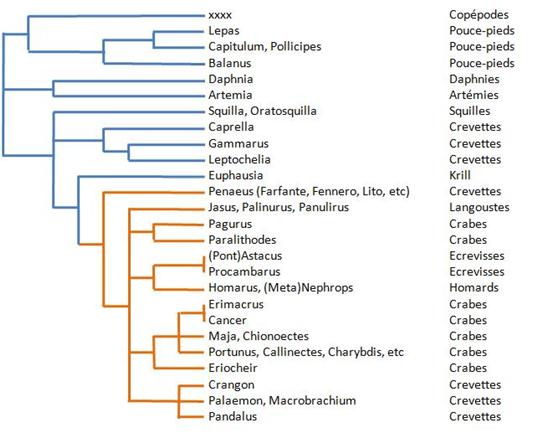
Les Crustacés ne se limitent pas aux Décapodes que sont les crevettes, les crabes ou les homards. La figure ci-dessous montre un arbre taxonomique des Crustacés pouvant intéresser l’allergologie.

Arbre taxonomique des principales familles de Crustacés ayant montré une IgE-réactivité.
La section en orange représente l’ordre des Décapodes
Les copépodes

Ce sont de lointains parents des Décapodes. Ces animaux aquatiques minuscules (1-2 mm) sont tout à fait ubiquitaires : on en trouve aussi bien dans la mer que dans les mares, les puits, etc..

Avec une autre branche des Crustacés, les espèces formant le krill, ils constituent la majeure partie du zooplancton et la première biomasse animale de la planète !

Une équipe s’est intéressée aux copépodes : une IgE-réactivité à été trouvée chez environ 40% des sujets atopiques, les blots montrant des bandes qui ne semblent pas correspondre aux allergènes classiques des Décapodes .

La portée de cette IgE-réactivité reste inconnue pour le moment.

Le krill

Un ensemble de crevettes minuscules, principalement issues de la famille des Euphausiaceae, compose le krill. Bien que peu pêché, le krill est un ingrédient alimentaire dans certains pays, tel le Japon.

Cette catégorie de Crustacés manifeste une IgE-réactivité chez des sujets allergiques aux crevettes (classiques), notamment par suite d’une présence de tropomyosines .

Le krill peut constituer aussi une nourriture pour poissons et une réactivité cutanée au krill a parfois été notée chez des patients consultant pour rhinite/asthme .


Les pouce-pieds

Les pouce-pieds, ou balanes ou encore anatifes, sont des Crustacés sédentaires dont l’apparence et le mode de vie pourrait évoquer plutôt des Mollusques. Ces animaux sont extrêmement prisés pour la chair de leur pédoncule.

Les cas d’allergie aux pouce-pieds sont rares :

  • Un enfant avec allergie connue aux fruits de mer et aux escargots qui présente une réaction lors de sa première ingestion de pouce-pieds . Bien que fortement réactif à rPen a 1, la responsabilité des tropomyosines n’est pas claire dans cette observation.
  • Deux enfants et trois adultes, dont 2 avec réactions sévères, dont l’histoire clinique relève une allergie aux acariens dans 4 cas
  • 3 enfants et 2 adultes, dont 4 avec réactions systémiques, allergiques aux acariens, un seul étant positif pour la tropomyosine rPen a 1
    Les tropomyosines de pouce-pieds ont été étudiées chez 2 espèces : elles s’avèrent être plus proches de celles d’ormeaux (Mollusques) que de celles de Décapodes .

L’allergie aux pouce-pieds pourrait donc être relativement indépendante de celle pour les crustacés classiques.


Les squilles

Ce sont des Crustacés d’assez grande taille et dont l’attaque est redoutable. Les squilles sont consommées comme les Crustacés classiques et contiennent des tropomyosines capables de réactivité croisée avec celles des Décapodes (89-98% d’identité) .

Un cas d’allergie à Squilla ampusa a été rapporté : il s’inscrivait dans le cadre d’une sensibilisation à d’autres fruits de mer (Décapodes mais pas Céphalopodes) .

Divers Crustacés

Certaines catégories de Crustacés sont utilisées en aquariophilie : les Daphnies, les Artémies et les crevettes Gammarus. Ces dernières sont également une source protéique en élevage (poissons, volailles).

Des cas d’allergie respiratoire ont été attribués à ces animaux, notamment en milieu professionnel . Cette manifestation allergique s’inscrit dans le cadre plus général d’une panallergie aux arthropodes , avec IgE-réactivité fréquente à d’autres animaux ayant le même usage, comme les chironomes .

Des réactions cutanées et/ou se manifestant hors du chmp professionnel ont été également rapportées .

L’allergie aux Crustacés classiques, les Décapodes

Dans certains pays, la consommation de Décapodes est très large et provoque un nombre important de réactions allergiques alimentaires, mais aussi respiratoires .

En plus de la pêche, une source de production de ces crustacés est l’aquaculture. En 2005, 40% des crevettes provenaient ainsi de l’aquaculture. S’agissant des crevettes, c’est avant tout des crevettes « tropicales » qui sont élevées, notamment Penaeus monodon et Litopenaeus vannamei.

Bien que les tropomyosines soient les allergènes dominants des crustacés et qu’elles forment une famille de protéines particulièrement proches les unes des autres sur le plan séquentiel (plus de 80% d’identité au sein des Crustacés), de petites différences d’IgE-réactivité sont possibles de l’une à l’autre, amenant à distinguer parfois dans la démarche diagnostique les crevettes d’eau douce de celles d’eau de mer, ou les crevettes tropicales de celles d’eaux froides (cf. Diagnostic).

Les statistiques du CICBAA donnent une fréquence de 1,6% avant 15 ans et 2,6% après 15 ans pour l’allergie aux Crustacés (D-A. Moneret-Vautrin, comm. pers., mai 2007).

Sur un total de 900 déclarations (mai 2010), le Réseau d’Allergo-Vigilance avait enregistré 39 cas concernant des crevettes, 8 pour langouste/langoustine, 5 pour crabes et 3 pour des Crustacés sans précision.

Comme pour les poissons, une dissociation pourrait exister entre les allergènes trouvés dans la chair et les allergènes des œufs du même animal. L’éventualité d’une allergie aux œufs des crevettes ne semble pas avoir été étudiée, bien que les œufs de ces animaux soient probablement assez souvent ingérés, volontairement ou non.

Un cas a été rapporté pour les œufs de langoustine où le patient tolérait la chair des mêmes langoustines, ainsi que les crevettes, etc.. .

Les allergènes des Crustacés

Dans la mesure où c’est avant tout la chair des Crustacés qui est consommée, les allergènes identifiés jusqu’à présent sont des protéines ayant un rôle dans les muscles.

Les premières ont été des tropomyosines dont l’IgE-réactivité a été caractérisée dès 1993 . Ces allergènes ont depuis été largement étudiés e sont considérés à la fois comme les allergènes principaux des Crustacés et comme des panallergènes d’invertébrés (acariens, insectes, nématodes, etc..) (cf. Tropomyosines).

Plus récemment, il a été montré que d’autres protéines pouvaient expliquer la réactivité à des Crustacés, au moins sur le plan biologique. Néanmoins, il est clair que certains patients présentent une allergie avérée aux Crustacés sans positivité pour les tropomyosines. D’autres allergèns sont donc en cause.

Parmi ces candidats, les plus sérieux semblent être les arginine kinases : on a caractérisé leur IgE-réactivité dans plusieurs espèces de Crustacés et une réactivité croisée avec des arginine kinases d’acariens a été montrée .

Dans un travail où, par ailleurs 13 patients sur 16 réagissaient à la tropomyosine, une réactivité pour l’arginine kinase de la même crevette a été notée 10 fois .

La chaîne légère de myosine montre une IgE-réactivité assez fréquente parmi les crevettes . De même les troponines C s’agissant du homard ou des crevettes .

Enfin, une triose-P isomérase et une troponine I seraient IgE-réactives chez certains sujets dans des crevettes ou écrevisses .

La relevance clinique de toutes ces protéines n’est cependant clairement affirmée que pour les tropomyosines.

Crustacés : polyréactivité / monoréactivité

On connaît depuis longtemps des tableaux d’allergie concomitante à plusieurs Crustacés .
Un test cutané (TC) positif pour la crevette s’accompagne très souvent d’un TC positif pour le crabe, le homard ou l’écrevisse .

Une allergie à plus d’un crustacé se rencontre dans environ les trois quarts des cas d’allergie aux crevettes , .

Mais il a été rapporté aussi des cas d’allergie isolée à une espèce de crevettes, de même que des réactions uniquement avec le céphalothorax de crevette ou avec la carapace mais pas le muscle caudal .

Cette diversité ne se limite pas à des patients particuliers : le répertoire des allergènes de crevettes asiatiques, par exemple, s’avère un peu différent de celui des crevettes d’eaux froides (comme Pandalus borealis) .

Des discordances entre tests diagnostiques du fait de l’origine différente des extraits entre eux ou entre l’extrait et le crustacé consommé sont parfois possibles.

Crustacés et acariens

Les tropomyosines sont les allergènes prépondérants des crustacés : 80 à 90% des allergiques aux crevettes sont positifs pour une tropomyosine .

Les acariens possèdent aussi des tropomyosines IgE-réactives, même si elles ne sont pas leurs allergènes dominants. On peut s’attendre à des réactivités croisées entre crustacés et acariens .

Mais est-ce qu’une allergie aux acariens est capable d’induire une allergie aux crustacés ? Et inversement ?

Chez les allergiques aux acariens :

L’exemple le plus démonstratif d’une réactivité pour les crustacés générée par les acariens a été relaté par Fernandes  : des TC positifs aux crustacés sont retrouvés chez des sujets dont la religion interdit la consommation de ces aliments alors qu’ils sont allergiques aux acariens. Ne pouvant envisager un TPO chez ces patients il n’est pas possible de contrôler la relevance clinique de cette réactivité cutanée.

Cette relevance clinique est vraisemblablement modérée . Ainsi, en Islande il a été relevé jusqu’à 58% de CAP crevette positifs chez des sujets TC positifs pour les acariens  : un tel taux est très supérieur à la prévalence de l’allergie à la crevette dans ce pays.

Cunha a étudié 164 enfants Portugais allergiques aux acariens (dont 61% sous IT spécifique acariens) : bien que sans allergie alimentaire, 19% des enfants avaient un TC crevette positif .

La responsabilité des acariens dans la positivation immunologique pour les crustacés a été soulignée dans 2 études en testant plusieurs sortes de tropomyosines chez les mêmes patients :

  • l’ordre de fréquence de positivité pour ces différentes tropomyosines est un indice indirect sur le probable allergène initiateur. Dans ces deux études il s’agissait des tropomyosines d’acariens.

Est-ce qu’une positivité pour la crevette chez les allergiques aux acariens est due à la seule réactivité croisée entre des tropomyosines ?

  • Ce n’est pas si simple. Il est possible que d’autres allergènes croisants soient en jeu, comme des arginine kinases.
  • En effet, la positivité pour la tropomyosine de crevette (Pen a 1) était seulement de 33% dans l’étude de Fernandes et de 17% dans l’étude Islandaise .

La positivité in vitro pour la tropomyosine de crevette n’entraîne que faiblement une allergie aux Crustacés chez les patients vus pour rhinite/asthme aux acariens : par exemple, 4 cas d’allergie à la crevette contre 22 nPen m 1 positifs dans la même cohorte . Et dans cette étude, la positivité pour nPen m 1 n’était pas corrélée avec la réactivité biologique ou clinique aux acariens.

Il en était de même dans un autre travail .

Chez des sujets allergiques aux acariens une autre voie de sensibilisation à des allergènes homologues présents dans les crustacés pourrait être l’immunothérapie. Cependant, une néo-réactivité ou une néo-allergie à la crevette du fait de l’immunothérapie semble très rare .

Dans une étude menée au Portugal et portant sur le suivi de 159 patients traités par IT spécifique aux acriens , les auteurs n’ont relevé :

  • Qu’un cas d’allergie à la crevette et 3 cas de positivité pour rPen a 1 avant l’IT
  • Et 3 néo-réactivités à rPen a 1, dont une avec allergie à la crevette, après 1 an d’IT
    L’immunothérapie par voie sublinguale a été moins étudiée mais ne semble pas induire non plus une allergie aux crevettes de façon significative .

Chez les allergiques aux crustacés :

La plupart des séries rapportant des allergies aux crustacés trouvent des prévalences d’allergie (ou TC positifs) pour les acariens allant de 80 à 100% ou un doublement de la prévalence habituelle localement .

Faute d’étude longitudinale démontrant une initiation de l’allergie aux acariens par la sensibilisation préalable des patients vis à vis de crustacés, il est vraisemblable que ces taux très élevés de prévalence représentent une sélection de sujets plus atopiques.

Ceci est d’ailleurs suggéré par l’observation de taux relativement proches de positivité in vitro pour les acariens chez des patients avec allergie attestée à la crevette (17 cas/20) et chez ceux avec un TPODA finalement négatif pour la crevette (10 cas/15) .

Les tropomyosines sont bien sûr les suspects principaux de ces réactivités, sauf pour des crustacés éloignés comme les pouce-pieds où d’autres allergènes pourraient être importants .

Au total ,l’association acariens-crustacés est faible .

Crustacés et blattes

On possède peu de travaux. Cependant, la réactivité pour la blatte germanique semble plus fréquente en cas d’allergie aux crustacés .

Les mêmes questions se posent pour la relation crustacés-blatte et pour la relation crustacés-acariens (cf. Crustacés et acariens).

Par exemple, quand le recrutement est basé sur une allergie respiratoire plutôt que sur une allergie aux Crustacés, la fréquence d’une réactivité pour la crevette est nettement plus faible (ex. 3 TC positifs parmi 32 patients ).

La responsabilité de tropomyosines a été suspectée également.

La relevance clinique d’une réactivité aux blattes (TC, tests in vitro) dans le cadre d’une allergie aux crustacés mériterait des études complémentaires pour mieux distinguer une simple réactivité croisée immunologique d’une allergie croisée.

Crustacés et Mollusques

Cf. l’article sur les Mollusques

Crustacés et autres insectes d’intérieurs

La relation entre crustacés et allergènes inhalés provenant d’insectes colonisant les habitations pourrait avoir pour support les tropomyosines.

Ces dernières sont libérées dans les fragments d’insectes morts et sont un constituant potentiel de la poussière de maison . De multiples insectes sont concernés, tels les poissons d’argent (Lepisma spp.), les mouches, des papillons, des coccinelles, etc...

On a ainsi décrit des réactions croisées entre divers arthropodes et la tropomyosine de crevette (rMet e 1) ou des TC positifs pour la crevette chez des sujets sensibilisés à la tropomyosine de poisson d’argent .

Les extraits de moustique étant « corps entier », ces travaux ont aussi montré une réactivité croisée moustique-tropomyosine. Cette réactivité est sans rapport avec l’allergie au moustique par piqûre, la salive de moustique étant dénuée de tropomyosines.

Crustacés : réactions par voie respiratoire

L’allergie professionnelle aux crustacés est bien connue. Elle concerne principalement les ouvriers des conserveries.
– Les allergènes des crustacés sont transférés dans l’eau de cuisson et vaporisés.
– Ces allergènes aéroportés sont en partie modifiés sous l’effet de la chaleur, avec une tendance à voir apparaître des protéines de plus fort poids moléculaire .
– L’allergie professionnelle se traduit fréquemment par un asthme mais il apparaît que ces patients tolèrent le plus souvent les crustacés par voie alimentaire .

L’observation d’allergie respiratoire aux vapeurs de cuisson sans exposition professionnelle est possible . Elle ne s’accompagne pas systématiquement d’une allergie alimentaire (crevettes).

Dans une étude portugaise, les auteurs estimaient à 1 patient sur 4 la fréquence des réactions par inhalation chez des allergiques aux crustacés et/ou mollusques .

On a décrit des cas d’allergie respiratoire aux crevettes Gammarus utilisées comme appâts ou en aquariophilie . Ces sujets étaient souvent allergiques aux acariens, mais la relation avec les crevettes ne semblait pas passer pas par des tropomyosines .

Dans le cas des chironomes, dont les larves sont utilisées aussi en aquariophilie, l’association avec une allergie aux crustacés est faible car les allergènes principaux des larves de chironomes sont des hémoglobines et non des tropomyosines.

Crustacés : influence de la chaleur et de la digestion.

Du fait de leur capacité à sensibiliser les patients à de nombreux crustacés, les tropomyosines sont réputées stables à la chaleur et à la digestion.

La cuisson modifie l’IgE réactivité des extraits de crevette. Certaines études ont trouvé une diminution du nombre des bandes IgE-réactives vues en blot (agrégation de protéines ?) .D’autres ont au contraire émis l’hypothèse de néo allergènes produits par la cuisson, des fragments IgE réactifs de la tropomyosine
.

La cuisson des crustacés pourrait augmenter leur réactivité, au moins cutanée (TC) , même si la plupart des comparaisons cru/cuit ont été faites sur des extraits chauffés à posteriori plutôt que sur des extraits réalisés sur des crustacés cuits .

L’effet de la cuisson sur la réactivité cutanée aux crevettes peut aussi varier d’une espèce à l’autre .

La digestibilité des tropomyosines a été peu étudiée : Fu montre une digestion gastrique très rapide (< 5 min) de tropomyosine de crevette. Mais le pH utilisé était celui de la pharmacopée US, c’est-à-dire peu réaliste (pH=1,2).

Ces travaux sur protéines pures ne tiennent pas compte non plus de l’influence de la matrice (bol alimentaire) sur la digestibilité .

Une arginine kinase de crevette a été étudiée : elle semble stable tant à la chaleur qu’à la digestion .

Crustacés : allergènes cachés.

La présence inattendue (ou négligée) de protéines issues des Crustacés n’est pas rare dans les pays où la consommation de produits de la mer est très large et où, de ce fait, de nombreuses préparations culinaires peuvent associer poissons et/ou mollusques avec des ingrédients tirés des Crustacés .

De même que les allergènes de crustacés sont capables d’être transférés dans l’eau de cuisson , de même on en retrouve dans l’huile de friture, notamment dans le cas d’utilisations itératives .

La réutilisation de cette huile pour une autre sorte d’aliment pourrait générer le transfert d’allergènes de crustacés vers cet autre aliment.

La glucosamine est parfois utilisée en rhumatologie, en association avec le sulfate de chondroïtine. La glucosamine peut être obtenue à partir de la carapace de divers Crustacés. Testée en TPO chez 6 patients allergiques aux Crustacés, elle n’a pas révélé d’allergénicité .

Crustacés : influence des procédés de pêche et de conservation.

Une étude Coréenne a noté une réactivité plus faible des crevettes salées et fermentées comparativement aux crevettes bouillies .

Des néo-bandes apparaissent en blot au cours de la conservation des crevettes dans la glace après pêche . L’IgE-réactivité résultant de cette transformation n’a pas été étudiée.

L’irradiation gamma semble diminuer l’IgE-réactivité des crevettes (au moins in vitro) .

Crustacés et difficultés diagnostiques

Les tests in vitro pour les Crustacés ont une sensibilité souvent inférieure à celle des prick-tests , même si les TC sont eux-mêmes assez mal prédictifs d’un TPO positif. On possède assez peu d’études où des TPO aient été réalisés. Dans l’une d’entre elles il fallait une réponse supérieure à 20 mm en TC pour avoir 95% de chances qque le TPO soit positif .

Dans l’hypothèse, a priori peu fréquente, où un doute subsisterait sur l’interprétation d’un test in vitro pour la crevette (et peut-être pour les autres crustacés), il pourrait être utile de tester le recombinant de crevette rPen a 1.

Une discordance entre un test négatif pour la crevette et positif pour la tropomyosine recombinante rPen a 1 pourrait provenir d’une réactivité vis à vis d’épitopes mieux représentés dans les crevettes d’origine asiatique (ex. Penaeus aztecus d’où est tiré rPen a 1) que dans les crevettes d’eaux froides (ex. Pandalus borealis) . C’est pourquoi la composition du CAP crevette ("F24") a récemment été modifiée : le test contient dorénavant des extraits de crevettes tropicales aussi (Penaeus monodon, Metapenaeus joyneri et Metapenaeopsis barbata).

Si ce mélange tend à augmenter la sensibilité du CAP crevette, il couvre partiellement la diversité de ces animaux : par exemple, une réactivité à la crevette d’eau douce Macrobrachium rosenbergii n’est parfois pas révélée en CAP , dissociation vis-à-vis de la réactivité à d’autres crevettes qui a lieu également en TC et en TPO .

Un test cutané ou in vitro positif avec un résultat négatif pour rPen a 1 peut être la marque d’une sensibilisation vis à vis d’un allergène autre qu’une tropomyosine dans le crustacé testé. On peut évoquer une arginine kinase sans qu’il soit possible, pour le moment, de le vérifier (pas de recombinant disponible).

Même si le recombinant rPen a 1 (E. coli) a une IgE-réactivité parallèle à celle de l’allergène naturel nPen a 1 , les résultats avec rPen a 1 sont légèrement inférieurs à ceux de nPen a 1 dans cette étude, et une négativité pour rPen a 1 malgré un CAP positif pour la crevette a été relevée dans d’autres travaux chez 18 à 43% des patients .

En dehors de la présence d’autres allergènes que les tropomyosines susceptibles de positiver les tests sur extrait global, la qualité-même de recombinant pourrait concourir à une moindre efficacité diagnostique :

  • Jeong évoque l’acétylation des tropomyosines, opérée à l’état naturel mais non reproduite avec le recombinant
  • Maranon observe quelques patients qui sont négatifs in vitro pour rPen a 1, ainsi que pour rPen m 1 (P. monodon), mais pourtant positifs pour l’allergène naturel nPen m 1. Cela semble du à des protéines de masse élevée accompagnant la tropomyosine normale à l’issue de la purification de nPen m 1 (des dimères de tropomyosine ?). Une réactivité plus faible avec l’allergène recombinant comparativement au naturel avait été remarquée aussi pour la tropomyosine de D. pteronyssinus et pour celle de blatte germanique .

Devient-on trop restrictif avec une protéine issue d’un clone unique ?

Crustacés et CCD

(voir aussi : Les CCD)

On a montré la présence d’environ 3% de glucides sur la tropomyosine de crevette Pen a 1 . La nature de ces chaînes glucidiques n’est pas connue. Ni leur éventuelle réactivité croisée avec des glyco-épitopes d’allergènes végétaux (CCD).

Des résultats contradictoires ont été obtenus avec les recombinants : parfois le recombinant (non glycosylé) montrait une réactivité in vitro plus faible , au moins chez certains patients , parfois aucune différence n’était trouvée .

De même des résultats positifs avec un test basé sur un extrait de crevette s’avérait négatif pour la tropomyosine recombinante chez quelques patients , .

L’atopie semblant augmenter la sensibilité du CAP crevette , il se pourrait qu’une partie de la réactivité du CAP crevette soit d’origine glucidique.

Ainsi un travail récent a montré chez un patient fortement réactif pour les CCD que la broméline inhibait 93% du résultat en CAP pour la crevette, alors que l’inhibition effectuée avec une tropomyosine recombinante chez ce patient n’abaissait que de 8% le résultat du CAP crevette .

Une autre étude corrobore cette observation, montrant qu’une fraction de la réactivité in vitro pourrait être due à des glyco-épitopes croisants avec des IgE anti-CCD .

D’autres travaux sont nécessaires pour connaître à quelle fréquence cette interférence est rencontrée
et pour mieux en préciser son importance quantitative.

[1] - Kagen S, Muthiah W, Breteler K. Copepods: a new worldwide source of allergens. ACAAI Annual Meeting, San Antonio, 15-20 Nov. 2002, Poster n° 1
Copepods are tiny aquatic animals distributed worldwide throughout nature. They are present wherever water exists, including deep sea oceans as part of the plankton food chain, fresh water lakes, thermal pools, rivers, wells, ponds and in droplets of water on the undersides of leaves. Copepods are distantly related to other crustaceans such as shrimp, lobster and crab. They are one of the most abundent forms of animal life on Earth, and yet prior to our studies, copepods have never before been studied as a cause of human allergy. A pure sample of the ocean dwelling copepod Pseudocalanus elongates was obtained from the Netherlands Institute of Sea Research. A 1:10 extract of P. elongates was prepared using phosphate buffered saline. This extract was studied using gel electrophoresis, immuno-blotting and direct ELISA for the presence of copepod-specific IgE using 75 randomly selected atopic sera. ELISA inhibition studies using inhalant allergens (ragweed, birch, grass, cadisfly, D. farinae and midge) and food allergens (shrimp, crab and lobster) were performed against the P. elongates extract. A patient with inflammatory bowel disease (Crohn‚s disease) was also studied for copepod-specific IgE reactivity. Copepod-specific IgE was present in 44% (33/75) of the 75 atopic sera studied. There was no cross reactivity between the food and inhalant allergens mentioned above and the P. elongates allergen extract. Three of the 34 P. elongates proteins bound human IgE. The copepod allergens had molecular weights of 36, 50, and 64 KDa. The Crohn‚s disease patient was positive for copepod-specific IgE. This is the first discovery to reveal that copepods induce specific IgE immune responses in humans. We found that 44% of allergy patients had specific IgE reactivity to P. elongates. Three copepod allergens have been identified. Copepods may be an important cause of allergic diseases, especially as they are ubiquitously distributed on Earth, and because they are in part parasitic in origin. Current studies are being directed at determining the amino acid sequences of the three copepod allergens. We are also studying the prevalence of copepod-specific IgE reactivity in Crohn‚s disease patients, evaluating copepod cross reactivity with other related allergens, and better defining the routes of human exposure to this new and important worldwide source of allergens.
↩
[2] - Muthiah R, Kagen S, Burton RS. Copepods: Worldwide Sources of Allergens—Partial Sequences of Three Unique Proteins. J Allergy Clin Immunol 2005;115(2 suppl.):S91
RATIONALE: Copepods are ancient crustaceans distributed worldwide in all aquatic environments. They are known to be the greatest source of protein on Earth. We previously identified copepods as sources of potential allergens. Here we present the partial sequences of three copepodderived proteins METHODS: Copepods (Tigriopus californicus) were collected from coastal California. They were extracted using a mortar and pestle in PBS We screened 42 atopic sera, and our negative control pool, for IgE and IgG reactivity. Electrophoresis and immunoblotting were performed to identify bands reactive with individual sera high in IgE and IgG copepod reactivity. MALDI analysis was employed to study six IgG reactive bands. Three protein bands at 41, 38 and 34 KDa were sequenced RESULTS: Seventeen atopic sera were positive for copepod-specific IgE, while all sera, including non-atopic controls, contained copepod-specific IgG. MALDI and protein sequence studies revealed that the three IgE reactive bands possess unique amino acids. No sequence homology to any known proteins was found. The N-terminals of the IgE binding proteins were: p41: Q-N-L-X -E-Q; p38: Q-N-E-A-E-Q-X-A-Q; and p34: QV- G-G-A-E-A-N-P-N-Q-F CONCLUSIONS: Humans are universally exposed to copepod antigens, as demonstrated by our findings that all sera contain IgG antibody to proteins in T. californicus. We have demonstrated that 40% of atopic sera also possess IgE reactivity to proteins found in copepods, be they copepodderived or bacterial proteins within the intestinal milieu of these ancient crustaceans. These three partial sequences are unique, and they shall provide for the further study of copepods as causes of human intestinal and other ailments
↩
[3] - Nakano S, Yoshinuma T, Yamada T. Reactivity of Shrimp Allergy-Related IgE Antibodies to Krill Tropomyosin. Int Arch Allergy Immunol 2008;145:175-181
BACKGROUND: Krill, which morphologically resembles small shrimp, represents small ocean crustaceans and has been used for human consumption in Japan and some other countries. The major allergen in crustaceans has been reported to be tropomyosin, but the allergenicity of krill tropomyosin remains uncertain . METHODS: Amino acid sequences of tropomyosin in two species of krill (Euphausia superba and E. pacifica) were deduced. Recombinant krill tropomyosins were produced in Escherichia coli using a pCold IV vector system, and the cross-reactivity of shrimp allergy-related IgE to the recombinant tropomyosins and several animal protein extracts was assessed by immunoblotting . RESULTS: The deduced amino acid sequences of the E. superba and E. pacifica tropomyosins (designated as Eup s 1 and Eup p 1, respectively) were 284 residues and showed significant homology to those of shrimp, lobster and crab tropomyosins. Shrimp allergy-related IgE reacted to approximately 38-kDa protein bands in krill (E. superba), shrimp, lobster and crab protein extracts but did not react to protein extracts from either mollusks or vertebrates. Furthermore, the IgE recognized rEup s 1 and rEup p 1 as 38-kDa protein bands, and absorption of the IgE with rEup s 1 removed IgE reactivity to recombinant tropomyosins and protein extracts from krill and shrimp . CONCLUSIONS: Krill tropomyosins included highly homologous sequences to previously reported IgE-binding epitopes in Pen a 1 (tropomyosin of Penaeus aztecus). The cross-reactivity in shrimp allergy-related IgE binding among krill, shrimp, lobster and crab tropomyosins was revealed. These observations suggest the potential allergenicity of krill tropomyosin.
↩
[4] - Motoyama K, Suma Y, Ishizaki S, Nagashima Y, Lu Y, Ushio H, et al. Identification of Tropomyosins as Major Allergens in Antarctic Krill and Mantis Shrimp and Their Amino Acid Sequence Characteristics. Mar Biotechnol (NY) 2008;10:709-718
Tropomyosin represents a major allergen of decapod crustaceans such as shrimps and crabs, and its highly conserved amino acid sequence (>90% identity) is a molecular basis of the immunoglobulin E (IgE) cross-reactivity among decapods. At present, however, little information is available about allergens in edible crustaceans other than decapods. In this study, the major allergen in two species of edible crustaceans, Antarctic krill Euphausia superba and mantis shrimp Oratosquilla oratoria that are taxonomically distinct from decapods, was demonstrated to be tropomyosin by IgE-immunoblotting using patient sera. The cross-reactivity of the tropomyosins from both species with decapod tropomyosins was also confirmed by inhibition IgE immunoblotting. Sequences of the tropomyosins from both species were determined by complementary deoxyribonucleic acid cloning. The mantis shrimp tropomyosin has high sequence identity (>90% identity) with decapod tropomyosins, especially with fast-type tropomyosins. On the other hand, the Antarctic krill tropomyosin is characterized by diverse alterations in region 13-42, the amino acid sequence of which is highly conserved for decapod tropomyosins, and hence, it shares somewhat lower sequence identity (82.4-89.8% identity) with decapod tropomyosins than the mantis shrimp tropomyosin. Quantification by enzyme-linked immunosorbent assay revealed that Antarctic krill contains tropomyosin at almost the same level as decapods, suggesting that its allergenicity is equivalent to decapods. However, mantis shrimp was assumed to be substantially not allergenic because of the extremely low content of tropomyosin.
↩
[5] - Eriksson NE, Ryden B, Jonsson P. Hypersensitivity to larvae of chironomids (non-biting midges). Cross-sensitization with crustaceans. Allergy 1989;44:305-313
In 2,368 consecutive adult patients with asthma and/or rhinitis the incidence of positive skin prick test (SPT) with a chironomid extract (CHIR) (produced from "red feather mosquito larvae" used as fish food) was 14% (26% in atopics and 4% in non-atopics). RAST with chironomid was positive in 4% of 110 consecutive sera (8% in atopic sera). Significant correlations were found between RAST and SPT results with chironomid and between SPT results with CHIR and with various crustaceans. Correlations were also found reciprocally among SPT results with different crustaceans and between some crustaceans and moluscs (clam and oyster) as well as among RAST results with chironomid, shrimp and crab. Inhibition experiments showed that chironomid extracts inhibited RAST with shrimp, and vice versa. It is concluded that Chironomidae might be allergens of clinical importance in asthma and rhinitis in Sweden, that cross-allergy exists between chironomids and shrimp and that cross-allergy also might occur among chironomids, crustaceans and molluscs.
↩
[7] - Moreno Escobosa MC, Alonso Lebrero E, Sanchez Alonso A, Mendez Alcalde J, Rico Diaz MA, Garcia Alvarez G, et al. Barnacle hypersensitivity. Allergol Immunopathol (Madr) 2002;30:100-103
Background: the aim of the present study is to investigate the responsible mechanism of different adverse reactions suffered by five patients, aged between six and thirty years-old, after consumption of barnacle. The symptoms were angioedema, dyspnea, generalized urticaria, conjunctivitis and one of them suffered from anaphylactic reaction. Four patients had personal atopic history.Methods: the allergic study included prick by prick test with raw and boiled barnacle and prick-test with a standardized battery of shellfish and neumoallergens, specific-IgE determination to barnacle, crustacean and house-dust-mite and SDS-PAGE immunoblotting to barnacle. Even though an oral challenge was proposed to three of the patients, they were reluctant to do the test and eventually the challenges were not carried out.Results: prick to prick tests were positive to barnacle for all of them. Specific-IgE was found in four patients. The western blotting results showed an IgE-binding band whose apparent molecular mass ranged between 58 and 68 kDa.Conclusions: barnacle could induce IgE-mediated adverse reaction. Our study has demonstrated the presence of an IgE-binding protein in barnacle extracts ranged between 58 and 68 kDa of molecular mass. It has not been previously described a crustacean allergen with the same molecular mass, so it could be a specific allergen from barnacle. We believe that further study will confirm this is the case.
↩
[8] - Marinho S, Morais-Almeida M, Gaspar A, Santa-Marta C, Pires G, Postigo I, et al. Barnacle allergy: allergen characterization and cross-reactivity with mites. J Investig Allergol Clin Immunol 2006;16:117-122
BACKGROUND: Barnacles are a type of seafood with worldwide distribution and abundant along the shores of temperate seas. They are particularly appreciated and regularly consumed in Portugal as well as in Spain, France and South America, but barnacle allergy is a rare condition of which there is only one reference in the indexed literature. The molecular allergens and possible cross-reactivity phenomena implicated (namely with mites) have not been established. OBJECTIVE: To demonstrate the IgE-mediated allergy to barnacle and to identify the proteins implicated as well as possible cross-reactivity phenomena with mites. METHODS: We report the clinical and laboratory data of five patients with documented IgE-mediated allergy to barnacle. The diagnosis was based on a suggestive clinical history combined with positive skin prick tests (SPT) to barnacle--prick to prick method. Two barnacle extracts were prepared (raw and cooked barnacle) and sodium dodecylsulphate polyacrylamide gel electrophoresis (SDS-PAGE) and IgE-immunoblotting were performed. An immunoblotting inhibition assay with Dermatophagoides pteronyssinus was also done in order to evaluate cross-reactivity. RESULTS: All patients had mite-related asthma and the allergic rhinoconjunctivitis; they all experienced mucocutaneous symptoms. All of them had positive SPT to barnacle, and the immunoblotting showed several allergenic fractions with a wide molecular weight range (19 - 94 kDa). The D. pteronyssinus extract inhibited several IgE-binding protein fractions in the barnacle extract. CONCLUSIONS: We describe five patients with IgE-mediated barnacle allergy. We also describe a group of IgE-binding+proteins between 30 and 75 kDa as the allergenic fractions of this type of Crustacea. Cross-reactivity with D. pteronyssinus was demonstrated in two cases.
↩
[9] - Suma Y, Ishizaki S, Nagashima Y, Lu Y, Ushio H, Shiomi K. Comparative analysis of barnacle tropomyosin: Divergence from decapod tropomyosins and role as a potential allergen. Comp Biochem Physiol B Biochem Mol Biol 2007;147:230-236
Tropomyosin, a myofibrillar protein of 35-38 kDa, represents a major and cross-reactive allergen in decapod crustaceans. This study was initiated to clarify whether decapod-allergic patients also recognize tropomyosins of barnacles, crustaceans phylogenetically remote from decapods, which are locally consumed as a delicacy. On SDS-PAGE, a 37 kDa protein was observed in all the heated extracts prepared from two species of decapods (American lobster Homarus americanus and black tiger prawn Penaeus monodon) and two species of barnacles (acorn barnacle Balanus rostratus and goose barnacle Capitulum mitella). In immunoblotting, the 37 kDa protein was found to react with monoclonal antibodies against American lobster tropomyosin and hence identified as tropomyosin. The patient sera reacted to tropomyosins from both decapods and barnacles and the reactivity was abolished by preincubation with American lobster tropomyosin, demonstrating that barnacle tropomyosins are allergens cross-reactive with decapod tropomyosins. However, the amino acid sequence of acorn barnacle tropomyosin, deduced by cDNA cloning experiments, shares higher sequence identity with abalone tropomyosins than with decapod tropomyosins. In accordance with this, the phylogenetic tree made for tropomyosins from various animals showed that the acorn barnacle tropomyosin is evolutionally classified not into the decapod tropomyosin family but into the molluscan tropomyosin family.
↩
[10] - Motoyama K, Suma Y, Ishizaki S, Nagashima Y, Lu Y, Ushio H, et al. Identification of Tropomyosins as Major Allergens in Antarctic Krill and Mantis Shrimp and Their Amino Acid Sequence Characteristics. Mar Biotechnol (NY) 2008;10:709-718
Tropomyosin represents a major allergen of decapod crustaceans such as shrimps and crabs, and its highly conserved amino acid sequence (>90% identity) is a molecular basis of the immunoglobulin E (IgE) cross-reactivity among decapods. At present, however, little information is available about allergens in edible crustaceans other than decapods. In this study, the major allergen in two species of edible crustaceans, Antarctic krill Euphausia superba and mantis shrimp Oratosquilla oratoria that are taxonomically distinct from decapods, was demonstrated to be tropomyosin by IgE-immunoblotting using patient sera. The cross-reactivity of the tropomyosins from both species with decapod tropomyosins was also confirmed by inhibition IgE immunoblotting. Sequences of the tropomyosins from both species were determined by complementary deoxyribonucleic acid cloning. The mantis shrimp tropomyosin has high sequence identity (>90% identity) with decapod tropomyosins, especially with fast-type tropomyosins. On the other hand, the Antarctic krill tropomyosin is characterized by diverse alterations in region 13-42, the amino acid sequence of which is highly conserved for decapod tropomyosins, and hence, it shares somewhat lower sequence identity (82.4-89.8% identity) with decapod tropomyosins than the mantis shrimp tropomyosin. Quantification by enzyme-linked immunosorbent assay revealed that Antarctic krill contains tropomyosin at almost the same level as decapods, suggesting that its allergenicity is equivalent to decapods. However, mantis shrimp was assumed to be substantially not allergenic because of the extremely low content of tropomyosin.
↩
[11] - Motoyama K, Suma Y, Ishizaki S, Nagashima Y, Lu Y, Ushio H, et al. Identification of Tropomyosins as Major Allergens in Antarctic Krill and Mantis Shrimp and Their Amino Acid Sequence Characteristics. Mar Biotechnol (NY) 2008;10:709-718
Tropomyosin represents a major allergen of decapod crustaceans such as shrimps and crabs, and its highly conserved amino acid sequence (>90% identity) is a molecular basis of the immunoglobulin E (IgE) cross-reactivity among decapods. At present, however, little information is available about allergens in edible crustaceans other than decapods. In this study, the major allergen in two species of edible crustaceans, Antarctic krill Euphausia superba and mantis shrimp Oratosquilla oratoria that are taxonomically distinct from decapods, was demonstrated to be tropomyosin by IgE-immunoblotting using patient sera. The cross-reactivity of the tropomyosins from both species with decapod tropomyosins was also confirmed by inhibition IgE immunoblotting. Sequences of the tropomyosins from both species were determined by complementary deoxyribonucleic acid cloning. The mantis shrimp tropomyosin has high sequence identity (>90% identity) with decapod tropomyosins, especially with fast-type tropomyosins. On the other hand, the Antarctic krill tropomyosin is characterized by diverse alterations in region 13-42, the amino acid sequence of which is highly conserved for decapod tropomyosins, and hence, it shares somewhat lower sequence identity (82.4-89.8% identity) with decapod tropomyosins than the mantis shrimp tropomyosin. Quantification by enzyme-linked immunosorbent assay revealed that Antarctic krill contains tropomyosin at almost the same level as decapods, suggesting that its allergenicity is equivalent to decapods. However, mantis shrimp was assumed to be substantially not allergenic because of the extremely low content of tropomyosin.
↩
[13] - Van Do T, Granslo JT, Aasen TB, Irgens Å, Florvaag E. Artemia-specific IgE antibodies in fish farm workers. Allergy 2007;62(suppl. 83):23
Background: Studies on allergy caused by Artemia are scarce. Artemia is a brine shrimp belonging to the Crustacea subphylum and is used as feed for fish fry in aquaculture throughout the world. Two workers in a fish farm out of Bergen, Norway developed allergic asthma and chest symptoms due to probably Artemia exposure. Objectives: to investigate the occupational exposure, sensitization, and respiratory symptoms in relation to Artemia; and to analyse partially allergens in Artemia. Methods: 30 of 42 workers of the fish farm participated this study and completed a questionnaire. Skin prick tests (SPT) and venipunctures were performed respectively on 30 and 28 subjects. Serum total IgE and specific IgE to shrimp, recombinant tropomyosin and Artemia were determined. SDS-PAGE and immunoblots of Artemia extracts were also carried out. Results: 3/24 (13%) of workers who had been exposed to Artemia had chest symptoms or allergic skin eruptions. Two of the 3 subjects with symptoms demonstrated immediate positive SPT, while one showed late positive SPT (after 11 hours). 5 subjects (21%) had Artemia-specific IgE. A pool serum of subjects with positive SPT exhibited IgE-binding to a protein (approximately 97 kD) in the Artemia extract. Conclusion: Artemia can sensitize and cause IgE-mediated occupational allergy by airways or direct skin contact.
↩
[16] - Eriksson NE, Ryden B, Jonsson P. Hypersensitivity to larvae of chironomids (non-biting midges). Cross-sensitization with crustaceans. Allergy 1989;44:305-313
In 2,368 consecutive adult patients with asthma and/or rhinitis the incidence of positive skin prick test (SPT) with a chironomid extract (CHIR) (produced from "red feather mosquito larvae" used as fish food) was 14% (26% in atopics and 4% in non-atopics). RAST with chironomid was positive in 4% of 110 consecutive sera (8% in atopic sera). Significant correlations were found between RAST and SPT results with chironomid and between SPT results with CHIR and with various crustaceans. Correlations were also found reciprocally among SPT results with different crustaceans and between some crustaceans and moluscs (clam and oyster) as well as among RAST results with chironomid, shrimp and crab. Inhibition experiments showed that chironomid extracts inhibited RAST with shrimp, and vice versa. It is concluded that Chironomidae might be allergens of clinical importance in asthma and rhinitis in Sweden, that cross-allergy exists between chironomids and shrimp and that cross-allergy also might occur among chironomids, crustaceans and molluscs.
↩
[17] - Pascual CY, Crespo JF, Sanmartin S, Ornia N, Ortega N, Caballero T, et al. Cross-reactivity between IgE-binding proteins from Anisakis, German cockroach, and chironomids. Allergy 1997;52:514-520
Anisakis simplex larvae parasitize animals used as seafood and can produce a specific immune response in man. The ingestion of seafood contaminated with stage three of A. simplex larvae can induce a specific IgE response with clinical symptoms, usually urticaria, even If the fish is cooked before ingestion and the invasive infestation power destroyed by heating. Our preliminary studies showed a strong association of A. simplex sensitization with Ascaris lumbricoides, Daphnia, chironomid spp., Atlantic shrimp (Pandalus borealis), and German cockroach (Blattella germanica). We conducted the cross-reactivity study with cockroach, a ubiquitous insect, and Chironomidae (red mosquito larvae), a work-related allergen, without any possibility of Anisakis contamination. Serum samples were collected from 60 pediatric patients, with serum specific IgE to A. simplex. Both specific-IgE and immunoblot-inhibition studies, with a serum pool from 18 patients, were performed to determine whether the association of sensitizations to nematodes and arthropods was due to immunologic cross-reactivity. In addition, serum samples from 21 of 60 patients who showed also sensitization to German cockroach were used for individual immunoblot studies. In the serum pool, dose-dependent inhibition of B. germanica and Chironomus spp, was observed after preincubation with the A. simplex extract. Immunoblot of Anisakis, inhibited with Chironomus and German cockroach, yielded a partial blot inhibition but mainly on bands below 41 kDa. Blot inhibition of German cockroach and Chironomus with Anisakis was dose related. The band patterns in individual blots were heterogeneous, but most of them had bands of 30-43 kDa. None of these sera recognized allergens in the 14-kDa area. In our study, CAP-inhibition and immunoblot-inhibition analysis of Anisakis showed that several IgE-binding components could be shared by the three allergens
↩
[18] - Ledent C, Mairesse M. Une dyspnéee d'origine halieutique. Rev Fr Allergol Immunol Clin 2006;46:36-37
Plusieurs études ont montré que des particules d'insectes ˜ hors hyménoptères ˜ peuvent se comporter comme des allergènes respiratoires. Les vers de farine, larves de Tenebrio molitor , représentent une source de manifestations allergiques chez des pêcheurs et des employés exposés à ces insectes.
↩
[19] - Fontan M, Anibarro B, Postigo I, Martinez J. Allergy to freshwater shrimp (Gammarus). J Investig Allergol Clin Immunol 2005;15:150-152
We report three new cases of allergy to Gammarus, two of them involving cutaneous symptoms, and the third one with occupational asthma. The results showed exposure to feed containing Gammarus shrimp to be the main cause of the allergic symptoms in the three patients. In all cases the intervention of IgE was demonstrated, with the absence of cross-reactions with other common allergenic arthropods.
↩
[21] - Serra Juanpere R, Dordal Culla MT, Pineda de la Losa F, Simon Jara J, Sánchez Benítez N, Pau Casanovas L, et al. Hypersensitivity to Norway Lobster roes. Allergy 2007;62(suppl. 83):330
Background: Crustaceans, such as shrimp, crab, crawfish and lobster, are frequently identified as a cause of IgE mediated adverse reactions in food allergic individuals. Ingestion and occasionally inhalation of crustacean allergens can induce allergic reactions such as pruritus, urticaria, angioedema, gastrointestinal symptoms, asthma, and life-threatening anaphylaxis. The muscle protein tropomyosin is the major allergen identified, and there‚s some degree of cross-reactivity with molluscs (squid) or arachnids (dust mites). However, we have not found in the literature any case of crustacean roe allergy with good tolerance to crustacean's body meat ingestion. Case Report - Evaluation: A 33 years-old male was referred to our Department on January 2006. He had suffered from three episodes of lip swelling and generalized urticaria, immediately postprandial; however, he cannot identify the triggering factor, although it seemed to be a weak association with shellfish ingestion. Skin prick-test was done with a panel of aeroallergens and food allergens according to anamnesis. Although he didn't suffer from respiratory symptoms, a positive response was obtained for cat dander, olive, cypress and plane tree pollen, and weakly to dust mites. Skin prick test was negative to the foods tested. Two months later he suffered another episode after eating Norway lobster roes; however, he had tolerated shrimp, prawn and Norway lobster after this reaction. A prick-prick test was negative to Norway lobster's body but positive to Norway lobster roes (13x6 wheal diameters, negative in control persons). Serum specific IgE was negative to shrimp. Results from SDS-PAGE immunoblotting revealed a binding protein of 70 kDa for Norway lobster roe extract. The patient is remaining asymptomatic since an exclusion diet has been recommended, and he's eating shellfish (without roes) with no problem. Conclusions: We describe an immediate type I allergic reaction after eating Norway lobster roes with good tolerance to crustaceans' body meat, including Norway lobster. Roe allergy should be explored in patients who test negative to shellfish but are suspected of having seafood-related allergy.
↩
[22] - Shanti KN, Martin BM, Nagpal S, Metcalfe DD, Rao PV. Identification of tropomyosin as the major shrimp allergen and characterization of its IgE-binding epitopes. J Immunol 1993;151:5354-5363
The major heat-stable shrimp allergen (designated as Sa-II), capable of provoking IgE-mediated immediate type hypersensitivity reactions after the ingestion of cooked shrimp, has been shown to be a 34-kDa heat-stable protein containing 300 amino acid residues. Here, we report that a comparison of amino acid sequences of different peptides generated by proteolysis of Sa-II revealed an 86% homology with tropomyosin from Drosophila melanogaster, suggesting that Sa-II could be the shrimp muscle protein tropomyosin. To establish that Sa-II is indeed tropomyosin, the latter was isolated from uncooked shrimp (Penaeus indicus) and its physicochemical and immunochemical properties were compared with those of Sa-II. Both tropomyosin and Sa-II had the same molecular mass and focused in the isoelectric pH range of 4.8 to 5.4. In the presence of 6 M urea, the mobility of both Sa-II and shrimp tropomyosin shifted to give an apparent molecular mass of 50 kDa, which is a characteristic property of tropomyosins. Shrimp tropomyosin bound to specific IgE antibodies in the sera of shrimp-sensitive patients as assessed by competitive ELISA inhibition and Western blot analysis. Tryptic maps of both Sa-II and tropomyosin as obtained by reverse phase HPLC were superimposable Dot-blot and competitive ELISA inhibition using sera of shrimp-sensitive patients revealed that antigenic as well as allergenic activities were associated with two peptide fractions. These IgE-binding tryptic peptides were purified and sequenced. Mouse anti-anti-idiotypic antibodies raised against Sa-II specific human idiotypic antibodies recognized not only tropomyosin but also the two allergenic peptides, thus suggesting that these peptides represent the major IgE binding epitopes of tropomyosin. A comparison of the amino acid sequence of shrimp tropomyosin in the region of IgE binding epitopes (residues 50-66 and 153-161) with the corresponding regions of tropomyosins from different vertebrates confirmed lack of allergenic cross-reactivity between tropomyosins from phylogenetically distinct species.
↩
[24] - García-Orozco KD, Aispuro-Hernández E, Yepiz-Plascencia G, Calderón-de-la-Barca AM, Sotelo-Mundo RR. Molecular Characterization of Arginine Kinase, an Allergen from the Shrimp Litopenaeus vannamei. Int Arch Allergy Immunol 2007;144:23-28
BACKGROUND: Consumption of seafood can produce allergic symptoms in susceptible individuals and crustacean allergies are the most frequently reported causes of allergic reactions . METHODS: An allergen from the muscle of the white shrimp Litopenaeus vannamei was purified by ion exchange chromatography and identified by mass spectrometry of tryptic peptides and its specific enzymatic activity. Moreover, the corresponding full-length cDNA was obtained from an L. vannamei muscle cDNA library . RESULTS: A 40-kDa protein was purified and identified as arginine kinase and its cDNA of 1.4 kb encoded a 356 amino acid protein. The obtained arginine kinase was recognized by IgE in serum from shrimp-allergic individuals using ELISA and immunoblotting analysis . CONCLUSIONS: This is the first allergen reported for the Pacific white shrimp species; it was named Lit v 2 and has a 96% identity to Pen m 2 from Penaeus monodon.
↩
[25] - Bi XZ, Chew FT. Molecular, Proteomic and Immunological Characterization of Isoforms of Arginine Kinase, a Cross-Reactive Invertebrate Pan-Allergen, From the House Dust Mite, Dermatophagoides farinae. AAAAI 60th Annual Meeting, San Francisco, 19-23 March 2004, Poster n°800
Rationale Arginine kinases (AK) were recently identified as major allergens in shrimp and the Indianmeal moth. Analysis of the mite proteome (Bi et al., ICACI 2003) revealed the presence of AK in its extracts. In this study, we cloned and expressed the AK from Dermatophagoides farinae (Der f) and examined its allergenicity. Methods Mass spectrometry and expressed sequence tag catalogues were used to identify this pan-allergen from Der f. IgE binding frequencies of the recombinant Der f AK were evaluated using sera from 49 Der f sensitive individuals, with or without shrimp allergy. Results AK was among the most abundant protein identified from the mite proteome. Mass spectrometry results indicated the presence of at least two isoforms. De novo peptide sequencing showed that the isoforms differed by one amino acid substitution (Gly161Glu162 substituting Tyr161), changing the protein charge from pI 6.33 to 6.54 without changing its molecular weight. Full length cDNA clones (showing 78% homology to shrimp AK) were obtained and the recombinant proteins expressed in E. coli were found to bind IgE in 12/49 (24%) of the sera tested. Significantly higher proportion of shrimp allergic individuals were sensitized to Der f AK (39% vs 12%, p<0.05). The pattern of reaction and inhibition studies however suggests that AK from shrimp and dust mites have both unique and cross reactive epitopes. Conclusions This study reports the first instance of the identification of native allergen isoforms by de novo peptide sequencing and the IgE reactivity of pan-allergenic arginine kinases from dust mites.
↩
[26] - Shiomi K, Sato Y, Hamamoto S, Mita H, Shimakura K. Sarcoplasmic Calcium-Binding Protein: Identification as a New Allergen of the Black Tiger Shrimp Penaeus monodon. Int Arch Allergy Immunol 2008;146:91-98
BACKGROUND: Tropomyosin and arginine kinase have been identified as crustacean allergens. During purification of arginine kinase from black tiger shrimp Penaeus monodon, we found a new allergen of 20-kDa . METHODS: A 20-kDa allergen was purified from the abdominal muscle of black tiger shrimp by salting-out, anion-exchange HPLC and reverse-phase HPLC. Following digestion of the 20-kDa allergen with lysyl endopeptidase, peptide fragments were isolated by reverse-phase HPLC, and 2 of them were sequenced. The 20-kDa allergen, together with tropomyosin and arginine kinase purified from black tiger shrimp, was evaluated for IgE reactivity by ELISA. Five species of crustaceans (kuruma shrimp, American lobster, pink shrimp, king crab and snow crab) were surveyed for the 20-kDa allergen by immunoblotting . RESULTS: The 20-kDa allergen was purified from black tiger shrimp and identified as a sarcoplasmic calcium-binding protein (SCP) based on the determined amino acid sequences of 2 enzymatic fragments. Of 16 sera from crustacean-allergic patients, 8 and 13 reacted to SCP and tropomyosin, respectively; the reactivity to arginine kinase was weakly recognized with 10 sera. In immunoblotting, an IgE-reactive 20-kDa protein was also detected in kuruma shrimp, American lobster and pink shrimp but not in 2 species of crab. Preadsorption of the sera with black tiger shrimp SCP abolished the IgE reactivity of the 20-kDa protein, suggesting the 20-kDa protein to be an SCP . CONCLUSIONS: SCP is a new crustacean allergen, and distribution of IgE-reactive SCP is probably limited to shrimp and crayfish. .
↩
[27] - Ayuso R, Grishina G, Bardina L, Carrillo T, Blanco C, Ibañez MD, et al. Myosin light chain is a novel shrimp allergen, Lit v 3. J Allergy Clin Immunol 2008;122:795-802
BACKGROUND: Shellfish allergy is a prevalent, long-lasting disorder usually persisting throughout life. Few options are available for treatment, and avoidance is the only therapy recommended . OBJECTIVE: We sought to identify relevant crustacean allergens for use as diagnostic and safe immunotherapeutic agents for subjects with shellfish allergy . METHODS: Thirty-eight patients were selected with immediate allergic reactions to shrimp and increased shrimp-specific serum IgE levels. One-dimensional and 2-dimensional electrophoresis of shrimp extracts were followed by IgE immunoblotting. Protein identification was done with matrix-assisted laser desorption/ionization-mass spectrometry and Edman sequencing. A cDNA library was generated from white pacific shrimp (Litopenaeus vannamei) and screened with primers designed on the basis of internal sequences obtained from 2-dimensional tryptic digests. Full-length cDNA clones were isolated from the library and sequenced. Recombinant protein was expressed and tested with sera from patients with shrimp allergy . RESULTS: Immunoblotting demonstrated IgE binding to a 20-kDa shrimp protein by 21 (55%) of 38 sera. Tryptic digestion of the protein followed by matrix-assisted laser desorption/ionization-mass spectrometric analysis and Edman sequencing identified it as a myosin light chain (MLC). Screening of the shrimp cDNA library resulted in isolation of a novel protein cDNA. Open reading frame translation provided the amino acid sequence of a new allergenic shrimp protein with high similarity to Bla g 8 (cockroach MLC). Recombinant protein was recognized by 17 patients, confirming the allergenicity of shrimp MLC . CONCLUSIONS: We have identified and cloned a new major shrimp allergen, Lit v 3.0101, an MLC protein.
↩
[32] - Reder MW, Wild LG, El-Dahr JM, Villacis J, Demerell D, Soteres D, et al. IgE Antibody Activity of Shrimp Allergic Subjects to Inhalant and Food Allergens. J Allergy Clin Immunol 2005;115(2 suppl.):S92
RATIONALE: Shrimp is an important allergenic seafood. The major shrimp allergen is the muscle protein tropomyosin. Since tropomyosin is present in other inhaled and ingested allergens, it was of interest to determine potential sensitivity of shrimp allergic subjects to these other allergens METHODS: Shrimp allergic subjects were recruited by advertisement 58 subjects (25 male, 33 female) ages 18-63, with definitive histories of shrimp allergy, as determined by questionnaire, were selected. Subjects were skin prick tested (ST) with aeroallergen and shellfish food extracts from Hollister-Stier; positive ST was determined by wheal with flare. IgE antibody responses to shrimp were measured by CAP-RAST RESULTS: 37/58 subjects were ST positive to at least 1 shrimp extract (64%). 41 (71%) were positive to either crab, lobster, crawfish, or oyster, 51 (88%) to either cockroach or DM, 19 (33%) to tree pollens, and 14 (24%) to grass pollens. Of the 37 subjects ST positive for shrimp, 35 (96%) were positive to crab, lobster, or crawfish. 36 (97%) reacted to either cockroach or DM. Of the 58 original subjects, 28 (48%) had undetectable IgE to shrimp (class 0) on CAP-RAST analysis. Of the 37 shrimp ST positive subjects, only 10 (27%) had undetectable IgE to shrimp CONCLUSIONS: Shrimp allergic subjects show significant reactivity to other shellfish, the greatest was to lobster, the least to oysters. Significant reactivity was observed to cockroach and DM extracts which is probably due in part to cross reactivity of invertebrate tropomyosin allergens. Better understanding of this should help improve diagnosis and therapy of food allergy
↩
[33] - Sicherer SH. Clinical implications of cross-reactive food allergens. J Allergy Clin Immunol 2001;108:881-890
As a consequence of the general increase in allergic sensitization, the prevalence of hypersensitivity reactions to multiple foods that share homologous proteins has become a significant clinical problem. A variety of these allergens conserved among plants (eg, profilin and lipid transfer proteins) and animals (eg, tropomyosin and caseins) have been characterized. Although studies with molecular biologic techniques have elucidated the nature of these ubiquitous allergens, clinical studies have lagged behind. The physician is called on to determine the risk of reaction to related foods among legumes, tree nuts, fish, shellfish, cereal grains, mammalian and avian food products, and a variety of other plant-derived foods that may share proteins with pollens, latex, and each other. Clinical evaluations require a careful history, laboratory evaluation, and in some cases oral food challenges. The pitfalls in the evaluation of food allergyˆunreliable histories and limitations in laboratory assessment primarily caused by false-positive skin prick test responses/RAST results are magnified when dealing with cross-reactive proteins. This review focuses on the clinical data regarding cross-reacting food allergens with the goal of providing a background for improved risk assessment and a framework on which to approach these difficult clinical questions
↩
[34] - Wild LG, Lehrer SB. Fish and shellfish allergy. Curr Allergy Asthma Rep 2005;5:74-79
Fish and shellfish are important in the American diet and economy. Nearly $27 billion are spent each year in the United States on seafood products. Fish and shellfish are also important causes of food hypersensitivity. In fact, shellfish constitute the number one cause of food allergy in the American adult. During the past decade, much has been learned about allergens in fish and shellfish. The major allergens responsible for cross-reactivity among distinct species of fish and amphibians are parvalbumins. The major shellfish allergen has been identified as tropomyosin. Many new and important potential cross-reacting allergens have been identified within the fish family and between shellfish, arachnids, and insects. Extensive research is currently underway for the development of safer and more effective methods for the diagnosis and management of fish and shellfish hypersensitivity.
↩
[37] - Östlund A, Norén M, Tanaka A, Dahlström J, Borgå Å. IgE antibody patterns to boiled and raw Pandalus borealis, Penaeus monodon, Penaeus orientalis, Metapenaeus barbata and Metapenaeus joyneri in patient samples from Europe, US and Japan. EAACI 25th Congress, Vienna, 10-14 June, 2006, Poster n°516
Aim As the interest in the Asian kitchen is increasing, we wanted to find out to what degree IgE antibodies to Asian shrimp species could be found in a Western population. The aim of the study was to compare the IgE antibody patterns to Pandalus borealis, tropomyosin, and four additional shrimp species commonly used in the Asian kitchen (Penaeus monodon, Penaeus orientalis, Metapenaeus barbarz and Metapenaeus joyneri.) Method Included where 31 serum-samples from individuals from Europe and United States, suspected of having shrimp allergy. Extracts from the different shrimp species and tropomyosin where coupled to ImmunoCAP TM (Phadia AB, Uppsala, Sweden) and the levels of specific IgE where measured according to the directions for use. Results Three sera (10%) where negative to Pandalus borealis and positive to one or more of the Asian species. The differences between raw and boiled shrimp where larger for the Asian species with a majority of patient samples having higher IgE antibody levels to raw shrimp. 19 of the patient samples (61%) where negative to tropomyosin. Conclusion Results indicated that the Asian species may be relevant also in a Western population.
↩
[38] - Jeong KY, Hong CS, Yong TS. Allergenic tropomyosins and their cross-reactivities. Protein Pept Lett 2006;13:835-845
The ingestion or inhalation of some proteins may lead to adverse immune reactions. Allergens may trigger allergic reactions in genetically predisposed individuals when they are absorbed through the skin or make contact with mucous membranes. An allergic disease often deteriorates the quality of life and may sometimes be life-threatening due to anaphylactic shock. A number of allergens have been characterized from various multicellular organisms to date. It is thought to be reasonable to pay a special attention to the substance which is highly cross-reactive and which causes adverse responses in the molecules that are not sensitized but similar to the sensitized allergen. Tropomyosin has been described as an important food allergen in shrimp, lobster, crab, oysters, squid, and other invertebrates. Allergic reactions to shellfish and mollusks are often cross-reactive, which may be explained by the highly conserved amino acid sequences of tropomyosins among invertebrates, but vertebrate tropomyosins are not known to be allergenic. Several tropomyosins from domestic arthropods have been reported to be allergenic. Recently, it was suggested that an infection of helminthic parasites might lead to sensitization to tropomyosin and elicit allergic reactions to other invertebrates. Much effort has been made to characterize these allergenic tropomyosins from various sources. We will discuss the physicochemical characteristics and the potential application of tropomyosin for the diagnosis and therapeutics of allergic disorders.
↩
[39] - Sun B, Wu A, Zhong N. Asthma after consumption of seafood in housedust- mite-allergic patients: cross-reactivity of shrimp, abalone and Derp1. Ann Allergy Asthma Immunol 2005;94:182
Background: The prevalence of allergic disease in most human population is steadily increasing. Seafood allergy is a serious food allergy, although hypersensitive reactions caused by seafood has long been know, biochemical and Immunological studies on seafood allergies had only begun lately. Shrimp and abalone are the most frequently reported causes early asthmatic response. OBJECTIVE: To investigate cross-reactivity of shrimp, abalone and Derp1. METHODS: Shrimp and abalone extracts were prepare from raw seafood. Sera from 17 patients from HongKong were studied who had asthma after consumption of seafood. IgE ELISA analyses comfirmed the combined sensitization to shrimp, abalone and Derp1. Specific-IgE ELISA assays were accomplished for shrimp and abalone extracts inhibited by Derp1 and Derp1 ELISA and Immunoblot assays inhibited by shrimp and abalone extracts. RESULTS: ELISA inhibition showed that most IgE antibodies against shrimp and abalone were cross-reactive with Derp1 and the same time, Derp1 ELISA was inhibition by shrimp and abalone extract. The ELISA inhibition percent (%)of shrimp extract (GM:53.28%) and abalone extract(GM:36.75%) by Derp1 were significantly higher than Derp1 by shrimp extract(GM:26.64%) and abalone extract (GM:17.59%). (P<0.01). Furthermore, and there was a significant correlation of ELISA inhibition percent between shrimp extract, abalone extract and Derp1 inhibited by each other; SDS-PAGE and immunoblot of shrimp and abalone is the 38 and 49kD allergen respectively. CONCLUSION: This indicates that Derp1 was the sensitive agent. Shrimp, abalone and Derp1 demonstrate significant cross-reactivity. These findings confirm that the primary crossreactive allergen of shrimp and abalone is the 38 and 49kD allergen respectively.
↩
[40] - Arlian LG, Morgan MS, Vyszenski-Moher DL, Sharra D. Cross-reactivity between storage and dust mites and between mites and shrimp. Exp Appl Acarol 2009;47:159-172
Many patients have sensitivities to multiple species of storage and house dust mites. It is not clear if this is because patients have multiple sensitivities to species-specific mite allergens or if these mites share many cross-reacting allergens. Our objective was to further define the cross-allergenicity between several species of storage and house dust mites using crossed-immunoelectrophoresis (CIE), crossed-radioimmunoelectrophoresis (CRIE), immunoblotting, and ELISA. CIE and CRIE reactions revealed that storage mites shared two cross-antigenic molecules and one of these bound IgE in a serum pool from mite allergic patients. Antibody in anti-sera built to each species of mite recognized many SDS-PAGE resolved proteins of other mite species and this suggested the potential for other cross-reactive allergens. Among patient sera, IgE bound to many different proteins but few had IgE that bound to a protein with common molecular weights across the mite species and this suggested mostly species-specific allergens. Antiserum built to each mite species precipitated one protein in shrimp extracts that bound anti-Der p 10 (tropomyosin) and IgE in the serum pool. Anti-Der p 10 showed strong binding to shrimp tropomyosin but very little to any of the mite proteins. ELISA showed the mite extracts contained very little tropomyosin. The storage and dust mites investigated contain mostly species-specific allergens and very small amounts of the pan-allergen tropomyosin compared to shrimp and snail.
↩
[41] - Fernandes J, Reshef A, Patton L, Ayuso R, Reese G, Lehrer SB. IgE antibody reactivity to the major shrimp allergen, tropomyosin, in unexposed Orthodox Jews. Clin Exp Allergy 2003;33:956-961
BACKGROUND: Assessment of allergic (IgE antibody-mediated) reactions to foods may become complicated by cross-reactivity that can occur among certain food families and between foods and seemingly unrelated allergens . OBJECTIVE: The allergenic properties of tropomyosin (muscle-derived protein) have been recently demonstrated in invertebrates such as cockroaches, dust mites, and shrimp. In view of a possible cross-reactivity between food allergens and related allergens from animal sources, we designed a study to assess IgE antibody reactivity to the major shrimp allergen, Pen a 1, in an unexposed population of Orthodox Jews, who observe Kosher dietary laws that prohibit eating shellfish . METHODS: Nine subjects, who reacted positively by skin tests to shrimp (Penaeus setiferous), were selected for the study. Subjects (two females, seven males) ranged in age from 14 to 32 years (mean 20.4). All subjects were strictly observant of Jewish tradition and had no prior exposure to seafood (regarded as a non-Kosher food). Serum was obtained from all the subjects and tested for IgE antibody reactivity to shrimp and dust mite . RESULTS: All subjects reported symptoms of perennial allergic rhinitis, five had history of asthma, atopic dermatitis, and/or sinusitis. All had positive skin prick tests to shrimp and house dust mite (HDM) (Dermatophagoides farinae, D. pteronyssinus, or both); 2/7 subjects were positive to cockroach mix (Blattella germanica and Periplaneta americana). Sera of 4/9 subjects demonstrated specific IgE antibodies by RAST to shrimp (7.0-20.0%), 3/9 to Pen a 1 (6.3-24.1%), and 3/9 to shrimp or Pen a 1 by immunoblot. IgE binding to Pen a 1 was inhibited with either mite or cockroach extracts as demonstrated by RAST and/or immunoblot inhibition analysis . CONCLUSIONS: These studies indicate that IgE antibody reactivity to a major food allergen, shrimp, can occur in an unexposed population of individuals; some subjects allergic to HDM and/or cockroach show substantial IgE antibody reactivity to the major shrimp allergen Pen a 1 (tropomyosin). Based on inhibition with cockroach and/or dust mite extracts, this reactivity appears to be due to cross-reacting tropomyosins.
↩
[42] - Kütting B, Brehler R. Reflections on clinical relevance of cross-reactivity between house dust mite, molluscs and crustacean. Allergologie 2002;25:321-325
Introduction: Cross-reactivity between house dust mite and molluscs or crustacean has been reported in the past, mainly French and Italian publications are related to this subject. In our region this house-dust mite associated food allergy seems to play a less important role. Patients: 33 patients consulting our outpatients department because of a clinically relevant type-I-sensitization to house dust mite were included in the study. The relevance of a possible house dust mite related food allergy due to cross-reactive IgE antibodies was studied by a questionnaire, skin prick tests and in vitro assays, as well. Results: 29 patients consumed shrimps, but only 2 patients reported on adverse reactions after consumption. Snails were rarely eaten, only one person regularly eats snails, 10 persons sporadically, but 22 persons never eat snails. No adverse effects were reported after consumption of snails. The two persons with clinical symptoms after consumption of shrimps had positive skin prick test results in the prick to prick test, but specific IgE was detected in one case. Conclusion: In our opinion patients suffering from a sensitization to house dust mite should be informed about possible related food allergies to molluscs and crustacean in spite of the fact that such adverse reactions are quite rare. Therefore this related food allergy can not be compared to the mugwort/celery syndrome. Patients with a food allergy after consumption of invertebrates should be examined if they are sensitized to house dust mite because in adults food allergy is mainly due to cross-reactivity between inhalative and food allergens.
↩
[43] - Sigurdardottir ST, Adalsteinsdottir B, Gislason T, Kristensen B, Gislason D. What is House Dust Mite Allergy in a Community with no House Dust Mites? AAAAI 62nd Annual Meeting, Miami, 3-7 March 2006, Poster n°451
RATIONALE: Previous studies in Iceland show that 6-9% of young adults are sensitized to the house dust mite (HDM) Dermatophagoides pteronyssinus (D. pter). However, only small amounts of HDM and HDM allergens were detected in their homes. The study investigates this discrepancy METHODS: We investigated all participants in the European Community Respiratory Health Surveys I and II (ECRHS I and II) with D. pter specific IgE, either in 1991-92 or nine years later. A D. pter negative but grass positive control group was recruited from the same cohort. A questionnaire was administered and the specific IgE (Pharmacia CAP system) against six D. pter cross-reactive allergens was measured RESULTS: Out of 518 ECRHS I participants with available IgE results, 90% returned for ECRHS II 8.4 years later. Out of 50 individuals with D pter specific IgE in ECRHS I, 25 had become negative in ECRHS II and four new individuals were detected. Compared to controls, HDM sensitive subjects were more often males, had lived on farms or kept goldfish in childhood. Of those with specific IgE against D. pter in ECRHS I and II, 75% had detectable IgE antibodies (_0.35 kU/l) to cross-reactive allergens; Lepidoglyphus destructor (L. destructor)(67%), shrimp (58%), cockroach (33%), mosquito (17%), tropomyosin (17%) and blood worm (4%), compared to none in the control group (p<0.0001) CONCLUSIONS: Compared to controls, Icelanders with specific IgE to D. pter have higher prevalence of cross-reactive IgE antibodies and are more often males who spent time on farms in childhood Funding: Landspitali University Hospital Science Fund
↩
[44] - Cunha L, Botelho C, Costa E, Lopes C, Falcao H. Evaluation of cockroach and shrimp sensitivity in a house dust mite allergic pediatric population. Allergy 2008;63(suppl. 88):168
Background: House dust mites (HDM) can present cross-reactivity with shellfish (shrimp) and other members of the Arthropoda family (ex: cockroach), being tropomyosin the panallergen more frequently involved. Aims: Evaluate cutaneous sensitisation to cockroach and/or shrimp in a house dust mite allergic pediatric population followed in a specialized allergy clinic. Material and methods: The authors studied sequentially 164 children followed in a specialized allergy clinic, all allergic to HDM without history of food allergy. We performed SPT to aeroallergens [Dermatophagoides pteronyssinus (Dp), Dermatophagoides farinae (Df), mixture of pollens from trees, grass and weeds; dog/cat dander and Blatella germanica (Alk Abellos)] and shrimp (Mercks). SPT were considered positive if the wheal size had a mean diameter _3 mm. Quisquare test and t-student test were used to perform statistical analysis. Results: One-hundred and nine were male patients (66.5%) with mean age of 9.8 y (SD - 3.6). One-hundred and eight patients (65.9%) had familiar history of atopy. Respiratory symptoms were present in 149 patients (89%), in 16 (9.8%) they were associated to other allergic symptoms and 2 (1.2%) patients had only atopic dermatitis. One-hundred and one patients (61.3%) were under specific immunotherapy to HDM (mean follow-up of 20 months, SD of 23). sensitisation to cockroach and shrimp was present in 30 (18.3%)/31 (18.9%) of patients, respectively. All patients sensitised to cockroach or shrimp had respiratory symptoms (asthma and/or rhinitis). The mean wheal diameter of the SPT to Dp/Df in patients sensitised or not to cockroach had no statistical differences (P=0.06/P=0.14). The same results were found when we compared the mean wheal diameter of the SPT to Dp/Df and presence or not of sensitisation to shrimp (P=0.055/P=0.23). Conclusions: Simultaneous sensitisation to HDM and cockroach or shrimp is present in 18% of patients. Co-sensitisation to those three allergens appears in only 7% of patients. In this pediatric population, cross-reactivity was not considered determinative.
↩
[45] - Scala E, Zaffiro A, Quaratino D, D'Ambrosio C, Bernardi M, Palazzo P, et al. IgE Recognition Pattern of Homologous Allergens Tested by Microarray-based Nanotechnology. J Allergy Clin Immunol 2007;119(1 suppl):S105
RATIONALE: IgE recognition of homologous molecules shared by inhalant and food allergen sources are often seen in clinical practice. The aim of our study was to evaluate through allergen microarray technique the IgE recognition pattern of the allergic population. METHODS: 1110 individuals (42/58 male/female) with a clinical history of urticaria, rhinitis, asthma and atopic dermatitis have been recruited and tested by allergen-based microarray system (VBC-Genomic, Vienna, Austria). Patients were grouped on the basis of their reactivity to at least one allergen in one of the following three groups: Profilins (Bet v 2, Cyn d 12, Hel a 2, Hev b 8, Mer a 1, Ole e 2, Par j 3, Phl p 12, Pho d 2); Bet v 1-related allergens (Aln g 1, Api g 1, Bet v 1a, Bet v 1d, Cor a 1, Dau c 1 and Mal d 1.0108); tropomyosins (Ani s 3, Der p 10, Hel as 1, Pen i 1, Pen m 1, Per a 7). RESULTS: 523 (47%) subjects were positive to at least one Bet v 1-related allergens, 415 (37%) to at least one Profilin, 123 (11.1%) to at least one tropomyosin. Bet v 1 (85%) was the most frequently IgE positive molecule within Bet v 1-related allergen reactive individuals, whereas Mer a 1 (89%) ranked first within the profilin subset, and Der p 10 (80%) was the most IgE recognized tropomyosin. Stratifying subjects by IgE concentrations showed an almost homogeneous recognition pattern for all profilins and tropomyosins, whereas IgE to some Bet v 1-like molecules from foods were not detected even at high Bet v 1-IgE concentration. CONCLUSIONS: Panel of grouped allergens to be tested by means of microarray system are helpful to fully describe homologous allergenic molecule immunological relationship. IgE reactivity pattern could relate to patient clinical picture.
↩
[46] - Purohit A, Shao J, Degreef JM, van Leeuwen A, van Ree R, Pauli G, et al. Role of tropomyosin as a cross-reacting allergen in sensitization to cockroach in patients from Martinique (French Caribbean island) with a respiratory allergy to mite and a food allergy to crab and shrimp. Eur Ann Allergy Clin Immunol 2007;39:85-88
BACKGROUND: Tropomyosin has been described as cross-reacting allergen between mite, cockroach and shrimp. METHODS: In 13 patients with asthma and/or rhinitis sensitized to mite and/or German cockroach and presenting urticaria, oral allergy syndrome or angio-edema upon eating shrimp and/or crab, we measured specific IgE to mite, cockroach, crab and shrimp tropomyosin. RESULTS: Ten patients had specific IgE to tropomyosin from mite, 8 from shrimp, 6 from crab and 5 from cockroach. AST inhibition tests indicated that mite allergen is a primary sensitizer and is cross-reacting with shrimp, crab and cockroach allergens. CONCLUSION: Tropomyosin could be the cross-reacting allergen relevant for clinical symptoms to mite, cockroach, shrimp and crab.
↩
[47] - Fernandes J, Reshef A, Patton L, Ayuso R, Reese G, Lehrer SB. IgE antibody reactivity to the major shrimp allergen, tropomyosin, in unexposed Orthodox Jews. Clin Exp Allergy 2003;33:956-961
BACKGROUND: Assessment of allergic (IgE antibody-mediated) reactions to foods may become complicated by cross-reactivity that can occur among certain food families and between foods and seemingly unrelated allergens . OBJECTIVE: The allergenic properties of tropomyosin (muscle-derived protein) have been recently demonstrated in invertebrates such as cockroaches, dust mites, and shrimp. In view of a possible cross-reactivity between food allergens and related allergens from animal sources, we designed a study to assess IgE antibody reactivity to the major shrimp allergen, Pen a 1, in an unexposed population of Orthodox Jews, who observe Kosher dietary laws that prohibit eating shellfish . METHODS: Nine subjects, who reacted positively by skin tests to shrimp (Penaeus setiferous), were selected for the study. Subjects (two females, seven males) ranged in age from 14 to 32 years (mean 20.4). All subjects were strictly observant of Jewish tradition and had no prior exposure to seafood (regarded as a non-Kosher food). Serum was obtained from all the subjects and tested for IgE antibody reactivity to shrimp and dust mite . RESULTS: All subjects reported symptoms of perennial allergic rhinitis, five had history of asthma, atopic dermatitis, and/or sinusitis. All had positive skin prick tests to shrimp and house dust mite (HDM) (Dermatophagoides farinae, D. pteronyssinus, or both); 2/7 subjects were positive to cockroach mix (Blattella germanica and Periplaneta americana). Sera of 4/9 subjects demonstrated specific IgE antibodies by RAST to shrimp (7.0-20.0%), 3/9 to Pen a 1 (6.3-24.1%), and 3/9 to shrimp or Pen a 1 by immunoblot. IgE binding to Pen a 1 was inhibited with either mite or cockroach extracts as demonstrated by RAST and/or immunoblot inhibition analysis . CONCLUSIONS: These studies indicate that IgE antibody reactivity to a major food allergen, shrimp, can occur in an unexposed population of individuals; some subjects allergic to HDM and/or cockroach show substantial IgE antibody reactivity to the major shrimp allergen Pen a 1 (tropomyosin). Based on inhibition with cockroach and/or dust mite extracts, this reactivity appears to be due to cross-reacting tropomyosins.
↩
[48] - Sigurdardottir ST, Adalsteinsdottir B, Gislason T, Kristensen B, Gislason D. What is House Dust Mite Allergy in a Community with no House Dust Mites? AAAAI 62nd Annual Meeting, Miami, 3-7 March 2006, Poster n°451
RATIONALE: Previous studies in Iceland show that 6-9% of young adults are sensitized to the house dust mite (HDM) Dermatophagoides pteronyssinus (D. pter). However, only small amounts of HDM and HDM allergens were detected in their homes. The study investigates this discrepancy METHODS: We investigated all participants in the European Community Respiratory Health Surveys I and II (ECRHS I and II) with D. pter specific IgE, either in 1991-92 or nine years later. A D. pter negative but grass positive control group was recruited from the same cohort. A questionnaire was administered and the specific IgE (Pharmacia CAP system) against six D. pter cross-reactive allergens was measured RESULTS: Out of 518 ECRHS I participants with available IgE results, 90% returned for ECRHS II 8.4 years later. Out of 50 individuals with D pter specific IgE in ECRHS I, 25 had become negative in ECRHS II and four new individuals were detected. Compared to controls, HDM sensitive subjects were more often males, had lived on farms or kept goldfish in childhood. Of those with specific IgE against D. pter in ECRHS I and II, 75% had detectable IgE antibodies (_0.35 kU/l) to cross-reactive allergens; Lepidoglyphus destructor (L. destructor)(67%), shrimp (58%), cockroach (33%), mosquito (17%), tropomyosin (17%) and blood worm (4%), compared to none in the control group (p<0.0001) CONCLUSIONS: Compared to controls, Icelanders with specific IgE to D. pter have higher prevalence of cross-reactive IgE antibodies and are more often males who spent time on farms in childhood Funding: Landspitali University Hospital Science Fund
↩
[49] - Corominas M, Lleonart R, Bonete J, Mestre M. Role of Tropomyosin in D. pteronyssinus Allergic Patients. J Allergy Clin Immunol 2009;123:S227
RATIONALE: We evaluated the role of tropomyosin sensitization in patients with D pteronyssinus (Dpt)-induced respiratory allergy because tropomyosin, the major allergen of shrimp, is a cross-reacting allergen found in house dust mites and cockroaches. METHODS:We studied 48 patients sensitized to Dpt (positive skin prick test-SPT- and positive Dpt specific IgE) with rhinitis and/or asthma. We measured specific IgE against to native tropomyosin (Pen m 1) by means of 3gAllergy with an IMMULITE_ 2000 immunoassay system (Siemens, USA). Levels higher than 0.35 KU/L were considered positive. RESULTS:30 patients with rhinitis and 18 patients with rhinitis and/or asthma were included. Only four patients also presented symptoms after shrimp ingestion. 44% of the patients showed levels of tropomyosin specific IgE. When we compared patients by positive or negative tropomyosin specific IgE, we did not find statistically significant differences with respect to gender, age, clinical symptoms, SPT to Dpt or shrimp, total IgE levels, or positive Dpt or shrimp specific IgE. We observed a significant correlation between tropomyosin levels and the weal‚s mean diameter obtained by SPT to shrimp (p 50.020), and also between tropomyosin levels and levels of shrimp specific IgE (p < 0.0001). CONCLUSIONS: Although a high number of patients with Dpt allergy have native tropomyosin specific IgE, this sensitization does not appear to influence the respiratory or oral symptoms presented by these patients.
↩
[50] - Ayuso R, Grishina G, Bardina L, Carrillo T, Blanco C, Ibañez MD, et al. Myosin light chain is a novel shrimp allergen, Lit v 3. J Allergy Clin Immunol 2008;122:795-802
BACKGROUND: Shellfish allergy is a prevalent, long-lasting disorder usually persisting throughout life. Few options are available for treatment, and avoidance is the only therapy recommended . OBJECTIVE: We sought to identify relevant crustacean allergens for use as diagnostic and safe immunotherapeutic agents for subjects with shellfish allergy . METHODS: Thirty-eight patients were selected with immediate allergic reactions to shrimp and increased shrimp-specific serum IgE levels. One-dimensional and 2-dimensional electrophoresis of shrimp extracts were followed by IgE immunoblotting. Protein identification was done with matrix-assisted laser desorption/ionization-mass spectrometry and Edman sequencing. A cDNA library was generated from white pacific shrimp (Litopenaeus vannamei) and screened with primers designed on the basis of internal sequences obtained from 2-dimensional tryptic digests. Full-length cDNA clones were isolated from the library and sequenced. Recombinant protein was expressed and tested with sera from patients with shrimp allergy . RESULTS: Immunoblotting demonstrated IgE binding to a 20-kDa shrimp protein by 21 (55%) of 38 sera. Tryptic digestion of the protein followed by matrix-assisted laser desorption/ionization-mass spectrometric analysis and Edman sequencing identified it as a myosin light chain (MLC). Screening of the shrimp cDNA library resulted in isolation of a novel protein cDNA. Open reading frame translation provided the amino acid sequence of a new allergenic shrimp protein with high similarity to Bla g 8 (cockroach MLC). Recombinant protein was recognized by 17 patients, confirming the allergenicity of shrimp MLC . CONCLUSIONS: We have identified and cloned a new major shrimp allergen, Lit v 3.0101, an MLC protein.
↩
[51] - Asero R. Lack of de novo Sensitization to Tropomyosin in a Group of Mite-Allergic Patients Treated by House Dust Mite-Specific Immunotherapy. Int Arch Allergy Immunol 2005;137:62-65
BACKGROUND: There is some evidence that specific immunotherapy may induce de novo sensitization to proteins contained in the allergen extract. This raises the possibility that the novel sensitization to cross-reacting allergens may cause food allergies . OBJECTIVE: The aim of this study was to assess whether injection of mite-specific immunotherapy (SIT) may induce sensitization to shrimp tropomyosin . METHODS: Seventy mite-allergic subjects who did not show any shrimp sensitization at baseline were followed up for at least 3 years. Thirty-one of them underwent a 3-year SIT course, 39 served as controls. At the follow-up visit, SPTs with both fresh shrimp and commercial extract were performed, and patients underwent an open oral challenge with shrimp . RESULTS: Neither patient nor control had become sensitized to shrimp allergens at the end of the study period. Both patients and controls reported the regular intake of crustaceans and/or molluscs . CONCLUSION: Injection SIT with house dust mite extracts does not seem to induce de novo tropomyosin sensitization in mite-allergic patients
↩
[52] - Tomaz E, Pires A, Inácio F, Quaresma R. Tropomyosin`s clinical importance in house dust mite allergic patients. EAACI 25th Congress, Vienna, 10-14 June, 2006, Poster n°991
Background: Tropomyosin is a protein largely distributed through several animal species. In invertebrates, such as house dust mite, crustaceans, silverfish and mollusks, it has been described as an allergic component, sometimes responsible for cross-reactivity. Methods: The purpose of this study was to determine the prevalence of sensitisation to tropomyosin in a house dust mite sensitized population, before and after immunotherapy, and its relationship to sensitisation and/or food allergy to snail, shrimp and Blatella germanica. 169 patients were reviewed (male=89; female=80), mean age 22 years old, allergic to house dust mite, who had performed Tropomyosin specific IgE analyses, before and, at least, after 12 months of immunotherapy. Specific IgE to snail, Blatella germanica and shrimp were analyzed in patients with positive Tropomyosin specific IgE (> 0,35 KuA/L). Patients were asked about allergic symptoms to food, specially crustaceans and mollusks. Results: Tropomyiosin sensitisation prevalence in this population was 3,5% (3 male, 3 female, mean age 19 years old; 50% were already sensitized before immunotherapy, 50% sensitized during immunotherapy). The sensitisation to Tropomyosin is closely associated to the sensitisation to snail, Blatella germanica and shrimp. The prevalence of food allergy is 33% (n=2) among tropomyosin sensitized patients and 2% (n=4) among non sensitized patients. Conclusion: The prevalence of sensitisation to Tropomyosin among this house dust mites allergic population is low (3,5%) and similar to data published by other authors that pointed Tropomyosin as a minor allergen of mites. The patients sensitized to Tropomyosin are also sensitized to species with homologues Tropomyosines, such as snail, Blatella germanica and shrimp. There is a high prevalence of food allergic symptoms to mollusks and crustacean among Tropomyosin sensitized patients. Those aspects come to reinforce the involvement of Tropomyosin on cross-reactivity between invertebrate species.
↩
[53] - van Ree R, Antonicelli L, Akkerdaas JH, Garritani MS, Aalberse RC, Bonifazi F. Possible induction of food allergy during mite immunotherapy. Allergy 1996;51:108-113
Sera of 17 patients receiving immunotherapy for house-dust mite allergy were tested for IgE antibodies against snail and shrimp. Serum samples were taken at the start of immunotherapy and 14-20 months later. While the average IgE response to mite, Der p 1, and Der p 2 did not alter significantly, the average response to snail showed a significant increase. This included two conversions from negative to strongly positive. These novel IgE antibodies against snail were shown to be cross-reactive with mite. Three patients had a positive RAST for shrimp. For one of them, a strong increase of IgE against shrimp (and snail) was observed. In 2/3 snail/shrimp-positive sera, IgE antibodies against the cross-reactive allergen tropomyosin from mite, snail, and shrimp were demonstrated. A clear IgE response to snail (> 10% binding in a snail RAST) was confirmed by a positive skin prick test (SPT) for 6/10 patients. The two patients with antitropomyosin IgE also had a positive SPT for shrimp, and demonstrated the oral allergy syndrome (OAS) after eating shrimp. The observations in this study indicate that house-dust mite immunotherapy is accompanied by the induction of IgE against foods, including tropomyosin-reactive IgE. Food allergy (OAS) was observed in patients that had IgE antibodies against this cross-reactive allergen. In conclusion, induction of IgE during mite immunotherapy might occasionally cause allergy to foods of invertebrate animal origin.
↩
[54] - Tavares B, Loureiro G, Pereira C, Ribeiro C, Chieira C. Mite specific immunotherapy and shrimp sensitisation: one year follow-up study. Allergy 2007;62(suppl. 83):71-72
Background: It is well known that allergen specific immunotherapy (SIT) induces reduction of specific IgE levels to the allergens to which the patient is sensitized. But sometimes it may induce de novo sensitization to proteins contained in the allergen extract. The novel sensitisation may include cross-reactive allergens responsible for food allergies. The aim of this study was to evaluate whether injection of mite SIT or mite sub-lingual SIT (SLIT) may induce sensitization to shrimp or reduce a previous sensitization to this crustaceous. Method: 24 mite-allergic patients with asthma and/or rhinitis underwent mite SIT (50% Dermatophagoides pteronyssinus and 50% Dermatophagoides farinae). 17 patients were treated with depigmented allergoid extract s.c. injection (Depigoid®, Leti, Spain) (group A), and 7 patients with SLIT (ALK Abelló, Spain) (group B). All the patients were submitted to a questionnaire about symptoms related to ingestion of shrimp, and performed skin prick tests (SPT) with Dermatophagoides pteronyssinus, Dermatophagoides farinae (ALK Abelló, Spain) and shrimp commercial extracts (Leti, Spain) before treatment and after one year on SIT. SPT were considered positive for a wheal diameter =3mm above the negative control. Results: 12 female and 12 male, mean age 27.04 ± 10.02 yrs, were included in the study. All except one patient reported regular intake of crustaceans and/or molluscs. 6 patients (5 from group A; 1 from group B) revealed baseline sensitisation to shrimp (SPT positive). One of these patients (from group B) had oral allergy syndrome, and nausea when eating shrimp. After one year of treatment, 7 patients (5 from group A; 2 from group B) revealed sensitisation to shrimp allergens. 5 patients revealed de novo sensitisation to shrimp (4 from group A; 1 from group B). 4 previously sensitised patients from group A, revealed negative SPT to shrimp after one year of treatment. Two patients maintained sensitization. The patient that revealed symptoms after ingestion of shrimp at baseline evaluation, maintained sensitisation on SPT and symptoms after one year of treatment. The other patients maintained regular intake of crustaceans and/or molluscs without any symptoms of food allergy. Conclusion: Injection SIT and SLIT with house dust mite extracts may induce de novo sensitization to shrimp allergens as well as reduce or maintain previous sensitisation.
↩
[56] - Rossi R, Monasterolo G. Lack of neo-sensitisation to Pen i 1 in patients treated with mite subcutaneous or sublingual immunotherapy. Allergy 2008;63(suppl. 88):239
Background: There are studies which refer to the possible induction of food allergy during mite immunotherapy. Life-threatening reactions such as anaphylaxis and respiratory failure after ingestion of snails have also been described during or after mite immunotherapy. However, another recent study shows that after a 3-year mite sub-cutaneous therapy course none of the patients involved reported any episode of allergy after the ingestion of crustaceans and/or molluscs. Objectives: The aim of this study was to evaluate the appearance of neo-sensitisation to Pen a 1 (tropomyosin) as well as the appearance of reactions after ingestion of organisms containing tropomyosin as a consequence mite immunization. Material and methods: This was an open study to evaluate Tropomyosin (rPen a 1) specific IgE before and after injective or sublingual mite vaccines (Alutard SQs and SLIT-ONEs, respectively, Alk-Abello` , Ha˘ rsholm, Denmark) in 44 subjects, of which xx were under subcutaneous immunotherapy, while 87 received sublingual immunotherapy. IgE-specific antibodies for mite extract and recombinant allergen Pen a 1 was evaluated using the immunoenzymatic CAP system (Phadia Diagnostics, Milan, Italy). Results: All patients had rPen a 1 IgE negative results before the start of miteextract injective or sublingual immunotherapy and did not show a conversion to rPen a 1 IgE positive results after the conclusion of treatment. Conclusion: To our knowledge the present study is the first in which the evaluation of a large fraction of patients treated with mite oral vaccines did not result in a neosensitisation to tropomyosin, which was certainly present (as mite group 10) in the vaccine administered. We recommend confirmation of a patient‚s pre-existing state of sensitisation to tropomyosin by skin test and/or specific IgE evaluation prior to starting a cycle of mite extract immunotherapy as reassurance that such sensitisation is not due to the therapy itself.
↩
[57] - Beatriz T, Loureiro G, Pereira C, Machado D, Cunha R, Chieira C. Sensitisation to shrimp tropomyosin after mite specific immunotherapy: one year follow-up study. Allergy 2008;63(suppl. 88):240
Background: There is some evidence that specific immunotherapy (SIT) may induce de novo sensitisation to proteins contained in the allergen extract. The new sensitisation may include cross-reactive allergens responsible for food allergies. The aim of this study was to evaluate whether mite SIT may induce or reduce sensitisation to shrimp and is clinical relevance after one year of treatment. Methods: 41 mite-allergic patients with asthma and/or rhinitis were studied. 31 patients underwent mite SIT (50% Derm. pteronyssinus and 50% Derm. farinae): 19 patients were treated with depigmented allergoid extract s.c. injection (Depigoids, Leti, Spain) (group A) and 12 patients with sub-lingual SIT (ALK-Abello´ , Spain) (group B); 10 patients without SIT were the control group (C). All the patients were submitted to a questionnaire about symptoms related to ingestion of shrimp, skin prick tests (SPT) with shrimp commercial extracts (Leti, Spain) and serum specific IgE (sIgE) level determination to shrimp and shrimp rtropomyosin (ImmunoCAPt, Phadia, Sweden) before and after one year of follow-up. Results: 22 female and 19 male, average age 24.59±10.13 years, were included in the study. All except three patients reported regular intake of crustaceans and/or molluscs. 14 patients (8 from group A; 2 from group B; 4 from group C) showed baseline sensitisation to shrimp (positive SPT and or sIgE). 5 patients had symptoms when eating shrimp (2 patients had oral allergy syndrome -1 from group B; 1 from group C - and 3 patients had anaphylaxis - 2 from group A; 1 from group B). After one year of treatment, 15 patients (11 from group A; 2 from group B; 3 from group C) showed sensitisation to shrimp allergens. De novo sensitisation to shrimp was observed in 5 patients (from group A). 4 previously sensitised patients had negative SPT to shrimp after one follow-up year (2 from group A; 2 from group C). 10 patients maintained sensitisation. All the shrimp allergic patients maintained symptoms after one follow-up year. The other patients maintained regular intake of crustaceans and/or molluscs without any symptoms of food allergy. Despite shrimp IgE 40.35 KU/L, in 9 patients, only one patient showed shrimp rtropomyosin positive. Conclusion: SIT with house dust mite extracts may induce de novo sensitisation to minor shrimp allergens, but clinically irrelevant. There was a lack of de novo sensitisation to tropomyosin after SIT. Previous sensitisation could be reduced.
↩
[58] - Wu AY, Williams GA. Clinical Characteristics and Pattern of Skin Test Reactivities in Shellfish Allergy Patients in Hong Kong. Allergy Asthma Proc 2004;25:237-242
Allergens from crustaceans and mollusks exhibit extensive cross-reactivity in vitro. However, the degree and pattern of crossreactivity between different shellfish species in vivo is still unclear. The objective of this study was to determine the clinical characteristics of shellfish allergic patients in Hong Kong and the pattern of skin test reactivities to the different species. This cohort study involves patients attending the allergy clinic of a large teaching hospital for suspected shellfish allergy. Each subject underwent skin-prick tests to eight species of shellfish and house-dust mites. Eighty-four consecutive patients were tested. Twenty-eight patients reported a history of severe anaphylaxis. Fourteen patients had no positive shellfish skin test and were excluded. There were 183 positive shellfish skin tests, with an average of 2.61 positive tests per subject. Ninety percent of subjects also had positive skin tests to house-dust mites. Overall, 65.7% of subjects had more than one positive skin test to shellfish. There were strong statistical associations between species belonging to the same order but also between some mollusks and crustaceans. We found a high degree of skin test cross-reactivity between different species of shellfish and between shellfish and house-dust mites. Therefore, patients with a history of shellfish allergy should be cautious with all types of shellfish.
↩
[59] - Moreno Escobosa MC, Alonso Lebrero E, Sanchez Alonso A, Mendez Alcalde J, Rico Diaz MA, Garcia Alvarez G, et al. Barnacle hypersensitivity. Allergol Immunopathol (Madr) 2002;30:100-103
Background: the aim of the present study is to investigate the responsible mechanism of different adverse reactions suffered by five patients, aged between six and thirty years-old, after consumption of barnacle. The symptoms were angioedema, dyspnea, generalized urticaria, conjunctivitis and one of them suffered from anaphylactic reaction. Four patients had personal atopic history.Methods: the allergic study included prick by prick test with raw and boiled barnacle and prick-test with a standardized battery of shellfish and neumoallergens, specific-IgE determination to barnacle, crustacean and house-dust-mite and SDS-PAGE immunoblotting to barnacle. Even though an oral challenge was proposed to three of the patients, they were reluctant to do the test and eventually the challenges were not carried out.Results: prick to prick tests were positive to barnacle for all of them. Specific-IgE was found in four patients. The western blotting results showed an IgE-binding band whose apparent molecular mass ranged between 58 and 68 kDa.Conclusions: barnacle could induce IgE-mediated adverse reaction. Our study has demonstrated the presence of an IgE-binding protein in barnacle extracts ranged between 58 and 68 kDa of molecular mass. It has not been previously described a crustacean allergen with the same molecular mass, so it could be a specific allergen from barnacle. We believe that further study will confirm this is the case.
↩
[60] - Wu YY. Spectrum of Skin Test Reactivities to Shellfish in Allergic Patients. AAAAI 59th Annual Meeting, Denver, 7-12 March, 2003, Poster n°745
RATIONALE: Shellfish is the most common food allergen amongst adult patients in Hong Kong, and accounts for a significant proportion of severe anaphylactic reactions seen in the emergency department. The pattern of cross-reactivity between different shellfish species in the local population is unknown. This study aims to determine the clinical presentation and skin test reactivity of patients allergic to shellfish in Hong Kong. METHODS: Patients attending the allergy clinic at Queen Mary Hospital from April 2001 to August 2002 for suspected shellfish allergy were recruited. Skin prick tests to eight shellfish and house dust mites were performed. RESULTS: 64 (22 M, 42 F) consecutive patients were recruited. The average age was 32 (range 14 months-70 years). 16 patients reported history of severe anaphylaxis requiring hospitalization. The most frequent positive skin test was to crab (60%), followed by lobster (50.77%), shrimp (41.54%), oyster (36.92%), chiton (35.38%), abalone (26.15%), scallop (21.54%) and clam (18.46%). There were 189 positive shellfish skin tests, with an average of 2.95 positive tests per subject. 6 (9.38%) subjects had no positive skin tests, and 4 (6.25%) subjects had eight positive skin tests. Overall, 76% of subjects had more than one positive skin test to shellfish. 55 (84.62%) subjects also had positive skin tests to house dust mites. CONCLUSIONS: There is a high degree of cross-reactivity between different species of shellfish. Patients with a history of shellfish allergy should therefore be cautious with all types of shellfish.
↩
[61] - Marinho S, Morais-Almeida M, Gaspar A, Santa-Marta C, Pires G, Postigo I, et al. Barnacle allergy: allergen characterization and cross-reactivity with mites. J Investig Allergol Clin Immunol 2006;16:117-122
BACKGROUND: Barnacles are a type of seafood with worldwide distribution and abundant along the shores of temperate seas. They are particularly appreciated and regularly consumed in Portugal as well as in Spain, France and South America, but barnacle allergy is a rare condition of which there is only one reference in the indexed literature. The molecular allergens and possible cross-reactivity phenomena implicated (namely with mites) have not been established. OBJECTIVE: To demonstrate the IgE-mediated allergy to barnacle and to identify the proteins implicated as well as possible cross-reactivity phenomena with mites. METHODS: We report the clinical and laboratory data of five patients with documented IgE-mediated allergy to barnacle. The diagnosis was based on a suggestive clinical history combined with positive skin prick tests (SPT) to barnacle--prick to prick method. Two barnacle extracts were prepared (raw and cooked barnacle) and sodium dodecylsulphate polyacrylamide gel electrophoresis (SDS-PAGE) and IgE-immunoblotting were performed. An immunoblotting inhibition assay with Dermatophagoides pteronyssinus was also done in order to evaluate cross-reactivity. RESULTS: All patients had mite-related asthma and the allergic rhinoconjunctivitis; they all experienced mucocutaneous symptoms. All of them had positive SPT to barnacle, and the immunoblotting showed several allergenic fractions with a wide molecular weight range (19 - 94 kDa). The D. pteronyssinus extract inhibited several IgE-binding protein fractions in the barnacle extract. CONCLUSIONS: We describe five patients with IgE-mediated barnacle allergy. We also describe a group of IgE-binding+proteins between 30 and 75 kDa as the allergenic fractions of this type of Crustacea. Cross-reactivity with D. pteronyssinus was demonstrated in two cases.
↩
[62] - Purohit A, Shao J, Degreef JM, van Leeuwen A, van Ree R, Pauli G, et al. Role of tropomyosin as a cross-reacting allergen in sensitization to cockroach in patients from Martinique (French Caribbean island) with a respiratory allergy to mite and a food allergy to crab and shrimp. Eur Ann Allergy Clin Immunol 2007;39:85-88
BACKGROUND: Tropomyosin has been described as cross-reacting allergen between mite, cockroach and shrimp. METHODS: In 13 patients with asthma and/or rhinitis sensitized to mite and/or German cockroach and presenting urticaria, oral allergy syndrome or angio-edema upon eating shrimp and/or crab, we measured specific IgE to mite, cockroach, crab and shrimp tropomyosin. RESULTS: Ten patients had specific IgE to tropomyosin from mite, 8 from shrimp, 6 from crab and 5 from cockroach. AST inhibition tests indicated that mite allergen is a primary sensitizer and is cross-reacting with shrimp, crab and cockroach allergens. CONCLUSION: Tropomyosin could be the cross-reacting allergen relevant for clinical symptoms to mite, cockroach, shrimp and crab.
↩
[63] - Rame JM, Lavaud F, Staevska M, Dubiez A, Adessi B, Vigan M, et al. Prevalence of the Sensitization to Snails and Shrimps in Patients Allergic to House Dust Mites (HDM) a Prospective European Multicenter Study. AAAAI 58th Annual Meeting, New York, 1-6 March, 2002, Poster n°654
To determine the prevalence of cross-sensitization to snails and shrimps in allergic patients and especially in patients allergic to HDM in different settings with different cultural eating habits, 394 consecutive patients who attended 3 Allergy Units in Besançon (192 patients, mean age 32) and Reims (151 patients, mean age 34), France, and in Sofia (51 patients, mean age 40), Bulgaria, were prospectively prick-tested using the same commercial allergen extracts (Allerbio, France) of D. pteronyssinus and D. farinae, cockroach, Alternaria sp, D. glomerata and P. pratense pollens, latex, cat, dog, shrimp and 2 commercial extracts of H. pomatia snail (Allerbio and Stallergènes), as well as „prick-n-prick‰ tested using boiled land- and sea-snails. Sensitization to snails, observed in 51 patients, was associated with sensitization to HDM (41/51; 80% of all cases; p<0.05; 7/11 in Besançon; 11/14 in Reims; and 23/26 in Sofia), and not with any other sensitization to aeroallergens. Shrimp sensitization was present in 13/51 patients allergic to snails, and snail sensitization was present in 13/25 patients sensitized to shrimp. This association was significant but was dependent on HDM sensitization. Among patients allergic to HDM, 18% were sensitized to snails and 10% were sensitized to shrimps. HDM/snail cross-sensitization was more frequent in multi-sensitized atopic patients: 34/41 patients sensitized to snails had positive prick-tests to 2 or more than 2 allergens including HDM. It was not significantly correlated with either past immunotherapy to HDM or previous consumption of snails: 82% never received HDM immunotherapy (61% in France and 100% in Bulgaria) and 63% had never eaten snails (41% in France and 80% in Bulgaria). The prick-n-prick tests using boiled snails had a higher sensitivity to disclose sensitization to snails than commercial extracts. Both commercial extracts had a similar sensitivity but did not identify the same snail-allergic patients. These results show that 1/5 and 1/10 patients allergic to HDM exhibit a sensitization to mollusks and shrimps respectively. Despite previous suggestive observations, cross-sensitization seems independent of previous HDM immunotherapy but is nevertheless strongly associated with atopic condition. It appears independent of mollusk consumption and this suggests that cross-sensitization is related to primary sensitization by the aero-allergen. The relatively high prevalence of sensitization to edible invertebrates in patients allergic to HDM and the potential risk of severe food allergy in these patients should encourage allergists to systematically test mollusks and crustaceans in these patients, especially when they live in countries where eating snails and sea food is common
↩
[64] - Jirapongsananuruk O, Sripramong C, Pacharn P, Udompunturak S, Chinratanapisit S, Piboonpocanun S, et al. Specific allergy to Penaeus monodon (seawater shrimp) or Macrobrachium rosenbergii (freshwater shrimp) in shrimp-allergic children. Clin Exp Allergy 2008;38:1038-1047
BACKGROUND: Allergy to specific shrimp species has not been studied systematically by oral challenges. A comparison of allergy to different shrimp species, especially seawater or freshwater varieties treatment, would be useful in testing shrimp-allergic subjects . OBJECTIVE: The aim of the study was to identify cases of specific allergy to seawater shrimp, Penaeus monodon (Pm), or freshwater shrimp, Macrobrachium rosenbergii (Mr), among shrimp-allergic children. Comparisons of skin tests using commercial and crude shrimp extracts plus the prick-to-prick (PTP) method were investigated . METHODS: Sixty-eight children with a history of shrimp allergy and skin tests positive to shrimp were orally challenged to both shrimp species. Reactivity to skin prick tests using extracts of Pm (PmSPT), Mr (MrSPT), commercial shrimp (ComSPT), and PTP tests (PmPTP, MrPTP) was compared . RESULTS: Food challenges identified specific allergy to Pm and Mr in 17.65% and 23.53% of the subjects, respectively. Positive and negative challenges to both shrimp species were found in 47.06% and 11.76% of the subjects, respectively. Correlations between the mean weal diameter (MWD) from ComSPT-PmSPT, ComSPT-PmPTP, ComSPT-MrPTP, PmSPT-PmPTP and MrSPT-MrPTP, but not ComSPT-MrSPT, were observed. The MWD from PmSPT and PmPTP were significantly larger in patients with positive than negative challenges to P. monodon (P<0.05). There was a trend that MWD from MrSPT were larger in patients with positive than negative challenges to M. rosenbergii (P=0.058). In the Pm allergy group, PmSPT with an MWD of 30 mm provided 80% predictive probability for positive challenges. PmPTP and ComSPT with an MWD of 22.5 and 20 mm provided 95% predictive probability, respectively. In the Mr allergy group, MrSPT with an MWD of 30 mm provided 95% predictive probability . CONCLUSION: Specific allergy to Pm or Mr was confirmed by food challenges. SPT using crude extracts and the PTP test are useful tools for screening shrimp sensitization before a food challenge. The predictive probability of SPT is helpful where a food challenge is not feasible.
↩
[65] - Katial RK, Lin FL, Stafford WW, Ledoux RA, Westley CR, Weber RW. Mugwort and sage (artemisia) pollen cross-reactivity: ELISA inhibition and immunoblot evaluation. Ann Allergy Asthma Immunol 1997;79:340-346
Plants of the genus Artemisia are a source of fall allergic symptoms, particularly in the western United States. Studies have characterized the allergens in one of the major species (A. vulgaris) but currently there are no cross-reactivity data on the major United States species. OBJECTIVE: The purpose of this study was to investigate the in vitro cross-reactivity among nine Artemisia species: A. frigida, A. annua, A. biennis, A. filifolia, A. tridentata, A. californica, A. gnaphalodes, A. ludoviciana, and A. vulgaris. METHODS: The cross-reactivity was demonstrated with the use of enzyme-linked immunosorbent assay (ELISA) inhibitions and immunoblotting techniques utilizing a serum pool from patients allergic to Artemisia species. RESULTS: The enzyme-linked immunosorbent assay inhibitions revealed strong cross-reactivity among all nine species with A. biennis and A. tridentata being two of the strongest inhibitors. The polyacrylamide gel electrophoresis showed a great deal of similarity in the bands among the nine species. The nitrocellulose blots showed similar IgE binding patterns among the Artemisia species with strong inhibition among all nine extracts. CONCLUSIONS: These data all demonstrate very strong in vitro cross-reactivity among the nine Artemisia species studied. Such data have significant clinical relevance, suggesting that a single Artemisia species may be sufficient for allergy skin testing and formulation of immunotherapy extracts.
↩
[66] - Reder MW, Wild LG, El-Dahr JM, Villacis J, Demerell D, Soteres D, et al. IgE Antibody Activity of Shrimp Allergic Subjects to Inhalant and Food Allergens. J Allergy Clin Immunol 2005;115(2 suppl.):S92
RATIONALE: Shrimp is an important allergenic seafood. The major shrimp allergen is the muscle protein tropomyosin. Since tropomyosin is present in other inhaled and ingested allergens, it was of interest to determine potential sensitivity of shrimp allergic subjects to these other allergens METHODS: Shrimp allergic subjects were recruited by advertisement 58 subjects (25 male, 33 female) ages 18-63, with definitive histories of shrimp allergy, as determined by questionnaire, were selected. Subjects were skin prick tested (ST) with aeroallergen and shellfish food extracts from Hollister-Stier; positive ST was determined by wheal with flare. IgE antibody responses to shrimp were measured by CAP-RAST RESULTS: 37/58 subjects were ST positive to at least 1 shrimp extract (64%). 41 (71%) were positive to either crab, lobster, crawfish, or oyster, 51 (88%) to either cockroach or DM, 19 (33%) to tree pollens, and 14 (24%) to grass pollens. Of the 37 subjects ST positive for shrimp, 35 (96%) were positive to crab, lobster, or crawfish. 36 (97%) reacted to either cockroach or DM. Of the 58 original subjects, 28 (48%) had undetectable IgE to shrimp (class 0) on CAP-RAST analysis. Of the 37 shrimp ST positive subjects, only 10 (27%) had undetectable IgE to shrimp CONCLUSIONS: Shrimp allergic subjects show significant reactivity to other shellfish, the greatest was to lobster, the least to oysters. Significant reactivity was observed to cockroach and DM extracts which is probably due in part to cross reactivity of invertebrate tropomyosin allergens. Better understanding of this should help improve diagnosis and therapy of food allergy
↩
[67] - Sanchez-Garcia S, Gamez C, Lopez E, Ibañez MD, Escudero C, Madero MF et al. Allergy To Shrimp: A Double Blind, Placebo-controlled, Food Challenge Study And Allergens Implicated In Spain. J Allergy Clin Immunol 2009;123:S23
RATIONALE: Our study aimed to investigate clinical characteristics and allergens recognized by patients with suspected shrimp allergy. METHODS: We studied 35 patients with suspected allergic reactions to shrimp, mostly urticaria. In all patients double-blind placebo controlled oral challenge (DBPCOC) was performed. Prick-by-prick tests and serum specific IgE (CAP system) with mites, anisakis, mosquito, cockroach, shrimp, clam, snail, mussel, scallop, cockle, squid, octopus and cuttlefish were performed as well as IgE to rPen a1 (tropomyosin). All patient‚s sera were tested individually by IgE immunodetection after SDS-PAGE with shrimp crude extract. Seven patients sensitized to mites and with good tolerance to shrimp were included as controls. RESULTS: 20 (57%) patients were considered allergic (14 1 DBPCOC and 6 anaphylaxis). Specific IgE was positive to all of extracts tested by CAP, except in 2 patients. 17 were sensitized to mites. All but 2 had specific IgE to tropomyosin, in 1 only detected by immunoblotting. In patients with negative DBPCOC, 5 had specific IgE to other seafood and 10 to mites. In the control group all CAP determinations were negative except in one patient who had specific IgE to shrimp and other patient a 37 kDa IgE-binding band. Immunoblots demonstrated several IgE bindingbands. The main bands were of 37 and 20 kDa in 12 allergic patients. These bands were also detected in 3 patients with negative DBPCOC. CONCLUSIONS: This study shows the need to perform food challenges for a correct diagnosis. Tropomyosin seems the major allergen in shrimp allergic patients in Spain, although, other allergens may be implicated.
↩
[68] - Moreno Escobosa MC, Alonso Lebrero E, Sanchez Alonso A, Mendez Alcalde J, Rico Diaz MA, Garcia Alvarez G, et al. Barnacle hypersensitivity. Allergol Immunopathol (Madr) 2002;30:100-103
Background: the aim of the present study is to investigate the responsible mechanism of different adverse reactions suffered by five patients, aged between six and thirty years-old, after consumption of barnacle. The symptoms were angioedema, dyspnea, generalized urticaria, conjunctivitis and one of them suffered from anaphylactic reaction. Four patients had personal atopic history.Methods: the allergic study included prick by prick test with raw and boiled barnacle and prick-test with a standardized battery of shellfish and neumoallergens, specific-IgE determination to barnacle, crustacean and house-dust-mite and SDS-PAGE immunoblotting to barnacle. Even though an oral challenge was proposed to three of the patients, they were reluctant to do the test and eventually the challenges were not carried out.Results: prick to prick tests were positive to barnacle for all of them. Specific-IgE was found in four patients. The western blotting results showed an IgE-binding band whose apparent molecular mass ranged between 58 and 68 kDa.Conclusions: barnacle could induce IgE-mediated adverse reaction. Our study has demonstrated the presence of an IgE-binding protein in barnacle extracts ranged between 58 and 68 kDa of molecular mass. It has not been previously described a crustacean allergen with the same molecular mass, so it could be a specific allergen from barnacle. We believe that further study will confirm this is the case.
↩
[69] - Marinho S, Morais-Almeida M, Gaspar A, Santa-Marta C, Pires G, Postigo I, et al. Barnacle allergy: allergen characterization and cross-reactivity with mites. J Investig Allergol Clin Immunol 2006;16:117-122
BACKGROUND: Barnacles are a type of seafood with worldwide distribution and abundant along the shores of temperate seas. They are particularly appreciated and regularly consumed in Portugal as well as in Spain, France and South America, but barnacle allergy is a rare condition of which there is only one reference in the indexed literature. The molecular allergens and possible cross-reactivity phenomena implicated (namely with mites) have not been established. OBJECTIVE: To demonstrate the IgE-mediated allergy to barnacle and to identify the proteins implicated as well as possible cross-reactivity phenomena with mites. METHODS: We report the clinical and laboratory data of five patients with documented IgE-mediated allergy to barnacle. The diagnosis was based on a suggestive clinical history combined with positive skin prick tests (SPT) to barnacle--prick to prick method. Two barnacle extracts were prepared (raw and cooked barnacle) and sodium dodecylsulphate polyacrylamide gel electrophoresis (SDS-PAGE) and IgE-immunoblotting were performed. An immunoblotting inhibition assay with Dermatophagoides pteronyssinus was also done in order to evaluate cross-reactivity. RESULTS: All patients had mite-related asthma and the allergic rhinoconjunctivitis; they all experienced mucocutaneous symptoms. All of them had positive SPT to barnacle, and the immunoblotting showed several allergenic fractions with a wide molecular weight range (19 - 94 kDa). The D. pteronyssinus extract inhibited several IgE-binding protein fractions in the barnacle extract. CONCLUSIONS: We describe five patients with IgE-mediated barnacle allergy. We also describe a group of IgE-binding+proteins between 30 and 75 kDa as the allergenic fractions of this type of Crustacea. Cross-reactivity with D. pteronyssinus was demonstrated in two cases.
↩
[70] - Marinho S, Morais-Almeida M, Gaspar A, Santa-Marta C, Pires G, Rosado Pinto J. Allergy to barnacle - clinical cases. EAACI 23th Congress, Amsterdam, 12-16 June, 2004, Poster n°1042
Allergy to barnacle (phylum Arthropoda, subphylum Crustacea) is a condition of which there aren't, until now, any cases described in the indexed literature. Barnacles are crustaceans regularly consumed in our country. We describe 5 cases of IgE mediated allergy to barnacles. Case 1: 3-year-old male, with asthma, allergic rhinitis, AEDS and egg allergy; sensitized to mites and egg. Generalized urticaria and facial angioedema after the first ingestion of barnacle at 2 years of age; subsequent facial angioedema after contact; no symptoms related to other crustaceans or molluscs. Positive skin prick tests (SPT) to raw and cooked barnacle. Case 2: 6 year old female, with allergic rhinitis and AEDS, sensitized to mites. Generalized urticaria and facial angioedema after the first ingestion of barnacle at 2 years of age; subsequent urticaria and facial angioedema after contact; no symptoms related to other foods. Positive SPT to cooked barnacle. Case 3: 9-year-old male, with asthma, allergic rhinitis and AEDS, sensitized to mites and cockroaches. Oral allergy syndrome (OAS), periorbitary angioedema and rhinoconjunctivitis after the first ingestion of barnacle at 7 years of age; similar episodes after the ingestion of snail, squid and cuttlefish at 8 years of age (prior ingestion with no symptoms); no symptoms upon the ingestion of other crustaceans or bivalves. Positive SPT to raw and cooked barnacle, snail, squid, cuttlefish, shrimp and clam. Case 4: 20-year-old female with asthma, allergic rhinitis and kiwi fruit allergy; sensitized to tree's pollens and kiwi fruit. Two episodes of laryngeal edema after the ingestion of barnacle and shrimp at 18 years of age (prior ingestion with no symptoms); no symptoms with other foods. Positive SPT to cooked barnacle and shrimp. Case 5: 29-year-old male, with allergic rhinitis, sensitized to mites, cockroaches and flowers' pollens. OAS after the ingestion of barnacle and shrimp since 10 years of age; generalized urticaria and face and hands angioedema after the ingestion of shrimp and crab since 20 years of age; periorbitary angioedema after the ingestion of snail at 29 years; no symptoms related to other molluscs. Positive SPT to raw and cooked barnacle and shrimp. We conclude that the food habits of a population strongly influence the patterns of food allergy; in our patients, also sensitized to mites, cross-reactivity phenomena appear to be most probable, as it was demonstrated for other crustaceans.
↩
[73] - Reder MW, Wild LG, El-Dahr JM, Villacis J, Demerell D, Soteres D, et al. IgE Antibody Activity of Shrimp Allergic Subjects to Inhalant and Food Allergens. J Allergy Clin Immunol 2005;115(2 suppl.):S92
RATIONALE: Shrimp is an important allergenic seafood. The major shrimp allergen is the muscle protein tropomyosin. Since tropomyosin is present in other inhaled and ingested allergens, it was of interest to determine potential sensitivity of shrimp allergic subjects to these other allergens METHODS: Shrimp allergic subjects were recruited by advertisement 58 subjects (25 male, 33 female) ages 18-63, with definitive histories of shrimp allergy, as determined by questionnaire, were selected. Subjects were skin prick tested (ST) with aeroallergen and shellfish food extracts from Hollister-Stier; positive ST was determined by wheal with flare. IgE antibody responses to shrimp were measured by CAP-RAST RESULTS: 37/58 subjects were ST positive to at least 1 shrimp extract (64%). 41 (71%) were positive to either crab, lobster, crawfish, or oyster, 51 (88%) to either cockroach or DM, 19 (33%) to tree pollens, and 14 (24%) to grass pollens. Of the 37 subjects ST positive for shrimp, 35 (96%) were positive to crab, lobster, or crawfish. 36 (97%) reacted to either cockroach or DM. Of the 58 original subjects, 28 (48%) had undetectable IgE to shrimp (class 0) on CAP-RAST analysis. Of the 37 shrimp ST positive subjects, only 10 (27%) had undetectable IgE to shrimp CONCLUSIONS: Shrimp allergic subjects show significant reactivity to other shellfish, the greatest was to lobster, the least to oysters. Significant reactivity was observed to cockroach and DM extracts which is probably due in part to cross reactivity of invertebrate tropomyosin allergens. Better understanding of this should help improve diagnosis and therapy of food allergy
↩
[75] - Rico Diaz A, Pita S, Martin J, Pertega S, Ferreiro M. Study of variables associated to shellfood sensitivity. EAACI 23th Congress, Amsterdam, 12-16 June, 2004, Poster n°1043
Background: Shellfish is one of the most frequent food allergy causes in adults and also a typical plate of our gastronomy. Objective: The investigation of risk factors to shellfish sensitivity by comparison of different variables associated to a group of shellfish sensitized patients in relation to a control group of our sanitary area. Method: 104 outpatients out of 11921 who consulted our Allergic Service in a seven year period, were shellfish sensitized (SSG) . 108 consecutive outpatients came to our Allergy Service for different reasons and formed part of a group control (CG) which was applied the same clinical history protocol, skin prick test to a battery of aeroallergens, invertebrates (aedes comunis, culex pipiens, blatella germanica, orientalis, pleriplaneta americana, anisakis simplex), and seafood: shellfish (octopus vulgaris, todarodes pacificus, helix aspersa, ruditapes spp, mytilus edulis, pandalus borealis, penaeus indicus, palinurus vulgaris, micropipus puber, pollicipes) and a mix of white and blue fish. The IgE (CAP-FEIA) was determined. Statistic analysis were made: descriptive statistic of the variable included in the study, X2, Fisher and OR estimation with 95% of CI. Results: Out of the 104 outpatients with hypersensitivity to shellfood, 61,8 % were male and 39,8 % were female. .A 98,1 % were atopic ( sensitive to at least one aeroallergen); P: 0,000; OR: 51;95 %, CI:11,5-314,8) and the 98 % had mite hypersensitivity (p: 0,000; OR: 61,4; 95 % CI:(14,4-261,7); and 83,3% had cocroach sensitivity (p ,000; OR: 72,1 CI 95%(28,3-183,8). In relation to the 108 CG outpatients, 38,2 % were male, 60,2 % were female, 50 % were atopic and a 45,3 % were mite sensitized, and 6,5% cocroach sensitized. A 22,2 % of this group were sensitive to shellfish and the 100 % were atopic (p: 0,000). Conclusion: The shellfish sensitized profile of the patient of the sample in our sanitary area is an atopic mite allergic young boy. Atopia and mite and cocroach allergy are two variables strongly associated to IgE mediated shellfish sensitivity.
↩
[76] - Lodrup Carlsen KC, Carlsen KH, Buchmann MS, Wikstrom J, Mehl R Cockroach sensitivity in Norway: a previously unidentified problem? Allergy 2002;57:529-533
BACKGROUND: Little is known about cockroach sensitization in Scandinavia, whereas cockroaches are implicated in allergic diseases throughout large parts of the world. In association with the Genetics of Asthma International Network (GAIN) study, we report sensitization to cockroaches and possible association with IgE-mediated diseases in Norway. METHODS: 100 Norwegian families (426 subjects) of 7-35-year-old sibling-pairs with asthma and their parents underwent questionnaire/interview (medical and exposure history), skin prick test (SPT) to common local inhalant allergens and German cockroach, and IgE specific to mites, mosquito, shrimp and cockroach. Cockroach sensitization was defined as positive if there was a positive (> or = 3 mm) skin prick test and/or presence of IgE antibody of class 2 or more. RESULTS: Thirty-one subjects (7.5%) were sensitized (five monosensitized) to cockroach (27 by skin prick test and seven by IgE antibody, all with additional inhalant allergy). Co-sensitization was most common to grass (in 61%), cat (48%), dog (48%) and mites (42%). Reported allergic diseases in cockroach-sensitized subjects were asthma and rhinitis (n = 10), asthma only (n = 9), rhinitis only (n = 2) and neither asthma nor rhinitis (n = 10). CONCLUSIONS: Since cockroach sensitization was relatively frequent in Norwegian atopic families, albeit with unclear clinical implications, we suggest that cockroach allergy should be considered in atopic subjects with respiratory disease.
↩
[78] - Leung PS, Chow WK, Duffey S, Kwan HS, Gershwin ME, Chu KH. IgE reactivity against a cross-reactive allergen in crustacea and mollusca: evidence for tropomyosin as the common allergen. J Allergy Clin Immunol 1996;98:954-961
Although cross-reactivity between mollusks and other crustaceans in shrimp-sensitive subjects has been reported, the mechanism of this allergenic cross-reactivity has not been studied in detail. OBJECTIVE: To investigate this cross-reactivity in vitro, we have taken advantage of a complementary DNA that expresses tropomyosin, the immunodominant shrimp allergen. METHODS: Serum IgE from nine patients with known anaphylaxis to shrimp and five normal volunteers were analyzed by immunoblotting against 13 distinct crustaceans and mollusks. As additional antigens, muscle preparations were isolated from grasshopper, cockroach, fruit fly, chicken, and mouse. RESULTS: Sera from all patients, but not control subjects, reacted specifically with a 38 kd protein in all crustaceans and mollusks studied. In addition, 8 of 9 sera from patients, but from none of the normal control subjects, recognized proteins of various other molecular weights among the mollusk extracts studied. The 38 kd protein was identified as tropomyosin and was shown to share immunodominant epitopes among all species of crustaceans and mollusks tested by specific absorption studies. Moreover, sera from all nine subjects with shrimp allergy demonstrated IgE reactivities against grasshopper, cockroach, and fruit fly but not chicken or murine muscle. CONCLUSION: The allergic epitopes on tropomyosin are conserved among invertebrates including not only shellfish but also insects. This latter observation suggests that persons sensitive to shrimp should undergo further study for potential cross-reactive inhalant or ingested insect sensitivity.
↩
[79] - Barletta B, Butteroni C, Puggioni EM, Iacovacci P, Afferni C, Tinghino R, et al. Immunological characterization of a recombinant tropomyosin from a new indoor source, Lepisma saccharina. Clin Exp Allergy 2005;35:483-489
Summary Background The presence of specific IgE antibodies to invertebrates is common among patients with rhinitis and asthma. Tropomyosin has been described as an invertebrate cross-reactive allergen. We have recently characterized an allergenic extract from silverfish (Lepisma saccharina). Since this insect could be a new source of tropomyosin in the indoor environment, we have thought important to clone and characterize the tropomyosin from it. Methods Recombinant tropomyosin was cloned and characterized by means of immunoblotting with tropomyosin-specific monoclonal antibodies, rabbit polyclonal antibodies and IgE from allergic patients. Its allergenic activity was investigated in histamine release assays. Immunoblotting and ELISA inhibition were carried out to identify the natural tropomyosin in the silverfish extract and to study the cross-reactivity among other arthropod tropomyosins. Results Tropomyosin-specific antibodies recognized in immunoblotting the natural tropomyosin in the insoluble fraction of silverfish extract. The silverfish tropomyosin (Lep s 1) was cloned and fully expressed. It shared high homology with other arthropod tropomyosins. rLep s 1 was recognized by tropomyosin-specific monoclonal and polyclonal antibodies and by IgE of allergic patients. It was able to inhibit the IgE binding to the insoluble fraction of silverfish extract, and to induce histamine release by an arthropod-allergic serum. Inhibition experiments revealed IgE cross-reactivity between rLep s 1 and other arthropod tropomyosins. Conclusion rLep s 1 is the first allergen cloned and characterized from silverfish extract. It enabled us to identify the natural counterpart in the insoluble fraction of silverfish extract, suggesting that the tropomyosin is not readily extractable with a classic aqueous extraction procedure. rLep s 1 displayed biological activity, suggesting that it could be regarded as a useful tool to study the role of silverfish tropomyosin in the sensitization to invertebrate allergic sources.
↩
[80] - Lehrer SB, Ayuso R, Reese G. Seafood allergy and allergens: a review. Mar Biotechnol (NY) 2003;5:339-348
Seafoods are composed of diverse sea organisms and humans are allergic to many of them. Tropomyosin is a major allergen in many shellfish, especially crustacea and mollusks. Interestingly, tropomyosin has also been identified as an important allergen in other invertebrates including dust mites and cockroaches, and it has been proposed by some to be an invertebrate pan allergen. Different regions of shrimp tropomyosin bind IgE; 5 major IgE-binding regions have been identified in shrimp tropomyosin containing 8 epitopes. Mutations of these shrimp allergenic epitopes can reduce seafood allergenicity; methods utilizing such mutations will provide safer vaccines for more effective treatment of seafood-allergic patients, and in the future less-allergenic seafood products for consumption.
↩
[83] - Griffin P, Allan L, Gibson M, Elms J, Wiley K, Curran AD. Measurement of personal exposure to aerosols of Nephrops norvegicus (scampi) using a monoclonal-based assay. Clin Exp Allergy 2001;31:928-933
BACKGROUND: The industrial processing of scampi (Nephrops norvegicus) generates bioaerosols which can cause occupational respiratory disease in exposed individuals. The objective of this study was to develop a monoclonal antibody-based immunoassay to measure scampi proteins collected using standard personal air sampling methods. METHODS: A monoclonal antibody was generated which predominantly bound to a single 97 Kd scampi protein, which we have shown to be a major allergen. This protein was shown by SDS PAGE immunoblotting to be present in various aqueous extracts from wastes produced during scampi processing. A quantitative immunoslotblot method was developed to quantify scampi from air sample filters. RESULTS: We demonstrated the utility of this method by showing a significant difference (P = 0.015) in the level of exposure of two groups of 12 workers processing scampi at a traditional open workstation (GM = 607 ng m(-3)) and at an enclosed workstation (GM = 451 ng m(-3)). CONCLUSION: We conclude that this assay can be used, in conjunction with health surveillance, to monitor exposure and the efficacy of measures to reduce exposure to airborne scampi allergen in an occupational environment.
↩
[84] - Jeebhay MF, Robins TG, Lehrer SB, Lopata AL. Occupational seafood allergy: a review. Occup Environ Med 2001;58:553-562
BACKGROUND: Recent years have seen increased levels of production and consumption of seafood, leading to more frequent reporting of allergic reactions in occupational and domestic settings. This review focuses on occupational allergy in the fishing and seafood processing industry. REVIEW: Workers involved in either manual or automated processing of crabs, prawns, mussels, fish, and fishmeal production are commonly exposed to various constituents of seafood. Aerosolisation of seafood and cooking fluid during processing are potential occupational situations that could result in sensitisation through inhalation. There is great variability of aerosol exposure within and among various jobs with reported allergen concentrations ranging from 0.001 to 5.061(microg/m(3)). Occupational dermal exposure occurs as a result of unprotected handling of seafood and its byproducts. Occupational allergies have been reported in workers exposed to arthropods (crustaceans), molluscs, pisces (bony fish) and other agents derived from seafood. The prevalence of occupational asthma ranges from 7% to 36%, and for occupational protein contact dermatitis, from 3% to 11%. These health outcomes are mainly due to high molecular weight proteins in seafood causing an IgE mediated response. Cross reactivity between various species within a major seafood grouping also occurs. Limited evidence from dose-response relations indicate that development of symptoms is related to duration or intensity of exposure. The evidence for atopy as a risk factor for occupational sensitisation and asthma is supportive, whereas evidence for cigarette smoking is limited. Disruption of the intact skin barrier seems to be an important added risk factor for occupational protein contact dermatitis. CONCLUSION: The range of allergic disease associated with occupational exposure to crab is well characterised, whereas for other seafood agents the evidence is somewhat limited. There is a need for further epidemiological studies to better characterise this risk. More detailed characterisation of specific protein antigens in aerosols and associated establishment of dose-response relations for acute and chronic exposure to seafood; the respective roles of skin contact and inhalational exposure in allergic sensitisation and cross reactivity; and the contribution of host associated factors in the development of occupational seafood allergies are important areas for future research. [References: 108]
↩
[85] - Kalogeromitros D, Makris M, Gregoriou S, Chliva C, Katoulis A, Papaioannou D, et al. IgE-mediated sensitization in seafood processing workers. Allergy Asthma Proc 2006;27:399-403
Occupational-related allergic sensitization has been reported in fishery workers. The aim of this study was to investigate the prevalence, work-related symptoms, and possible risk factors in this occupationally exposed population in Greece. Sixty-four fish and seafood processing workers were compared with 60 controls regarding sensitization to seafood allergens. All participants underwent skin-prick tests (SPTs) with cod, sardines, shrimp, spiny lobster, crabs, salmon, mussels, and trout plus negative and positive control. The level of specific IgE (radioallergosorbent test) was evaluated in subjects with positive SPTs. Sensitization criteria were both SPTs and the corresponding positive radioallergosorbent test. Atopic status was tested with SPTs to seven common inhalant allergens. Potential risk factors for IgE sensitization were investigated using logistic regression analysis. Twenty-three of 64 workers (35.9%) were sensitive to at least one of the seafood allergens tested, and the prevalence in the control group was 10% (6/60; odds ratio, 5.049; 95% CI, 1.884-13.533). The prevalence of sensitization in allergen species tested in the fishery workers group was shrimp, 12.5%; spiny lobster, 10.9%; mussels, 7.8%; crabs 3.1%; cod, 3.1%; sardines, 1.6%; salmon, 1.6%; and trout, 1.6%. Presence of atopy (p = 0.02), intensity (p = 0.03), and duration of exposure (p = 0.03) was found as potential risk factors for IgE sensitization. Four of 64 (6.25%) workers reported work-related symptoms. Occupational exposure to fish and seafood significantly increases the likelihood of sensitization in seafood allergens and atopy, duration, and intensity of exposure may represent potential risk factors in seafood processing workers.
↩
[86] - Desjardins A, Malo JL, L'Archeveque J, Cartier A, McCants ML, Lehrer SB. Occupational IgE-mediated sensitization and asthma caused by clam and shrimp. J Allergy Clin Immunol 1995;96:608-617
BACKGROUND: To confirm occupational asthma caused by clam and shrimp in a food company worker, the following investigation was planned in 60 other exposed workers (56 participants) . METHODS: Before the production period of clam and shrimp, a medical and occupational questionnaire was carried out and skin and RAST testing were done with common inhalants and clam, shrimp, crab, and lobster extracts. During the production period, environmental monitoring was performed with personal and general samplers; inhalation testing with methacholine was proposed to subjects with immediate skin reactivity to clam, shrimp, or both. After the production period, all subjects with an immediate skin reactivity to clam, shrimp, or both and either a history of rhinoconjunctivitis, asthma, or bronchial hyperresponsiveness were seen by a specialist . RESULTS: Including the index case in whom occupational asthma to clam and shrimp had been confirmed, four (7%) subjects had a history of rhinoconjunctivitis and two (4%) had a history of asthma during the period of clam production, whereas three (5%) subjects had rhinoconjunctivitis and two (4%) had asthma during the shrimp production. Three (5%) subjects had immediate skin reactivity to clam, and nine (16%) subjects to shrimp. Four (7%) subjects had increased specific IgE antibodies (RAST binding > or = 3%) to clam and eight (14%) to shrimp. Significant associations were found between immunologic reactivity to clam and shrimp on the one hand and to crab and lobster on the other. Environmental monitoring demonstrated clam and shrimp on the air sampling filters. Occupational asthma caused by clam was confirmed by specific inhalation challenges in one subject in addition to the index case. These two subjects had skin reactivity and increased specific IgE antibodies to clam, shrimp, or both . CONCLUSION: By including the initial subject, the prevalence of immediate sensitization is 5% to 7% to clam and 14% to 16% to shrimp. Two (4%) subjects had occupational asthma caused by clam, and one (2%) had occupational asthma caused by shrimp.
↩
[89] - Piedade S, Gaspar A, Rosa S, Santa-Marta C, Paiva M, Matos V, et al. Seafood allergy and house dust mite sensitisation: what is the truth ? Allergy 2008;63(suppl. 88):10
Background: Seafood allergy is a usual food allergy often associated with severe lifethreatening systemic reactions. Nevertheless, the true prevalence of this clinical entity remains uncertain, namely in patients sensitised to house dust mites (HDM). Purpose: To determine the prevalence of seafood allergy in a specialized Immunoallergy outpatient clinic, and to evaluate the importance of HDM sensitisation as a risk factor. Methods: In 1067 patients, with >=6 years of age, consecutively observed in our Immunoallergy department during the period of 1 year, a normalized questionnaire and skin prick tests (SPT) with common aeroallergens were applied. All patients with symptoms related with seafood ingestion were studied with SPT (commercial extracts and fresh food) and specific IgE (sIgE) to the implicated food(s), HDM (Dermatophagoides pteronyssinus and Dermatophagoides farinae) and cockroach (Blattella germanica); food challenges were performed when needed. Results: During the one year period, 110 patients referred adverse reaction after seafood ingestion (10.3%), being the food allergy confirmed in 56 (5.2%). The prevalence of seafood allergy in HDM sensitised patients was significantly higher, 8.2% vs. 1.5% (OR55.9, CI95%52.5-14.4; P< 0.0001). The seafood allergic patients had a mean age of 27±15 years (ranged from 6 to 62 years), 34% with =<15 years of age. The male/female ratio was 0.8 : 1. The mean age of the onset of symptoms was 19±15 years (range from 6 months to 56 years). Symptoms occurred after the first ingestion of the seafood in 24% of the patients. Clinical manifestations were: anaphylaxis - 27 patients (2 required mechanical ventilation), mucocutaneous - 21 and respiratory - 8. They also had symptoms with inhalation in 25% of cases. The foods associated were: crustaceous - 51 patients, molluscs - 37 (gastropods - 20, bivalves - 15, cephalopods - 19). In 13 patients the SPT were positive only with the fresh food. The sIgE to the implicated food was positive in 60% of seafood allergic patients. Conclusion: Seafood allergy is an important problem in our population. HDM sensitisation proved to be a risk factor for the development of this food allergy, probably in the context of a cross-reactivity phenomenon. Anaphylaxis was the clinical presentation of the disease in half of patients. We emphasize the importance of performing SPT with fresh food in order to increase the diagnostic sensitivity.
↩
[90] - Fontan M, Anibarro B, Postigo I, Martinez J. Allergy to freshwater shrimp (Gammarus). J Investig Allergol Clin Immunol 2005;15:150-152
We report three new cases of allergy to Gammarus, two of them involving cutaneous symptoms, and the third one with occupational asthma. The results showed exposure to feed containing Gammarus shrimp to be the main cause of the allergic symptoms in the three patients. In all cases the intervention of IgE was demonstrated, with the absence of cross-reactions with other common allergenic arthropods.
↩
[92] - Galindo PA, Lombardero M, Mur P, Feo F, Gomez E, Borja J, et al. Patterns of immunoglobulin E sensitization to chironomids in exposed and unexposed subjects. J Investig Allergol Clin Immunol 1999;9:117-122
We present our study of four patients with occupational type I allergy to red midge larvae (group 1) who we compared with seven individuals also sensitized to red midge larvae but who had not apparently been exposed to them (group 2). All patients showed elevated specific IgE against Chironomus thummi, and positive skin prick tests (SPT) and provocation tests with red midge larvae. We carried out SPT with Dermatophagoides pteronyssinus, Acarus siro, shrimp, cockroach and common mosquito (Culex pipiens) and specific serum IgE was also determined. The red midge larvae wheal size was significantly larger in group 1 (x = 149.2 mm2) than in group 2 (x = 18 mm2). Significant differences between levels of IgE anti-C. thummi were also found in group 1 (x = 52.12 kU/l) and in group 2 (x = 1.5 kU/l). The patients in group 2 had high levels of specific IgE against other allergens (D. pteronyssinus, shrimp and/or common mosquito) and had positive SPTs with these allergens, while the patients in group 1 were only sensitized to chironomids. The IgE-immunoblotting profile was quite different in both groups. The patients in group 1 seemed to have IgE against Chi t 1, the main Chironomus allergen, while the patients in group 2 had IgE against several protein bands in Chironomus, mosquito, shrimp and D. pteronyssinus extracts, some of them with equivalent molecular weights. We believe that the patients in group 2 were sensitized to Chironomus as a result of cross-reactivity with other insect or crustacean species.
↩
[93] - Ayuso R, Grishina G, Bardina L, Carrillo T, Blanco C, Ibañez MD, et al. Myosin light chain is a novel shrimp allergen, Lit v 3. J Allergy Clin Immunol 2008;122:795-802
BACKGROUND: Shellfish allergy is a prevalent, long-lasting disorder usually persisting throughout life. Few options are available for treatment, and avoidance is the only therapy recommended . OBJECTIVE: We sought to identify relevant crustacean allergens for use as diagnostic and safe immunotherapeutic agents for subjects with shellfish allergy . METHODS: Thirty-eight patients were selected with immediate allergic reactions to shrimp and increased shrimp-specific serum IgE levels. One-dimensional and 2-dimensional electrophoresis of shrimp extracts were followed by IgE immunoblotting. Protein identification was done with matrix-assisted laser desorption/ionization-mass spectrometry and Edman sequencing. A cDNA library was generated from white pacific shrimp (Litopenaeus vannamei) and screened with primers designed on the basis of internal sequences obtained from 2-dimensional tryptic digests. Full-length cDNA clones were isolated from the library and sequenced. Recombinant protein was expressed and tested with sera from patients with shrimp allergy . RESULTS: Immunoblotting demonstrated IgE binding to a 20-kDa shrimp protein by 21 (55%) of 38 sera. Tryptic digestion of the protein followed by matrix-assisted laser desorption/ionization-mass spectrometric analysis and Edman sequencing identified it as a myosin light chain (MLC). Screening of the shrimp cDNA library resulted in isolation of a novel protein cDNA. Open reading frame translation provided the amino acid sequence of a new allergenic shrimp protein with high similarity to Bla g 8 (cockroach MLC). Recombinant protein was recognized by 17 patients, confirming the allergenicity of shrimp MLC . CONCLUSIONS: We have identified and cloned a new major shrimp allergen, Lit v 3.0101, an MLC protein.
↩
[94] - Kamath SD, Rahman AM, Voskamp A, Komoda T, Rolland JM, O'Hehir RE et al. Effect of heat processing on antibody reactivity to allergen variants and fragments of black tiger prawn: A comprehensive allergenomic approach. Mol Nutr Food Res 2014;58:1144-1155
Abstract SCOPE: Prawn allergy is one of the leading causes of IgE-mediated hypersensitivity to food. Alterations of IgE-antibody reactivity to prawn allergens due to thermal processing are not fully understood. The aim of this study was to analyze the impact of heating on prawn allergens using a comprehensive allergenomic approach. METHODS AND RESULTS: Proteins from raw and heat-processed black tiger prawn (Penaeus monodon) extracts as well as recombinant tropomyosin (rPen m1) were analyzed by SDS-PAGE and immunoblotting using sera from 16 shellfish allergic patients. IgE antibody binding proteins were identified by advanced mass spectroscopy, characterized by molecular structure analysis and their IgE reactivity compared among the prepared black tiger prawn extracts. Heat processing enhanced the overall patient IgE binding to prawn extracts and increased recognition of a number of allergen variants and fragments of prawn allergens. Allergens identified were tropomyosin, myosin light chain, sarcoplasmic calcium binding protein, and putative novel allergens including triose phosphate isomerase, aldolase, and titin. CONCLUSION: Seven allergenic proteins are present in prawns, which are mostly heat-stable and form dimers or oligomers. Thermal treatment enhanced antibody reactivity to prawn allergens as well as fragments and should be considered in the diagnosis of prawn allergy and detection of crustacean allergens in processed food.
↩
[95] - Ayuso R, Lehrer SB, Tanaka L, Ibanez MD, Pascual C, Burks AW, et al. IgE antibody response to vertebrate meat proteins including tropomyosin. Ann Allergy Asthma Immunol 1999;83:399-405
Although meat is a main source of proteins in western diets, little information is available regarding allergy to vertebrate meats or the allergens implicated in these reactions. OBJECTIVE: To evaluate the in vitro IgE antibody response to different vertebrate meats in suspected meat-allergic subjects, as well as the possible role of tropomyosin in meat allergy and to analyze the cross-reactivity between vertebrate meats and the effect of heating on the IgE-binding to meat proteins. METHODS: Fifty-seven sera from suspected meat-allergic subjects were tested by grid blot to extracts of beef, lamb, pork, venison, chicken, and turkey and to four mammalian tropomyosins of different origins. RESULTS: Meat-allergic subjects have IgE antibodies to proteins in different mammalian meats (43/57 subjects); cross-reactivity with avian meat was limited: less than 50% (19/43) of meat positive sera reacted to chicken. In contrast, most of the poultry-positive sera also reacted to different mammalian meats. In general, there was stronger IgE reactivity to raw meats in comparison to cooked meats; an exception was six cases in which IgE reactivity to cooked poultry was stronger. Weak IgE reactivity to tropomyosin was detected in only 2/57 sera tested. CONCLUSIONS: Suspected meat-allergic subjects have serum IgE directed to meat proteins. In vitro cross-reactivity among mammalian meats appears to be important, while cross-reactivity to poultry is limited indicating mammalian-specific proteins. Although cooking in general denatures meat proteins rendering them less allergenic, in some cases the process of cooking may result in the formation of new allergenic moieties. The muscle protein tropomyosin is not an important vertebrate meat allergen.
↩
[96] - Herrero MD, Gómez M, Ojeda P, Moneo I, Aldaya E. Shellfish hypersensitivity and specific IgE detection. Alergol Immunol Clin 2001;16:13-17
Background:Hypersensitivity reactions in relation to shellfish ingestion are among the most frequent food allergy reactions in the adult.We report the study carried out on three patients,two of them with a history of hypersensitivity manifestations after the ingestion of various shellfish and the third one with a history of inhalational hy- persensitivity reactions during the preparation ˆboiling ˆof sea crabs (Spanish:"né- cora").Methods:A clinical questionnaire was administered and prick tests perfor- med with a panel of airborne allergens and shellfish.The total serum IgE levels were quantitated,and SDS-PAGE and IgE immunodetection was carried out with both raw and cooked shrimp,Norway lobster,sea crab (two species)and prawn antigens. Results:The skin tests were positive in all three patients with some of the shellfish tested.Multiple allergens with varying molecular weights were detected with he se- ra of two of the patients,but with greater intensity for hose with molecular weights below 20 kDa and with the boiled extracts;in the third patient only three low-mole- cular weight (ca.14 kDa)allergens were detected in the boiled crab extract,with no further allergen recognition in any other of the shellfish studied.Conclusions:The diagnosis of shellfish hypersensitivity must always be carried out using both raw and boiled extracts,and it must be complemented with specific IgE immunodetection studies.
↩
[97] - Venkatesh P, Cartier A, Horth-Susin L, Jong M, Swanson M, Currie D, et al. Identification of Raw and Cooked Snow Crab Proteins That Elicit IgE Reactivity in Snow Crab Processing Workers. AAAAI 60th Annual Meeting, San Francisco, 19-23 March 2004, Poster n°803
Rationale Snow crab proteins produce IgE-mediated reactions in crab processing workers. We sought to identify and compare the relevant allergenic proteins in raw crab (RC) and cooked crab (CC). Method s : Sera were selected based on IgE reactivity to RC (8), CC (3), or both (3). RC and CC meat proteins were separated by SDS-PAGE electrophoresis, transferred to nitrocellulose membranes incubated with the IgE-reactive sera and then 125I-anti-IgE. IgE-reactive proteins were detected by autoradiography. Competitive immunoassay using RC or CC inhibitors ranging from 500µg to 0.001µg concentrations was performed to compare RC and CC allergens. Result s : RC and CC-reactive sera detected three proteins in RC and CC (14.4 kD, 18.5 kD, and 25.1 kD proteins). There were 5 additional reactive proteins identified only in RC (including 28.2 kD, 34 kD, and 40.7 kD proteins), and several proteins (14.4 kD to 54.3 kD) identified only in CC. IgE inhibition revealed that 10 µg of RC inhibited RC sera pool 76%; whereas 10 µg of CC did not inhibit RC sera pool significantly (8%). Similarly, 1µg of CC inhibited CC sera pool 86%, whereas 1µg of RC only inhibited CC sera pool 44%. Conclusions : Three IgE-reactive proteins were common to RC and CC. Five other IgE-reactive proteins identified in RC were not present in CC. IgE inhibition results demonstrate a difference in the allergenic content of RC and CC. Additional studies will further identify allergens in RC and CC and determine their role in occupational allergy of crab workers.
↩
[98] - Ferrer A, Huertas J, Carnés J, Casanovas M, Fernández-Caldas E. Seafood Extracts: Raw or Boiled for the Diagnosis of Allergic Patients ? J Allergy Clin Immunol 2005;115(2 suppl.):S92
RATIONALE: Seafood is an important component of the human diet The aim of this study was to evaluate what kind of extract (boiled or raw) is more effective to diagnose seafood allergy METHODS: Raw (A) and boiled (B) extracts from 2 types of lobsters, prawns, squid, octopus, mussels and clams were manufactured. Extracts B were prepared after the raw materials were boiled for 30 minutes. Extract A and B were homogenized, separately, and extracted for 4 hours. Afterwards, the content was centrifuged, dialyzed, filtered, frozen and freezedried Antigenic profile of extract A and B were compared by SDS-PAGE and the protein content determined. Fifty-six seafood allergic patients were included in the study. They were allergic to at least one of the seafood tested All of them were skin prick tested with all A and B extracts RESULTS: Important antigenic differences were detected in the antigenic profile of both types of extracts by SDS-PAGE. However, the protein content remained similar. In vivo results showed that extracts B induced statistically significant larger wheal sizes than extracts A in all cases except for clams, where extract Aand B induced similar wheal sizes This could be explained because clams can be ingested either boiled, or raw. In vitro experiments by direct ELISA confirmed the in vivo results CONCLUSIONS: The use of boiled extracts seems to be more effective to detect seafood allergy. The antigenic profile of B extracts is considerably modified after boiling
↩
[99] - Östlund A, Norén M, Tanaka A, Dahlström J, Borgå Å. IgE antibody patterns to boiled and raw Pandalus borealis, Penaeus monodon, Penaeus orientalis, Metapenaeus barbata and Metapenaeus joyneri in patient samples from Europe, US and Japan. EAACI 25th Congress, Vienna, 10-14 June, 2006, Poster n°516
Aim As the interest in the Asian kitchen is increasing, we wanted to find out to what degree IgE antibodies to Asian shrimp species could be found in a Western population. The aim of the study was to compare the IgE antibody patterns to Pandalus borealis, tropomyosin, and four additional shrimp species commonly used in the Asian kitchen (Penaeus monodon, Penaeus orientalis, Metapenaeus barbarz and Metapenaeus joyneri.) Method Included where 31 serum-samples from individuals from Europe and United States, suspected of having shrimp allergy. Extracts from the different shrimp species and tropomyosin where coupled to ImmunoCAP TM (Phadia AB, Uppsala, Sweden) and the levels of specific IgE where measured according to the directions for use. Results Three sera (10%) where negative to Pandalus borealis and positive to one or more of the Asian species. The differences between raw and boiled shrimp where larger for the Asian species with a majority of patient samples having higher IgE antibody levels to raw shrimp. 19 of the patient samples (61%) where negative to tropomyosin. Conclusion Results indicated that the Asian species may be relevant also in a Western population.
↩
[100] - Carnes J, Ferrer A, Huertas AJ, Andreu C, Larramendi CH, Fernandez-Caldas E. The use of raw or boiled crustacean extracts for the diagnosis of seafood allergic individuals. Ann Allergy Asthma Immunol 2007;98:349-354
BACKGROUND: Seafood plays an important role in human nutrition and is responsible for severe hypersensitivity reactions. OBJECTIVE: To evaluate how the cooking process may alter the in vivo and in vitro allergenicity of these extracts. METHODS: Raw and boiled extracts of shrimps and 2 types of lobsters were manufactured. Boiled extracts were prepared after the raw material was boiled for 15 minutes in phosphate-buffered saline. Raw and boiled extracts were homogenized and extracted for 4 hours. Afterward, the extracts were centrifuged, dialyzed, filtered, and freeze-dried. Seventy-eight patients were skin prick tested with these raw and boiled extracts. Specific IgE against the 6 extracts was measured by enzyme-linked immunosorbent assay (ELISA). Immunoblots and ELISA inhibition studies were performed with a pool of sera. RESULTS: In vivo results showed that boiled extracts induced statistically significant larger wheals than raw extracts. More patients with positive results were also detected with boiled extracts. In vitro experiments by direct ELISA confirmed the in vivo results. The protein content in the boiled extracts decreased, and important differences were detected by sodium dodecyl sulfate-polyacrylamide gel electrophoresis. Cross-reactivity experiments showed that both types of extracts retained similar allergenic characteristics, even if the immunoblots revealed some differences in IgE binding. CONCLUSIONS: More patients were identified using boiled extracts of shrimp and American and spiny lobsters than with raw extracts. The wheal sizes of the skin test reactions and specific IgE levels were also significantly greater using boiled extracts. The use of boiled extracts seems to be more effective in diagnosing seafood allergy.
↩
[101] - Moreno Escobosa MC, Alonso Lebrero E, Sanchez Alonso A, Mendez Alcalde J, Rico Diaz MA, Garcia Alvarez G, et al. Barnacle hypersensitivity. Allergol Immunopathol (Madr) 2002;30:100-103
Background: the aim of the present study is to investigate the responsible mechanism of different adverse reactions suffered by five patients, aged between six and thirty years-old, after consumption of barnacle. The symptoms were angioedema, dyspnea, generalized urticaria, conjunctivitis and one of them suffered from anaphylactic reaction. Four patients had personal atopic history.Methods: the allergic study included prick by prick test with raw and boiled barnacle and prick-test with a standardized battery of shellfish and neumoallergens, specific-IgE determination to barnacle, crustacean and house-dust-mite and SDS-PAGE immunoblotting to barnacle. Even though an oral challenge was proposed to three of the patients, they were reluctant to do the test and eventually the challenges were not carried out.Results: prick to prick tests were positive to barnacle for all of them. Specific-IgE was found in four patients. The western blotting results showed an IgE-binding band whose apparent molecular mass ranged between 58 and 68 kDa.Conclusions: barnacle could induce IgE-mediated adverse reaction. Our study has demonstrated the presence of an IgE-binding protein in barnacle extracts ranged between 58 and 68 kDa of molecular mass. It has not been previously described a crustacean allergen with the same molecular mass, so it could be a specific allergen from barnacle. We believe that further study will confirm this is the case.
↩
[102] - Marinho S, Morais-Almeida M, Gaspar A, Santa-Marta C, Pires G, Rosado Pinto J. Allergy to barnacle - clinical cases. EAACI 23th Congress, Amsterdam, 12-16 June, 2004, Poster n°1042
Allergy to barnacle (phylum Arthropoda, subphylum Crustacea) is a condition of which there aren't, until now, any cases described in the indexed literature. Barnacles are crustaceans regularly consumed in our country. We describe 5 cases of IgE mediated allergy to barnacles. Case 1: 3-year-old male, with asthma, allergic rhinitis, AEDS and egg allergy; sensitized to mites and egg. Generalized urticaria and facial angioedema after the first ingestion of barnacle at 2 years of age; subsequent facial angioedema after contact; no symptoms related to other crustaceans or molluscs. Positive skin prick tests (SPT) to raw and cooked barnacle. Case 2: 6 year old female, with allergic rhinitis and AEDS, sensitized to mites. Generalized urticaria and facial angioedema after the first ingestion of barnacle at 2 years of age; subsequent urticaria and facial angioedema after contact; no symptoms related to other foods. Positive SPT to cooked barnacle. Case 3: 9-year-old male, with asthma, allergic rhinitis and AEDS, sensitized to mites and cockroaches. Oral allergy syndrome (OAS), periorbitary angioedema and rhinoconjunctivitis after the first ingestion of barnacle at 7 years of age; similar episodes after the ingestion of snail, squid and cuttlefish at 8 years of age (prior ingestion with no symptoms); no symptoms upon the ingestion of other crustaceans or bivalves. Positive SPT to raw and cooked barnacle, snail, squid, cuttlefish, shrimp and clam. Case 4: 20-year-old female with asthma, allergic rhinitis and kiwi fruit allergy; sensitized to tree's pollens and kiwi fruit. Two episodes of laryngeal edema after the ingestion of barnacle and shrimp at 18 years of age (prior ingestion with no symptoms); no symptoms with other foods. Positive SPT to cooked barnacle and shrimp. Case 5: 29-year-old male, with allergic rhinitis, sensitized to mites, cockroaches and flowers' pollens. OAS after the ingestion of barnacle and shrimp since 10 years of age; generalized urticaria and face and hands angioedema after the ingestion of shrimp and crab since 20 years of age; periorbitary angioedema after the ingestion of snail at 29 years; no symptoms related to other molluscs. Positive SPT to raw and cooked barnacle and shrimp. We conclude that the food habits of a population strongly influence the patterns of food allergy; in our patients, also sensitized to mites, cross-reactivity phenomena appear to be most probable, as it was demonstrated for other crustaceans.
↩
[103] - Ayuso R, Grishina G, Bardina L, Carrillo T, Blanco C, Ibañez MD, et al. Myosin light chain is a novel shrimp allergen, Lit v 3. J Allergy Clin Immunol 2008;122:795-802
BACKGROUND: Shellfish allergy is a prevalent, long-lasting disorder usually persisting throughout life. Few options are available for treatment, and avoidance is the only therapy recommended . OBJECTIVE: We sought to identify relevant crustacean allergens for use as diagnostic and safe immunotherapeutic agents for subjects with shellfish allergy . METHODS: Thirty-eight patients were selected with immediate allergic reactions to shrimp and increased shrimp-specific serum IgE levels. One-dimensional and 2-dimensional electrophoresis of shrimp extracts were followed by IgE immunoblotting. Protein identification was done with matrix-assisted laser desorption/ionization-mass spectrometry and Edman sequencing. A cDNA library was generated from white pacific shrimp (Litopenaeus vannamei) and screened with primers designed on the basis of internal sequences obtained from 2-dimensional tryptic digests. Full-length cDNA clones were isolated from the library and sequenced. Recombinant protein was expressed and tested with sera from patients with shrimp allergy . RESULTS: Immunoblotting demonstrated IgE binding to a 20-kDa shrimp protein by 21 (55%) of 38 sera. Tryptic digestion of the protein followed by matrix-assisted laser desorption/ionization-mass spectrometric analysis and Edman sequencing identified it as a myosin light chain (MLC). Screening of the shrimp cDNA library resulted in isolation of a novel protein cDNA. Open reading frame translation provided the amino acid sequence of a new allergenic shrimp protein with high similarity to Bla g 8 (cockroach MLC). Recombinant protein was recognized by 17 patients, confirming the allergenicity of shrimp MLC . CONCLUSIONS: We have identified and cloned a new major shrimp allergen, Lit v 3.0101, an MLC protein.
↩
[104] - Pariyaprasert W, Pacharn P, Jirapongsananuruk O, Vichyanond P, Visitsunthorn N. Comparison of Raw and Boiled Shrimp Extracts for Skin Prick Test at Different Storage Time. J Allergy Clin Immunol 2009;123:S191
RATIONALE: The difference of stability between raw and boiled shrimp extracts has never been reported. The aim of the study was to compare the stability of raw and boiled shrimp extracts of two species; Penaeus monodon (seawater shrimp) and Macrobrachium rosenbergii (freshwater shrimp) at different storage time by using skin test reactivity. METHODS: Raw and boiled P. monodon and M. rosenbergii extracts were prepared and stored at 48C for 1, 7, 14, and 30 days. Thirty patients were skin prick tested with raw and boiled shrimp extracts of both species at all storage times as well as prick to prick skin test (PTP) to fresh raw and boiled shrimps of both species. The mean wheal diameter (MWD) of all shrimp extracts was measured and compared. RESULTS: All shrimp extracts, except raw P. monodon extract, had no statistical difference of MWD during 30 days of storage. The shrimp extracts of all storage times yielded the percentage of positive skin test results at the range of 90%-100%. Raw P. monodon extracts induced larger wheals than boiled extracts at all storage times. There was no significant difference of MWD between raw and boiled M. rosenbergii extracts on day 1, 7, and 14. The significant correlations betweenMWDof PTP to fresh shrimps and all shrimp extracts were observed. CONCLUSIONS: Raw and boiled P. monodon and M. rosenbergii extracts were stable at 48C for at least 30 days. The cooking process provided the different effect to species-specific shrimp extracts.
↩
[105] - Jirapongsananuruk O, Sripramong C, Pacharn P, Udompunturak S, Chinratanapisit S, Piboonpocanun S, et al. Specific allergy to Penaeus monodon (seawater shrimp) or Macrobrachium rosenbergii (freshwater shrimp) in shrimp-allergic children. Clin Exp Allergy 2008;38:1038-1047
BACKGROUND: Allergy to specific shrimp species has not been studied systematically by oral challenges. A comparison of allergy to different shrimp species, especially seawater or freshwater varieties treatment, would be useful in testing shrimp-allergic subjects . OBJECTIVE: The aim of the study was to identify cases of specific allergy to seawater shrimp, Penaeus monodon (Pm), or freshwater shrimp, Macrobrachium rosenbergii (Mr), among shrimp-allergic children. Comparisons of skin tests using commercial and crude shrimp extracts plus the prick-to-prick (PTP) method were investigated . METHODS: Sixty-eight children with a history of shrimp allergy and skin tests positive to shrimp were orally challenged to both shrimp species. Reactivity to skin prick tests using extracts of Pm (PmSPT), Mr (MrSPT), commercial shrimp (ComSPT), and PTP tests (PmPTP, MrPTP) was compared . RESULTS: Food challenges identified specific allergy to Pm and Mr in 17.65% and 23.53% of the subjects, respectively. Positive and negative challenges to both shrimp species were found in 47.06% and 11.76% of the subjects, respectively. Correlations between the mean weal diameter (MWD) from ComSPT-PmSPT, ComSPT-PmPTP, ComSPT-MrPTP, PmSPT-PmPTP and MrSPT-MrPTP, but not ComSPT-MrSPT, were observed. The MWD from PmSPT and PmPTP were significantly larger in patients with positive than negative challenges to P. monodon (P<0.05). There was a trend that MWD from MrSPT were larger in patients with positive than negative challenges to M. rosenbergii (P=0.058). In the Pm allergy group, PmSPT with an MWD of 30 mm provided 80% predictive probability for positive challenges. PmPTP and ComSPT with an MWD of 22.5 and 20 mm provided 95% predictive probability, respectively. In the Mr allergy group, MrSPT with an MWD of 30 mm provided 95% predictive probability . CONCLUSION: Specific allergy to Pm or Mr was confirmed by food challenges. SPT using crude extracts and the PTP test are useful tools for screening shrimp sensitization before a food challenge. The predictive probability of SPT is helpful where a food challenge is not feasible.
↩
[106] - Fu TJ, Abbott UR, Hatzos C. Digestibility of food allergens and nonallergenic proteins in simulated gastric fluid and simulated intestinal fluid-a comparative study. J Agric Food Chem 2002;50:7154-7160
Information on the comparative digestibility of food allergens and nonallergenic proteins is crucial when stability to digestion is to be used as a criterion to assess the allergenic potential of novel proteins. In this work, we compared the digestive stability of a number of food allergens and proteins of unproven allergenicity and examined whether allergens possess a higher stability than nonallergenic proteins of similar cellular functions, and whether there is a correlation between protein digestibility and allergenicity. The stability of groups of storage proteins, plant lectins, contractile proteins, and enzymes, both allergens and proteins with unproven allergenicity, in a standard simulated gastric fluid and a standard simulated intestinal fluid was measured. Food allergens were not necessarily more resistant to digestion than nonallergenic proteins. There was not a clear relationship between digestibility measured in vitro and protein allergenicity.
↩
[107] - Teuber SS. Hypothesis: the protein body effect and other aspects of food matrix effects. Ann N Y Acad Sci 2002;964:111-116
With regard to the allergenicity of edible seeds and nuts, certain proteins may not be immediately accessible to digestion in the stomach and the upper small intestine because of the nature of the organization of such proteins into protein body organelles. Protein body hydration status, interactions between proteins, phytochemicals, protease inhibitors, and other matrix effects may contribute to the ability of a protein or package of proteins to reach the sites of active immune sampling in the gastrointestinal mucosa and thus be an influence on the potential allergenicity of a protein.
↩
[109] - Zauli D, d’Ecclesia AR, Bortolotti R, Grassi A, Ballardini G. Prevalence of seafood allergy in a selected italian population. Ann Allergy Asthma Immunol 2005;94:132
The recently published results of a telephone survey about the prevalence of seafood allergy in the US indicate that seafood allergy is a significant health concern. Aim of the present study was to retrospectively review our data on the topic. We have interviewed 7391 subiects attending our Allergy outpatients about any suspected food allergy. Over 95% were 14 years or older. Any reaction to food was reported by 33% of the patients, more frequently by women. Of these 2419 patients, 125 reported reactions to seafood (5%) with an overall prevalence of seafood reactions of 1.7%: 50 to fish (0.7%), 58 to shellfish (including mollusks) (0.8%) and 17 to both (0.2%). In the case of the reactions to fish it is quite possible that shellfish is also included, as the patients were often unable to tell the role of finfish from shellfish apart. This is most probably due to the fact that seafood dishes or a complete seafood meal in Italy generally include both shell and finfish. In only less than half cases there was a convincing relationship between the ingestion of seafood and the reaction. The reactions reported were: gastrointestinal (17), non life-threatening angioedema (15), mild oral allergy syndrome (13), acute urticaria (9), asthma (3), rhinoconjunctivitis (2). The gastrointestinal reactions might not all be true (IgE-mediated) allergic reactions, but also toxic. In conclusion, even in a selected population like that attending an Allergy Clinic and using a broad definition of adverse reaction, seafood allergy appears to be a rare phenomenon and of limited clinical impact, the prevalence of moderate to severe reactions (angioedema and asthma) in the whole selected population being 0.2%.
↩
[110] - Lehrer SB, Ayuso R, Reese G. Seafood allergy and allergens: a review. Mar Biotechnol (NY) 2003;5:339-348
Seafoods are composed of diverse sea organisms and humans are allergic to many of them. Tropomyosin is a major allergen in many shellfish, especially crustacea and mollusks. Interestingly, tropomyosin has also been identified as an important allergen in other invertebrates including dust mites and cockroaches, and it has been proposed by some to be an invertebrate pan allergen. Different regions of shrimp tropomyosin bind IgE; 5 major IgE-binding regions have been identified in shrimp tropomyosin containing 8 epitopes. Mutations of these shrimp allergenic epitopes can reduce seafood allergenicity; methods utilizing such mutations will provide safer vaccines for more effective treatment of seafood-allergic patients, and in the future less-allergenic seafood products for consumption.
↩
[112] - Lehrer SB, Kim L, Rice T, Saidu J, Bell J, Martin R. Transfer of Shrimp Allergens to Other Foods Through Cooking Oil ? J Allergy Clin Immunol 2007;119(1 suppl):S112
RATIONALE: The possibility that cooking oils may absorb and transfer food allergens during deep frying of allergenic and non-allergenic foods may present serious problems for food-allergic individuals. The following study addressed the issue of shrimp allergen transfer in cooking oils. METHODS: Peeled shrimp meat, and potatoes were deep fried separately and consecutively. Test material included controls, oils in which 1-5 batches of shrimp had been cooked, and potatoes fried in these oil samples. All assays employed a pool of sera from shrimp-allergic individuals, using the Radioallogosorbent test (RAST) inhibition assay. RESULTS: Six oil extracts, 2 shrimp extracts and 4 potato extracts were analyzed. Control oil and oil used to cook only French fries yielded essentially no activity. Shrimp extracts yielded activity of 50-76% inhibition at 1 µg/ml to 100 µg/ml concentrations. Interestingly, oil that was used to cook one batch of shrimp had inhibition activity of up to 20-25% while oil used to cook 5 batches of shrimp and then one batch of French fries had activity ranging from 14-62%. The French fries that were cooked following the shrimp had activity of 7.5-23% compared to normal French fries that had inhibitory activity up to 8%. Curiously, oil used commercially to cook food had no inhibitory activity. CONCLUSIONS: These preliminary results suggest that shrimp allergenic activity can be detected in oil used to cook shrimp; the more cooked, the greater the activity in the oil. However, further testing of samples and other foods, and analysis of data must be done for definitive conclusions.
↩
[114] - Hong C, Bae S, Choi S, Jin H, Kim C. Changes of Allergenecity of Salted and Fermented Shrimp. AAAAI 59th Annual Meeting, Denver, 7-12 March, 2003, Poster n°727
RATIONALE: Shrimp is one of the most common food allergens. The salted and fermented shrimp (S/F shrimp) is traditional food and ingested frequently in daily life of many Korean people. The aim is to find out the changes of the allergenecity of S/F shrimp. MATERIAL: Crude allergen was extracted from 3 kinds of S/F shrimp and 4 kinds of shrimp after boiling and was used for SDS-PAGE, ELISA, ELISA inhibition test, immunoblotting, and immunoblotting inhibition test with sera from 10 subjects with strong RAST positivities. RESULTS: The protein concentrations of S/F shrimp extracts were less than half of the extracts of shrimps (1.1-1.9 mg/ml vs 3.83-6.8 mg/ml). The extracts of S/F shrimp showed weaker and more diffusely distributed protein bands in SDS-PAGE and noted less than half of the O.D. value in IgE-ELISA than those of shrimp extracts. The specific IgE immunoblotting of S/F shrimp extracts showed 9 bands (36, 33, 30, 29, 28, 26, 23, 20, 19 kDa) but they were weaker than those of shrimp. Dose dependent inhibition was observed between shrimps and S/F shrimp in ELISA-inhibition and inhibition-immunoblotting test. Allergen concentration of S/F shrimp needed to 50% inhibition of shrimp-IgE-ELISA was about five times higher than that of shrimp. CONCLUSION: The crude extracts of S/F shrimps showed less than half the amount of protein that crude extracts of shrimps have and also showed reduced allergenecity by fermentation.
↩
[115] - Martinez I, Jakobsen Friis T, Careche M. Post mortem muscle protein degradation during ice-storage of Arctic (Pandalus borealis) and tropical (Penaeus japonicus and Penaeus monodon) shrimps: a comparative electrophoretic and immunological study. J Sci Food Agric 2001;81:1199-1208
Water-, low-salt- and high-salt-soluble protein fractions from the abdominal muscles of Pandalus borealis, Penaeus japonicus and Penaeus monodon extracted immediately after death and after 5, 16, 24, 48, 72, 96 and 120h (P borealis) or 16, 22, 43, 71 and 92 h (Penaeus spp) of ice-storage were analysed by one- and two-dimensional electrophoresis and immunological techniques. The most evident effect in P borealis was the decrease in the relative amount of myosin heavy chain (MHC) and a concomitant increase in the number and intensity of bands of molecular size about 100 kDa cross-reacting with anti-MHC antiserum. MHC degradation of P borealis was confirmed by sodium dodecyl sulphate polyacrylamide gel electrophoresis (SDS-PAGE) of partially isolated native myosin. Other prominent features were the disappearance of bands of about 67 and 50kDa after 24h and the appearance of a band of slightly less than 50 kDa after 5h of ice-storage. These last bands showed the potential to be used as freshness markers. One spot tentatively identified as desmin did not suffer significant changes in any of the three species. Two bands (about 100 and 96kDa) gave a positive reaction with the a-actinin antibody in the zero-time extract of P borealis, but after 24h only one faint 96kDa band was detected. In contrast, the extracts of P japonicus and P monodon did not suffer significant alterations during the examined period, and even after 92 h of ice-storage only the 100 kDa anti-a-actinin cross-reacting band was clearly visible in the high-salt extract of P japonicus.
↩
[116] - Sinanoglou VJ, Batrinou A, Konteles S, Sflomos K. Microbial population, physicochemical quality, and allergenicity of molluscs and shrimp treated with cobalt-60 gamma radiation. J Food Prot 2007;70:958-966
Frozen molluscs (squid, octopuses, and cuttlefish) and crustaceans (shrimp) were irradiated using a cobalt-60 gamma source, at different doses, in order to investigate the effects of gamma radiation on their microbial population, organoleptic characteristics, lipid profile, and tropomyosin content. Irradiation of shrimp and squid with either 2.5 or 4.7 kGy reduced mesophilic bacteria contamination to low or nondetectable levels, respectively, whereas irradiation of octopus and cuttlefish with the same doses reduced the bacterial population. Irradiation treatment had no significant (P > 0.05) effect on the total lipid content and the major detected classes of polar and neutral lipids, whereas it significantly (P < 0.05) increased the contents of neutral lipids in octopus mantle and in shrimp muscle and cephalothorax samples. The total fatty acid content and the omega-3: omega-6 fatty acid ration was not affected. A dose-dependent significant (P < 0.05) decrease in the ratio of polyunsaturated fatty acids:saturated fatty acids was observed. With the increase in radiation dose, redness (a) and yellowness (b) values showed a variation, whereas the lightness (L) value was significantly (P < 0.05) decreased in mollusc mantles and shrimp muscle and increased in shrimp cephalothorax. The total of color changes ( delta E) increased (P < 0.05) as the dose increased. Significant (P < 0.05) changes in textural properties were observed with radiation treatment in octopus tentacles and in squid and cuttlefish mantle. The amount of tropomyosin, which is the major mollusc and crustacean allergen in the irradiated organisms, was reduced by gamma radiation, depending on the dose.
↩
[117] - Caiado J, Pregal A, Costa C, Lopes Silva S, Mendes A, Osório Ferreira E, et al. Evaluation of sensitivity of skin prick test (SPT) with commercial extracts, fresh food prick-to-prick and specific IgE in seafood allergy diagnosis. EAACI 25th Congress, Vienna, 10-14 June, 2006, Poster n°575
Background: Seafood is a common cause of food allergy and the diagnosis is based on the clinical history and a positive skin prick test (SPT); although the diagnostic accuracy of the SPT in food allergy is controversial, the use of fresh food seems to be superior to commercial extracts. OBJECTIVE: To evaluate the sensitivity of SPT with commercial extracts, fresh food prick-to-prick and specific IgE in the diagnosis of seafood allergy. METHODS: The study enrolled 40 patients with seafood allergy history (anaphylaxis, asthma, urticaria and/or angioedema), followed in an outpatient allergology unit (25 female/15 male; 15-64 years-old). All patients were submitted to a questionnaire, SPT with 2 different commercial extracts and prickto- prick to each seafood (shrimp, crab, lobster, clam and blue mussel). Serum was obtained from each patient to determine the specific IgE (UniCAP system) to the 5 seafood studied. Sign test was used for statistical analysis. RESULTS: Allergens eliciting a mean wheal diameter of 3 mm or greater than the negative control were considered positive; for specific IgE, cut-off of 0.35 KUA/l was considered; for the compute of sensitivity prick-to-prick was considered as gold standard. For individual commercial extracts the higher sensitivity values were approximately 58%, 68%, 73%, 41% and 39% for shrimp, crab, lobster, clam and blue mussel, respectively; the sensitivity was higher when assuming the two commercial extracts together: 60%, 81%, 80%, 48% and 50%. Considering specific IgE, lower sensitivities were observed: 43%, 55%, 43%, 26% and 23%. If we gather the specific IgE to 2 different extracts, the sensitivity increases to 70%, 87%, 83%, 56% and 54% respectively. Statistically significant differences were detected in mean diameter of the wheals between the commercial extracts and the prick-to-prick to all seafood (p<0,05), always larger in prick-to-prick. CONCLUSIONS: In this study, the most accurate test to diagnose seafood allergy was prick-to-prick. In high risk patients or when fresh food is not available, the simultaneous use of 2 different commercial extracts and specific IgE increase the sensitivity in seafood allergy diagnosis.
↩
[118] - Jirapongsananuruk O, Sripramong C, Pacharn P, Udompunturak S, Chinratanapisit S, Piboonpocanun S, et al. Specific allergy to Penaeus monodon (seawater shrimp) or Macrobrachium rosenbergii (freshwater shrimp) in shrimp-allergic children. Clin Exp Allergy 2008;38:1038-1047
BACKGROUND: Allergy to specific shrimp species has not been studied systematically by oral challenges. A comparison of allergy to different shrimp species, especially seawater or freshwater varieties treatment, would be useful in testing shrimp-allergic subjects . OBJECTIVE: The aim of the study was to identify cases of specific allergy to seawater shrimp, Penaeus monodon (Pm), or freshwater shrimp, Macrobrachium rosenbergii (Mr), among shrimp-allergic children. Comparisons of skin tests using commercial and crude shrimp extracts plus the prick-to-prick (PTP) method were investigated . METHODS: Sixty-eight children with a history of shrimp allergy and skin tests positive to shrimp were orally challenged to both shrimp species. Reactivity to skin prick tests using extracts of Pm (PmSPT), Mr (MrSPT), commercial shrimp (ComSPT), and PTP tests (PmPTP, MrPTP) was compared . RESULTS: Food challenges identified specific allergy to Pm and Mr in 17.65% and 23.53% of the subjects, respectively. Positive and negative challenges to both shrimp species were found in 47.06% and 11.76% of the subjects, respectively. Correlations between the mean weal diameter (MWD) from ComSPT-PmSPT, ComSPT-PmPTP, ComSPT-MrPTP, PmSPT-PmPTP and MrSPT-MrPTP, but not ComSPT-MrSPT, were observed. The MWD from PmSPT and PmPTP were significantly larger in patients with positive than negative challenges to P. monodon (P<0.05). There was a trend that MWD from MrSPT were larger in patients with positive than negative challenges to M. rosenbergii (P=0.058). In the Pm allergy group, PmSPT with an MWD of 30 mm provided 80% predictive probability for positive challenges. PmPTP and ComSPT with an MWD of 22.5 and 20 mm provided 95% predictive probability, respectively. In the Mr allergy group, MrSPT with an MWD of 30 mm provided 95% predictive probability . CONCLUSION: Specific allergy to Pm or Mr was confirmed by food challenges. SPT using crude extracts and the PTP test are useful tools for screening shrimp sensitization before a food challenge. The predictive probability of SPT is helpful where a food challenge is not feasible.
↩
[119] - Östlund A, Norén M, Tanaka A, Dahlström J, Borgå Å. IgE antibody patterns to boiled and raw Pandalus borealis, Penaeus monodon, Penaeus orientalis, Metapenaeus barbata and Metapenaeus joyneri in patient samples from Europe, US and Japan. EAACI 25th Congress, Vienna, 10-14 June, 2006, Poster n°516
Aim As the interest in the Asian kitchen is increasing, we wanted to find out to what degree IgE antibodies to Asian shrimp species could be found in a Western population. The aim of the study was to compare the IgE antibody patterns to Pandalus borealis, tropomyosin, and four additional shrimp species commonly used in the Asian kitchen (Penaeus monodon, Penaeus orientalis, Metapenaeus barbarz and Metapenaeus joyneri.) Method Included where 31 serum-samples from individuals from Europe and United States, suspected of having shrimp allergy. Extracts from the different shrimp species and tropomyosin where coupled to ImmunoCAP TM (Phadia AB, Uppsala, Sweden) and the levels of specific IgE where measured according to the directions for use. Results Three sera (10%) where negative to Pandalus borealis and positive to one or more of the Asian species. The differences between raw and boiled shrimp where larger for the Asian species with a majority of patient samples having higher IgE antibody levels to raw shrimp. 19 of the patient samples (61%) where negative to tropomyosin. Conclusion Results indicated that the Asian species may be relevant also in a Western population.
↩
[121] - Jirapongsananuruk O, Sripramong C, Pacharn P, Udompunturak S, Chinratanapisit S, Piboonpocanun S, et al. Specific allergy to Penaeus monodon (seawater shrimp) or Macrobrachium rosenbergii (freshwater shrimp) in shrimp-allergic children. Clin Exp Allergy 2008;38:1038-1047
BACKGROUND: Allergy to specific shrimp species has not been studied systematically by oral challenges. A comparison of allergy to different shrimp species, especially seawater or freshwater varieties treatment, would be useful in testing shrimp-allergic subjects . OBJECTIVE: The aim of the study was to identify cases of specific allergy to seawater shrimp, Penaeus monodon (Pm), or freshwater shrimp, Macrobrachium rosenbergii (Mr), among shrimp-allergic children. Comparisons of skin tests using commercial and crude shrimp extracts plus the prick-to-prick (PTP) method were investigated . METHODS: Sixty-eight children with a history of shrimp allergy and skin tests positive to shrimp were orally challenged to both shrimp species. Reactivity to skin prick tests using extracts of Pm (PmSPT), Mr (MrSPT), commercial shrimp (ComSPT), and PTP tests (PmPTP, MrPTP) was compared . RESULTS: Food challenges identified specific allergy to Pm and Mr in 17.65% and 23.53% of the subjects, respectively. Positive and negative challenges to both shrimp species were found in 47.06% and 11.76% of the subjects, respectively. Correlations between the mean weal diameter (MWD) from ComSPT-PmSPT, ComSPT-PmPTP, ComSPT-MrPTP, PmSPT-PmPTP and MrSPT-MrPTP, but not ComSPT-MrSPT, were observed. The MWD from PmSPT and PmPTP were significantly larger in patients with positive than negative challenges to P. monodon (P<0.05). There was a trend that MWD from MrSPT were larger in patients with positive than negative challenges to M. rosenbergii (P=0.058). In the Pm allergy group, PmSPT with an MWD of 30 mm provided 80% predictive probability for positive challenges. PmPTP and ComSPT with an MWD of 22.5 and 20 mm provided 95% predictive probability, respectively. In the Mr allergy group, MrSPT with an MWD of 30 mm provided 95% predictive probability . CONCLUSION: Specific allergy to Pm or Mr was confirmed by food challenges. SPT using crude extracts and the PTP test are useful tools for screening shrimp sensitization before a food challenge. The predictive probability of SPT is helpful where a food challenge is not feasible.
↩
[122] - Reese G, Schicktanz S, Lauer I, Randow S, Lüttkopf D, Vogel L, et al. Structural, immunological and functional properties of natural recombinant Pen a 1, the major allergen of Brown Shrimp, Penaeus aztecus. Clin Exp Allergy 2006;36:517-524
BACKGROUND: Recombinant allergens are considered the basis for new diagnostic approaches and development of novel strategies of allergen-specific immunotherapy. As Pen a 1 from brown shrimp Penaeus aztecus is the only major allergen of shrimp and binds up to 75% of all shrimp-specific IgE antibodies this molecule may be an excellent model for the usage of allergens with reduced IgE antibody-binding capacity for specific immunotherapy. AIM: The aim was to clone, express and characterize a full-length recombinant Pen a 1 molecule and compare it with natural Pen a 1 in regard to structural and immunological parameters such as IgE antibody capacity and ability to induce IgE-mediated mediator release. METHODS: Total RNA was isolated from P. aztecus and a rapid amplification of cDNA ends (5' RACE) was performed to obtain full-length cDNA coding for Pen a 1. Using a gene-specific primer, PCR was performed and full-length cDNA was cloned and sequenced. Recombinant His-tagged Pen a 1 was isolated from Escherichia coli under native conditions by immobilized metal affinity chromatography. Secondary structure of natural and recombinant Pen a 1 was compared by circular dichroism (CD) spectroscopy, and the IgE antibody-binding capacity evaluated by RAST. The allergenic potency was tested by the capability of natural and recombinant Pen a 1 to induce mediator release in a murine and human in vitro model of IgE-mediated type I allergy. RESULTS: The deduced amino-acid sequence was 284 residues long and amino-acid sequence identities with allergenic and non-allergenic tropomyosins ranged from 80% to 99% and 51% to 58%, respectively. The analysis of the secondary structure of natural and recombinant Pen a 1 by CD spectroscopic analysis showed that both nPen a 1 and rPen a 1 had alpha-helical conformation that is typical for tropomyosin. The IgE antibody binding capacities of nPen a 1 and r Pen a1 were found to be essentially identical by RAST. The mediator release experiments using both wild-type and humanized rat basophilic leukaemia 30/25 cells showed that rPen a 1 and nPen a 1 induced a similar level of mast cell activation. CONCLUSIONS: Recombinant Pen a 1 and natural Pen a 1 are structurally and immunologically identical and rPen a 1 may be used as the basis for component-resolved diagnosis and the generation of modified shrimp tropomyosin for allergen-specific immunotherapy. The results of the animal studies indicate that C3H/HeJ mice that were sensitized with shrimp extract in combination with cholera toxin as adjuvant may be a suitable model to study shrimp allergy.
↩
[123] - García Sifuentes L, García-Rubio I, Santos-Magadán S, Carballo Martín M, Zayas Romero L, Cimarra Alvarez-Lovel M, et al. Value of the determination of specific IgE to recombinant Tropomyosin (rPen a 1) in cross-reactivity between crustaceans and arthropods. Allergy 2007;62(suppl. 83):149
Background: The tropomyosin molecule is associated with fine muscle filaments and plays an important role in muscular contraction. In 1984, tropomyosin was identified as an allergenic protein in shrimps. Currently it is considered to be a panallergenic found not only in crustaceans but also in molluscs and arthropods (mites and cockroaches) and responsible for the cross reactivity between them. That is why we wish to establish the sensitivity, specificity and detection value of the recombinant allergen rPen a1 in a group of patients sensitised to shrimps and other crustaceans and arthropods. Material and Methods: The specific IgE to anisakis, crabs, cockroaches (Blatella germanica), Dermatophagoides farinae, Dermatophagoides pteronyssinus, and rPen a1 tropomyosin was determined in 36 patients with a medical history suggestive of allergies to crustaceans or molluscs and with specific IgE positive to shrimps. The same steps were also taken in 15 control patients chosen at random from a serum pool of patients with no related medical history of these allergens. Information was obtained of the number of patients who, as well as having a medical history suggesting allergies to some crustaceans or molluscs also had a medical history related to anisakiasis and/or allergy to mites. The contingency tables were calculated from the results of each allergen with tropomyosin and its qualitative correlation by means of the chi-squared test and kappa index between the determinations. RESULTS: Of the 36 patients studied, 36.11% (13/36) as well as having a medical history suggesting allergies to some crustaceans or molluscs, showed signs suggestive of anisakiasis (11.11%) and/or allergies to mites (25%). The sensitivity (rTropomyosin compared to shrimp) was 34.4%, specificity of 100%, PPV of 100%, NVP of 41.6%. In the contingency tables a better correlation was obtained with high values of specific IgE (classes 4 -5) for all of the antigens, there not being a correlation between the determinations, as there was a very low kappa index (<0,3-0,1) for all of the antigens. In a statistically significant way, it was shown that specific IgE to rTropomyosin is not a valid method of establishing sensitivity. CONCLUSION: The determination of specific IgE to rPen a1 in patients sensitised to shrimp with cross reactivity with other crustaceans and/or arthropods is not effective for the diagnosis of sensitivity to the panallergenic protein.
↩
[125] - Östlund A, Norén M, Tanaka A, Dahlström J, Borgå Å. IgE antibody patterns to boiled and raw Pandalus borealis, Penaeus monodon, Penaeus orientalis, Metapenaeus barbata and Metapenaeus joyneri in patient samples from Europe, US and Japan. EAACI 25th Congress, Vienna, 10-14 June, 2006, Poster n°516
Aim As the interest in the Asian kitchen is increasing, we wanted to find out to what degree IgE antibodies to Asian shrimp species could be found in a Western population. The aim of the study was to compare the IgE antibody patterns to Pandalus borealis, tropomyosin, and four additional shrimp species commonly used in the Asian kitchen (Penaeus monodon, Penaeus orientalis, Metapenaeus barbarz and Metapenaeus joyneri.) Method Included where 31 serum-samples from individuals from Europe and United States, suspected of having shrimp allergy. Extracts from the different shrimp species and tropomyosin where coupled to ImmunoCAP TM (Phadia AB, Uppsala, Sweden) and the levels of specific IgE where measured according to the directions for use. Results Three sera (10%) where negative to Pandalus borealis and positive to one or more of the Asian species. The differences between raw and boiled shrimp where larger for the Asian species with a majority of patient samples having higher IgE antibody levels to raw shrimp. 19 of the patient samples (61%) where negative to tropomyosin. Conclusion Results indicated that the Asian species may be relevant also in a Western population.
↩
[126] - Jeong KY, Lee J, Lee IY, Ree HI, Hong CS, Yong TS. Allergenicity of recombinant Bla g 7, German cockroach tropomyosin. Allergy 2003;58:1059-1063
BACKGROUND: Cockroach infestation may sensitize and elicit allergic responses to genetically predisposed individuals. Invertebrate tropomyosins are a frequent cause of allergy and highly cross-reactive in nature. In this study, we aimed to produce recombinant German cockroach tropomyosin and investigate its allergenicity. METHODS: German cockroach tropomyosin (Bla g 7) was cloned by reverse transcriptase polymerase chain reaction (RT-PCR). The cloned cDNA was over-expressed in Escherichia coli and purified by affinity chromatography using Ni-nitrilotriacetic (NTA) acid resin. The allergenicity of the recombinant tropomyosin was examined by enzyme-linked immunosorbent assay (ELISA). RESULTS: The cloned Bla g 7 shared up to 91% amino acid sequence identity with other cockroach tropomyosins. ELISA showed a recombinant Bla g 7 sensitization rate of 16.2% to German cockroach allergic sera. Recombinant tropomyosin was able to inhibit 32.4% of the specific IgE binding to cockroach extract. CONCLUSIONS: Tropomyosin represents a minor allergen in cockroach extracts. It is hoped that recombinant tropomyosin will be useful for further studies and clinical applications.
↩
[127] - Maranon M, Wang A, Whitters E, Salazar L, Campbell B, Hall G, et al. IgE reactivity to native and recombinant tropomyosin (Pen m 1) from Peneus monodon: implications in the development of allergy diagnostic tests. EAACI 25th Congress, Vienna, 10-14 June, 2006, Poster n°510
Background: Current research in allergy diagnosis suggests the potential utility of panallergens representing families of proteins with structural similarities. Many allergies could thus be diagnosed using a discrete number of proteins occurring in distantly related species. Recombinant proteins are chosen because they are easy to produce in large quantities. However, posttranslational modifications and differences in secondary and tertiary structures (folding) make them different from their native homologues. In this study we assess differences in reactivity between native and recombinant tropomyosins from black tiger shrimp (Peneus monodon) using the chemiluminescent IMMULITE 2000® 3gAllergyTM assay for allergen-specific IgE. Methods: Recombinant Pen m 1 (rPen m 1) was cloned and expressed in E. coli, affinity purified and refolded by dialysis against 0.2 M bicarbonate buffer at pH 9.5. The cDNA sequence was identical to the tropomyosin from Peneus aztecus (Pen a 1). Native Pen m 1 (nPen m 1) was extracted from black tiger shrimp and purified to homogeneity. Both nPen m 1 and rPen m 1 were indistinguishable by SDS-PAGE and reacted with a commercial monoclonal antibody against arthropod tropomyosin (MAb 1A6, Indoor Biotechnologies). Results: The reactivity of IgE from the sera of patients known to be allergic to shrimp was tested with both nPen m 1 and rPen m 1 by IMMULITE 2000 and compared to Pharmacia's UniCAP® which uses rPen a 1. rPen m 1 and rPen a 1 showed similar results in detecting serum specific IgE. However, the recombinant proteins were less sensitive than the native one. nPen m 1 reacted with serum from a shrimp-allergic patient (class 3) missed by both rPen m 1 and rPen a 1. nPen m 1 previously incubated with an IgE-reactive pool inhibited the reactivity to rPen a 1 (UniCAP) by 86%. Mouse antisera against nPen m 1 and rPen m 1 reacted to tropomyosins from shrimp, lobster, squid, cockroach and house dust mites. Reactivity differences may be related to the formation of 70 kDa dimers in nPen m 1 absent from rPen m 1. By Western blot, 3 shrimp-allergic patients out of 30 reacted with the dimer, but not the monomer, of nPen m 1 and were negative against rPen m 1. Conclusions: This study demonstrates the validity of using panallergens in the diagnosis of allergies and the determination of cross-reactivity. It also suggests that recombinant proteins may not always be as effective as native proteins in allergy diagnosis.
↩
[128] - Aki T, Kodama T, Fujikawa A, Miura K, Shigeta S, Wada T, et al. Immunochemical characterization of recombinant and native tropomyosins as a new allergen from the house dust mite, Dermatophagoides farinae. J Allergy Clin Immunol 1995;96:74-83
Two predominant mite species, Dermatophagoides farinae and Dermatophagoides pteronyssinus, are responsible for the immediate hypersensitivity reaction. Although a large number of antigens and allergens was detected in a whole mite culture extract, only the major allergens of Der I and II groups have been extensively studied. Much information on other important allergens remains to be accumulated. METHODS: A new allergen complementary DNA (cDNA) clone was isolated from a D. farinae protein cDNA library. The expression product of the cDNA and native tropomyosin from D. farinae were purified, characterized, and evaluated. RESULTS: An amino acid sequence deduced from the cDNA clone revealed significant homology with tropomyosins conserved in a wide range of animals. The amino acid sequences of two fragments obtained by degradation of the purified protein with cyanogen bromide coincided completely with the corresponding portions of the deduced amino acid sequence. The native tropomyosin reacted with specific IgE in the 31 sera tested at a high frequency (80.6%), comparable to that of Der f I (90.3%) and Der f II (74.2%). CONCLUSIONS: The cloned cDNA encodes tropomyosin. The high binding response of specific IgE antibodies to recombinant and native tropomyosins demonstrates that mite tropomyosin is an additional important allergen in house dust mite.
↩
[129] - Jeong KY, Lee J, Lee IY, Ree HI, Hong CS, Yong TS. Allergenicity of recombinant Bla g 7, German cockroach tropomyosin. Allergy 2003;58:1059-1063
BACKGROUND: Cockroach infestation may sensitize and elicit allergic responses to genetically predisposed individuals. Invertebrate tropomyosins are a frequent cause of allergy and highly cross-reactive in nature. In this study, we aimed to produce recombinant German cockroach tropomyosin and investigate its allergenicity. METHODS: German cockroach tropomyosin (Bla g 7) was cloned by reverse transcriptase polymerase chain reaction (RT-PCR). The cloned cDNA was over-expressed in Escherichia coli and purified by affinity chromatography using Ni-nitrilotriacetic (NTA) acid resin. The allergenicity of the recombinant tropomyosin was examined by enzyme-linked immunosorbent assay (ELISA). RESULTS: The cloned Bla g 7 shared up to 91% amino acid sequence identity with other cockroach tropomyosins. ELISA showed a recombinant Bla g 7 sensitization rate of 16.2% to German cockroach allergic sera. Recombinant tropomyosin was able to inhibit 32.4% of the specific IgE binding to cockroach extract. CONCLUSIONS: Tropomyosin represents a minor allergen in cockroach extracts. It is hoped that recombinant tropomyosin will be useful for further studies and clinical applications.
↩
[130] - Daul CB, Slattery M, Reese G, Lehrer SB. Identification of the major brown shrimp (Penaeus aztecus) allergen as the muscle protein tropomyosin. Int Arch Allergy Immunol 1994;105:49-55
Shrimp, a major seafood allergen, was investigated as a model food allergen. Extracts from both shrimp (Penaeus aztecus) meat and cooking fluid contain a substantial and similar amount of allergenic activity. A 36-kD allergen, demonstrated in both extracts by SDS-PAGE/Western blot analysis, reacted with 28/34 (82%) sera from shrimp-sensitive, skin test and RAST-positive, individuals. This allergen, named Pen a I, was isolated by SDS-PAGE; its amino acid composition was rich in aspartic and glutamic acids. A 21-residue peptide, obtained from endoproteinase Lys-C digested Pen a I by high-performance liquid chromatography, demonstrated significant homology (60-87%) with the muscle protein tropomyosin from various species and origins. The greatest homology (87%) was noted with tropomyosin of the fruit fly (Drosophila melanogaster) reflecting the phylogenic relationship between these two arthropods. These studies demonstrate that tropomyosin is the major shrimp allergen. Although the amino acid sequence of this shrimp muscle protein shares considerable homology with tropomyosins of other species including man, significant differences remain in allergenic activity.
↩
[131] - Aki T, Kodama T, Fujikawa A, Miura K, Shigeta S, Wada T, et al. Immunochemical characterization of recombinant and native tropomyosins as a new allergen from the house dust mite, Dermatophagoides farinae. J Allergy Clin Immunol 1995;96:74-83
Two predominant mite species, Dermatophagoides farinae and Dermatophagoides pteronyssinus, are responsible for the immediate hypersensitivity reaction. Although a large number of antigens and allergens was detected in a whole mite culture extract, only the major allergens of Der I and II groups have been extensively studied. Much information on other important allergens remains to be accumulated. METHODS: A new allergen complementary DNA (cDNA) clone was isolated from a D. farinae protein cDNA library. The expression product of the cDNA and native tropomyosin from D. farinae were purified, characterized, and evaluated. RESULTS: An amino acid sequence deduced from the cDNA clone revealed significant homology with tropomyosins conserved in a wide range of animals. The amino acid sequences of two fragments obtained by degradation of the purified protein with cyanogen bromide coincided completely with the corresponding portions of the deduced amino acid sequence. The native tropomyosin reacted with specific IgE in the 31 sera tested at a high frequency (80.6%), comparable to that of Der f I (90.3%) and Der f II (74.2%). CONCLUSIONS: The cloned cDNA encodes tropomyosin. The high binding response of specific IgE antibodies to recombinant and native tropomyosins demonstrates that mite tropomyosin is an additional important allergen in house dust mite.
↩
[132] - Maranon M, Wang A, Whitters E, Salazar L, Campbell B, Hall G, et al. IgE reactivity to native and recombinant tropomyosin (Pen m 1) from Peneus monodon: implications in the development of allergy diagnostic tests. EAACI 25th Congress, Vienna, 10-14 June, 2006, Poster n°510
Background: Current research in allergy diagnosis suggests the potential utility of panallergens representing families of proteins with structural similarities. Many allergies could thus be diagnosed using a discrete number of proteins occurring in distantly related species. Recombinant proteins are chosen because they are easy to produce in large quantities. However, posttranslational modifications and differences in secondary and tertiary structures (folding) make them different from their native homologues. In this study we assess differences in reactivity between native and recombinant tropomyosins from black tiger shrimp (Peneus monodon) using the chemiluminescent IMMULITE 2000® 3gAllergyTM assay for allergen-specific IgE. Methods: Recombinant Pen m 1 (rPen m 1) was cloned and expressed in E. coli, affinity purified and refolded by dialysis against 0.2 M bicarbonate buffer at pH 9.5. The cDNA sequence was identical to the tropomyosin from Peneus aztecus (Pen a 1). Native Pen m 1 (nPen m 1) was extracted from black tiger shrimp and purified to homogeneity. Both nPen m 1 and rPen m 1 were indistinguishable by SDS-PAGE and reacted with a commercial monoclonal antibody against arthropod tropomyosin (MAb 1A6, Indoor Biotechnologies). Results: The reactivity of IgE from the sera of patients known to be allergic to shrimp was tested with both nPen m 1 and rPen m 1 by IMMULITE 2000 and compared to Pharmacia's UniCAP® which uses rPen a 1. rPen m 1 and rPen a 1 showed similar results in detecting serum specific IgE. However, the recombinant proteins were less sensitive than the native one. nPen m 1 reacted with serum from a shrimp-allergic patient (class 3) missed by both rPen m 1 and rPen a 1. nPen m 1 previously incubated with an IgE-reactive pool inhibited the reactivity to rPen a 1 (UniCAP) by 86%. Mouse antisera against nPen m 1 and rPen m 1 reacted to tropomyosins from shrimp, lobster, squid, cockroach and house dust mites. Reactivity differences may be related to the formation of 70 kDa dimers in nPen m 1 absent from rPen m 1. By Western blot, 3 shrimp-allergic patients out of 30 reacted with the dimer, but not the monomer, of nPen m 1 and were negative against rPen m 1. Conclusions: This study demonstrates the validity of using panallergens in the diagnosis of allergies and the determination of cross-reactivity. It also suggests that recombinant proteins may not always be as effective as native proteins in allergy diagnosis.
↩
[133] - Villacis JF, Lehrer N, Vogel L, Schicktanz S, Randow S, Reese G, et al. Comparison of IgE Reactivity of Recombinant and Natural Pen a 1 by RAST and Mediator Release. AAAAI 60th Annual Meeting, San Francisco, 19-23 March 2004, Poster n°490
Rationale Pen a 1 is the major shrimp allergen of Penaceus aztecus and has been identified as the muscle protein tropomyosin. It is responsible for the majority of IgE-mediated hypersensitivity to shrimp. Since recombinant proteins may be useful in diagnosis and treatment of food allergic individuals, recombinant Pen a 1 (rPen a 1) was cloned and expressed in E. coli. This study was performed to compare the immunological activity of rPen a 1 and natural Pen a 1 (nPen a 1) by RAST and mediator release. Method s : Sera from six shrimp-allergic individuals with positive skin tests to shrimp extract were tested. RAST was performed using discs coated with whole shrimp extract, nPen a 1 (purified by preparative SDS-PAGE), and rPen a 1 at different concentrations (10.0 - 0.01 µg per disc). Peanut-coated discs were used as controls. Mediator release was performed by sensitizing humanized rat basophilic leukemia cells with human IgE from shrimp-allergic individuals. Result s : All six of the shrimp-allergic sera had RAST reactivity at all concentrations to both nPen a 1 and rPen a 1. Non-allergic control sera did not show reactivity. Linear regression analysis demonstrated identical IgE antibody binding capacity of rPen a 1 and nPen a 1. This was confirmed by the mediator release assay. Conclusion : The use of rPen a 1 may have a role in determining shrimp-allergic individuals. Since this study is small, further serological testing should be conducted to confirm these results and skin testing with rPen a 1 should be performed.
↩
[134] - Petersen A, Boquete M, Barber D, Johansen N. Different shrimp specific IgE assays may give various test results. EAACI 23th Congress, Amsterdam, 12-16 June, 2004, Poster n°1177
Background: Tropomyosin has been defined as the only major allergen in shrimp and extensive cross-reactivity exists to other tropomyosins from other crustacean species, mites and insects. A method comparison between two specific IgE assays Pharmacia CAP (CAP) and ADVIA Centaur (AC) for shrimp (f24) revealed 39 % discrepancy between the two systems. Selected discrepant samples (AC negative and CAP positive) were further investigated. Method: Purified tropomyosin Pan b1 from shrimp and recombinant mite tropomyosin Der p10 were biotinylated. Available concordant and discrepant samples were tested against the two reagents in the AC specific IgE assay and compared to response against shrimp allergens (f24) in AC or CAP. Serum inhibition CAP assay with extracts of shrimp, crab, mite, cockroach and olive (a nonsense allergen) was performed on 5 discordant samples. Results: There was 98 % and 100 % concordance between Pan b1 and Der p10, and the AC f24 assay respectively. There was 56 % and 65 % concordance between Pan b1 and Der p10, and the CAP f24 assay respectively. All concordant samples in the AC and CAP f24 assay were concordant to the tropomyosin assay, while discrepant samples were also negative against tropomyosin. At 50 µg/ml inhibition allergen, only 1 out of 5 discordant samples were inhibited completely with shrimp and 1 other sample was partly inhibited with shrimp and crab. 3 out of 5 samples were inhibited completely with mite and cockroach. Skin prick tests (SPT) were negative for 6 other discrepant samples. Serum samples from verified seafood allergic patients in Spain showed 7 out of 9 were AC f24 positive and 6 of these were Pan b1 positive. All 9 patients were AC squid positive and 8 were CAP f24 positive. Serum samples from verified mite allergic and non-seafood allergic patients showed 11 out of 12 were negative against AC f24, Pan b1, Der p10, but 4 of these samples were CAP f24 positive. Conclusion: These results suggest that the Pharmacia CAP f24 assay measures different sIgE than the ADVIA Centaur f24 assay. The ADVIA Centaur f24 assay is concordant with tropomyosin sensitization, while sIgE measured with Pharmacia CAP are in some cases not related with any known allergen.
↩
[135] - Östlund A, Norén M, Tanaka A, Dahlström J, Borgå Å. IgE antibody patterns to boiled and raw Pandalus borealis, Penaeus monodon, Penaeus orientalis, Metapenaeus barbata and Metapenaeus joyneri in patient samples from Europe, US and Japan. EAACI 25th Congress, Vienna, 10-14 June, 2006, Poster n°516
Aim As the interest in the Asian kitchen is increasing, we wanted to find out to what degree IgE antibodies to Asian shrimp species could be found in a Western population. The aim of the study was to compare the IgE antibody patterns to Pandalus borealis, tropomyosin, and four additional shrimp species commonly used in the Asian kitchen (Penaeus monodon, Penaeus orientalis, Metapenaeus barbarz and Metapenaeus joyneri.) Method Included where 31 serum-samples from individuals from Europe and United States, suspected of having shrimp allergy. Extracts from the different shrimp species and tropomyosin where coupled to ImmunoCAP TM (Phadia AB, Uppsala, Sweden) and the levels of specific IgE where measured according to the directions for use. Results Three sera (10%) where negative to Pandalus borealis and positive to one or more of the Asian species. The differences between raw and boiled shrimp where larger for the Asian species with a majority of patient samples having higher IgE antibody levels to raw shrimp. 19 of the patient samples (61%) where negative to tropomyosin. Conclusion Results indicated that the Asian species may be relevant also in a Western population.
↩
[136] - Samson RKT, Chen FH, Miura K, Odajima Y, Iikura Y, Rivas MN, et al. IgE Binding to Raw and Boiled Shrimp Proteins in Atopic and Nonatopic Patients with Adverse Reactions to Shrimp. Int Arch Allergy Immunol 2004;133:225-232
BACKGROUND: Characterization of seafood allergens is important to understand the immune response to these allergens. Moreover, a detailed comparison between atopic and nonatopic patients with adverse reactions to shrimp has never been reported. METHODS: Raw and boiled shrimp extracts were analyzed by immunoblotting using sera from 9 atopic and 7 nonatopic patients with a history of adverse reactions to shrimp, and 13 control subjects. Total IgE, specific IgE and skin prick tests (SPT) to shrimp were also investigated. RESULTS: The level of specific IgE to shrimp was higher in atopic patients than nonatopic patients (p <0.05). Symptoms, SPT results and major allergens involved were similar in atopic and nonatopic patients. The 16.5-kD protein had the highest frequency of IgE binding followed by the 40-kD protein in these patients. Other minor IgE-binding proteins were observed at the 20-, 22-, 54-, 72-, 129- and 140-kD regions. Patients who had binding to the 16.5-kD protein had either positive (25% raw/31% cooked) or negative (13% raw/cooked) CAP-FEIA-RAST, while patients who recognized the 40-kD protein all had positive (31% raw/19% cooked) CAP-FEIA-RAST. All control subjects had negative immunoblots for these two proteins. CONCLUSION: The 16.5-kD protein was the most frequent protein identified regardless of CAP-FEIA-RAST results, while the 40-kD protein was only present in patients with positive CAP-FEIA-RAST. Therefore, 16.5-kD protein may be an important allergen that is clinically relevant in both atopic and nonatopic patients with adverse reactions to shrimp even if it is not detected by the CAP-FEIA-RAST system.
↩
[137] - Holmquist I, Jortso L, Kober A, Sjolander S. Investigation of cross-reactions and co-sensitisations patterns in cockroach sensitized individuals. EAACI 25th Congress, Vienna, 10-14 June, 2006, Poster n°318
Background: IgE sensitisation to cockroach is often associated with multi-sensitisation to a number of allergens, which may complicate the evaluation of IgE antibody (ab) responses to cockroach. Concurring responses to cockroach, house dust mite, shrimp and bromelain (BR) are often seen. Mite, shrimp and cockroach are known to share the allergen tropomyosin (TM) and cross-reactions have been demonstrated. BR has been used as an indicator of IgE ab to cross-reacting carbohydrate determinants (CCD) and indications of their presence on cockroach allergens has been demonstrated. METHODS: 730 human sera with known IgE ab responses to cockroach were analysed for responses to mite and shrimp, using the ImmunoCAP System. 84 of the sera were analysed for responses to BR and ImmunoCAP RAST-inhibition in 20 sera by the use of a BR based CCD inhibitor was performed. RESULTS: Simultaneous responses to cockroach and mite/shrimp were found in 83% and 67% of the sera, respectively. IgE ab responses to mite were significantly higher than responses to cockroach (p<0.001) although no significant correlation was seen. No significant difference was demonstrated between response levels to shrimp and cockroach, but a strong correlation (p<0.05) was shown. The response patterns indicate that simultaneous responses to cockroach and mite, beside the known cross-reaction to TM, may comprise additional co- or cross-mechanisms. Co-exposure of mite and cockroach has been demonstrated earlier and co-sensitisation therefore appears likely. The response pattern also indicates that simultaneous responses to cockroach and shrimp to a high degree are represented by cross-reactions to, for example, TM. Finally, a significant response to BR was found in 74% of the sera. Inhibition using a CCD inhibitor showed inhibition in 80% of the sera. The results strongly indicate the presence of CCD on cockroach allergens and that cross-reactions of this type seem to occur frequently. CONCLUSION: In this study we describe concurrent IgE responses to cockroach, mite and shrimp, and suggest that they either are due to co-sensitisation (mite) and/or cross-reactions specific for TM (mite and shrimp). We also propose the presence of recurrent cross-reactions to CCD. Awareness of these patterns will facilitate the evaluation of IgE responses to cockroach, and concomitant testing for several allergens and/or components may therefore be a useful tool in the subsequent diagnosis of cockroach allergy.
↩
[138] - Malandain H, Giroux F, Cano Y. The influence of carbohydrate structures present in common allergen sources on specific IgE results. Eur Ann Allergy Clin Immunol 2007;39:216-220
BACKGROUND: Cross-reactive carbohydrate determinants (CCD) are well known interferants in specific IgE assays (sIgE). Glyco-epitopes are not restricted to CCD and extracts used to prepare in vitro tests contain many other glycoproteins able to bind glycan-specific IgE. The overall amounts of IgE-bindable glycan structures in allergen sources are unknown . OBJECTIVE: We aimed at quantifying the influence of N-glycan structures on IgE reactivity to commonly tested allergen sources . METHODS: IgE reactivity to 51 allergen extracts, one purified natural allergen and 10 recombinant allergens was measured on Phadia UniCAP system using 2 sera demonstrating significant levels of glycan-related IgE reactivity. Immobilized bromelain and horseradish peroxidase (HRP) were used to capture N-glycan-specific IgE from these sera. Residual IgE reactivity was measured for 42 allergen sources and 4 recombinant/purified allergens . RESULTS: An obviously excessive number of positive CAP-results were obtained with both sera, especially for plant-based allergen sources. Capture of glycan-specific IgE led to a decrease of serum IgE ractivity, variable among allergen sources and between sera. Among others, peanut results were proven largely interfered by the presence of glycan-specific IgE. Unexpectedly some allergen sources showed a slight influence of glycan-related reactivity, such as cockroach, mosquito, mussel, shrimp and domestic mites . CONCLUSION: In patients sensitized to pollens or to Hymenoptera venoms sIgE results should be interpreted with caution. One cannot substract the result of a glyco-reporter test (bromelain and/or HRP) in order to compute glycan-free slgE results for common allergen sources like peanuts. As long as the demonstration of a significant role for glycan structures in clinical allergic reactions is lacking, a simple pre-treatment able to discard glycan-specific IgE from serum would be useful to improve accuracy of in vitro diagnostic tests.
↩
Imprimer la bibliographie